Sunday News

July 21, 2024

CEO: Gayle Nash, MPH, RN

COO/CFO: Sam Sheth, PharmD, MBA

Contracts Manager: Kristin Miller, JD

CEO Corner


Hi all, and I hope you had a good week. We are continuing our four-part series focused on instruments and instrument reprocessing. Hospitals are experiencing an uptick in sterile processing findings from the accreditation organizations and CMS. The findings are centered around poorly maintained instruments as well as not following the manufacturer’s instructions when performing high-level disinfection and sterilization. 


This week, our expert consultant, Mark Duro, wrote the following article offering critical insights and education on instruments and the importance of adhering to the manufacturer’s instructions for use. Mark Duro, CRCST-FCS, is President and CEO of Sterile Processing Direct, a trusted name in healthcare equipment sterilization. If you have any questions about the content, please do not hesitate to contact us.  


Instrument Care - Instructions for Use (IFU)


The world of instrument reprocessing is becoming increasingly challenging due to the need for healthcare users to follow manufacturers' instructions for use. Surveyors often ask staff, "How do you know how to clean or sterilize a medical device?" The correct response is to state that one follows the IFU. This ties specifically to medical devices having the manufacturer's identification or reorder number so that one can reference the IFU. If an instrument lacks markings, at a minimum of a reorder or part number, the device should be taken out of service because it cannot be identified, and the proper IFU cannot be accessed. Some IFUs provide extensive information regarding reprocessing, while others lack the necessary details for cleaning and sterilization.


IFU Access


There are many ways to access IFUs. Most commonly, there are software databases that allow a user to search by manufacturer or reorder number. Another method of IFU management is to collect them and keep them in a binder. It is required by the FDA that when a new device is purchased, it must be accompanied by an IFU. One last way to access an IFU is directly from the manufacturer's website. This is a good way to ensure you have the most recent version. IFU software databases can also be flawed by having outdated or obsolete IFUs. If a user maintains an IFU binder, it is important to ensure the most recent IFU is available. To verify you have the most recent IFU, check the bottom of each IFU for the date it was published or revised. Using binders can also get complicated as you would need access to them in the decontamination area as well as the assembly and sterilization areas.


Instructions for Use in Decontamination


Some IFUs provide very detailed cleaning instructions. For many complex medical devices, such as orthopedics or robotics, there are numerous cleaning steps. It is important to have a timer in the decontamination area, as the IFU may instruct to wash, rinse, soak, or brush for a set amount of time. It is also essential to have the correct cleaning chemistries, brushes, and other tools needed to clean. Some IFUs may refer to other IFUs regarding the use of chemistries and automated washing cycle details. Many IFUs will show what cycle they validated their device on, getting into specifics such as wash, rinse, final rinse, and dry cycles, including temperatures and times.


Instructions for Use in Assembly


In assembly, some of the better IFUs will instruct technicians if an item needs to be dismantled or kept together for sterilization. Some of the larger manufacturers will also advise technicians on difficult areas to inspect or if a borescope should be used. A few IFUs specifically recommend the use of a borescope on arthroscopic shavers. If you have no way of inspecting the inside of these devices, you are not following the IFU.


The IFU will also explain packaging. For example, I recently had a device with a 4-minute exposure and a 60-minute dry time if it was in its transport and storage/sterilization container. However, if it was not in its container, the dry time was reduced by 10 minutes.


Instructions for Use Sterilization


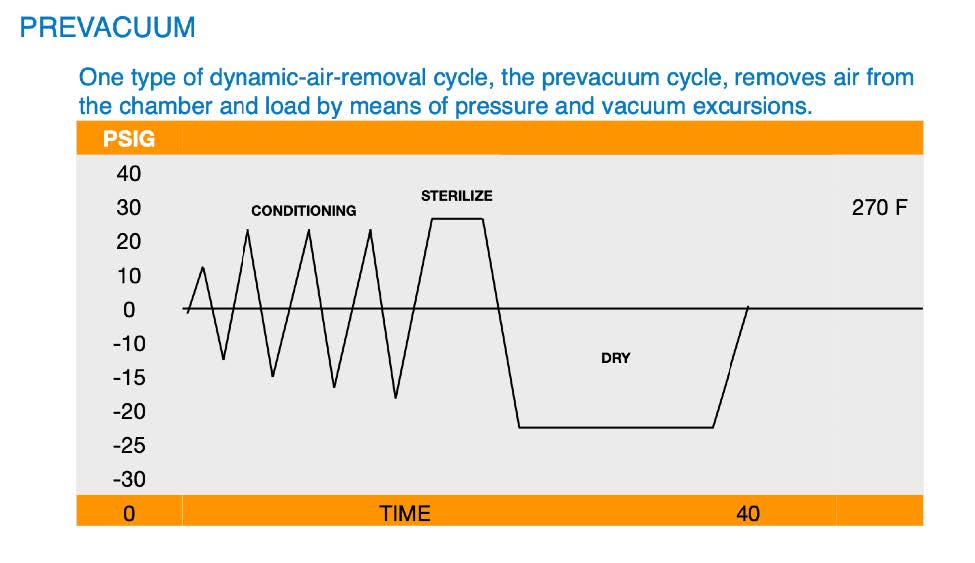
Below is a chart of a standard pre-vacuum steam sterilization cycle. The cycle is a 270-degree temperature cycle with 4 minutes of exposure at 270 degrees, and a 20-minute dry time. The conditioning phase gradually pulses steam in and removes steam and air in the chamber. This example pulses 4 times before it reaches the exposure or sterilize phase. After 4 minutes of exposure, the sterilizer pulls a deep vacuum and remains there for whatever set time the user programmed. In this case, 20 minutes. The cycle then returns to regular atmospheric pressure, and the cycle is then complete and ready to unload.


IFU Access


There are many ways to access IFUs. Most commonly, there are software databases that allow a user to search by manufacturer or reorder number. Another method of IFU management is to collect them and keep them in a binder. It is required by the FDA that when a new device is purchased, it must be accompanied by an IFU. One last way to access an IFU is directly from the manufacturer's website. This is a good way to ensure you have the most recent version. IFU software databases can also be flawed by having outdated or obsolete IFUs. If a user maintains an IFU binder, it is important to ensure the most recent IFU is available. To verify you have the most recent IFU, check the bottom of each IFU for the date it was published or revised. Using binders can also get complicated as you would need access to them in the decontamination area as well as the assembly and sterilization areas.

PREVACUUM


It is very important to review the sterilization recommendations from the manufacturer. It is common for facilities to have a standard cycle that, in some cases, does not follow the specific recommendation in the IFU. The thought process is that if they have to sterilize at 4 minutes of exposure, they may double it and run all items at 8, or more commonly 5 minutes. We must adhere to the exposure parameters provided by the manufacturer. Dry times will be advised as well in the IFU.


However, in many cases with dry time, it may be listed as a minimum dry time. This means if it states a minimum of 20 minutes dry, we could go over that set time to 30 or 45 minutes. This is all based on the size of the load, size of the sterilizer, packaging materials used, etc. If the dry time does not state minimum, the posted dry time must be followed as extended dry may damage the device. Adhering to the exposure time is the most important part of the sterilization process, as that is how a device was cleared for use by the FDA.


Extended Cycles


An extended cycle is over 4 minutes of exposure. Most of the devices sold in the US recommend a 4-minute exposure with a dry time from 20 to 45 minutes. Many items that come from outside the US, especially in the dental area, may often have extended cycles. Extended cycles become problematic as sterilizers need to be reprogrammed and the unit tested. Many of these devices from outside the US have these extended cycles because processes in parts of Europe, China, and Japan differ, and some countries validate their sterilizers rather than perform routine quality assurance. Many dental devices are sterilized using gravity sterilization.


Example of an extended cycle:


  • Before sterilization, it is recommended to use alcohol wipes to remove any adherent material attached to the surface of the air-motor
  • Place the air-motor only into a sterilization pouch and seal it.
  • Autoclave it at 275 degrees F. for 20 minutes
  • Allow a minimum of 20 minutes for the drying cycle.

Extended Cycle Monitoring


One of the difficulties in monitoring extended cycles is ensuring we have the correct biological indicators (BI) and chemical indicators (CI) that are validated for use in these cycles. Many biological indicators are not approved for use in an extended cycle. Some manufacturers have options to monitor up to 10 minutes, but when you go above that, it is hard to find a BI that can effectively monitor the cycle. This makes it difficult if you practice ELM (every load monitoring). Contact your BI manufacturer to see if your BI can be used in extended cycles and the maximum exposure your BI is approved for. Healthcare facilities should always work with sterile processing when evaluating new purchases. Having the IFU in the hands of the sterile processing leadership can better help navigate this issue.

Information for You

  1. ANSI AAMI ST24 Updated to Reflect Tech Changes Learn More
  2. CMS CY 2025 Medicare Hospital Outpatient Proposed Rule Learn More
  3. HP Online Instrument Air Learn More
  4. JQPS Infection Control Measure Performance Long Term Learn More
  5. Beckers Top 10 CMS Citations for Nonprofit Learn More
  6. CMS QSO 24 16 Learn More
  7. ISMP Error Prone Abbreviation List Learn More
  8. CDC Antimicrobial Resistance Threats Update Learn More
  9. DNV Advisory Notice 24HC05 Learn More
  10. JC BHC Restraint Seclusion Requirements Learn More
  11. NAN 20240710 Learn More
  12. ECRI Diagnostic Excellence in Dementia Care Learn More
  13. CMQCC 20233 Annual Report Learn More
  14. JC RS R3 Final Restraint and Seclusion Learn More
  15. Utilizing Artificial Intelligence to Aid SPDs in Cleaning Verification Learn More

We would love to hear from you!


We can help support your organization.

For consultations, education, and training, please contact us.

Visit Our Website
Contact Us
Join Our Email List