Sunday News
November 3, 2024
| |
|
CEO: Gayle Nash, MPH, RN
COO/CFO: Sam Sheth, PharmD, MBA
Contracts Manager: Kristin Miller, JD
| |
CEO Corner
Hi all, I hope you are having a good week. We have received updates from the Joint Commission Consultants Forum that I would like to share with you.
Those of you who attended the Executive Briefings course may have this information. If not, I think you'll find it valuable.
| | |
We have also shared (below) helpful articles and publications on the following: informed consent blood transfusion, maternal health indicators, MRSA ICU and Non-ICU, pertussis trends and report, community ambulatory, pressure injuries, cybersecurity newsletter from OCR, telehealth from SAMHSA, sterility assurance, and more. | | |
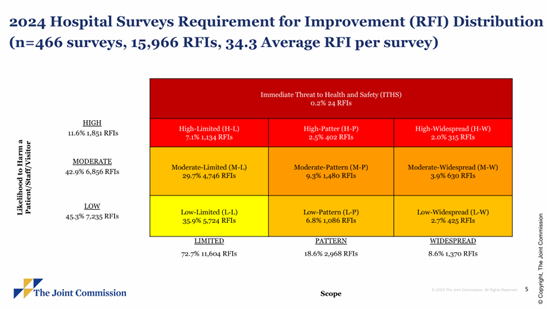
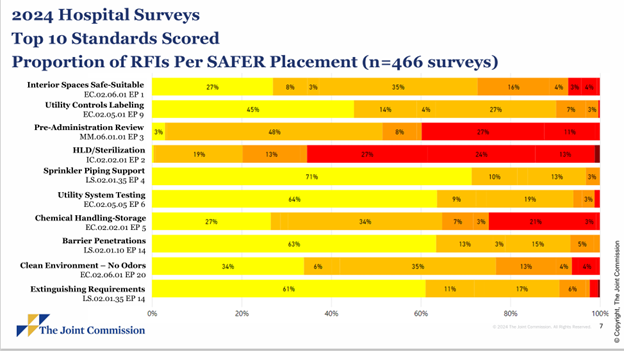
2024 Hospital Surveys: The average number of RFIs did not change much from the prior year, with MM.06.01.01 and IC in the top 10 list. | |
|
The Top 10 standards scored in 2024 resulted in many of the same issues from prior years. The environment of care occupied 50% of the top ten. Three of the top ten were in the life safety chapter, one in medication management, and one in IC, so there was no surprise at the disinfection and sterilization EP.
EC.02.06.01 EP 1: This element of performance is well-known to all of us. It is the EP where cracked and broken ceiling tiles are scored, issues with pull cords, peeling wallpaper, cracks in the floor, particularly in sealed flooring in the operating rooms, hand hygiene sinks used to rinse soiled instruments, unsecured needles, syringes and blades in patient exam rooms, gaps in the ceiling in operating rooms around electrical junction boxes and the inability to unlock a patient bathroom door. We consider these issues the “low-hanging fruit” of survey findings, observed during frequent environmental rounds and resolved on the spot, through just-in-time coaching and training, or referred to the process owner for resolution. Next up is EC.02.05.09 EP 1: Examples of observations at this standard and EP:
- A main fire alarm panel did not have the breaker it was fed from being labeled at the panel.
- The line isolation monitor panel breakers were turned on in an OR Room and marked as spares.
- Fire pump valves were not labeled to identify the source and control valves.
- Circuit breakers in a corridor electrical panel closet were spare breakers in the "ON" position.
- A circuit breaker was turned on and not labeled, indicating what it was powering.
- An electric panel had a breaker labeled "spare" in the "on" position.
- The main fire alarm panel did not have the breaker it was fed from labeled at the panel.
- An electrical distribution panel with breakers identified as spare was observed in the "on" position.
|  | |
MM.06.01.01 EP 3 has been a challenging standard and continues in the top ten list. For example, observations in this EP are as follows:
- Pain medication administered in the PACU was inconsistent with the physician's orders. For example, oxycodone was ordered for moderate pain but was given for mild pain.
- Medication for pain was ordered every six hours but was given every four hours. Documentation and an order change was needed to substantiate the rationale for an earlier dose if given every four hours.
- Medications that are held or omitted when the patient's pain level exceeds the patient's pain goal or tolerance level; there must be documentation in the chart describing why the pain medication was not given or held, and there must be communication with the patient’s provider.
- As written in the order, oxytocin was to be titrated in two milliunits/minute increments. There were two instances when the medication was titrated by one milliunit per minute. The dosage change was based on patient status, but no instructions were found in the order or unit policy to support this.
| |
|
IC.02.02.01 EP 2 (IC.06.01.01 EP 3): This element of performance also contributes to the ITHS category. Observations in this EP are as follows:
- High-level disinfection: Issues observed with ultrasound probes, such as not drying the probe with a lint-free cloth before insertion it into the Trophon, not cleaning the inside of the Trophon chamber, or not performing point-of-use decontamination of the probe.
- Sterilization: Observations in this category consist of sterilizer parameters not set according to the manufacturer’s instructions for specific instruments and improper sterilization of eye and dental instruments.
- Instruments: Etched, scratched, improperly taped, hinged, and rusted instruments are sterilized for use. Instruments with bioburden, film, or debris are inside the hard-sided tray. Instruments such as dental mirrors and circumcision gomcos are fully assembled when sterilized. Gauze and sponges are sterilized in trays, and sterilization parameters for gauze and sponges cannot be located.
- Point of use: Improper handling of instruments, such as not spraying with the enzymatic spray before transport, instruments allowed to dry at the point of use, instruments sprayed in a closed position, or not placed on the stringer as required by policy. In clinical settings, instruments are stored in a red bin throughout the day without applying enzymatic or precleaning.
- Endoscope processing: Not performing flow validation testing daily, improper precleaning, and not following the manufacturer's instructions for precleaning the endoscope; when performing channel testing, staff members did not follow the test strip instructions and did not have the correct color code chart, the inside of the endoscope was wet after hanging for four days, endoscopes, processed on the same day were used for patient procedures with no evidence the inside of the endoscope was dry.
| |
|
LS.02.01.35 EP 5: Number five on the top 10 frequently cited.
Examples of RFI’s
- A fire sprinkler pipe in an equipment room supported an insulated pipe attached to the sprinkler pipe with split rings and an all-thread rod.
- A fire sprinkler pipe was supporting cables above the ceiling.
- Data cabling was resting on a fire sprinkler pipe.
- There was an electrical conduit all-thread wire tied to the sprinkler pipe.
At EC.02.05.05 EP 6:
Examples of RFI’s are as follows:
- Electrical panels located in a corridor were blocked by medical equipment.
- The scheduled maintenance completion rate for non-high-risk utility systems was not available for review. (Document review).
- An electrical junction box with no cover was observed in a corridor.
- During the building tour, a portable hand respiratory hygiene station blocked an electrical circuit breaker panel.
Number seven on the top ten list:
EC.02.02.01 EP 5
- A bottle of cleaner with a pH of 12.5 to 13.5 was observed in a housekeeping closet. This would require an eyewash station to be available, which was farther than ten seconds away.
- Chemical containers were found with no lids in housekeeping closets during the building tour.
- Staff members who work with a corrosive chemical with a pH of 12 did not have immediate, unimpeded access to an eyewash station.
- In the pharmacy, the floor cleaning mop used to clean the floor of the hazardous compounding room was being stored in the ante area rather than in the hazardous compounding room.
- The pharmacy did not have a mop handle in the hazardous compounding room for surface cleaning. The staff could not demonstrate that the mop handle had been decontaminated before removing it from the hazardous room, and they stated that they believed the mop was supposed to remain there.
- The pre-op area had an eyewash station. The weekly inspections for September 2024 were missing.
At LS.02.01.10 EP 14, the following are examples of observations:
- A penetration through a firewall next to an electrical junction box was observed on the first floor above the ceiling.
- In the ceiling space at the entrance of a patient care unit, a conduit was open and unfilled with fire-stop material (s).
- There was an unsealed fire barrier penetration caused by the end of a conduit not being sealed.
- A cable that penetrated the 2-hour fire-rated wall above the ceiling at an entry was not sealed with an approved fire-stop system.
- In the MRI controls room, orange expanded foam was used to fill a gap where a 2" conduit penetrated the acoustic ceiling. This fire-resistive product is unacceptable in commercial buildings, and it off-gases a hazardous gas under fire conditions.
- In the corridor, near a stairwell above the ceiling, the 2-hour building occupancy separation wall had a drywall patch over a gap/hole, sometimes termed a "scab patch." This product application is not an acceptable means of filling a void in a fire-rated wall assembly.
EC.02.06.01 EP 20: Examples of observations at this standard:
- Dust accumulation was observed on the return air ventilation grill in the OR room.
- Tape and tape residue were observed to be stuck to the OR floor.
- Significant dust accumulation was observed on the three return air vents behind the sterilizers in sterile processing.
- Tape adhered to a counter in the pharmacy was fraying/peeling in various areas.
- During tracer activities in the Physical Therapy (PT) Department, exercise equipment was identified as visibly soiled and ready for patient care.
- Observed tape on the floor to mark off areas peeling in all ORs; the tape was peeling across OR door thresholds and at various other locations.
- During a tour of the primary labor and delivery OR that had been terminally cleaned and set up for the following case, it was observed that there was a significant amount of dust and debris on the edges of the room, the floor near the OR table and under items such as the anesthesia medication cart. Per unit policy, daily cleaning would include moving all items/equipment to ensure all areas of the floor were cleaned.
LS.02.01.35 EP 14
- On the left side of the kitchen, above the cooking surface, the filter baffles had a two-inch gap between them.
- The chemical fire suppression system in the kitchen did not cover the deep fryer.
- There was a blocked fire extinguisher caused by equipment being stored in front of the fire extinguisher.
- In an X-ray room and a Cath Lab room, the fixed ceiling tracks were installed next to the sprinkler heads, obstructing the sprinkler pattern.
- Two sprinkler heads were roughly two feet apart in the middle of a patient care room. NFPA 13- 2010, 8.6.3.4 requires a minimum separation distance of six feet between sprinklers.
- In radiology, it was observed that the hot lab suspended tile ceiling had large, unsealed penetrations greater than 1/8" in dimension. The first was the space around the 2" conduit for the pressure monitor, and the second was the space around the (out-of-use) compounding hood chimney and electric supply flexible conduit.
- Penetrations were observed in the lay-in ceiling of an electrical conduit and two piping support rods of one of the facility's patient care areas. Sprinklers protect the stairwell.
| |
|
Next week, I will send more of the same information, except focusing on the non-EOC/LS findings and providing examples.
Thanks for all the feedback. We strive to provide valuable information on current, high-risk, and trending issues.
Gayle Nash
| |
|
We would love to hear from you!
We can help support your organization.
For consultations, education, and training, please contact us.
| | | | |