CEO Corner
Hi all and hope you have had a good week.
We continue to see high risk findings scored in MM.06.01.01 EP 3, and in 2023 this standard was identified as a top ten frequently cited. Not only are we seeing findings written for not titrating medications such as Fentanyl, Precedex, or Levophed properly, but also findings in this standard for heparin administration, insulin and pain.
Test your probability of getting a finding in this standard by looking at three records for patients who receive insulin based on a sliding scale. If the insulin is not being administered as defined by the order, the nurse should document why the insulin was not administered and a conversation with the provider. In most cases if we look deeper into the chart, we can find the reason why the insulin was not administered but unfortunately, in most cases, the order is not changed or no information in the chart to support the medication change.
Let’s look at another medication – Heparin: This is my favorite medication tracer in this category because I constantly find issues with heparin administration. For example, the order is usually written to increase or decrease the heparin based on the PTT results drawn every 6 hours. In most cases the PTT is not drawn in 6 hours (usually done ½ hour on either side of the hour) but most likely I find that the heparin dose is not increased or decreased based on the results. The time of day where the issues usually happens is at the change of shift or in the middle of the night. Lastly, if the patient is undergoing diagnostic studies or removed from the unit for some reason, the PTT is not drawn. In this case, the record needs to have a documented reason for not drawing the PTT and, once again, a conversation with the provider and documentation the provider is aware of the delay, and the PTT will be rescheduled after the procedure.
Pain management: You can count on pain and pain management being surveyed. Here is an example of a finding in this category: In three of four PACU records reviewed, the patient reported pain in the severe (7-10) range. In this case, the pain medication that was ordered was not administered as required by the order. For example, Fentanyl 25 mcg was ordered for 7-10 pain. Pain medication was administered as ordered for moderate pain, 4-6. In these cases, nurses can absolutely use their assessment results to administer what the patient needs or wants. However, the medical record needs to demonstrate evidence the nurse spoke to the provider to administer the lesser dose. If the patient requests a lower dose or a different medication that is ordered, the record needs to reflect this request.
What you can count on is, this standard will be reviewed, usually the medications involved are high risk or high alert medications and should be administered as ordered. If not, the medical record needs to reflect any changes and why, and the changes that were reviewed with the provider were done so in an interdisciplinary manner.
If you are going to be surveyed this year and have not developed an audit tool, I would do so for all areas such as Med/Surg, Telemetry, ICU, ED, Labor and Delivery, PACU and any other units where titratable medications are administered. You may also consider a multidisciplinary team to focus on this standard. If you do not have a good understanding of the documentation baseline, review at least ten charts in each unit. You may find one unit is better than others. Usually, what I find, is the Med/Surg area will of often have opportunities with documentation due to the level of experience of the nursing staff. Next in line is the Telemetry floor and usually heparin is the issue in this area. Lastly, L&D, ED and ICU for the titration infusions.
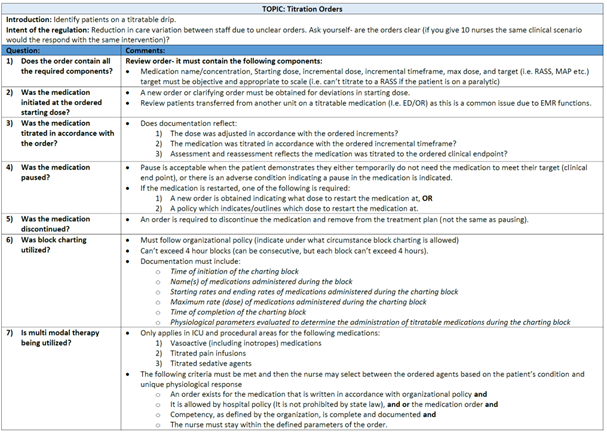
Attached is an example of a titration tracer tool you may find helpful. We often conduct offsite chart reviews via Zoom or Teams with hospital nursing staff just to help with education and what needs to be documented. Let us know if we can help in this area.
|