|
The Bay Area's Intercity Bus Stops +
Burlington Trailways Says Goodbye
Intercity Bus E-News, Late September 2025
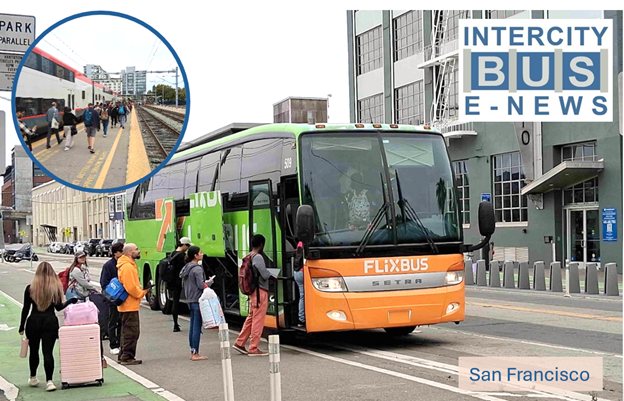
September 24, 2025 | Caption: FlixBus at 5th & Townsend stop; Inset: Caltrain in September 2025.
| |
Editor’s Perspective
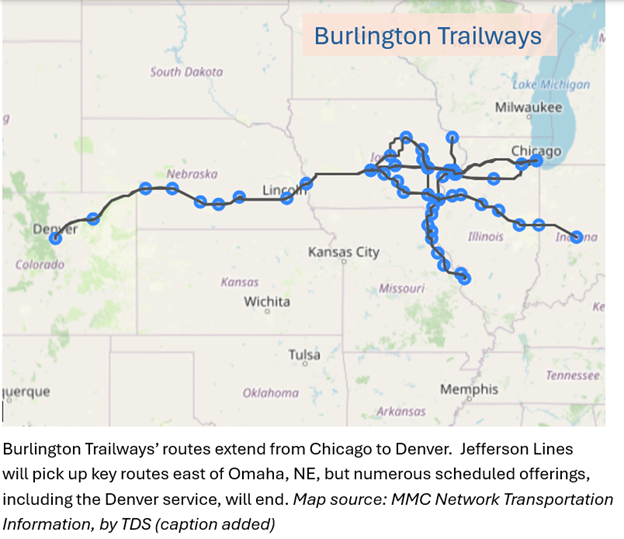
The recent few weeks have brought a flurry of developments, not all of which are good, here in the Midwest. The headliner is Burlington Trailways' announcement that it is suspending scheduled service after September 27, 2025. The family-owned line, founded in 1929, has long been a major player in Illinois, Iowa, Nebraska, and other states. It has separate long-distance routes linking Chicago and Indianapolis to Davenport and Des Moines, IA, and Omaha, NE. Other routes it operates include Omaha to Denver, CO, Chicago to Waterloo, IA, and central Iowa - St. Louis, MO.
| |
The dropped service highlights growing concern that, for operators of lengthy routes through lightly populated areas, the financial support provided by many state governments through the federal 5311(f) grant formulas and other programs may no longer be sufficient to sustain some routes. Rising bus insurance costs were also cited as factors. Other bus lines running full-size coaches far removed from major metro areas are no doubt also feeling the pinch.
| |
But this week brought welcome news: Jefferson Lines, the Minnesota-based company and long-time interline partner with Burlington Trailways, will pick up several of its key routes, including:
-
A once-daily overnight Chicago – Des Moines - Omaha service. Departing westbound from Chicago at 9:30 pm and arriving in Omaha at 6 am, this 460+ mile route allows for timely connections to Denver via Arrow Express.
-
The daily Indianapolis – Des Moines – Omaha route, which runs via Champaign & Bloomington, IL, and the Quad Cities, IL/IA, and Cedar Rapids, IA (with planned Amtrak connections)
-
The daily Des Moines – St. Louis route, via Burlington, IA. Jefferson is starting with a 4x/week service to better understand operational capacity and demand before increasing the frequency to daily in the near future.
Much credit goes to the Burlington and Jefferson management teams for working together to preserve as much service and as many employees as possible.
| |
Still, the loss of Burlington Trailways will be felt and will lessen the Chicago Hub’s vitality. For example, Chicago to Dubuque, IA connecting service will apparently end. Chicago – Omaha service in either direction that does not involve being on a bus or train after 11 pm or before 5:15 am will disappear. Plus, service between Chicago and Des Moines will be scaled back. Greyhound has an early morning westbound run, but there will be no departures between 6:30 am and 9:30 pm. Similar gaps exist eastbound.
We commend the Burlington Trailways team for its decades of excellent service, and particularly Ron and Lori Moore, who have owned the company since 1981. A testament to this excellence was the experience of one of my graduate students, who recently took a ride to Moline, IL, and raved about the courtesy of the drivers and the comfort of the coach. We are also pleased that Chicago will become part of Jefferson's system.
| While all this occurs, vigorous efforts to preserve the Chicago Intercity Bus (“Greyhound”) Station continue. We hope to have more on that story soon. Be sure to check out my feature on California’s Bay Area below. | |
Joseph Schwieterman, PhD
Intercity Bus E-News Editor | Professor and Director, Chaddick Institute at DePaul University
For a link to this newsletter to share with others, click here.. I thank the industry executives and Illinois expert John Corey for their assistance with this article.
| Insights from a Trip Around San Francisco Bay | |
California may have fewer intercity bus lines than certain other states — FlixBus and Greyhound are the only providers on some routes—but the connecting opportunities it provides passengers to trains and transit buses are exemplary. The Golden State is a prototype for metropolitan areas prioritizing multimodal connectivity.
| My familiarity with California’s latest developments had fallen out of date, so I set aside time during a recent visit for a daytrip by bus and train around most of San Francisco Bay to visit the Bay Area’s four busiest intercity bus stops—much of what I saw surprised me. | |
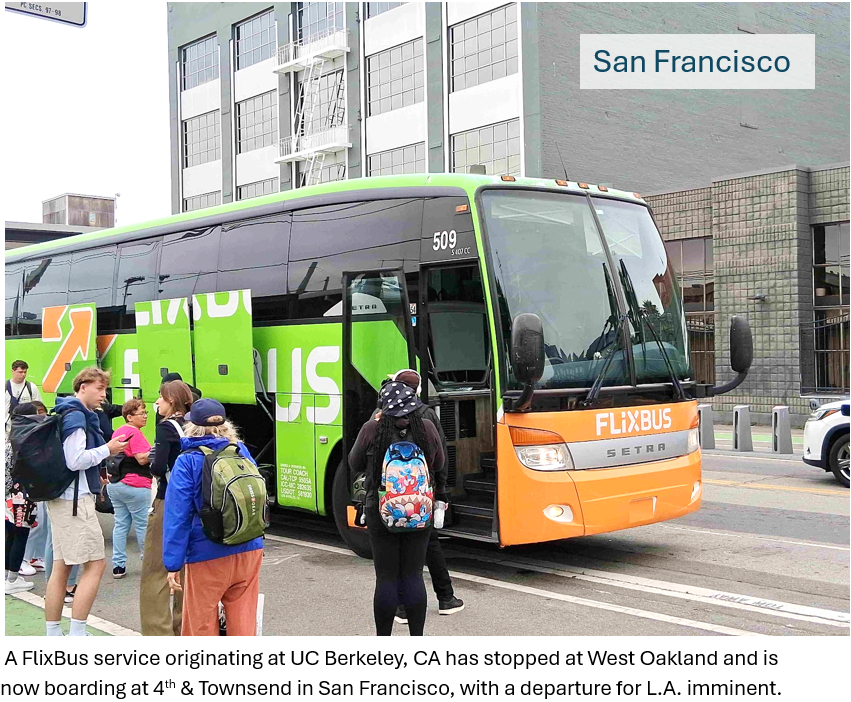
Starting at the Lawrence train station near San Jose, I boarded a bi-level Caltrain service to the San Francisco terminal at 5th & Townsend, just one long block from FlixBus’s 4th & Townsend curbside stop. This bus stop, located in an office district along the Caltrain tracks and adjacent to a busy Muni transit bus stop, was seeing heavy foot and bicycle (and even autonomous taxis!) activity on this sunny day. Like nearly all curbside locations, this one lacks a canopy for protection from rain, and there is a lack of seating in the surrounding area. In fairness, seating at the Caltrain Station is also scarce, limited to a few benches, which may be intended to discourage loitering and panhandling. All in all, the assigned location was well-maintained and vibrant; during my visit, 32 passengers boarded a Los Angeles-bound coach.
|
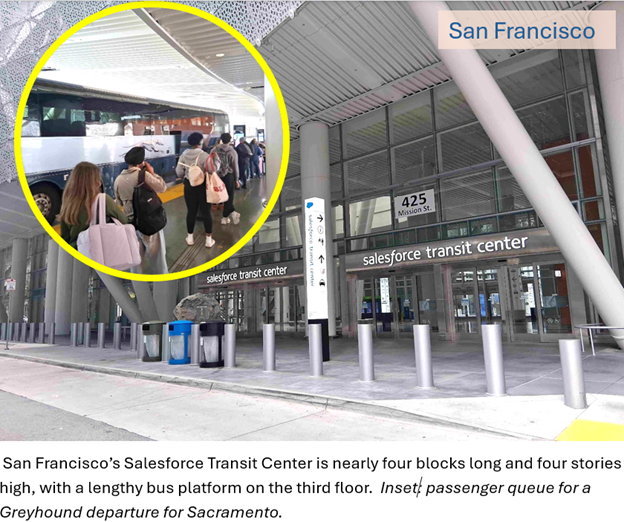
 | | The massive Salesforce Transit Center, used by Greyhound in the heart of the business district and sometimes called TransBay Transit Center, has a superlative location. Still, it evokes potential risks of public agencies adopting a “build it and they will come” approach to terminal development rather than following a more flexible and nuanced strategy. This enormous facility, opened in 2019, spans roughly four blocks and is four stories high; it features large atriums, extensive public amenities, and retail shops. It is large enough to accommodate 100,000 daily passengers. Seeing it become the “Grand Central Station of the West," as some hope, however, will require much to happen, including the creation of a two-mile tunnel from the present Caltrain terminus to allow commuter trains and the state’s planned high-speed-rail service to reach here, which is years away. Passenger traffic is presently only a tiny fraction of the six-figure max, leaving the region’s transit authority saddled with a cavernous and costly-to-maintain facility.
Intercity bus riders ride one long escalator to reach Greyhound’s waiting room, with the station's signage not particularly reassuring. After this, you leave the Greyhound facility and take another escalator to access a third-floor bus platform that is several blocks long and has 35+ bays, most for transit buses. About two dozen people boarded my Greyhound heading for Sacramento. A Greyhound attendant dutifully helped customers who had trouble finding their way. Few used the waiting room.
| |
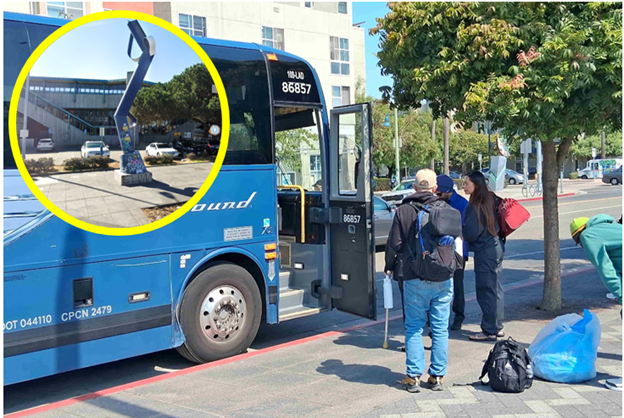
The station’s direct elevated bus link to the San Francisco – Oakland Bay Bridge enabled my coach to arrive in Oakland early, so the driver invited riders to step outside for some fresh air. This curbside spot at the West Oakland BART Station (also used by Flixbus) is close to downtown and next to the city’s busiest rapid-transit rail line, and it has ample waiting areas for riders to be picked up.
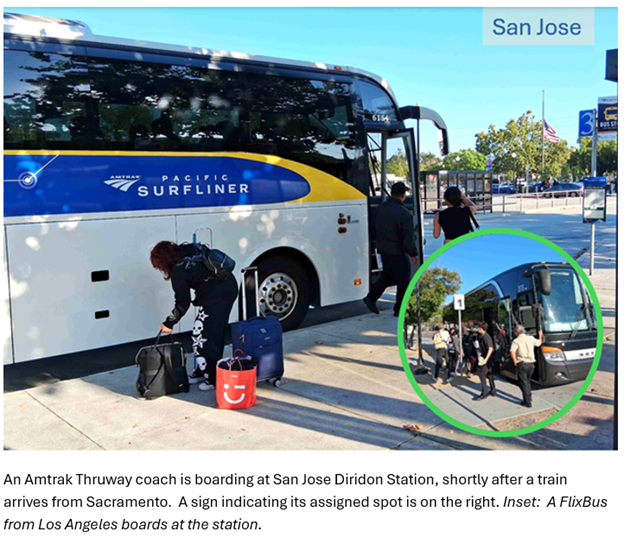
Connecting from intercity buses (or BART trains) to Amtrak trains from Jack London Square Station is more challenging. I rode a Capital Corridor train to San Jose, where I found Diridon Station earning its reputation as a multimodal powerhouse. Commuter and light rail lines, Amtrak, and city buses were handling large numbers, with many connecting between modes, some scurrying to an Amtrak Thruway coach for Santa Cruz as that branded coach departed. LA-bound FlixBus paused at the curbside stop (also used by Greyhound) perpendicular to the station’s front door.
| |
What is my overall assessment?
· Curbside pickup in Oakland and San Francisco has drawbacks, but credit public authorities and bus lines for keeping intercity bus service at convenient and transit-friendly locations.
· Each of the four stops offers convenient connections to rail and bus transit, as well as retail shops. Each has a Walk Score of more than 80 out of 100, indicating its walkable surroundings.
· The lack of a public bus station in either S.F. or Oakland equipped with a waiting room next to bus bays is a misstep and likely a hindrance to new entrants serving the Bay Area. We encourage public agencies to explore full or partial remedies.
If you have time when in the Bay Area, take a look at the sharp contrasts between San Jose Diridon Station and the Salesforce Center.
| |
FlixBus’ Kai Boysan’s Op-Ed, “Congress Has A Big Opportunity to Connect America By Intercity Bus,” makes a strong case for strengthening federal policy to support intercity bus travel.“ "The next federal transportation bill could be a chance to connect rural America with buses like never before — and it will have spillover benefits nationwide,” he argues. Boysan describes how feeder routes connect rural communities to the national intercity bus network, thereby expanding mobility.
In other FlixBus news, the brand has launched service from New York’s Brooklyn borough to Washington, DC, with just one stop, New Brunswick, NJ. It has also expanded its recently launched service from New York's Queens borough to Boston to four daily. Flix has also been undertaking significant expansion in Canada, Mexico, and overseas.
| |
OurBus now offers a Philadelphia – Scranton service via Allentown that runs on Fridays, Sundays, and holidays. The Philadelphia stop is near William H. Gray 30th Street Station. Travelers from the Philadelphia and Allentown areas can now reach Upstate New York via transfer at Gouldsboro-Poconos, PA.
| |
Wisconsin's Amtrak Thruway service on the busy I-41 corridor between Milwaukee and Green Bay has been significantly thinned due to the loss of funding within the state. Intercity Bus E-News has regularly highlighted this route as a model for the Midwest, citing the short connecting times in Milwaukee for Chicago – Green Bay trips. Currently, only one northbound trip with a connection time of less than 30 minutes remains in either direction, while the other requires waits of 90 minutes or more. Southbound passengers who prefer a schedule option with a quick connection will have to settle for an itinerary that does not arrive in Chicago until the evening.
| |
Michigan Flyer, a service operated by Indian Trails between East Lansing, Whitmore Lake, Ann Arbor, and Detroit Metro Airport, has added several roundtrips, growing to 14 daily. This initiative serves both flyers and individuals requiring practical non-airport transportation, including university students and staff. Indian Trails also operates the Detroit Air Express (DAX) between Metro and downtown Detroit, as well as the Detroit to Ann Arbor (D2A2) commuter service.
| |
A website and booking portal, Uptown Vans, is being created by intercity bus experts George Kaufer and Jared Maldonado for independent bus and van companies filling gaps in corridors underserved by traditional intercity carriers. A key objective is to integrate these smaller companies into a ticketing platform tailored to their unique operating model. An example of services that will be hosted on the platform includes a heavily used van service linking Wilkes-Barre, PA, to metro New York via Scranton and Stroudsburg, PA. We’ll have more info on this valuable initiative in our next edition, when its booking platform will be up and running.
| State Supported Services Successes | |
The Association of State Highway and Transportation Officials has a new feature article showcasing successful state-led intercity bus initiatives. Among the highlights:
-Colorado’s Bustang celebrated its 10th anniversary. This growing system served 351,000 passenger trips over 12 months through June, supported by “mobility hubs" along major corridors that allow for faster stops and greater convenience. Shoshana Lew, Colorado DOT’s executive director, commented in a statement: “Bustang is a national model for how transit can work across urban and rural areas [while] providing consumers with more choices.”
| |
-Maine’s transportation department has reached the first anniversary of its Lewiston, Auburn, and Portland "LAP" commuter bus service. The department noted that LAP had averaged more than 1,900 passengers per month and reached a high of 2,508 passengers in July. Passengers can make connections to Amtrak’s Downeaster in Portland.
| |
-The North Carolina transportation department helped make possible a new stop in Chapel Hill on an established state-supported Greyhound service in August. A Greyhound press release indicates that four buses stop at the university town daily. Greyhound also returned to downtown Asheville this August, after a nearly one-year hiatus due to Hurricane Helene.
| The Potential of a National Intercity Bus Network | A new study available through the University of Texas at Austin demonstrates the considerable potential of a well-planned bus network. Professors Guan Huang, Kara Kockelman, and Anthony Yeh's “Connecting U.S. Cities via Low-Cost, High-Frequency, Long-Distance Bus Service" uses a simulation model to show this potential. The model is built on reasonable assumptions about the speed, capacity, and cost of bus service and uses conservative assumptions about the price sensitivity of travelers. | |
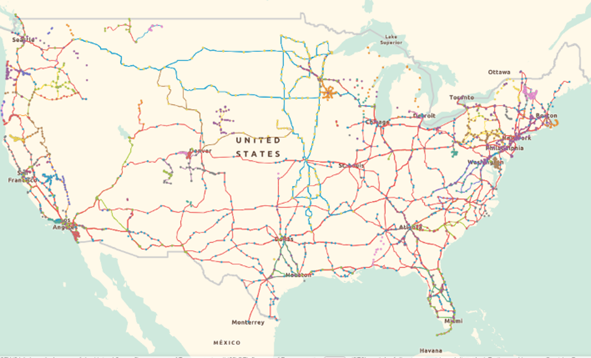
After 2,500 iterations, the simulation created the most effective network possible, satisfying the many constraints. A fleet of 761 fifty-seat buses was found to be capable of serving 100,000 long-distance passenger-trips daily, about three-quarters of the nation’s existing long-distance bus ridership. A federal subsidy of just $45 million annually would increase city-to-city bus frequencies by 17% and attract 14% more riders. This would reduce CO2 emissions by 144,000 tons annually, primarily by inducing travelers to shift from private vehicles. This important work demonstrates the flexibility and cost-effectiveness of intercity buses, while also addressing a gap in understanding the national bus network’s potential. Map credit: USDOT's Intercity Bus Atlas
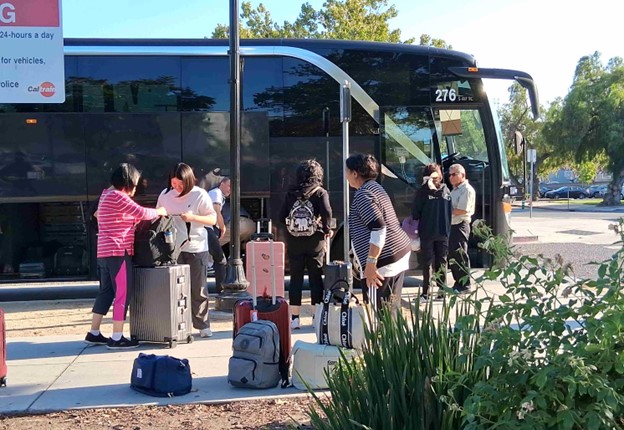
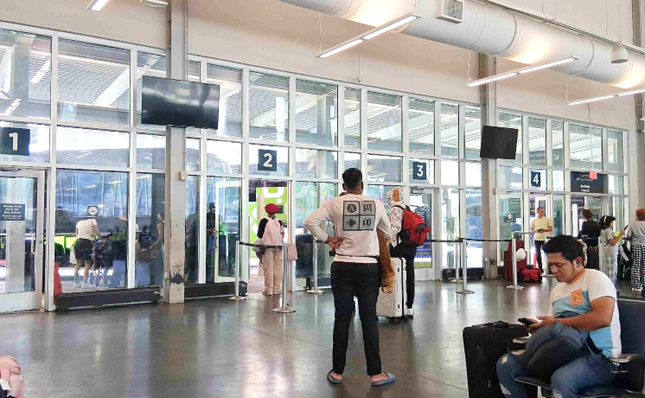
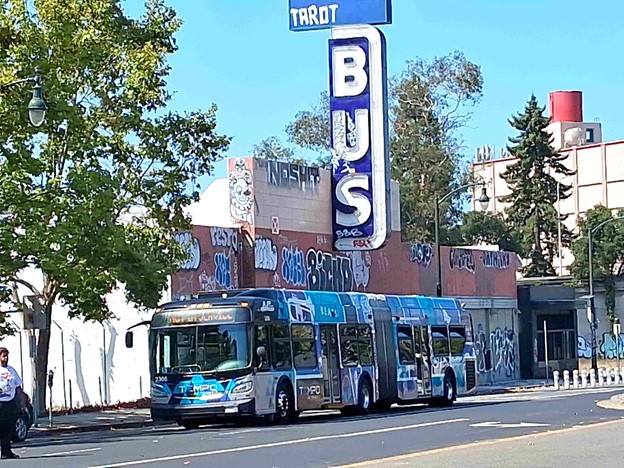
| News Photos from Around the U.S. | Mineta Transportation Center, San Jose | Flixbus passengers toting luggage are about to board a coach for Los Angeles, with the driver waiting at the door to check tickets. San Jose's Diridon Station building, where bus and rail connections are available to many Bay Area points, is just out of view at right. | Atlanta Intercity Bus (“Greyhound”) Station | Atlanta Bus Station is busy on a Sunday in August 2025, with a pair of Greyhound buses and a FlixBus visible behind the glassy gates. Cordons are being used to allow for orderly queues at the gates. The neighborhood's rapid transit rail station is immediately behind the buses. | Greyhound passengers at West Oakland get ready for an on-time departure to Sacramento. Several travelers originating in San Francisco briefly exited to enjoy some fresh air on account of the bus’s early arrival. Inset: The elevated BART transit station, immediately behind this view, with a public art display | Former Oakland Greyhound Station | The Oakland (CA) Greyhound Station at 2103 San Pablo, which last saw intercity buses in 2021, is slated to become a nightclub. This classic station, which still boasts its large vertical "Bus" sign, is largely intact. A festively painted articulated transit bus is making a stop next to the now-locked front door. An Intercity Bus E-News visit this month revealed that significant new condominium development in the area is likely an incentive for adaptive reuse. However, the area's homeless population remains a significant concern. | | |
Invite others to join Intercity Bus Listserv
For a link to this newsletter to share with others, click here.
Check out past editions and reports here
Invite your colleagues to join our Intercity Bus Listserv. To become part of our Intercity Bus ListServ and receive 8 – 10 emails per year, email Zaria by replying to this email. No spam. Free. Also, check out our recent studies, briefs, and podcasts below. The Intercity Bus E-News team is Zaria Bonds and Joe Schwieterman.
-
For a link to our previous (August) E-News, click here
-
Our newly released Schedule Frequency analysis of 69 routes, updated for summer 2025 schedules.
This independently produced e-newsletter brief has been shared with our Intercity Bus (IB) and Transportation listservs. The Chaddick Institute does not receive funds from transportation companies or related industries.
| | | | |