Leading Through Change
Change at its most basic level is a movement from a current state, how things are today, through a transition state to a future state, how things will be going forward. While the states of change are clear, how we experience change is not. This is because change is experienced on an individual basis. For example, a change can be seen as positive, negative, easy, difficult, vital or unnecessary, and often all of the above.
As a manager or supervisor you play a critical role in helping your employee’s navigate and adapt to change, often in the face of uncertainties, fears and distractions. This requires not only an understanding of the process of change, but an understanding of how different people have different built in reactions to it.
To help you approach this real-world change challenge, here is a key idea effective change leaders need to know: People navigate change from a continuum of change preferences.
The Change Style Indicator from Discovery Learning, Inc. describes two extremes as well as the midpoint on the continuum of change preference:
- Conservers accept the current structure, systems, and processes. They are champions of incremental change and strong advocate of Continuous Improvement.
- Pragmatist tend to focus on getting the job done. They are champions of change that is functional and often see merit in the perspectives of both conservers and originators as long as there is a strong business case for it.
- Originators like to challenge current structures, systems, and processes. They tend to focus on new possibilities, vision and direction.
As a manager or supervisor, paying attention to your change preference and the preference of the individuals on your team can help you better understand why each person reacts the way they do when faced with change. This will make you more prepared to address concerns, leverage different contributions, avoid pitfalls and adapt your own change approach when needed.
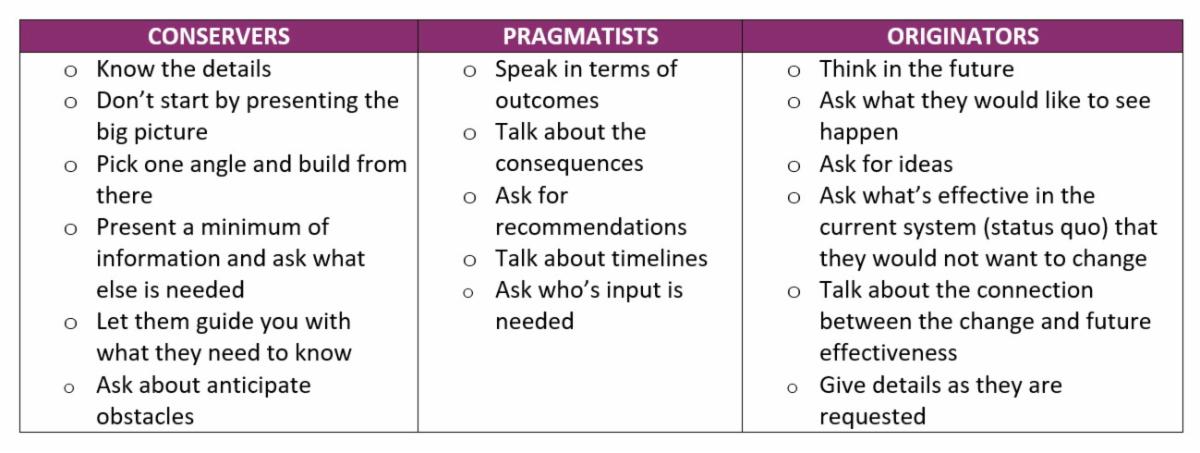
The below offers suggestions on how to approach change based on an individual's change preference.