Hello!


Snow or sunshine? February is keeping us on our toes. While the weather can’t seem to make up its mind, we’re excited to share this month’s updates, resources, and a few bright spots to help carry you toward spring. Read on to learn more about neurodiversity and explore our newest social skills group.


All my best,


Dr. Pam McCaskill


office@mccaskillfamilyservices.com

734-416-9098

McCaskill Family Services Newsletter

Term: Winter | Issue 74| February 25 , 2026

What is Neurodivergence and Why is it Important in Therapy? 🧠


Neurodiversity is more than a social media buzzword, it is a vital lens for understanding how people think, feel, and experience the world. This article by Jaclyn Rink, MS, LLP explores what neurodiversity really means, why it matters in a therapeutic context, and how recognizing these brain based differences can transform treatment. Through real word examples, it highlights how effective support depends on understanding WHY behaviors occur, not just trying to change them. This approach, which we take here at MFS, leads to more compassionate and individualized mental health care.

At McCaskill Family Services, we specialize in working with adults, children, teenagers and families with various presenting issues. If you or someone you know could benefit from our services, please contact us. Our clinicians are trained in empirically-based techniques, and would be happy to promptly schedule an appointment in person or via tele-health. We can be reached by phone at 734-416-9098 or by email at office@mccaskillfamilyservices.com.

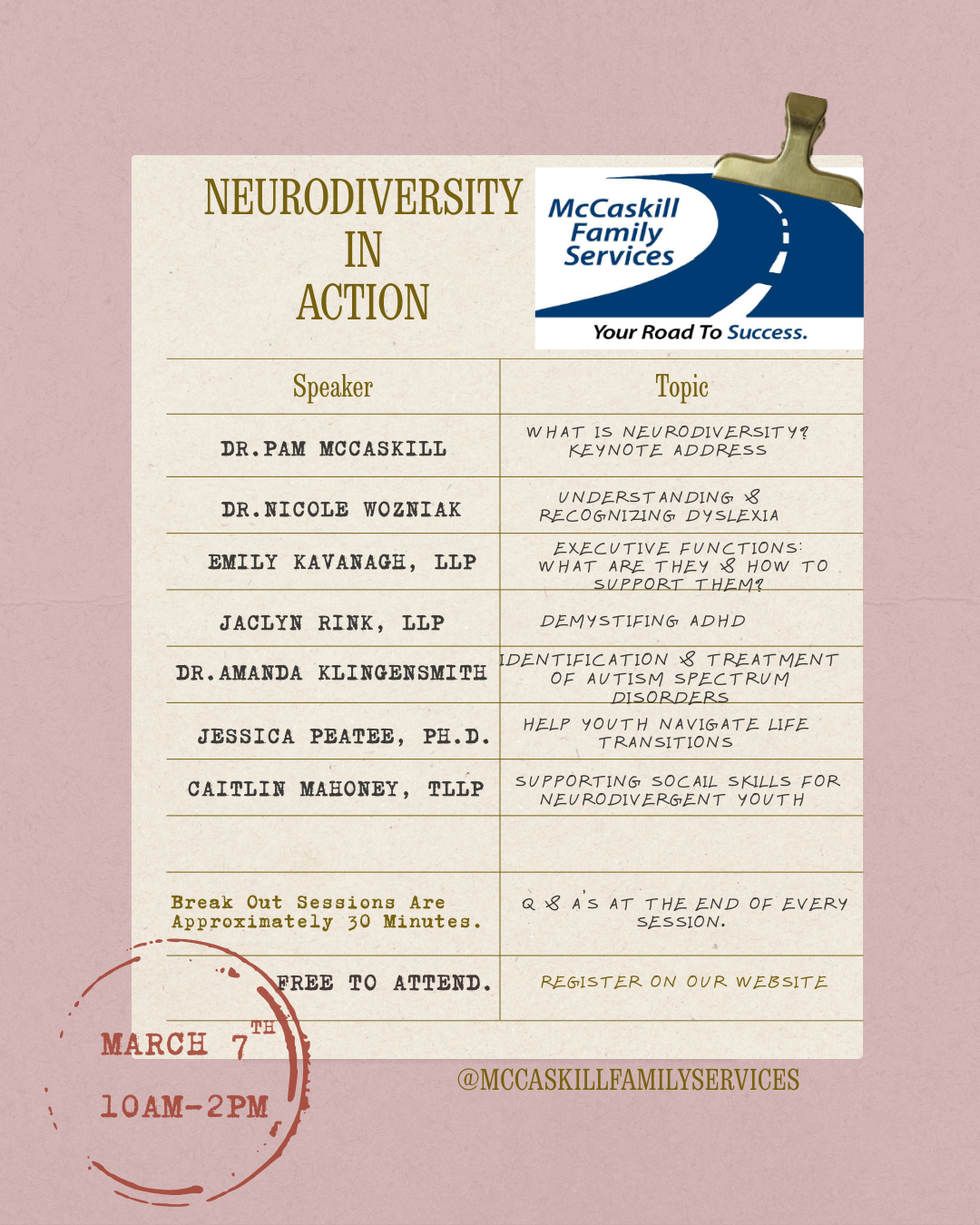
Neurodiversity In Action Event

This event filled quickly and is now at capacity!

We’re thrilled and grateful for the overwhelming response to our Neurodiversity in Action event on March 7th. Over 150 people have already registered! Due to high demand, we need to close registration at this time. We are not able to accept walk-ins who have not registered in advance; however, if you’d like to be added to the waitlist, please email office@mccaskillfamilyservices.com.

Thank you for your incredible support. We’re so excited to share this day with our community!

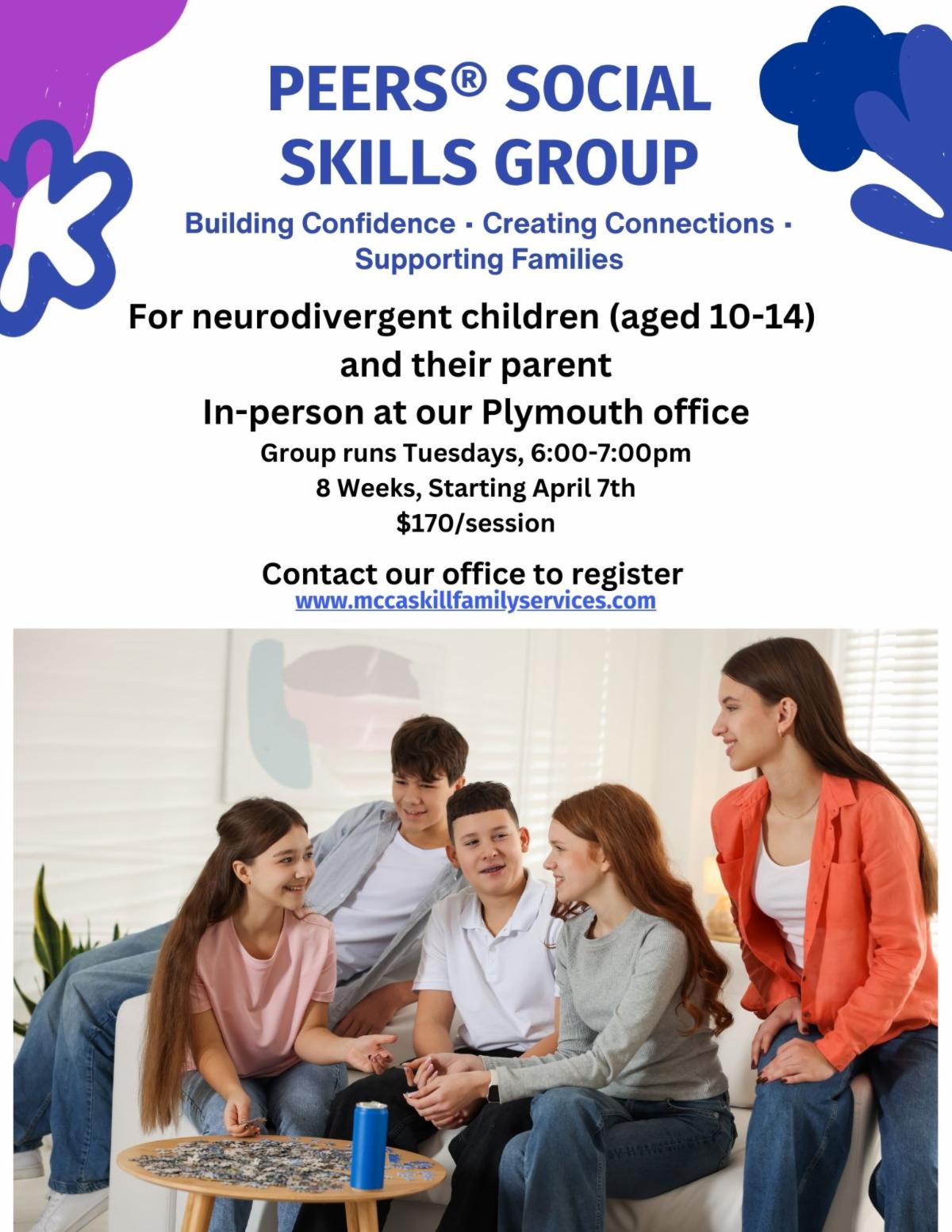
NEW Social Skills Group

After our Neurodiversity In Action event, we will be launching a PEERS® Social Skills Group for children. PEERS is an evidence-based program designed to help children develop friendship skills, conversational confidence, and tools for navigating social situations. This group is a great follow-up resource for families seeking structured, supportive social learning opportunities and will be lead by Caitlin Mahoney, TLLP, a PEERS certified provider, and Amanda Klingensmith, PhD.

Awareness and Recognition Spotlight

This Month We Recognize: Black History Month

It is important to recognize the contributions of Black and African American individuals to the mental health community, which are often overlooked. At McCaskill Family Services, we strive for cultural awareness in the mental health treatment of Black and African American individuals, in order to provide competent and compassionate care year round.


Here are some Black pioneers in mental health:


  • Herman George Canady, Ph.D.

Dr. Canady was a pioneering Black clinical and social psychologist who studied how interpersonal dynamics affect IQ testing. He was the first psychologist to examine how rapport (and specifically the race of the test administrator) can influence test performance and create bias in IQ scores. His work also contributed to improving testing environments to better support Black students’ success.


  • Mamie Phipps Clark, Ph.D. and Kenneth Bancroft Clark, Ph.D.

Dr. Mamie Phipps Clark was the first African American woman to earn a doctorate in psychology from Columbia University, after completing her bachelor’s and master’s degrees at Howard University. Recognizing the lack of psychological services for Black communities, she dedicated her career to expanding access to care. Alongside her husband, Dr. Kenneth Clark, she co-conducted the landmark “Doll Study,” which provided critical evidence in Brown v. Board of Education, demonstrating that school segregation was psychologically harmful to Black children.

In 1946, the Clarks founded the Northside Center for Child Development in Harlem to provide comprehensive psychological services to Black and other marginalized children and families. Dr. Clark worked there until her retirement in 1979 and remained active in advisory roles and community work afterward.


  • Joseph L. White, Ph.D.

Dr. White, often called the “father of Black psychology,” authored the groundbreaking article “Toward a Black Psychology,” which offered the first strengths-based analysis of Black behavior and culture. He argued that applying white psychological frameworks to Black communities created a false narrative of inferiority due to culturally irrelevant standards. White was a passionate advocate for the development of Black psychology and helped found both the Association of Black Psychologists and the Black Studies program at San Francisco State University in 1968.

We acknowledge that numerous important heritage/awareness months and religious/cultural observances may occur at the same time. While we are highlighting one in this issue, this choice is not intended to diminish the significance of others. In alignment with our commitment to cultural humility and ethical professional practice, we aim to approach these acknowledgments thoughtfully and remain mindful of the diverse identities and experiences represented within our community.

Food For Thought

A monthly newsletter addition from our

Dietitian and Eating Disorder Recovery Team.


3 Ways To Work With Picky Eating While On Vacation

Travel with a picky or particular eater can sometimes bring unwanted stress to family travel. Here are our three quick tips to hopefully ease those struggles so everyone can focus on the fun!

  1. Prepare - Discuss strategies with family members and how they can best support you and yor child. Extended family may not always understand your child’s needs and giving them “do’s” and “please do not’s” can provide helpful guidance.
  2. Adjust Expectations - It is okay for your child to eat a meal separate from restaurants and planned outings. It’s okay for them to not eat balanced meals while on vacation. Getting enough to eat, no matter what it is, is always the most important. 
  3. Coordinate - Work together with your child to get on board with the plans. Knowing what to expect can help lessen big feelings in the moment.


Couples Corner

A monthly addition from our team of relationship experts: covering important topics, information, and answering common questions about romantic relationships.


Connection-Focused Tips to Beat the “Roommate” Sensation

At some point, many couples notice a subtle shift — conversations revolve around logistics, evenings default to screens, and the relationship starts to feel more like co-managing a household than sharing a life. If you’re feeling the “roommate sensation,” you’re not

alone — and it’s absolutely reversible.


Here are a few connection-focused ways to bring energy and aliveness back into your relationship:

1. Try a New Interest or Hobby Together

Novelty sparks connection. When you learn something new side-by-side — whether it’s gardening, pickleball, painting, or hiking — your brains light up in similar ways. Shared learning creates shared stories, inside jokes, and a renewed sense of teamwork.

2. Replace a Passive Activity with Something More Engaging

If your evenings default to scrolling or watching TV, experiment with swapping one passive habit for something interactive. Cook a new recipe together, take a walk after dinner, play a game, or tackle a small home project. The goal isn’t productivity — it’s shared engagement.

3. Sign Up for a Class

There’s something powerful about being beginners together. Dance lessons, a cooking workshop, language classes, or even a fitness program can reignite playfulness and help you see each other in a fresh light.

4. Subscribe to Local Event Listings

Get intentional about staying curious. Sign up for local event newsletters or community calendars so you’re regularly exposed to new ideas — festivals, live music, art shows, and seasonal events. Even choosing together builds anticipation and shared excitement.

5. Plan a Mini Adventure

Adventure doesn’t require a passport. Explore a new neighborhood, try a restaurant outside your usual rotation, visit a nearby town, or take a spontaneous day trip. Shared novelty builds emotional closeness and helps break routine autopilot.

The antidote to the roommate dynamic isn’t grand gestures — it’s intentional shared experiences. Connection grows when couples move from coexisting to actively experiencing life together.

Newsletter Editor

Hi there! My name is Sierra Sands and I'm a masters level clinician at McCaskill Family Services who specializes in the treatment of Anxiety, Body Image/Self-Esteem Issues, Depression, Interpersonal Conflicts, and Struggling to Launch/Survive for Young Adults. I am also part of our comprehensive psychological evaluation team.


Thank you so much for staying in touch with the practice and I hope that you can use some of the useful information from our newsletter. If you or someone you know would like to schedule an appointment with me, please contact our office at 734-416-9098 or email us at office@mccaskillfamilyservices.com.

Facebook  Instagram  YouTube

Counseling Services

409 Plymouth Road, Suite 250, Plymouth, MI 48170 • 734.416.9098
Facebook  Instagram  X  YouTube