|
I’ve always joked…
No doctor should be a doctor who hasn’t had a baby and suffered gout.
No manager of elder care should plan those services if they can still cut their own toenails.
Now I can add…
… no Prime Minister should try and tackle social care until they’ve tried to negotiate their way thought the swamp, on behalf of their own family.
Well, now we have one.
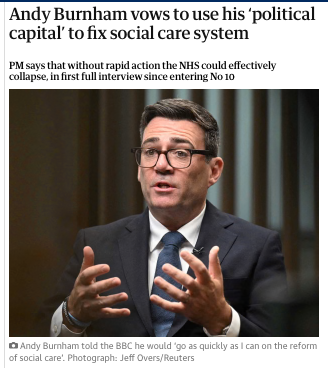
In yesterday’s speech about ‘fixing social care’ Andy Burnham did not announce a solution to social care.
He announced the beginning of a process designed to make one possible.
That may sound like a distinction without a difference, but...
... Britain has had enough reviews, commissions, consultations and promises to paper every wall in Whitehall, but...
... this felt different…
… Cocidius spoke without notes, answered questions directly and sounded like a man who had walked in the shoes of millions of families.
Not as a minister. Not as a mayor. As a son.
His father’s dementia has clearly changed the way he sees the issue. He spoke with the authority of someone who has watched care workers perform difficult, intimate, skilled work for people at their most vulnerable…
… only to return to their own home on wages that tell them society values almost everyone else, more.
That matters, because Burnham’s first substantial point was the workforce.
Before we argue about caps, insurance, inheritance, eligibility or who pays for what, there has to be somebody there to provide the care.
There’s no point promising free personal care if nobody can recruit a home-care worker.
There is no point announcing a National Care Service if providers are closing, councils are underpaying and staff can earn more stacking shelves.
A workforce settlement is not a side issue. It is the foundation.
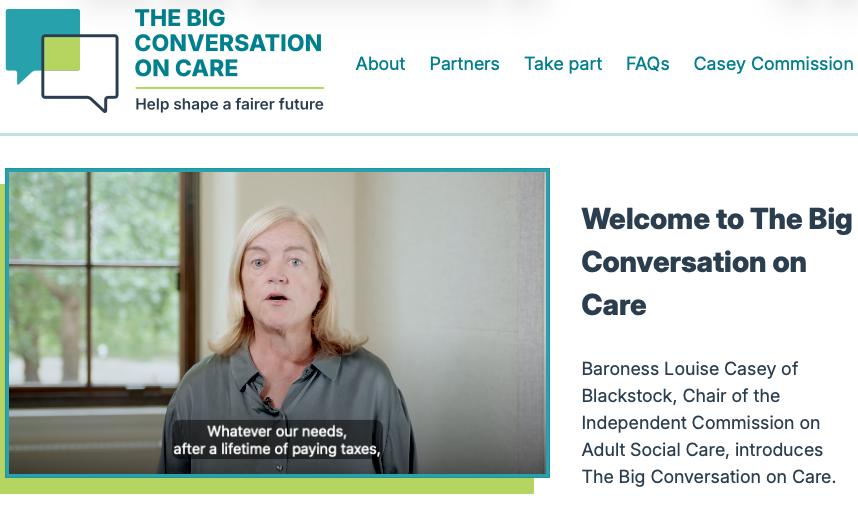
Burnham’s second proposal was to bring forward Louise Casey’s final report. Good!
Summer 2027 is still a long way away for families struggling now, and there is a danger that ‘bringing it forward’ becomes another way of postponing decisions, but…
… Casey’s Big Conversation may be more important than it sounds.
The technical answers to social care have been available for years.
Dilnot gave us one. Free personal care gives us another. A social insurance model offers a third.
-
The problem has never been the absence of policy options.
-
The problem is political consent, and…
-
The problem as been a meddlesome press
Every proposal has been killed by a slogan...
...death tax, dementia tax, insurance raid, inheritance grab.
Casey’s task is not merely to ask people what sort of care system they want. It is to establish a shared understanding that we are already paying.
We pay through council tax.
We pay through lost wages when relatives give up work.
We pay through delayed discharges and blocked hospital beds.
We pay when families exhaust their savings.
We pay when self-funders subsidise council care-home rates.
We pay unpredictably, unfairly and often catastrophically.
The real choice is not between paying and not paying. It’s between paying collectively and predictably…
… or privately, randomly and ruinously.
Burnham’s third point was cross-party talks. He knows why they are necessary. No settlement will survive if one party introduces it and another spends the next election promising to abolish it.
The politics has to be shared because the pain will be shared, but…
…cross-party agreement carries a risk.
It can produce the lowest common denominator. A compromise so cautious that nobody opposes it because it changes almost nothing.
Burnham must avoid that.
Yesterday, his authority came from speaking plainly about the scale of the failure and his willingness to spend political capital fixing it.
Now, he must turn that authority into urgency, money and a timetable.
The likely destination is becoming clearer…
- national rights,
- local delivery,
- a better-paid workforce,
- free or largely free personal care,
- continued responsibility for ordinary living costs and some
- progressive way of pooling the catastrophic risk.
Dilnot+ perhaps?
A National Care Service in principle, if not in uniform.
Cocidius didn’t give us the answer.
What he did was more important than another policy launch. He began to create the permission to ask the hardest question in British politics;
‘What are we prepared to contribute, together, so that no family has to face dementia, disability or frailty alone?’
That is the conversation Casey must now lead, and …
… the PM must make sure it ends with a funded decision, and…
… implemented, swiftly.
|