Weekly update from the National Housing Conference | | News from Washington | By Brittany Webb | | |
OCC and FDIC propose major CRA changes
The Office of the Comptroller of the Currency (OCC) and Federal Deposit Insurance Corporation (FDIC) proposed a rewrite of the Community Reinvestment Act (CRA) regulations that could significantly reduce bank investment in affordable housing at a time when communities nationwide face severe housing supply and affordability pressures. The Federal Reserve did not join the rulemaking, departing from past interagency proposals. Although the agencies describe the proposal as a targeted update that preserves much of the existing framework, it would place greater weight on lending while weakening several of the investment and community development incentives that have made CRA a critical source of capital for affordable housing.
The proposal would classify banks with less than $1 billion in assets as small banks, create an intermediate-bank category for institutions with between $1 billion and $10 billion, and reserve the large-bank tests for institutions above $10 billion, while also seeking comment on whether the large-bank threshold should be raised to $30 billion. This would move many banks out of the large-bank investment test, potentially reducing affordable housing investment, including through the Low-Income Housing Tax Credit, particularly in smaller and underserved markets.
The proposal would allow grants and donations to receive CRA consideration only if the recipient directly uses the funds for a qualifying community development program, project, or initiative in the bank’s local community. For grants from large banks, recipients’ indirect or administrative costs could not exceed 15%. Such a change is particularly concerning for Community Development Financial Institutions, housing counselors, fair housing groups, and other affordable housing organizations that work to ensure investments deliver lasting results for communities.
NHC urged the regulators to withdraw the proposal and pursue a coordinated approach that protects affordable housing investment, nonprofit capacity, and meaningful community development accountability. Comments will be due 60 days after the proposal is published in the Federal Register.
| | | |
NFHA sues HUD over FHIP changes
The National Fair Housing Alliance (NFHA) and the Massachusetts Fair Housing Center filed a lawsuit against the U.S. Department of Housing and Urban Development (HUD) regarding changes to the Fair Housing Initiatives Program (FHIP), arguing that HUD’s new funding structure would make it nearly impossible for most local fair housing nonprofits to receive funding. The groups contend that Congress created FHIP to support community-based organizations that enforce the Fair Housing Act, but that HUD is now channeling money toward a small number of favored recipients instead of the broader network of groups that typically receive such grants. NFHA notes that those groups handle the vast majority of fair housing complaints each year, making the local nonprofit system central to fair housing enforcement. If the program is dismantled, NFHA warns that it will destroy many of the more than 100 organizations that enforce the Fair Housing Act and leave consumers without paths to assert their rights.
“When a family faces an act of discrimination, they don’t call someone in HUD’s D.C. offices for help. They call one of the more than 100 private, nonprofit fair housing organizations throughout the nation,” stated NFHA’s Executive Vice President Nikitra Bailey. “That call often comes on a person’s worst day. It’s answered with compassion and swift action, and it saves the federal government money. NFHA’s member organizations handle three in four housing discrimination complaints every year. HUD handles fewer than one in twenty.”
The lawsuit is the latest in a series of disputes over HUD’s fair housing funding decisions, following earlier court fights over withheld grants. HUD Assistant Secretary Craig Trainor stated the department “will not be deterred” by the lawsuit, adding that Secretary Scott Turner’s leadership will “steward taxpayer funds responsibly, uphold the law without exception, and deliver results for the American people.”
| | | |
Join the National Housing Conference on December 8 at the National Press Club in Washington, D.C., for our annual Solutions for Affordable Housing convening. This premier event brings together leaders from across the affordable housing ecosystem, including government, philanthropy, nonprofit organizations, real estate development, lending, and other sectors, to build connections and advance housing priorities that are tangible, impactful, and achievable.
Through engaging discussions with national experts and policymakers, attendees will gain a deeper understanding of the most pressing housing challenges facing communities today and the federal, state, and local policies shaping solutions. Whether you're looking to strengthen partnerships, stay ahead of emerging trends, or better align your organization's work with the nation's housing priorities, Solutions for Affordable Housing offers valuable insights and actionable ideas to help drive meaningful progress.
Registration will open this month. Stay tuned for additional details, including the agenda and featured speakers.
| | |
Fed maintains target rate for fifth consecutive meeting
The Federal Open Market Committee (FOMC) held the target federal funds rate at 3.5%–3.75% for the fifth consecutive meeting, citing continued economic growth and elevated inflation as justification for the decision. The rate decision is the second under the leadership of Chairman Kevin Warsh and was approved by a split vote of 9-3. Three FOMC governors dissented in favor of a quarter-point increase. The committee said inflation remains above its 2% target, partly because of supply shocks and higher energy costs tied to continued conflict in the Middle East.
The decision offers little immediate relief for the housing market, where elevated mortgage rates continue to constrain affordability and home sales. Mortgage rates rose from below 6% in late February to 6.66% by the end of July, increasing borrowing costs for prospective homebuyers. Three dissenting votes and the Fed’s continued emphasis on price stability also raised expectations that the central bank could increase rates at a future meeting if inflation remains elevated.
Housing groups emphasized that monetary policy cannot directly resolve supply-driven inflation. The National Association of Home Builders noted that the nation’s housing shortage continues to place upward pressure on shelter costs and must be addressed through policies that reduce barriers to housing production. The Mortgage Bankers Association also said elevated inflation and the shift in monetary policy have contributed to mortgage rates reaching their highest levels of the year.
| |  | |
HUD expands Foster Youth to Independence vouchers
The U.S. Department of Housing and Urban Development (HUD) announced changes to expand access to Foster Youth to Independence (FYI) vouchers, which provide rental assistance and supportive services to young adults transitioning out of foster care. A new HUD notice removes the cap on the number of vouchers that public housing authorities can request, makes unused fiscal year 2025 funding available, and signals that HUD intends to recapture vouchers that are not being used. HUD also encouraged housing authorities to update their administrative plans in advance so they can respond more quickly to voucher requests.
“Every young American deserves the opportunity to pursue the American Dream,” said HUD Secretary Scott Turner. “We sat down with young adults across the country to listen to their testimonies, their challenges, and their hopes for the future. Now, we are acting to better equip youth exiting foster care with the tools they need to build independent, successful futures.”
The changes were accompanied by a new Statement of Findings based on roundtables HUD held with current and former foster youth, housing authorities, child welfare agencies, and service providers. Participants identified barriers including limited awareness of the program before aging out of foster care, inadequate financial literacy training, difficulty finding available rental units, and move-in expenses. HUD recommended earlier outreach, stronger financial education, landlord incentives, more flexible tenant-screening practices, and additional support for deposits and other move-in costs.
| | | |
U.S. home prices have cooled, but affordability remains stretched
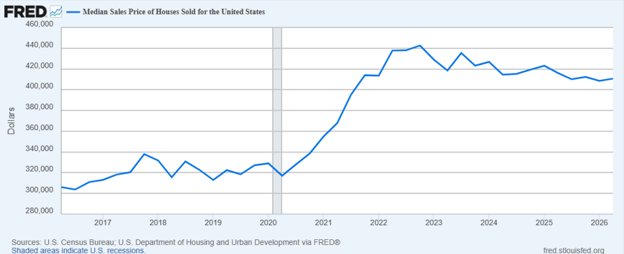
The Federal Reserve Bank of St. Louis’ FRED database shows that the median sales price of U.S. houses rose from approximately $300,000 in 2016 to about $408,000 in early 2026, reflecting a long period of upward pressure in the housing market. Prices were fairly steady from 2016 through 2020, with only modest fluctuations before rising sharply beginning in 2021. The biggest jump came in 2021 and 2022, when the median price moved rapidly into the low- to mid-$400,000 range. By 2026, the series suggests a market that has cooled from its peak but remains well above its pre-pandemic level. The recent slowdown has not erased the post-pandemic price increase but has mainly flattened it into a higher plateau.
| | |
A brief from the Urban Institute examines down payment assistance as part of a wider set of tools for expanding access to homeownership, providing overviews of innovative strategies from practitioners working across the country. The publication suggests that helping buyers with upfront costs can be impactful but works best when paired with other supports rather than used alone. The report focuses on how financial health strategies can complement assistance programs in closing homeownership gaps.
Vox argues that America’s housing system was designed around older assumptions about how people live, work, and move, and that it now needs to be reshaped for a very different future. The piece points to denser suburbs, more walkable places, and housing that makes better use of existing infrastructure as likely directions for the next several decades. It also suggests that solving today’s housing problems will require more than incremental zoning changes, as the underlying form of many communities still reflects a model that no longer fits current demographic and economic realities.
An opinion piece by Jared Bernstein and Jim Parrott in The New York Times offers good news and bad news about the 21st Century ROAD to Housing Act. The article examines the newly enacted bill and its implications for the nation’s affordable housing crisis. The authors argue that, if implemented as envisioned, the law could cut through bureaucratic obstacles and regulatory “sludge,” modernize outdated rules for manufactured and modular housing, expand small-dollar mortgage lending, and streamline permitting to help close the housing supply gap. They also warn that President Trump’s decision to let the bill become law without his signature signals an indifferent administration that may fail to provide the resources, staffing, and sustained attention HUD needs to design pilot programs, update regulations, and carry out the law’s reforms.
| | The National Housing Conference is a diverse continuum of affordable housing stakeholders that convene and collaborate through dialogue, advocacy, research, and education, to develop equitable solutions that serve our common interest. | | Defending Our American Home since 1931 | | Copyright © 2024. All Rights Reserved. | | | | |