Sylvia Woods Harp Center logo

Sylvia Woods Harp Center

April 2025 Newsletter

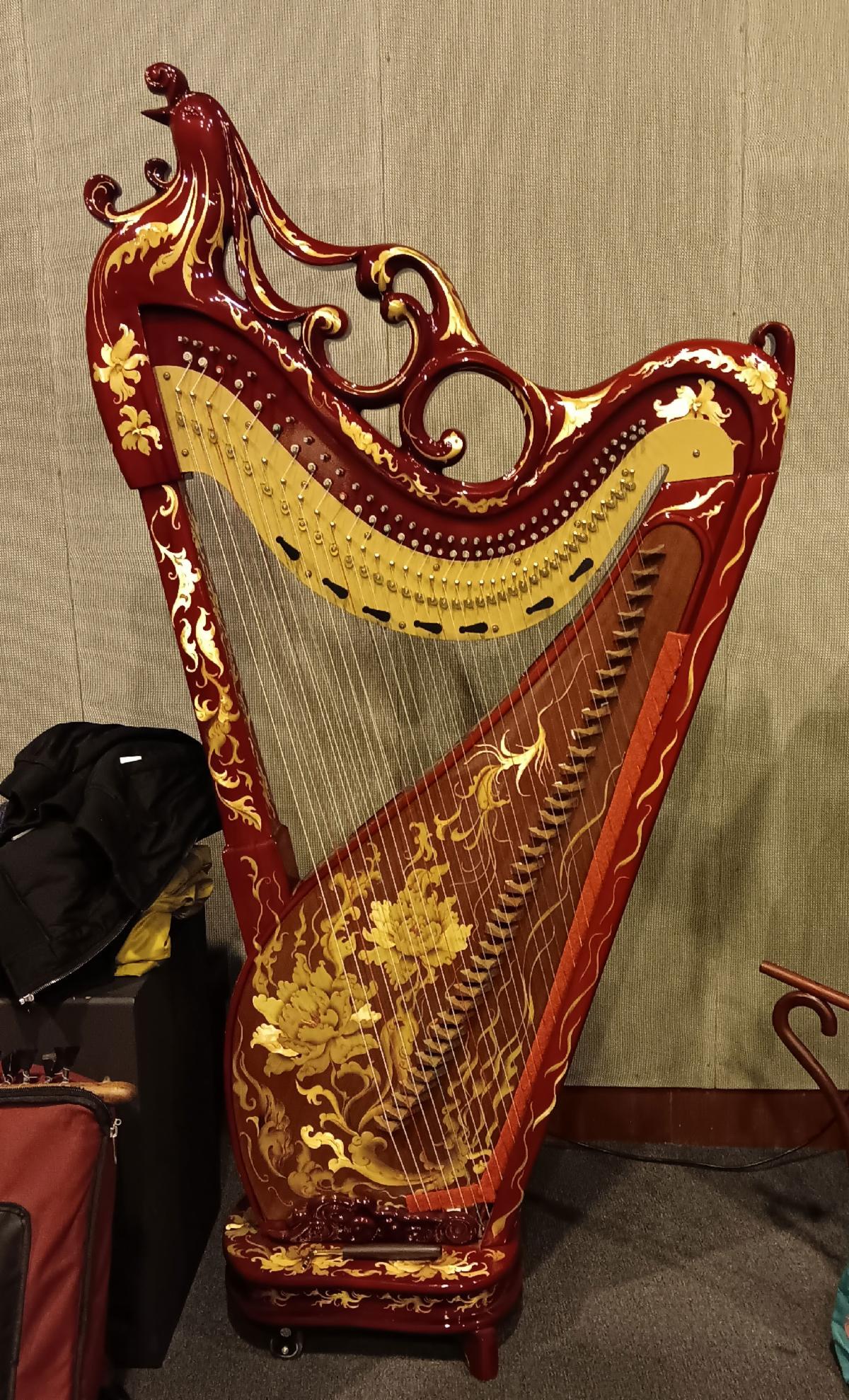
Konghou painting

Once again, I thank Nancy Thym for her fascinating article in last month's newsletter about the Chinese Konghou and other ancient harps. I received many emails from readers saying how much they enjoyed reading the article and watching the video. Several of the emails were from well-known harpists who, like me, have been playing for many years but were unaware that many of these types of harps existed.


As was mentioned last month, Nancy also wrote a short history of the Chinese Konghou harp, which you'll find below. I love learning new things about the harp!


I hope you're having a spectacular spring. Or, if you're in the southern hemisphere, a fabulous fall.


-- Sylvia

New Products at Harpcenter.com

An American Hymn Sing

Here are some of the PDFs I've recently added to harpcenter.com.


Philip Hayden

An American Hymn Sing - Two American hymn tunes: Foundation and Holy Manna


Rhett Barnwell

Priere (Prayer) - A classic late-Romantic French piece by Marc Delmas

Fantasia on "Veni Emmanuel" - "O Come, O Come, Emmanuel" for Advent and Christmas


Joy Slavens

Hand in Hand - An original composition, perfect for weddings


Diana Stork

Early Pieces for the Harp - 25 pieces for advanced-beginner students


Kathleen Blackwell-Plank

Ili, Ili Tulog Anay (Hush, Sleep for Now) - A Filipino lullaby


Meg Robinson

Irish Dreams - A lovely, lilting, original composition


Carolyn Mills

Three Celtic Arrangements - I Love My Love in the Morning, All Through the Night, and Bonny at Morn


Please note: The PDFs in this section are not part of the monthly sale.

The Chinese Konghou – a brief history

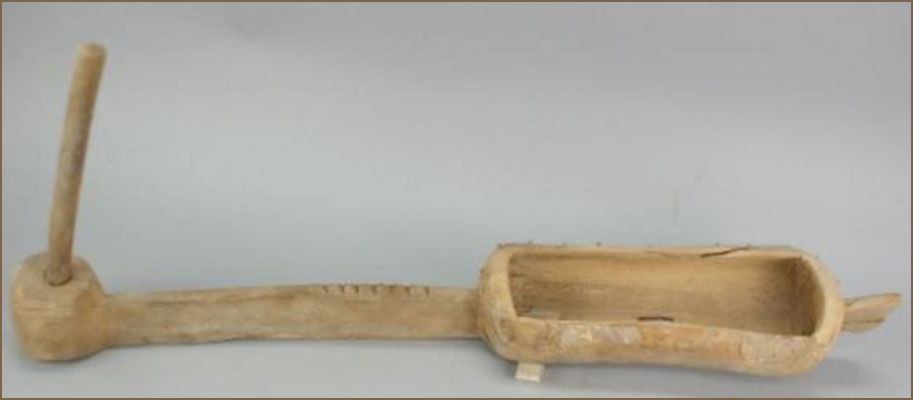
harp from the Tarim Baasin

The earliest harps found within the current borders of China were excavated in the Xinjiang Uygur Autonomous Region. A total of twenty-three horizontal angular harps have been discovered in graves with mummified remains near Zhagunluke (Zagunluq) and Yanghai in the Tarim Basin region. Interestingly, the mummified remains appear to have Caucasian features. Some of the graves are presumably those of shamans* as there are copious amounts of marijuana placed with the dead, as well as other shamanistic accouterments. The harps date from at least 500 BCE and perhaps earlier.

harp from Pazyryk

They strongly resemble the harp from Pazyryk in the Altai Region to the north of Xinjiang, dating from ca. 390 BCE, as well as the horizontal harps depicted on stone reliefs from Nimrud and Nineveh in Assyria from ca. 650 BCE. Some of the earliest depictions of both vertical and horizontal harps (2nd millennium BCE) have been found in Assyria, so most scholars assume that the harp moved eastwards and westwards from this area.


The harps from Xinjiang Uygur Autonomous Region are built from native wood, so the harps were part of the local tradition by this time; they were not imported. Vertical angular harps appear to have spread eastward during the Han Dynasty (202 BCE – 220 AD), by which time the borders of China included areas of the Xinjiang Uygur Autonomous Region.

British Museum

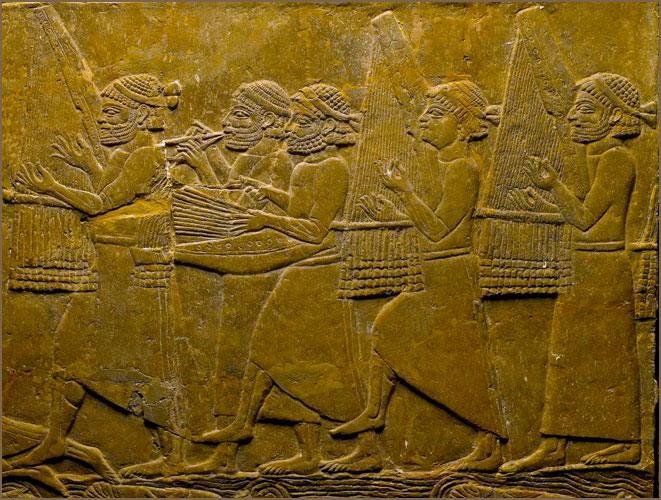
This image of a limestone wall relief from the Assyrian king Ashurbanipal's palace at Nineveh (660-650 BCE) shows conquered Elamite musicians playing both vertical and horizontal angular harps after their defeat at the Battle of Til-Tuba. 


Image © The Trustees of the British Museum. Shared under a Creative Commons Attribution-NonCommercial-ShareAlike 4.0 International (CC BY-NC-SA 4.0) licence.

Lady Su Hui

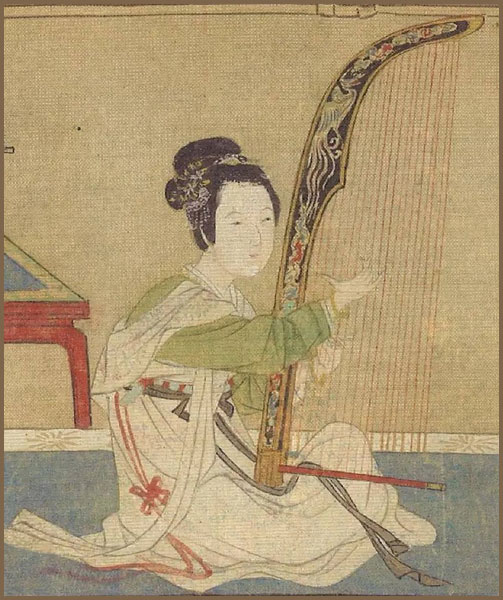
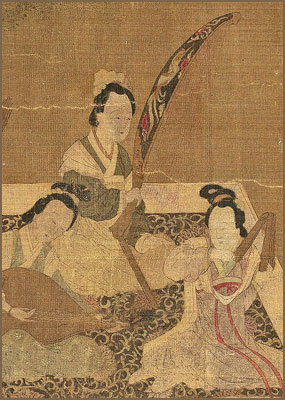
Numerous ancient paintings and stone carvings portray a vertical angular harp, the konghou, with a bowed soundbox that often rises above the player's head. These harps were highly decorated, probably had silk strings, and may even have had soundboards of hide or skin. This image is a portion of a 16th-century painting, Lady Su Hui and Her Verse Puzzle, on display at The Metropolitan Museum of Art in New York.


The konghou reached its highest popularity during the Tang Dynasty (618-906 AD). Fragments of a konghou from this period, presented to the Japanese royal family in the 9th century, have survived in the musical instrument collection of the Shosoin Temple in Japan. A similar vertical angular harp, the kugo, was played in ancient Japan. A type of arched harp (similar to the Burmese saun gauk) called the Phoenix-headed konghou appears in iconography from the Eastern Jin dynasty (317-420 AD) and probably entered China through India. The konghou tradition in China declined during the late Ming Dynasty (1368-1644).

Chinese harp

Just as the ancient wire-strung clàrsach of Scotland and cláirseach of Ireland died out in the 18th century, the ancient konghou also died out completely by the Qing Dynasty (1644-1912). And just as the revival of the harp in Scotland and Ireland was based upon building smaller versions of the modern pedal harp, but using levers instead of pedals, a modern form of konghou was also invented in China beginning in the 1970s. In its basic form, the modern Chinese konghou resembles a modern pedal harp and often has seven pedals. There are, however, essential differences. The bottom of the harp is formed like a zither or lute; the strings lie parallel to the soundbox at the base but vibrate freely in the upper area of the harp. The modern konghou has two rows of strings, which are connected to each other and tuned parallel. They run continuously over bridges on the zither-like soundbox. By pressing on the corresponding string on the other side of the instrument to that which is being played, it is possible to bend or vibrate notes producing similar sounds to those of the Chinese zither or guzheng. The modern konghou is enjoying increasing popularity in China and has been represented at many World Harp Congresses and historical harp symposiums.

Lu Lu

This photo shows Lu Lu, who was featured in last month's newsletter, playing a modern konghou at the Jiuding Konghou Museum in Xinxiang City, China.


Here are a few links if you'd like more information.

Konghou: A Musical Gem of the Ancient Silk Road

Reflection upon Chinese Recently Unearthed Konghous in Xin Jiang Autonomous Region

Tarim Harps

Ancient Mummies of the Tarim Basin

Sanxiang Konghou Culture Museum to open in late July

The Chinese Harp, or Konghou - on Harpspectrum.org

The Chinese Harp, or Konghou - on Wikipedia


* I used the word "shaman" with caution. The term “shaman” did not appear in English until the 17th century AD. It described those who are able to communicate with the spirit world through altered states of consciousness, enhanced by the use of hallucinogens or the music of instruments such as harps and drums. It is not the term the practitioners would have used for themselves, but it is the word most commonly used in English. Interestingly, the “shamans” of the Chanty and Mansi in western Siberia use both harp music and hallucinogens to enter a trance state. 


-- Nancy Thym

This Month's Sale
Flowers and rain

As the saying goes, "April showers bring May flowers." So this month's sale features music that has the words April, showers, flower, or flowers in the title.


To get the 15% discount, enter the code word April in the "Enter Promo Code" box on your shopping cart page and click "Enter Code" by April 30, 2025. See the "How to get the 15% discount" section at the bottom of this newsletter for more information.

Disney Book-PDF

76 Disney Songs

by Sylvia Woods

including Little April Shower

from Bambi

PDF or Book

15% off with April code

------------------------------

Flower Duet

Flower Duet

from Lakme

by Sylvia Woods

PDF or Sheet

15% off with April code

------------------------------

52 Scottish Songs

52 Scottish Songs

by Sylvia Woods

including

The Flowers O' The Forest

PDF or Book, CD or mp3

15% off with April code

------------------------------

Small Tunes

Small Tunes for Young Harpists

by Bonnie Goodrich

including April Dance

PDF or Book

15% off with April code

------------------------------

A Walk in the Woods

A Walk in the Woods

by Kathryn Cater

including Wildflowers

PDF

15% off with April code

------------------------------

All Seasons of Spring

All the Seasons of Spring

by William Mahan

including An April Lullaby

PDF

15% off with April code

------------------------------

Celtic Echoes

Celtic Echoes

by Sally Perreten

including

Flowers of Edinburgh

PDF

15% off with April code

------------------------------

Forget Not the Angels

Forget Not the Angels

by Kim Robertson

including

Fine Flowers of the Valley

PDF

15% off with April code

------------------------------

Jasmine Flower

Jasmine Flower

for harp duo or ensemble

by Ellie Choate

PDF

15% off with April code

------------------------------

How to get the 15% discount

15% off select sale items when you use the code word April


Our newsletter promo codes are redeemable online and are only valid for the products listed above in the monthly sale section. They are not valid for phone or email orders. This month's code word is April.


Here's how to get your newsletter discount at harpcenter.com:

#1. Put the items you want to purchase in your cart.

#2. On the page where you view the items in your cart, type this month's code word April in the "Enter Promo Code" box and click "Apply."

The actual price of the featured sale products on this page will then automatically change to reflect the discount. For example,


   Unit Price: $9.95 (the original price)

   Total Price: $8.46 (the discounted price)


You'll also see a note below the Promo Code box saying the name of the promo code you entered and the percentage amount of the discount.


REMEMBER: You must enter this month's code word April in the Promo Code box and click "Apply" on your shopping cart page by April 30, 2025, to get the discount!

If you forget, or if you have trouble adding it to your order, email Sylvia immediately.  


This offer expires at the end of the day on 4/30/2025.


Sylvia Woods Harp Center

Lihue, Hawaii

 
(808) 212-9525