|
|
|
Sylvia Woods Harp Center
July 2024 Newsletter
| |
|
The articles in this newsletter issue are part of my periodic series about living in Hawaii.
I often sign my emails with "Aloha," a word frequently used here in Hawaii. Aloha means more than just "hello" and "goodbye." The Hawaiian dictionary lists many definitions of aloha, including love, affection, compassion, mercy, sympathy, pity, kindness, sentiment, grace, charity, greeting, salutation, and regards.
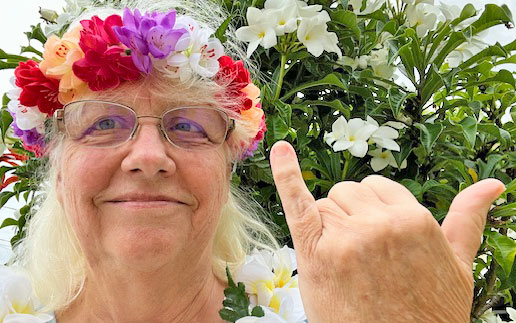
I deeply value and appreciate each one of you, my customers and readers, so I'm starting this newsletter by extending my warmest aloha and sharing a shaka with you.
You might be asking yourself, "What is a shaka?"
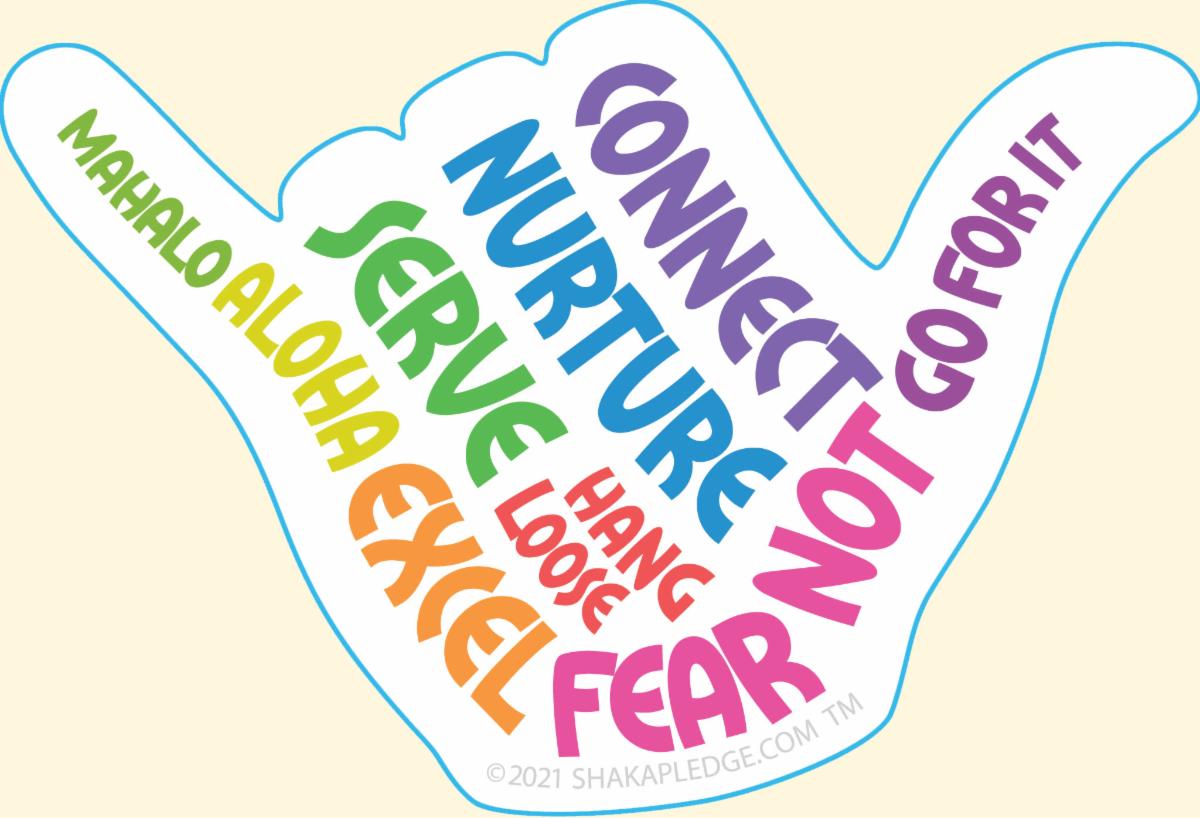
The recent Hawaiian Senate Bill 3312 defines the shaka as "generally (consisting) of extending the thumb and smallest finger while holding the three middle fingers curled, and gesturing in salutation while presenting the front or back of the hand; the wrist may be rotated back and forth for emphasis."
| |
|
Although there are various theories about the origin of the shaka gesture, they all agree that it originated in Hawaii. It was later adopted by surf culture, to signify "hang ten" or "surf's up." Nowadays, a similar gesture with the thumb placed near the ear, and the pinky by the mouth, means "call me."
But, here in Hawaii, the shaka has multiple positive connotations. The To-Hawaii.com website explains it this way. "The shaka is a simple yet powerful way to remind locals and visitors of the way people look out for each other on the islands and strive to spread aloha day in and day out, in keeping with the Hawaiian principle of malama i kekahi i kekahi, - take care of one, take care of all."
The shaka has become a physical manifestation of Aloha.
-- Sylvia
| |
Shaka: the official Hawaiian gesture | |
|
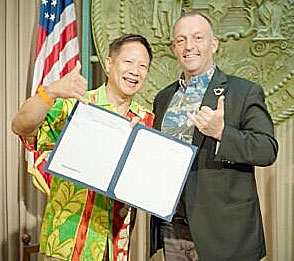
Hawaii is the 50th state, but it is the very first state to declare an official gesture. "On June 24, 2024, after rare unanimous approvals in the Hawai’i House and Senate, Hawai’i Governor Josh Green signed a new Hawai’i law that adopts the shaka as Hawai’iʻs Official State Gesture."
This photo shows Governor Green on the right and Steve Sue, the bill's author, celebrating the signing with shakas.
Part of the wording of the bill states the following.
“While multiple origin theories exist, all theories have the shaka developing within the State. More importantly, while multiple Hawai’i ethnic cultures and resident groups have contributed varying layers of meaning to the shaka, there is a shared agreement in the shaka’s positive sentiments and usage toward sharing aloha, fostering connection, and being pono.* As the shaka is now used around the world, this Act ensures that Hawai’i retains recognition as the birthplace of the shaka . . . and to share the aloha spirit around the world.”
*(Pono, a key concept in Hawaiian culture, embodies the idea of righteousness, balance, virtue, goodness, correctness, and morality. It is a fundamental part of the Hawaiian state motto: “Ua Mau Ke Ea o ka ʻĀina i ka Pono” which translates to “The life of the land is perpetuated in righteousness.”)
| |
|
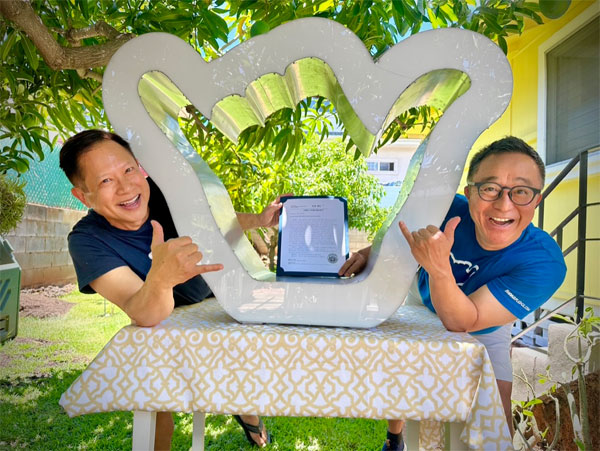
Senator Wakai, who sponsored the bill in the State Senate, is shown here with Steve Sue. The senator said: “It’s a simple initiative, with a huge impact. The shaka captures the goodness of Hawai‘i. It’s a ubiquitous gesture that is offered with the best of intentions. … Since the shaka was born in Hawai‘i, it makes sense to claim it as our own. . . . Our world needs less hate and gunfire, and more shakas!”
Steve Sue's ID8 nonprofit organization is a beacon of the aloha spirit, fostering "ideation and expression skills to create positive impacts through sharing the aloha spirit." Their full-length documentary film, “Shaka, A Story of Aloha,” had its world premiere in Los Angeles at the VC Film Festival in May 2024. You can watch the movie trailer on YouTube.
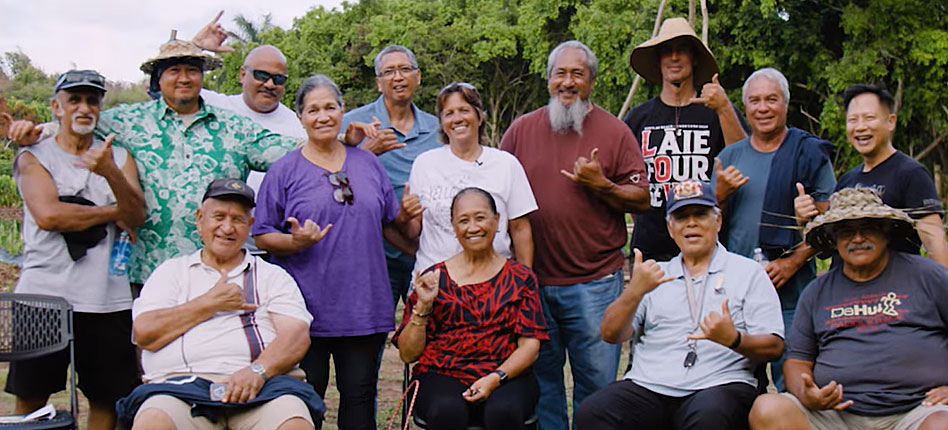
Here's how Steve describes this next photo.
"It shows the leaders of the Laie Community Association, a group that produced a traditional Hukilau that hadn’t been run in 60 years. We covered it in our film as the event was part of Shaka history from the 1940s-60s. The image contains interviewees in our film including Joel “Baldy” Apuakehau (standing, far left) and front row seated left to right Harold Pukahi, Kekela Miller, and Cy Bridges."
| |
I'd like to thank Steve for allowing me to use photos and quotes from the ID8 website in this newsletter. Mahalo! | |
|
The most popular theory about the origin of the shaka is that it originated with Hamana Kalili, a worker at the Kahuku Sugar Mill on Oahu in the 1940s. He lost the three middle fingers of his right hand when they were caught in the sugar cane pressing machine. After the accident, he was given the job of guarding the sugar train. The children who would try to jump on the train for a free ride began to imitate his wave to signal to each other that he was not around, so it was "all clear" to hop aboard.
Hamana was a respected member of the Mormon community in Laie and continued to lead the singing at the church using his injured hand.
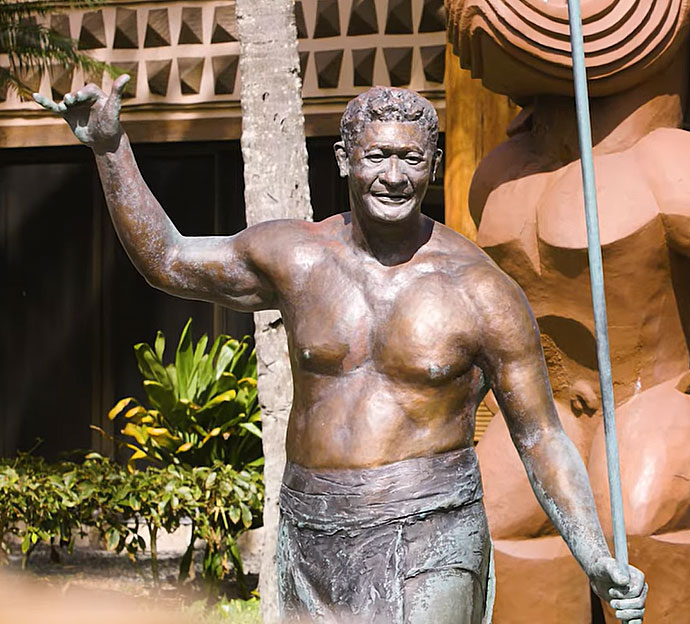
This statue of Hamana Kalili, a tribute to his enduring legacy, is prominently displayed outside the Polynesian Cultural Center in Laie. You can read more about the history of the shaka on their website.
| |
|
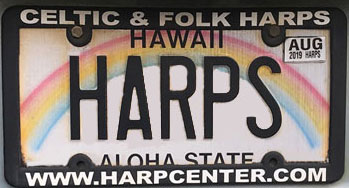
As I mentioned near the bottom of my November 2018 newsletter, most Hawaiian license plates feature a beautiful rainbow. Here's a photo of mine.
Hawaii also has a Nonprofit Plates Program with special license plates designed for select nonprofit organizations. A portion of the annual vehicle registration fee is donated directly to the nonprofit. Some of these organizations include the Bishop Museum, Hawaiian Humane Society, Honolulu Police Relief Association, Polynesian Voyaging Society, Volcanoes National Park, and more.
| |
|
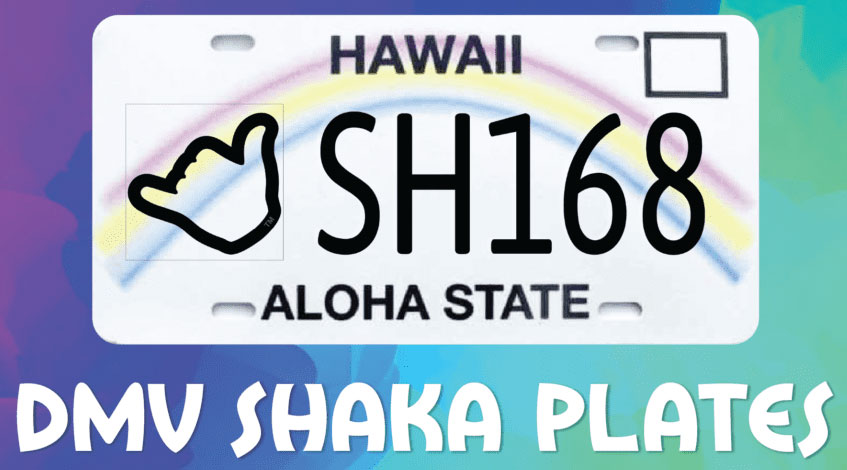
After a 2-year review process with the state and counties of Hawaii, the new Shaka License Plates are now available. Each year, $20 of every $25 Shaka Plate fee will go to ID8, a Honolulu nonprofit "dedicated to fostering ideation and expression that result in positive impacts."
Steve Sue, the Chairperson of ID8, states: "This is very much Hawaii’s culture. This is all about sharing the Aloha spirit on the highways. Keep the road rage down, keep the Aloha up. That’s all this is. It is pretty simple."
In my November 2018 newsletter, I also wrote about driving with Aloha.
Honking horns. I can't remember the last time I heard a car horn! The law states, "The driver of a motor vehicle shall, when reasonably necessary to ensure safe operation, give audible warning with his or her horn; but shall not otherwise use such horn when upon a highway." We "drive with Aloha" here. Letting traffic merge or turn left in front of us (even when we have the right-of-way), is the norm, not the exception on Kauai.
In keeping with today's theme, I'll add that the shaka is a part of driving here, as well. People often flash shakas as a "thank you" for kind and considerate driving. So, wherever you live on this planet, always drive with Aloha!
| |
New Products at Harpcenter.com | |
|
This month's sale includes music that helps convey the spirit of aloha. Only a few of the pieces are Hawaiian, but they all embody aloha, either in their titles or the lyrics.
To get the 15% discount, enter the code word Aloha in the "Enter Promo Code" box on your shopping cart page and click "Enter Code" by August 5, 2024. See the "How to get the 15% discount" section at the bottom of this newsletter for more information.
| |
|
What a Wonderful World
arranged by Brenda Bowen Cox
"I see friends shaking hands saying 'How do you do?' They're really saying 'I love you.' "
PDF
15% off with Aloha code
------------------------------
| |
|
22 Romantic Songs
arranged by Sylvia Woods
including
Hawaiian Wedding Song
"This is the moment of sweet Aloha."
Book or PDF
15% off with Aloha code
------------------------------
| |
|
76 Disney Songs
arranged by Sylvia Woods
including It's A Small World
"There's so much that we share that it's time we're aware, It's a small world after all."
Book or PDF
15% off with Aloha code
------------------------------
| |
|
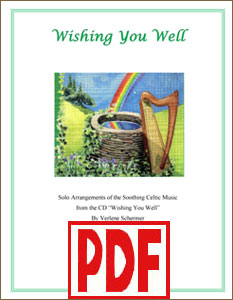
Wishing You Well
by Verlene Schermer
PDF
15% off with Aloha code
------------------------------
| |
|
Chanting for Peace
by Linda Larkin
PDF
15% off with Aloha code
------------------------------
| |
|
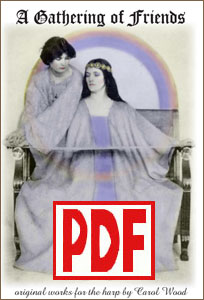
Gathering of Friends
by Carol Wood
PDF
15% off with Aloha code
------------------------------
| |
How to get the 15% discount
| |
|
15% off select sale items when you use the code word Aloha
Our newsletter promo codes are redeemable online and are only valid for the products listed above in the monthly sale section. They are not valid for phone or email orders. This month's code word is Aloha.
Here's how to get your newsletter discount at harpcenter.com:
#1. Put the items you want to purchase in your cart.
#2. On the page where you view the items in your cart, type this month's code word Aloha in the "Enter Promo Code" box and click "Apply."
The actual price of the featured sale products on this page will then automatically change to reflect the discount. For example,
Unit Price: $9.95 (the original price)
Total Price: $8.46 (the discounted price)
You'll also see a note below the Promo Code box saying the name of the promo code you entered and the percentage amount of the discount.
REMEMBER: You must enter this month's code word Aloha in the Promo Code box and click "Apply" on your shopping cart page by August 5, 2024, to get the discount!
If you forget, or if you have trouble adding it to your order, email Sylvia immediately.
This offer expires at the end of the day on 8/5/2024.
| |
Sylvia Woods Harp Center
Lihue, Hawaii
| | | | |