|
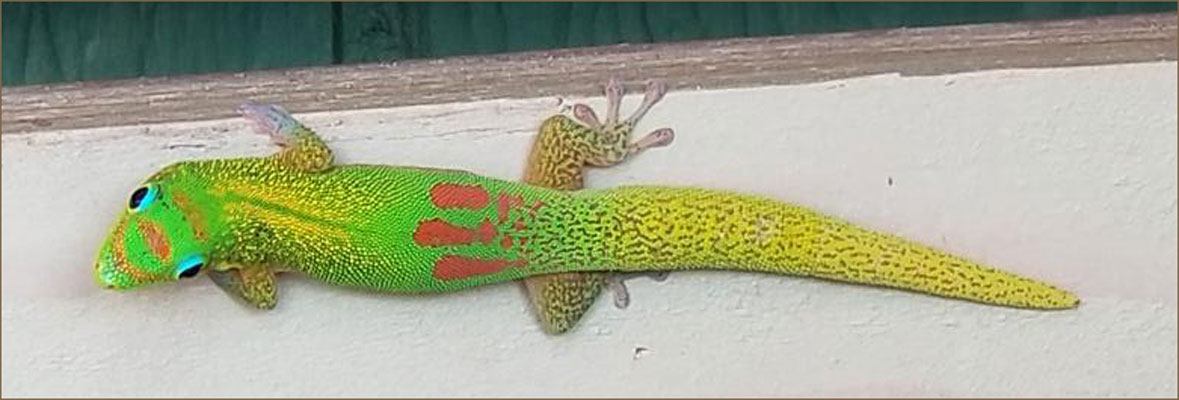
I was first introduced to geckos when we began visiting Kauai in 1988. Geckos can often be found in houses in Hawaii. These days, I usually see one in my living room every week or two. They love to hide out behind the framed artwork on my walls.
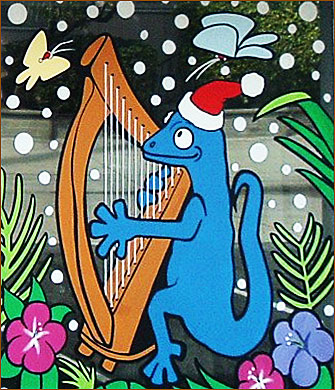
In 2003, I published my book of Gecko Tails compositions, including Sticky Toes, View from the Ceiling, Dancing in the Waterfalls, Tropical Dreams, and The Gecko Stroll.
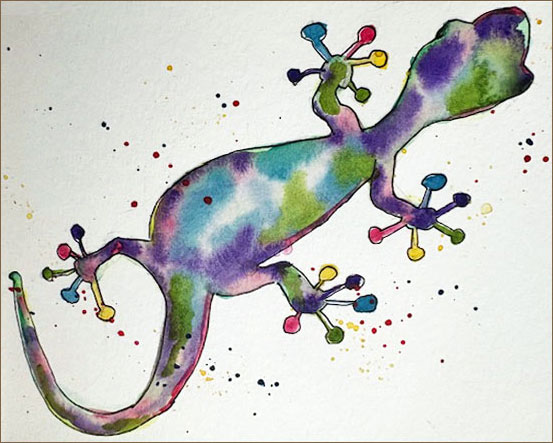
I was very happy that David Kolacny agreed to create this fine artwork for the cover.
Here’s what I wrote in the introduction.
"This suite of 5 pieces was inspired by the geckos that live in my house in Kauai, Hawaii. I’ve always admired the way they scamper up the walls and windows and across the ceiling. I hope you enjoy this playful suite. Have FUN!"
Here are the Fun Gecko Facts that I included in the book's introduction.
Geckos are the only lizards that can produce sounds. Their name comes from the clicking or chirping “geck-o” sound made by some species.
There are over 900 species of geckos worldwide living on every continent except Antarctica. Eight species live in Hawaii. The most common geckos on the island of Kauai are House Geckos, Mourning Geckos, and Stump-toed Geckos. Adults range from about 3" to 5½ " long.
Geckos live in lots of the houses of Hawaii. They are considered by many to be good luck. They often stake out territories; there might be a front window gecko, a kitchen sink gecko, a picture frame gecko, etc.
One good reason to have geckos in your house is because they are carnivorous. They can eat four to five mosquitoes or termites a minute. They also eat cockroaches, crickets, and ants.
When a gecko is caught by its tail, it releases the tail, which twitches for a while and allows the gecko to escape capture. The gecko will later grow another tail.
Geckos have immovable eyelids; their eyes are always open. They lick them to keep them clean.
STICKY TOES
A gecko can dash up a smoothly polished glass surface, sticking and unsticking its feet 15 times a second. It can hang from a ceiling, if it wants to, by a single toe. Even in a laboratory-created vacuum, where suction would do little good, a gecko's foot will still stick. How does it do it?
In the year 2000, scientists from Lewis and Clark College, the University of California, and Stanford University published results from their studies of Tokay Geckos, the largest geckos on the planet. Each gecko toe has a network of about 2 million tiny hairs called setae, each about one-tenth the diameter of a human hair. One seta can lift the weight of an ant. A million setae, which could easily fit onto the area of a dime, could lift a 45-pound child, and a gecko using all of its setae at the same time could support 280 pounds.
The end of each seta is further subdivided into hundreds to thousands of structures called spatulae. These tiny pads work through the weak attraction that molecules have for one another when they are brought very, very close together, called “van der Waals forces.” This force is what allows the gecko to stick to virtually any surface -- even polished glass.
As one researcher said, "Geckos have developed an amazing way of walking that rolls these hairs onto the surface, and then peels them off again, just like tape. But it's better than tape." Scientists hope that this knowledge will help them invent a gecko-inspired adhesive that is dry, self-cleaning, and reusable. It could be used on semiconductors, robots, and a variety of consumer products. Who knows, maybe someday we’ll all be able to climb walls and ceilings like Spiderman (or like geckos!) with special gecko gloves and shoes.
|