|
This article is part of my ongoing series about Hawaii.
On the May 12th local KITV evening news, I saw a fascinating segment about the U.S. Mint issuing a new commemorative quarter honoring a well-known Hawaiian, Edith Kanaka'ole. The following paragraphs are from the U.S. Mint website.
The Edith Kanakaʻole Quarter is the seventh coin in the American Women Quarters™ Program. Edith Kanakaʻole was an indigenous Hawaiian composer, chanter, kumu hula, and a custodian of native culture, traditions, and the natural land. Her moʻolelo, or stories, served to rescue aspects of Hawaiian history, customs, and traditions that were disappearing due to the cultural bigotry of the time.
Kanakaʻole, or “Aunty Edith,” as she is commonly known, was a renowned practitioner of and authority on modern Hawaiian culture and language. She learned hula from her mother, who was instructed by the acclaimed dancer Akoni Mika.
Kanakaʻole believed that the oli, or Hawaiian chants, formed the basis of Hawaiian values and history. She started composing oli in 1946 and choreographed hula to go with many of her chants.
In the 1950s, she toured the contiguous United States, western Canada, and much of Asia with a hula group named after her daughter Nalani. She also founded her own hālau (hula school), Hālau O Kekuhi.
Kanakaʻole assisted in the development of the first Hawaiian language program for public school students at the Keaukaha School in Hilo. In the 1970s, she created college courses and seminars on subjects including ethnobotany, Polynesian history, genealogy, and Hawaiian chant and mythology.
In 1979, she received the Distinction of Cultural Leadership award, the state’s highest honor. It is given to an individual who has made significant outstanding lifetime contributions to Hawai’i in areas of culture, arts, and humanities.
Edith Kanakaʻole died on October 3, 1979. Her teachings, beliefs, and practices are maintained by the Edith Kanakaʻole Foundation (EKF), a Hawaiian cultural-based non-profit 501(c)(3) organization established in 1990.
THE COIN
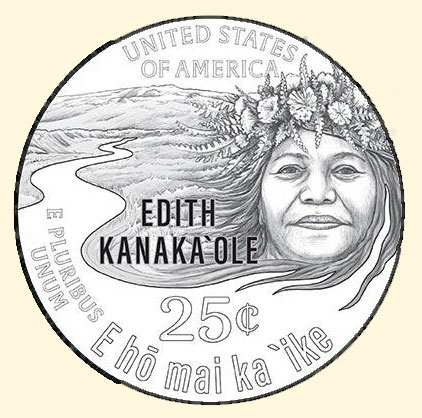
The reverse (tails) features a depiction of Edith Kanakaʻole, with her hair and lei poʻo (head lei) morphing into the elements of a Hawaiian landscape, symbolizing Kanakaʻole's life’s work of preserving the natural land and traditional Hawaiian culture. The inscription "E hō mai ka ʻike" translates as “granting the wisdom,” and is a reference to the intertwined role hula and chants play in this preservation.
You can learn more about Edith Kanaka'ole on the Smithsonian American Women's History Museum website.
Part of the segment that I saw on the news included an interview with Emily Damstra, the artist who designed the image on the coin. You can watch the video on the KITV4 website.
I have purchased two rolls of these quarters and am sharing them with friends.
|