|
Hello Synapse Spotlight readers,
Welcome to the latest edition of Synapse Spotlight! As we move through 2025, we’re excited to share new discoveries in neuroscience and highlight the incredible work of our community. At the Society of Biological Psychiatry (SOBP), we remain dedicated to making neuroscience accessible to all. Please feel free to share this newsletter with your students, colleagues, family, and friends!
In this issue, we feature cutting-edge research on brain development and mental health. Highlights include studies on prenatal alcohol exposure and its lasting impact on brain maturation, the long-term effects of maternal mental health during pregnancy, and shared brain patterns across youth mental health conditions. Our Member Spotlight shines on Dr. Carrie E. Bearden, current SOBP President and a researcher who is advancing understanding of genetic contributions to brain development and risk for psychiatric illness.
You’ll also find “Around the Brain in MCQs”, our interactive quiz to test your knowledge on the latest discoveries, and a recap of our recent public engagement event at the SOBP Annual Meeting in Toronto.
Looking ahead, our next few issues will focus on brain development and how the brain is built, in preparation for the 81st Annual Meeting in New York City, April 2026—stay tuned for more deep dives into the fascinating science of development across the lifespan.
For even more groundbreaking new research, explore the latest issues of our three journals: Biological Psychiatry, Biological Psychiatry: Cognitive Neuroscience and Neuroimaging, and Biological Psychiatry: Global Open Science.
Follow us on social media (Facebook, X, Bluesky) to stay connected and get the latest updates!
Happy Reading!
The Synapse Spotlight Team
| | Brains in the Making: From Womb to Wow | | |
Did you know your brain starts forming just three weeks after conception? At this tiny stage, a structure called the neural tube begins to develop. By the end of the first trimester, most of the brain’s neurons—the cells that carry messages—are already in place.
Even before birth, the brain’s outer layer, called the cerebral cortex, is organizing itself into layers. Over a century ago, scientist Korbinian Brodmann drew this detailed image of the brain in an 8-month-old fetus, showing how these layers follow the curves and grooves of the developing brain.
And the brain keeps busy long after birth! Connections between neurons, called synapses, continue forming at an amazing pace well into adolescence. These connections help shape memory, decision-making, emotions, and even risk-taking. Early experiences—like a mother’s health, nutrition, and exposure to substances such as alcohol—can leave lasting effects on how the brain develops.
Image: Tectogenetic layers of cerebral cortex, human fetus 8 months (K. Brodmann, 1909, public domain)
| | Hot Topics in Biological Psychiatry | | |
Prenatal Alcohol Exposure Disrupts Brain Maturation in Youth
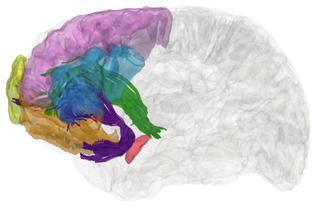
A recent study from Dr. Catherine Lebel's lab, led by Jamie Roeske, looked at brain scans from children and teens with and without prenatal alcohol exposure. The researchers found that alcohol exposure before birth can change how key brain areas—especially those involved in emotions and self-control—grow and connect with each other. These changes suggest the brain may be less flexible in adapting as kids get older.
The image above shows the brain regions studied, including the amygdala (red; processes emotions) and regions of the prefrontal cortex (pink, blue, orange, and yellow; important for decision-making and self-control). The green and purple pathways show how these regions connect. Disruptions in these regions and their connections may help explain why some youth with prenatal alcohol exposure have more difficulty with impulsivity and risk-taking.
Dr. Lebel’s lab works to understand what healthy brain development usually looks like, how it is disrupted in conditions like prenatal alcohol exposure, and what factors might help protect or support children facing these challenges.
Image adapted from Roeske, J., Long, X., Perdue, M.V., Long, M., Geeraert, B., Ghasoub, M., Yeates, K.O., McMorris, C.A., Pei, J., Gibbard, W.B. and Tortorelli, C., Amygdala and prefrontal cortex maturational differences in children and adolescents with prenatal alcohol exposure. Biological Psychiatry: Cognitive Neuroscience and Neuroimaging.
| |
Why It Matters: These findings shed light on why youth with prenatal alcohol exposure may be more likely to struggle with impulsivity or risk-taking. Understanding these brain differences can guide more supportive, evidence-based approaches for children and families affected. | | | | |
The Lasting Impact of Maternal Mental Health on the Brain
A long-term study from Dr. Klára Marečková’s team at Masaryk University in the Czech Republic found that a mother’s depression during pregnancy can leave lasting marks on her child’s brain into adulthood. Using brain scans of people followed since before birth, the team found changes in two regions: the thalamus (mood and information processing) and the nucleus accumbens (motivation and reward).
The effects looked different for men and women—women showed smaller volumes in both regions, while men had a larger nucleus accumbens by their late twenties. These differences remained stable across young adulthood, even after accounting for family background and postpartum depression.
Photo by Jamie Coupaud on Unsplash.
| |
Why It Matters: Supporting maternal mental health during pregnancy may help protect children's long-term brain health and reduce risk for later mental health challenges. | | | | |
Different, but the Same: Shared Brain Patterns Across Youth Mental Health Conditions
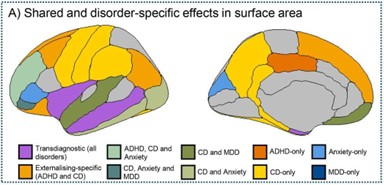
A large study led by Dr. Sophie Townend at the University of Bath (United Kingdom) examined brain scans from thousands of children and teens with anxiety, depression, ADHD, or conduct disorder. Despite looking very different behaviorally, these conditions showed strikingly similar changes in brain structure. In the image below, the regions shown in purple are those altered across all four disorders. This suggests that prevention and treatment strategies may be effective across multiple conditions—especially important during childhood and adolescence, when many mental health challenges first emerge and the brain is still developing.
Notably, the team found the most widespread brain changes in youth with conduct disorder, particularly across surface area in many cortical regions. Conduct disorder, often mislabeled as simple “bad behavior,” involves persistent antisocial patterns and can lead to serious challenges in school and beyond. These findings highlight a biological basis for the condition and the need for continued longitudinal research to better understand causes and outcomes.
Image from: Townend S, Staginnus M, Gao Y, et al. Shared and distinct alterations in brain structure of youth with internalizing or externalizing disorders: Findings from the ENIGMA Antisocial Behavior, ADHD, MDD, and Anxiety Working Groups. Biol Psychiatry. Published online August 12, 2025. doi:10.1016/j.biopsych.2025.08.003
| |
Why it matters: Focusing on similarities in brain development across mental health conditions could help reduce stigma and support more unified, effective interventions for young people. | | | | SOBP member spotlight: Dr. Carrie E. Bearden | | |
Dr. Carrie E. Bearden, Ph.D., is a Professor of Psychiatry, Psychology, and Biobehavioral Sciences at UCLA and the current President of the Society of Biological Psychiatry (SOBP). Her research focuses on identifying early markers that signal vulnerability to developmental psychiatric disorders. A major focus of her work is on 22q11.2 copy number variants (CNVs), a genetic change linked to differences in brain development and higher risk for psychiatric illness. She uses tools such as neurocognitive testing, multimodal brain imaging, and genomics to identify early biomarkers of risk.
In a recent publication (1), Dr. Bearden and colleagues used both mice and humans to study how brain connections change during development in 22q11.2 deletion syndrome. In the mouse model, they found that functional brain connectivity and dendritic structure shift dramatically across puberty, and remarkably, similar developmental patterns emerged in human fMRI data. This kind of cross-species translation is especially exciting because it strengthens the confidence of the human neuroimaging findings.
Dr. Bearden also leads the VERGE (2) project, funded by the California Institute for Regenerative Medicine (CIRM), which links cellular and human brain data. Using stem-cell–derived organoids (small, lab-grown models of the developing brain), her team studies how specific genetic mutations alter neural development and contribute to psychiatric risk.
She is also a Principal Investigator in the international Accelerating Medicines Partnership for Schizophrenia (AMP-SCZ) (3), which unites scientists and clinicians worldwide to identify biological markers that predict who is most at risk for developing psychosis, advancing efforts toward earlier, more effective intervention.
“I love working in early intervention because research and clinical care are so closely connected,” Dr. Bearden says. “If we can identify what’s disrupted in the brain—and when—it gives us a chance to change the course of illness.”
Beyond her research, Dr. Bearden is deeply engaged in science communication and advocacy. She has helped lead initiatives such as Save Our Science (SOS) in California and supports national efforts like Stand Up for Science, all aimed at strengthening public trust in science and sustaining research funding.
(1) https://pmc.ncbi.nlm.nih.gov/articles/PMC11900866/
(2) https://www.verge.ucsd.edu/
(3) https://www.ampscz.org/
| | | Around the brain in MCQs! | | |
Which part of the brain is critical for decision-making and planning, and continues developing well into adolescence?
A. Prefrontal cortex
B. Cerebellum
C. Brainstem
D. Temporal lobe
Scroll to the bottom of the newsletter to find the answer!
| | |
Brodmann areas – Brain regions defined by Korbinian Brodmann in the early 20th century based on differences in cellular organization (cytoarchitecture).
Cerebral cortex – The outer layer of the brain, responsible for complex functions like thinking, decision-making, and sensory perception.
Conduct disorder – A psychiatric condition in youth characterized by persistent antisocial, aggressive, or rule-breaking behaviors.
Copy number variants (CNVs) – Genetic changes in which sections of DNA are duplicated or deleted; 22q11.2 CNVs are linked to differences in brain development and higher risk for psychiatric disorders.
Nucleus accumbens – A brain region involved in motivation, reward processing, and reinforcement learning.
Neural tube – The embryonic structure that eventually develops into the brain and spinal cord, forming around three weeks after conception.
Neurons – Brain cells that transmit information via electrical and chemical signals.
Prefrontal cortex (PFC) – The front part of the cerebral cortex, critical for decision-making, planning, self-control, and social behavior; continues developing into young adulthood.
Synapse – A connection between neurons where chemical or electrical signals are transmitted, essential for communication across the brain.
Thalamus – A brain structure that acts as a relay center for sensory information and is involved in regulating mood and cognition.
| | |
To learn more about the Society of Biological Psychiatry (SOBP), or to become a professional member, visit https://sobp.org/
To subscribe to our newsletter, click here: Newsletter sign-up
To reach out to an expert, or for topic suggestions, email sobp@sobp.org
To learn more about SOBP journals, click here: https://sobp.org/publications/journals/
Press releases: https://sobp.org/publications/journal-press-releases/
To learn more about the brain and brain disorders, listen to the BrainSTEM podcast, hosted by SOBP members. Available on Spotify, Apple Podcasts, and more.
| |
How can I get involved?
SOBP is a proud Associate Member of the American Brain Coalition. Visit the website for the American Brain Coalition to learn more about their vision and how together we can advocate for increased support of research that will lead to better treatments for our patients as well as a national commitment towards finding cures for individuals with disabling neurological and psychiatric disorders.
| |
How can I get help?
We can all help prevent suicide. The 988 Lifeline provides 24/7, free and confidential support for people in distress, prevention and crisis resources for you or your loved ones, and best practices for professionals in the United States.
Call or text 988; Llama al 988 (para ayuda en español)
| | |
Find a therapist in your area with the Psychology Today’s Find a Therapist Tool: www.psychologytoday.com
Visit the National Alliance on Mental Illness (NAMI) website
Visit the National Institute of Mental Health (NIMH) website
| |
Brain teaser answer: A! - Prefrontal Cortex
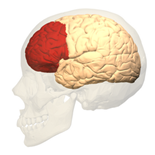
The prefrontal cortex (PFC) is the brain’s “control center” for decision-making, planning, problem-solving, and self-control. Unlike many other brain regions, the PFC continues developing well into adolescence and early adulthood. This extended development helps teens gradually improve skills like impulse control, goal-setting, and weighing long-term consequences—key abilities for navigating complex social and academic challenges.
Image from: Database Center for Life Science (DBCLS). (2010, February 25). Prefrontal cortex (left) – lateral view [Image]. Creative Commons Attribution-Share Alike 2.1 JP.
| | | | |