|
Hello Synapse Spotlight readers,
Happy 2026! 🎉 Welcome to the latest edition of Synapse Spotlight.
At Society of Biological Psychiatry (SOBP), we’re excited to kick off the new year by sharing fresh discoveries in neuroscience and celebrating the incredible work of our community. As always, our goal is simple: make neuroscience accessible to all. Please feel free to share this newsletter with students, colleagues, family, and friends.
In this issue:
• 🧠 Brain development: “Use it or lose it” in adolescence.
• 🌟 Estradiol: Puberty hormones shape the brain.
• 💡 Anxiety treatment: Brain activity predicts CBT response.
• 👤 Member Spotlight: Dr. Shalaila S. Haas links behavior and brain patterns.
• ❓ Around the Brain in MCQs: A quick quiz to test your neuroscience knowledge.
What’s next?
Upcoming issues will dive deeper into how the brain is built—across development and the lifespan—as we look ahead to the 81st Annual Meeting in New York City (April 2026).
For even more groundbreaking new research, explore the latest issues of our three journals: Biological Psychiatry, Biological Psychiatry: Cognitive Neuroscience and Neuroimaging, and Biological Psychiatry: Global Open Science.
Follow us on social media (Facebook, X, Bluesky) to stay connected and get the latest updates!
Happy Reading!
The Synapse Spotlight Team
| | Refining Our Brain: Use It or Lose It | | |
Beginning just weeks after conception, neurons (brain cells) start forming connections with one another. From that point through adolescence, trillions of new connections are created as the brain rapidly develops.
During adolescence, the brain undergoes a key developmental process known as synaptic pruning, in which unused or redundant connections are eliminated to improve efficiency. Which connections remain? While genetics play a role, a teen’s environment is a powerful force in shaping which neural pathways are strengthened and which are cut—quite literally, use it or lose it.
Positive experiences such as sports, music, learning, and supportive peer relationships can strengthen underlying neural connections, increasing the likelihood that they are retained. In contrast, negative experiences, including adverse childhood experiences like abuse or neglect, can disrupt this process and contribute to atypical patterns of brain development.
Image: Illustration generated using OpenAI’s DALL E 3 model via ChatGPT (2026)
| | Hot Topics in Biological Psychiatry | | |
Estradiol Levels in Girls Shapes Brain Development
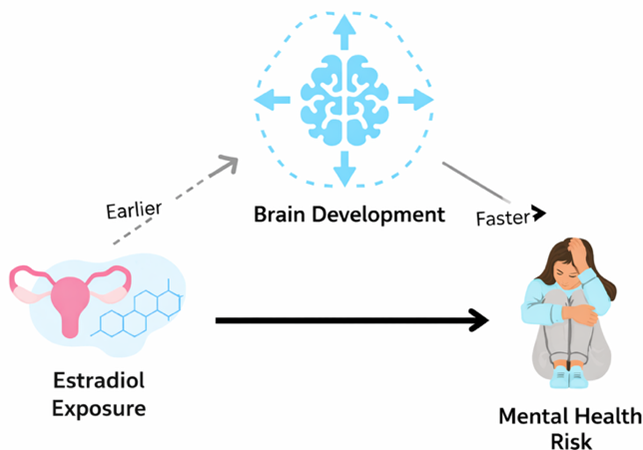
A recent study from Dr. Sarah Whittle's lab, led by Muskan Khetan, examined how estradiol—a key estrogen hormone involved in puberty—relates to brain development and mental health. The researchers found that earlier exposure to estradiol was linked with altered brain development, while faster changes in estradiol levels were associated with greater risk for mental health problems. Puberty is a sensitive developmental window when many girls become more vulnerable to mental illness. This study suggests that the timing and pace of estradiol changes may help explain that risk. The image below illustrates the relationships between estradiol, brain development, and mental health examined in this research.
Image adapted from: Khetan, M., Vijayakumar, N., Tian, Y. E., & Whittle, S. Linking oestradiol timing and tempo, brain development, and mental health problems in adolescent females. Biological Psychiatry: Cognitive Neuroscience and Neuroimaging. Figure adapted using ChatGPT based on GPT-5.2 (2026).
| |
Why It Matters: Differences in when and how quickly girls’ hormone levels change may shape brain development and influence mental health during adolescence. | | | | |
Helping Kids Get the Right Anxiety Treatment
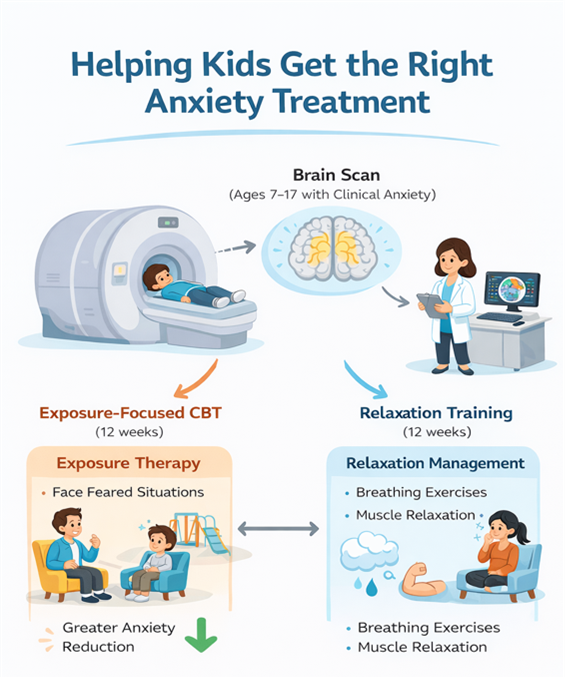
Cognitive Behavioral Therapy (CBT) is the most effective treatment for anxiety in children and teens, but not all youth benefit equally from a core component—exposure therapy, which involves gradually facing feared situations rather than avoiding them. In this study from the Child OCD and Anxiety Program at Colubmia University, Dr. Dana E. Díaz and colleagues asked whether brain activity before treatment could predict who benefits most. Youth ages 7–17 with clinical anxiety completed a brain scan and were then randomly assigned to 12 weeks of exposure-focused CBT or relaxation management training, which emphasizes breathing and muscle relaxation. Overall, exposure-focused CBT led to greater reductions in anxiety compared to relaxation training. Importantly, youth with lower pretreatment activity in brain regions involved in thinking, attention, and emotion regulation (including the dorsolateral prefrontal cortex and anterior cingulate cortex) showed greater improvement with exposure therapy, but less benefit from relaxation training. These findings suggest that anxiety affects youth in different ways at the brain level—and that these differences may help explain why some children respond better to certain treatments than others.
Image generated using ChatGPT based on GPT-5.2 (2026).
| |
Why It Matters: Anxiety treatment isn’t one-sized-fits-all. Brain-based markers may help guide more personalized care for anxious youth in the future. | | | | SOBP member spotlight: Dr. Shalaila S. Haas | | |
Dr. Shalaila S. Haas is an Assistant Professor in the Department of Psychiatry at the Icahn School of Medicine at Mount Sinai and Director of the Multimodal Insights into Neuropsychiatric Disorders (MIND) Lab. A cognitive neuroscientist, her research uses advanced machine learning to link behavioral patterns with neural signatures, with a primary focus on psychosis spectrum disorders. Her work aims to improve identification, prognosis, and prediction of treatment response, while clarifying mechanisms underlying clinical heterogeneity and accelerated aging across psychiatric disorders. Dr. Haas earned her B.A. from UC Berkeley, an M.Sc. from LMU Munich, and a Ph.D. in Translational Psychiatry from the International Max Planck Research School.
| | | Around the brain in MCQs! | | |
Which part of the brain is critical for error monitoring, conflict detection, and regulating emotion during decision-making?
A. Prefrontal cortex
B. Anterior cingulate cortex
C. Amygdala
D. Hippocampus
Scroll to the bottom of the newsletter to find the answer!
| | |
Estradiol – A key estrogen hormone involved in puberty that influences brain development and mental health.
Maternal mental health – A mother’s psychological well-being during pregnancy, which can have lasting effects on a child’s brain development.
Neurons – Brain cells that transmit information via electrical and chemical signals.
Nucleus accumbens – A brain region involved in motivation, reward processing, and reinforcement learning.
Prefrontal cortex (PFC) – The front part of the cerebral cortex, critical for decision-making, planning, self-control, and social behavior; continues developing into young adulthood.
Synapse – A connection between neurons where signals are transmitted, essential for brain communication.
Thalamus – A brain structure that relays sensory information and supports mood and cognition
Cognitive behavioral therapy (CBT) - A structured, evidence-based psychotherapy that helps individuals identify and change unhelpful thoughts and behaviors to improve emotional regulation and mental health.
| | |
To learn more about the Society of Biological Psychiatry (SOBP), or to become a professional member, visit https://sobp.org/
To subscribe to our newsletter, click here: Newsletter sign-up
To reach out to an expert, or for topic suggestions, email sobp@sobp.org
To learn more about SOBP journals, click here: https://sobp.org/publications/journals/
Press releases: https://sobp.org/publications/journal-press-releases/
To learn more about the brain and brain disorders, listen to the BrainSTEM podcast, hosted by SOBP members. Available on Spotify, Apple Podcasts, and more.
| |
How can I get involved?
SOBP is a proud Associate Member of the American Brain Coalition. Visit the website for the American Brain Coalition to learn more about their vision and how together we can advocate for increased support of research that will lead to better treatments for our patients as well as a national commitment towards finding cures for individuals with disabling neurological and psychiatric disorders.
| |
How can I get help?
We can all help prevent suicide. The 988 Lifeline provides 24/7, free and confidential support for people in distress, prevention and crisis resources for you or your loved ones, and best practices for professionals in the United States.
Call or text 988; Llama al 988 (para ayuda en español)
| | |
Find a therapist in your area with the Psychology Today’s Find a Therapist Tool: www.psychologytoday.com
Visit the National Alliance on Mental Illness (NAMI) website
Visit the National Institute of Mental Health (NIMH) website
| |
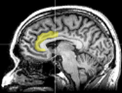
Brain teaser answer: B! - Anterior Cingulate Cortex
The ACC sits at the intersection of cognition and emotion—key for monitoring mistakes, resolving conflict, and guiding adaptive behavior, especially during development.
Image from: Sagittal MRI slice highlighting the anterior cingulate cortex, by Geoff B Hall, CC0/Public Domain (MRI anterior cingulate.png, 2011).
| | | | |