|
|
4608 Tower St.
Edina, MN 55424
(612) 440-7171
tcwalleyes@gmail.com
|
|
Twin Cities Walleyes Unlimited - Monthly Newsletter |
|
Tis the season
Greetings Club friends! I hope you and your families are safe and healthy and you all enjoyed your Thanksgiving holiday.
It was great to have our October and November meetings and get back to something a little normal, but as we have all learned normal is not quiet back yet. I certainly was looking forward to our December speaker Tony Roach and kicking off our ice fishing season. The good news is that Tony has agreed to join us next year at our December 2021 club meeting.
Some more great news is that after talking to Tony our January 9th 2021 club outing and ice-fishing clinic is still on! Space is still limited, so make sure you let us know if you want to join us and don’t forget that kids 16 and younger can join us for free!
For now, we plan on moving forward with our January 7, 2021 club meeting with guest speaker Matt Nelson. I’m looking forward to learning more about how to use our electronics when we are out fishing.
December is a month of great seasons, hunting season continues, ice fishing season kicks into full swing, and the holiday season brings us joy and hope.
I hope that you all have a safe and joyful month of seasons and I look forward to seeing you all at the January meeting.
Dale Meinders
President of Twin Cities Walleyes Unlimited
|
|
Sign up today for the Tony Roach Ice Fishing Clinic scheduled for January 9th. See details below. |
Important Slot limit changes to Lake Mille Lacs and Upper Red Lake. Check out the Minnesota DNR news section below for all the details.
|
If you are a member of MN-Fish or are thinking of joining here is quite the Dream Package. You can join MN-Fish at no cost. Good luck I hope to see a TCWU member win |
|
TCWU club outing and ice fishing clinic featuring Walleye fishing legend Tony Roach as our Guide
Saturday January 9, 2021
|
|
Good news for a change Hooray for fun!
The Tony Roach 2nd Annual TCWU Ice Fishing outing and clinic is on and scheduled for Saturday January 9, 2021 at Lake Mille Lacs!
We were really looking forward to have Tony Roach lead us into the Ice fishing season at our December meeting and then put those tips to work at his clinic.
Unfortunately we had to cancel the meeting but luckily we can still go fishing. Added bonus Tony is coming back next year to speak at our 2021 December club meeting.
Tony is stoked to host this event and has an awesome day planned for us.
Check out a couple of his latest articles by clicking on the links below to get tuned in on the latest and pick up some his favorite new lures and hot tips.
|
|
Event Details
- Meet at Nitti's Hunters Point Resort at 7:00 am for breakfast.
- Tony will coach us up and lay out the game plan for the all day fish.
- Lunch will be served on the Ice, bring your favorite snacks and beverages.
- Bring your fishing gear; Tony will make sure you are rigged up for success.
- There are wheel houses to share.
- Please bring your portable Ice/Wheel House if you have one, they are good for moving around and space is limited in the 3 wheel houses.
- Prizes, you Betcha! we have some cool stuff to award.
-
If you and your fishing buddies want to turn this into a weekend of fishing fun, contact Nitti's directly (see contact information below). Nitti's offers lodging and a variety of fish house rentals. Book your lodging now if you plan to make it a weekend of fishing fun!
Cost is $130.00 each (Tip not included) Kids 16 and under attend for Free!
Clinic includes shelters, lunch, bait, personal coaching from Tony and his guides and the latest ice fishing technology and equipment to try out.
Space is limited, Tony can host up to 30 of us.
Special Thanks to Tony for hosting and supporting our club!
|
|
Special Thanks to TROPHY Level Sponsors |
|
2020/2021 TCWU Meetings and Guest Speakers |
|
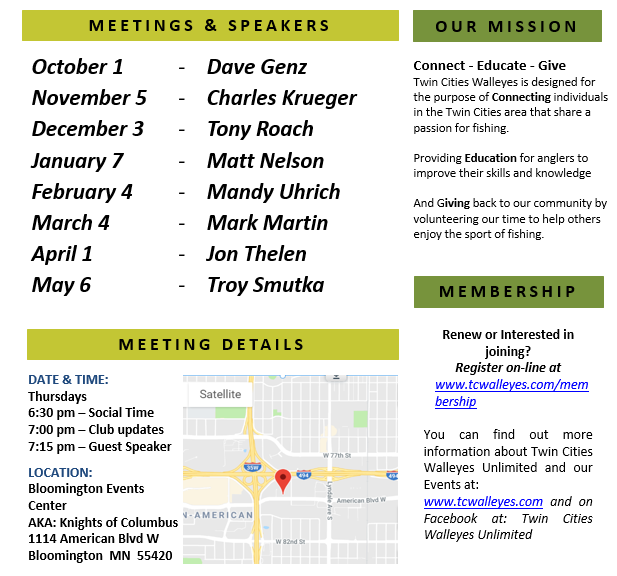
Welcome back TCWU Club Friends!
We hope to get back to the way things were before COVID, starting on January 7th with Matt Nelson. We scheduled an awesome line up of guest speakers for 2020/2021 and are excited to host them all. We are lucky to have a large facility to host our events and will be sure to have everything needed to host our club events safely. Check out this years speakers below!
|
|
TCWU featured on Minnesota Bound |
|
TCWU was featured with our FRASER fishing friends community on Minnesota Bound just a few weeks ago. We are excited to share the link with you all, as it was recently posted on the web. Special thanks to all of you who support the club at all these special events.
Giving back a little time to take our friends fishing makes for a day of memories. It gives us all that special uplift, which creates the passion to come back and do it again. Our feature is about 6 minutes into the show, enjoy!
|
|
|
Lake Mille Lacs winter anglers allowed 1 Walleye starting Dec. 1, 2020
Winter anglers on Mille Lacs Lake will enjoy a walleye harvest this winter for the fifth season in a row. Starting Tuesday, Dec. 1, anglers will be allowed to keep one walleye between 21-23 inches or one fish longer than 28 inches. This is the same regulation as the last two winter seasons.
“It’s good news that anglers will be able to harvest walleye again this winter,” said Sarah Strommen, commissioner of the Minnesota Department of Natural Resources. “Conservative management continues to sustain good fishing on Mille Lacs.”
Upper Red Lake Walleye regulations change for the winter season
Anglers fishing during the winter season on Upper Red Lake in northern Minnesota will have a three-walleye bag limit, with only one walleye longer than 17 inches allowed. The new regulations, which become effective Sunday, Nov. 1, lower the possession limit from the four-walleye limits in place during the 2020 open water season "Anglers should remember to bring a good measuring device along with them on their trip to Upper Red Lake,” said Andy Thompson, Bemidji area fisheries supervisor with the Minnesota Department of Natural Resources. “Many walleye will measure just above, and just under, the 17-inch size restriction.”
Take caution around open water, newly formed ice
With the continued surge in the number of people recreating outdoors this year, the Minnesota Department of Natural Resources reminds everyone that lakes and ponds across the state have started to freeze, and where there isn’t ice, the water is dangerously cold.
Review and refer to the ice safety guidelines provide in this article.
|
|
Thank You to all our Sponsors and Donors! |
|
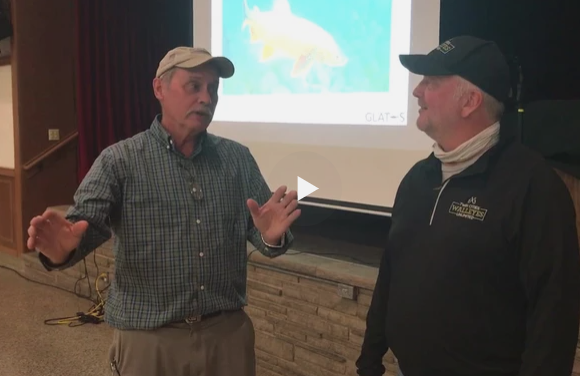
TCWU Club President Dale Meinders interviews November guest speaker Chuck Krueger who shares this “Pro Tip of the Month"
Click on the image below to link to Chuck and Dale's discussion.
|
|
Chuck Krueger - Guest Speaker Re-cap |
|
Great Lakes fisheries Leader, Chuck Krueger, joined the club and shared his many years of Fishery Science with us in November. He provided us all with a new perspective of walleye study that most anglers haven't experienced or been privy too. It was an eye opening presentation, that our club has the exclusive on, all re-capped right here, thank you Chuck!
Chuck started his presentation off by sharing a little history of the Great Lakes, specifically on their Demise and Restoration. He followed that up with an amazing eye opening presentation titled "Prying into the Secret Lives of Fish's", which featured fish tagging, tracking, fish movements and GLATOS.
Enjoy the re-cap and take note as Chuck shares the data that will put you on Great Lakes Walleye concentrations.
Who is Chuck Krueger?
- Chuck is an avid fisherman and outdoorsman, who grew up in Minnesota fishing the North Shore lakes, streams and the BWCA. Like most of us, his fondest memories and fishing mentor was his Grand Father.
- He attended the University of Minnesota and achieved (B.S. 1974; Ph.D. 1979) and Iowa State University (M.S. 1976).
- His first professional positions were with the Minnesota Department of Natural Resources, the Wisconsin Department of Natural Resources and the US Fish and Wildlife Service.
-
He was appointed by President Ronald Reagan as the U.S. Commissioner of the Great Lakes Fishery Commission and re-appointed by President Bush from 1988 to 1998.
- Chuck established the Great Lakes Acoustic Telemetry Observation system in 2010, which launched an array of cutting-edge research on fish movements, behavior, and habitat use
- Advanced the application of fish stocking through widely-cited management guidance publications and papers that evaluate genetic approaches to restoration
- He authored 180 fishery science publications and co-edited 3 books.
|
|
The Demise of the Great Lakes Fishery |
|
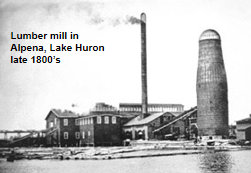
Huge deposits of sawdust from lumber mills destroyed spawning habitat, along with rock quarrying, new refineries and factories. Smelters, foundries and chemical companies became heavy polluters that impacted the waters as commerce grew. |
|
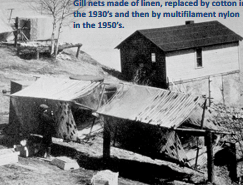
Gill netting crushed fish populations as the city populations increased.
As these cities grew, also did the sewage volumes that were pumped into the lakes. Compounding the pollution of the waters
|
|
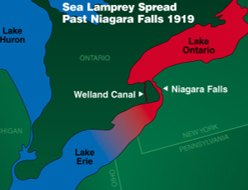
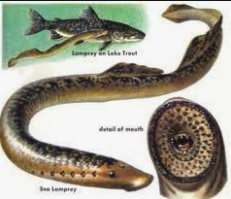
Sea Lamprey migration begins in 1919. Overpopulation and lack of effective controls nearly destroys all native fish populations |
|
What happened by 1960?
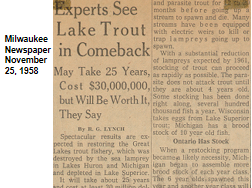
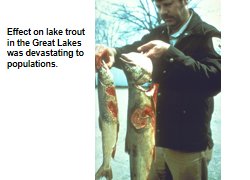
- Lake trout and whitefish populations mostly gone from lakes Ontario, Erie, Huron, and Michigan.
- Alewife and sea lamprey populations super abundant
- Near-shore lake trout populations gone in Lake Superior, only offshore deep water fish survived.
- Walleye population was beginning to crash
- The Great Lakes hold 1/5 of the worlds fresh water, which was all horribly polluted by 1960 due to the industry that had grown on its shores.
|
|
Restoration Begins- Great Lakes Fisheries |
|
- The Great Lakes Fisheries was established in 1955.
-
It was a partnership between Canada and the U.S. to coordinate fishery management and fishery rehabilitation program, focused on saving the lake trout population and controlling the spread of the sea lamprey.
- Management actions included; fishery regulation, stocking of lake trout, and environmental protection.
- Sea Lamprey (Lampricides) were developed and successfully applied beginning in 1958
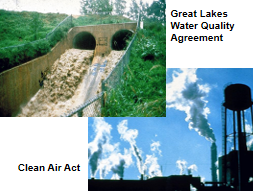
- The Great Lakes Water Quality Agreement was enacted in 1972
|
|
The Great Lakes Water Quality Agreement (GLWQA) was first signed in 1972 to coordinate the actions of Canada and the United States.
The purpose was to restore and maintain the chemical, physical, and biological integrity of the Waters of the Great Lakes.
|
|
After testing more than 6,000 compounds, scientists discovered the answer in TFM, which is a chemical that finally could control sea lampreys effectively and safely.
TFM along with river barriers combined to reduce sea lamprey populations by 90%. Without sea lamprey control, the Great Lakes fishery would not exist as we know it.
|
|
Fifty years is a long time from 1960 but the results are miraculous if you think back on how bad things were. Between 2010 - 2020 the following restorations were achieved.
- Sea lamprey successfully managed and suppressed.
- Pacific salmon fisheries established
- Lake trout restored in Lake Superior
- Natural reproduction of lake trout in lakes Michigan, Huron, and Ontario.
- Walleye recovery in Saginaw Bay, Lake Huron and Lake Erie.
- Great Lakes Acoustic Telemetry System established.
- GLWQA helped achieve a 90% reduction of Phosphorus, DDT, PCB's, DDE's and untreated sewage. Mercury content in Walleyes dropped 80%
These achievements represent one of the single most remarkable ecological recovery stories in North America because of where we started with the gross water pollution of the 1960s.
|
|
Prying into the Secret Lives of Fishes
In 2010 Chuck and his team began and lead an amazing technology aimed at creating a mobile and state of the art fish tracking system, which could target specific fishes on the Great Lakes. Named GLATOS, short for (Great Lakes Acoustic Telemetry Observation System). The system is fairly simple, which includes tagging fish, inserting transmitters, setting out data receivers and gathering data. The execution on the other hand requires a lot of hard work in the outdoors.
What is a fish tagging?
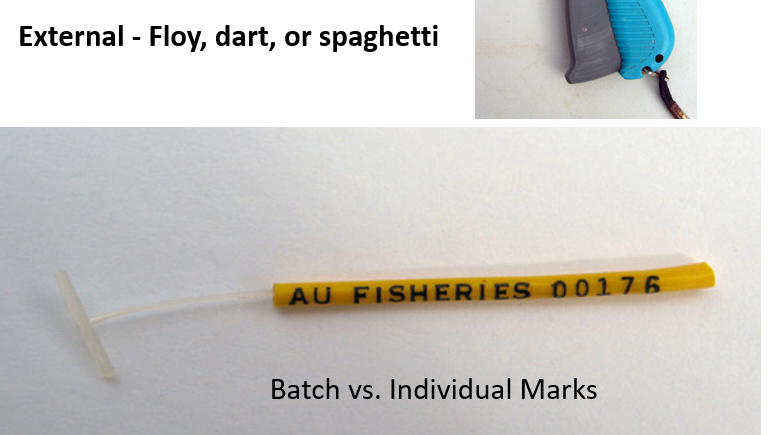
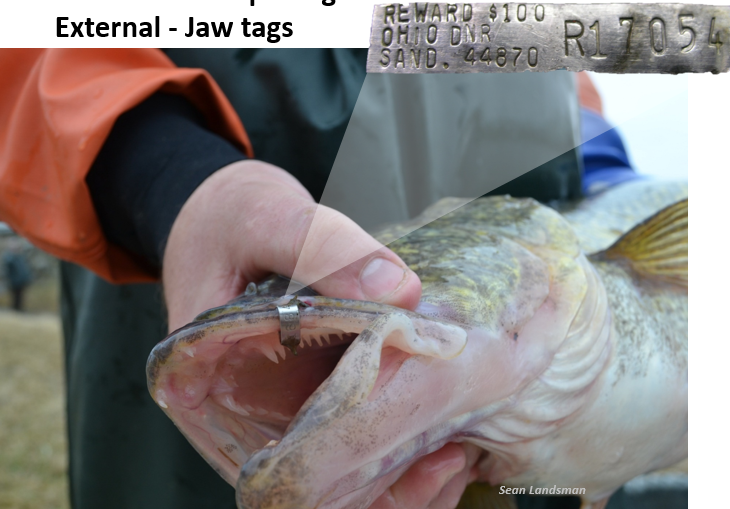
It is an attachment or placing on or within the body of a fish that is used to identify fish groups or individual fishes and provide information back to the fisheries specialists. There are three types:
- Clipping a fin
- External tags – jaw and spaghetti
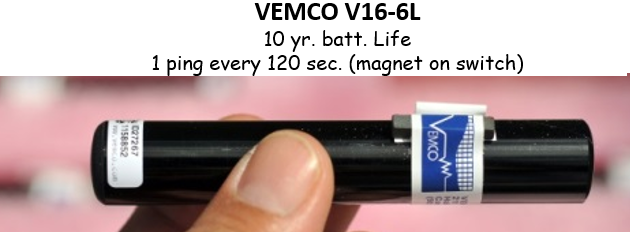
- Internal tags – radio and acoustic
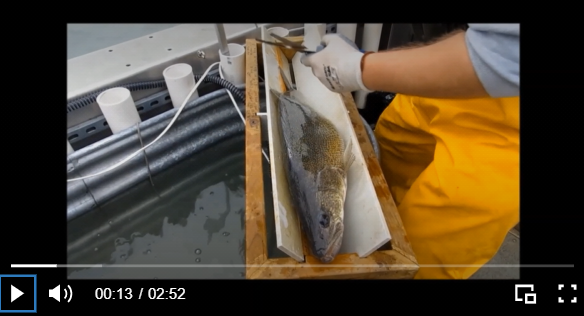
Click on the video below to view a Walleye tagging with an internal transmitter from start to finish. (Some phones may not load videos effectively, use your computer to view if you have a loading issue)
|
|
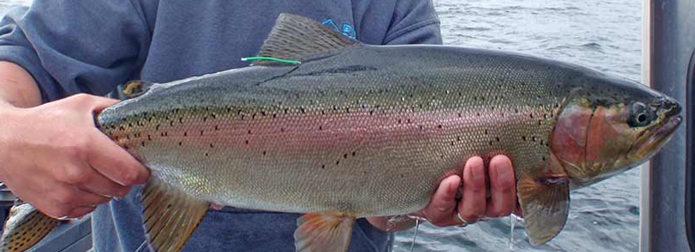
Images of the different tags |
|
|
|
Internal Radio Transmitting Tag |
|
Why we tag – To gather important information for making fishery management decisions about regulations, habitat protection, and fish stocking.
We monitor:
- Fish movement – from release point to recapture
- Fish behavior- identify and locate fish habitat
- Survival rates and fish abundance
|
|
Tracking fish with GLATOS
Great Lakes Acoustic Telemetry Observation System
|
|
Acoustic Telemetry includes:
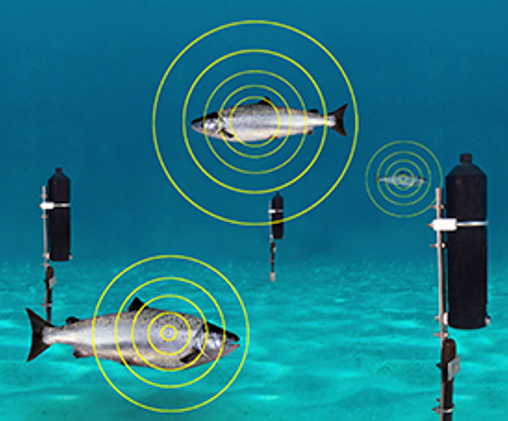
- Surgically implanted tags that transmit a signal that are read by receiver detectors anchored on the lake bottom.
- Tags are made specifically for different fish species and the weight burden must be less than 2% of body weight
- Tags are programmable by frequency of transmission time and are usually in 2 to 5 minute intervals. Longer intervals = longer tag battery life.
- Tag range 500 yards to 1.3 miles
- Average tag time = 4 minutes and is done on the water on a boat as seen on the video above. The Walleyes have a low mortality rate 1% or less
- Transmitters are placed in the belly along with a tag and last up to 10 years
Intensive studies may require up to 4 times the amount of receivers in a given area
- Lake Erie receivers are staged 6 miles apart and are anchored with concrete, and connected to buoy’s to elevate the receiver
- Two types of Receivers record specific date and time stamps
- Gather and store data for upload upon retrieval
- Link to cellphone network and transmit real-time data
GLATOS Stats
- 98 projects
- 47 species tagged
- 13,660 receivers deployed
- 13,526 tagged fish released
- 426,477,245 fish tag detections in data base
- 75 Scientific Publications – peer reviewed
Significant Great Lakes Studies:
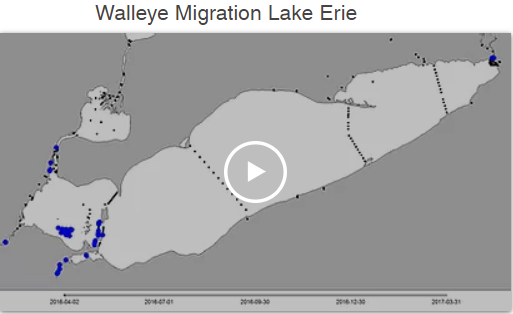
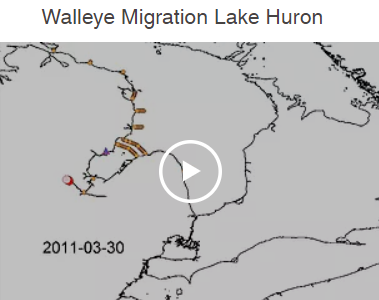
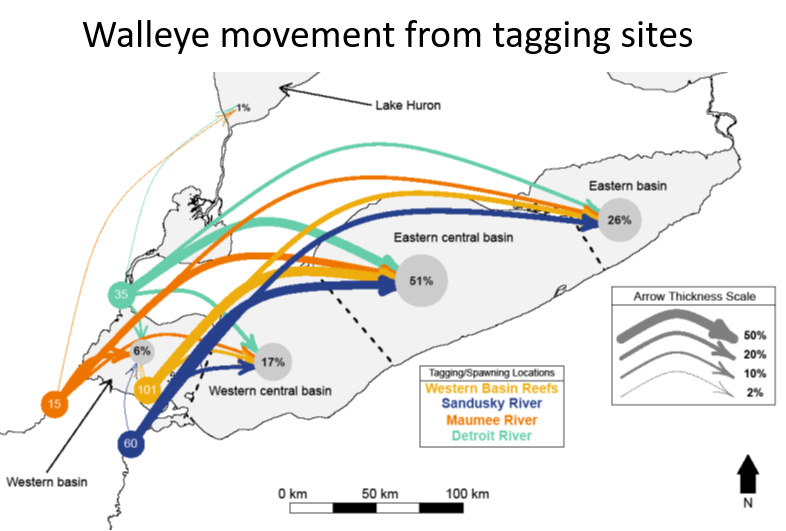
The two videos below track Walleye migrations on Huron and Erie over a one year time period. Click on images below to link to the TCwalleyes.com website/Educate Page and view in entirety. Pretty darn cool!
|
|
GLATOS is important for continued Great Lakes Mgmt
The Great Lakes are an ever changing environment and are in need of constant monitoring.
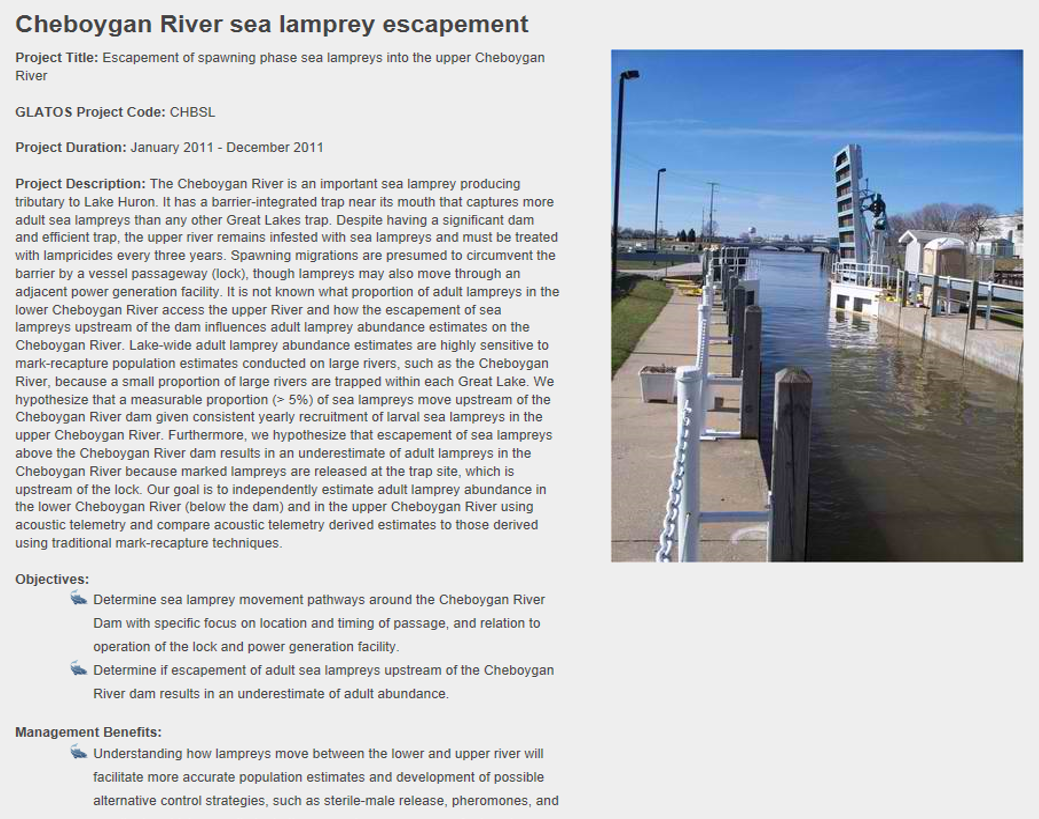
Many of the rivers and tributaries of the Great Lakes were not suitable for spawning Sea Lamprey's before the Great Lakes restoration efforts began. Restoration actually made these areas suitable and the fisheries managers noticed an increase to the Sea Lamprey population. GLATOS was the key to discovering these new spawning areas and gave them the knowledge to hone in on the optimum target areas to quickly and effectively control the issue.
Below is an article of study that calls out escapement of Lamprey and how quickly they can react due to experience and having the right tools (GLATOS) to manage the job.
|
|
GLATOS Summary
- Tags used to identify groups and individuals
- Tags = clipped fins to electronic transmitting tags
- Acoustic tags transmit every 2 min with a unique code for each fish
- Acoustic receivers listen for tags 24 hours a day, 7 days a week
- Studies in the Great Lakes are being conducted on every lake for a wide variety of species – walleye, lake trout, lake sturgeon, lake whitefish, round gobies, cisco, and even lampreys
- The environment is ever changing. GLATOS is the most important tool to manage the fishery
Thank you Chuck for gracing us with your presence. We were honored to have a true fisheries leader join our club and share experiences we never realized. The history summary and achievements of your department are often overlooked. It was interesting to hear about the cool technology and amazing accomplishments you all have achieved. Thanks for restoring the Great Lakes!
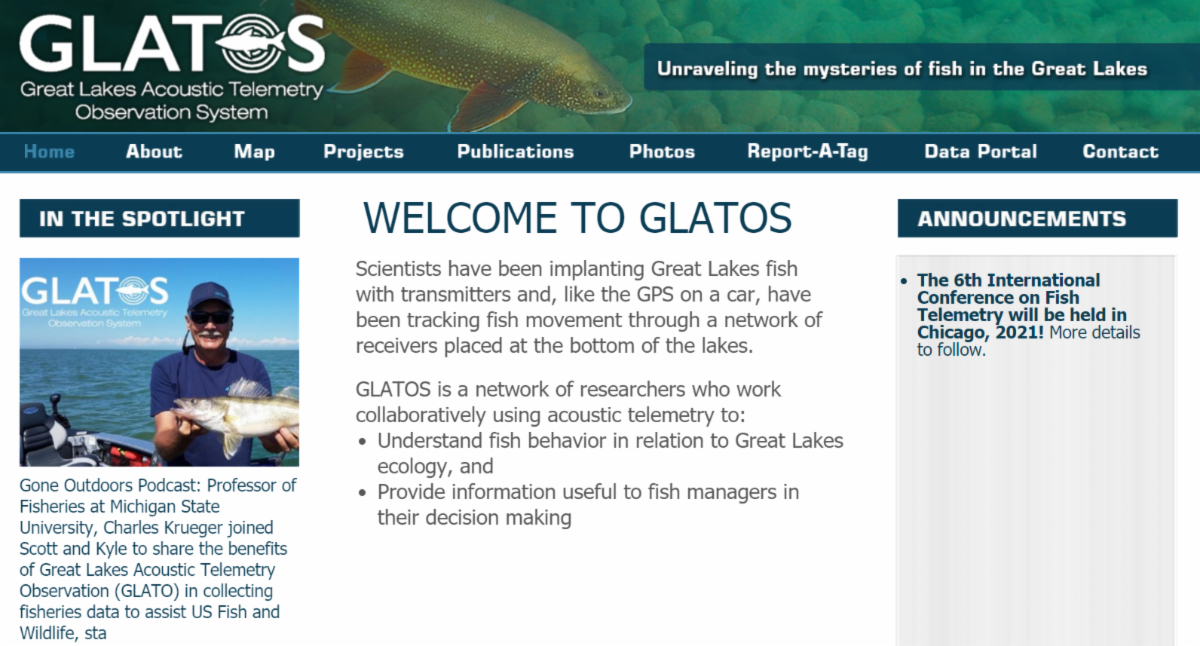
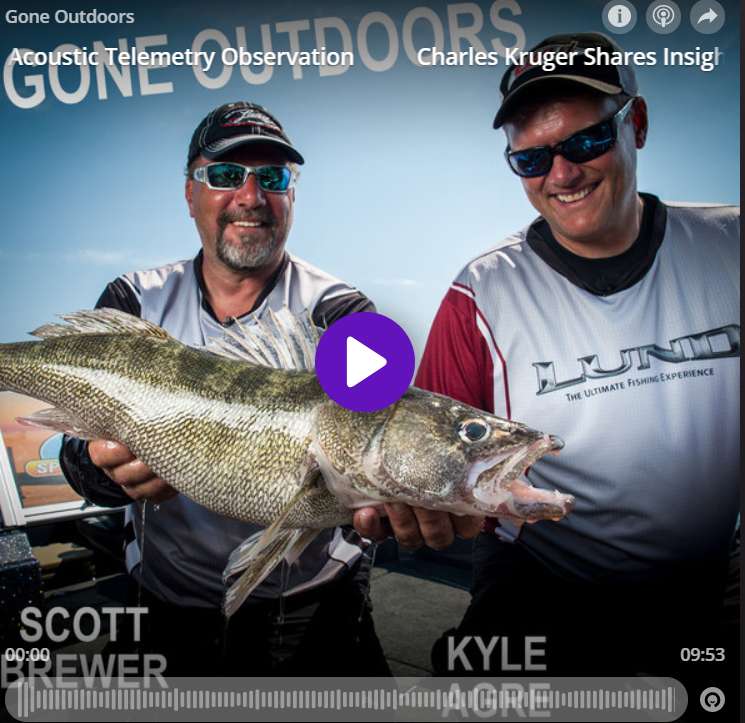
Hey Club members, check out the GLATOS website to see what else they have done. It is well written, up to date and features Chuck's "In the Spotlight" podcast with club friends Kyle Agre and Scott Brewer who are long time contributors to our Fargo Moorhead Walleye Club Chapter.
Click on the pictures below to listen to the podcast and view GLATOS on the Web.
|
|
This Podcast is amazing, Kyle and Scotty host an awesome program. To hear other informational podcasts make sure to check them out at
|
|
Thank You to all our Sponsors and Donors! |
|
TC Walleyes Unlimited, Inc. |
|
|
|
|
|
|
|