Think you know all about legendary jump rider A.P. Smithwick and his clan through son Patrick’s memoir trilogy?
Think again.
|
|
5 exclusive reveals about the life-and-times of Hall of Fame champ ‘Paddy’ Smithwick
|
|
His story reads like Homeric epic, a real page-turner with linear plot stretching from Ireland’s emerald racecourses to Maryland’s Hunt Valley. Alfred Patrick “Paddy” Smithwick levitated to dominate the jockey table – five years, and counting, in the 1950s and ’60s. The summer of 1966, a single miscalculated stride, and resultant crash, gave the tale a tragic turn.
The fall brought down the closest thing American steeplechasing has seen to a populist hero, but Paddy Smithwick wasn’t done.
Not by a longshot.
With Herculean strength and the character and finesse he’d refined over 20 seasons on the circuit, the champ rose like a Phoenix. He shrugged off eight frightening weeks of complete paralysis when doctors weren’t even sure he’d survive. Paddy joined younger brother Mike on the steeplechase trainers’ roster – and, against doctors’ strictest orders, would still sneak in an occasional hurdle school.
Paddy died of cancer in 1973 at age 47, struck down, for good this time, in the prime of his career, but thanks to his author son Patrick, the legend lives on.
Patrick Smithwick took time to talk recently as he prepared for his third memoir release. He’s getting ready for a big book-launch event held in conjunction with the 22nd running of the A.P. Smithwick Memorial hurdle stake July 25 at Saratoga Racecourse in New York.
Patrick candidly discussed the surprising things he continues to discover about his pop – and about himself. The book is a searching analysis of the highest highs and lowest lows that punctuate the world of horse racing, and the love and loss he’s grown to recognize as the universal human condition.
|
|
Strange is a life that can be distilled down to a scrap of stretched cowhide.
Smooth from wear, A.P. “Paddy” Smithwick’s favorite race saddle is a talisman to son Patrick, an artifact that today, 46 years after Paddy’s death, is still a guiding force in the ongoing Smithwick story.
The saddle hangs in writer Patrick’s Monkton, Maryland office, converted horse stalls at his family’s historic Prospect Farm. Patrick draws inspiration just looking at the worn leather, by now as familiar as the back of his own hands. Sometimes he touches the low cantle Paddy had custom-cut to allow for his trademark “long hold, deep seat” style. His efficient equitation proved so effective, that Paddy Smithwick to this day remains the sport’s second all-time leading rider.
The five-time National Steeplechase Association champ’s tale has already been told in exacting detail through Patrick’s pair of award-winning memoirs: “Racing My Father: Growing Up With a Riding Legend”, published in 2006, and “Flying Change: A Year of Racing and Family and Steeplechasing”, published in 2012.
|
|
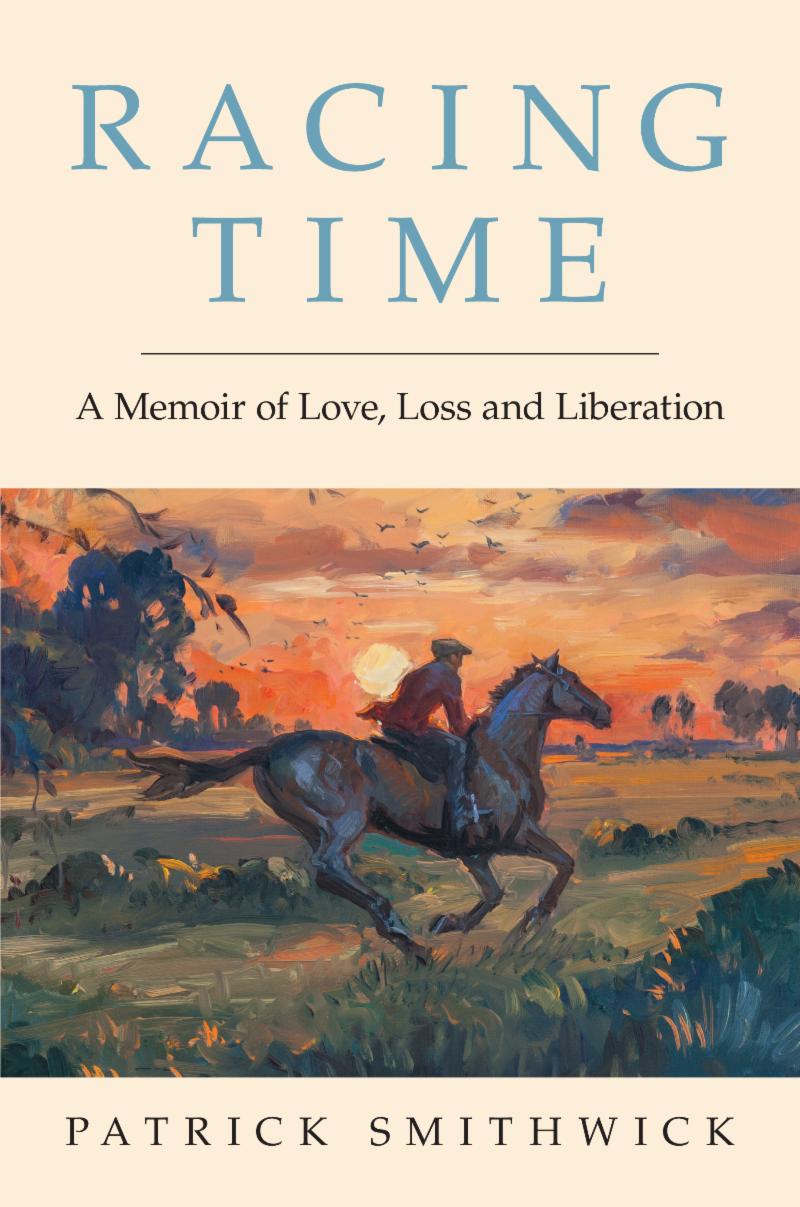
Substantive events over the past seven years led to a third book: “Racing Time: A Memoir of Love, Loss and Liberation”. It’s a doozy – 481 pages thick with poignant tales of the relationships that continue to drive the story’s action, punctuated by lush illustrations by local painter Sam Robinson.
The new book breathes life into the legend of his Hall of Fame father, Patrick says, at once proving cathartic, helping synthesize the losses that continue to punctuate his life.
|
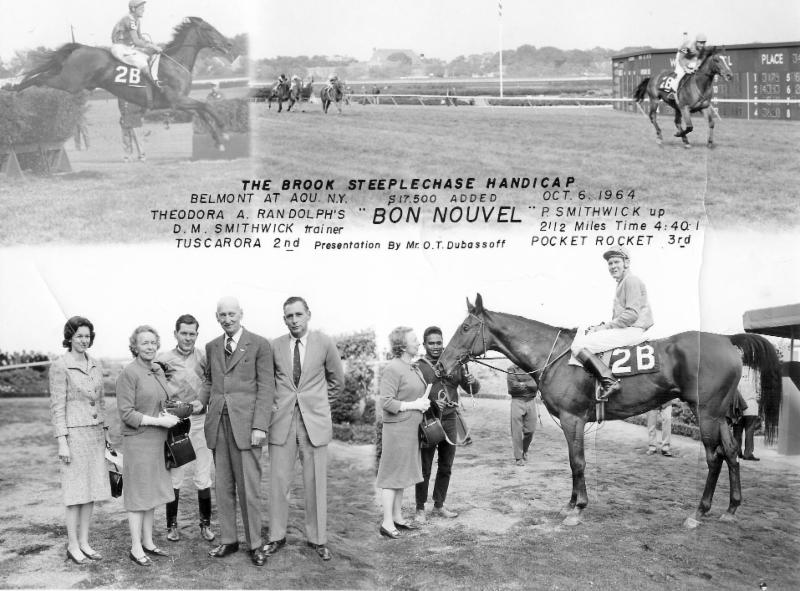
The Mike and Paddy Smithwick trainer / rider duo. Bon Nouvel won the first of three champion steeplechaser titles in 1964. Photo courtesy of Patrick Smithwick.
|
A.P. Smithwick – the legend:
A.P. Smithwick’s father Alfred fought for the English cavalry in World War I. After Sinn Fein tried to assassinate the Irish-born horseman in the 1920s, the young bachelor hurriedly – and understandably – made a run for the U.S. He landed at Maryland’s Elkridge-Harford Hunt Club where he became huntsman and made a lucrative business importing Irish horses to sell as foxhunters to an eager clientele.
Paddy, born in 1927, and younger brother Mike worked with their father from age 10. Paddy was drafted into the U.S. Army at 18, sent to Germany at the conclusion of World War II in 1945. While he was stationed there, Alfred Smithwick died, and, as eldest son, Paddy was allowed to leave the army.
A short visit to Ireland on the way home turned into a couple months. Paddy rode a few races as an amateur, and, as son Patrick puts it, got bit – hard – by the steeplechase bug.
When Paddy returned to Maryland, he went to work for Patrick’s godfather, Morris Dixon in Unionville, Pennsylvania.
He started winning immediately, a lot, and the rides piled up.
Mike Smithwick rode as an amateur, winning six Maryland Hunt Cups 1948 to 1960, but his chief focus was training. The brothers made a formidable duo: with Paddy riding first-call, Mike claimed the trainer title 1956-1960, 1962 and 1966-1969.
“Pop was tall and built more like a lightweight boxer than a jockey,” 5’11”, Patrick recalls. “All he ate was steak and salad at night and he had to sweat every time he rode.”
His father would wear thermal underwear and blast the heater in the car on the way to races in order to sweat the last pounds off. Paddy was always driven to succeed, says his son, something he pursued with unrelenting dedication.
Paddy won his first National Steeplechase jockey title in 1950, following up 1956-’58 and 1962.
Despite the competitive personality, Paddy had a notably soft demeanor. In the 1958 edition of American Steeplechasing, it was pointed out his “good sense and spirit of fair play” kept him out of trouble.
“If a popularity poll were taken among steeplechase riders, the name Alfred Patrick Smithwick would lead the list,” according to the article. “Quiet, unassuming, but a man with very articulate ideas about horses and riding, he is the personification of a gentleman, a race rider and a great credit to the sport.”
With 398 winners, Paddy Smithwick remains second to Joe Aitcheson in all-time rider standings.
|
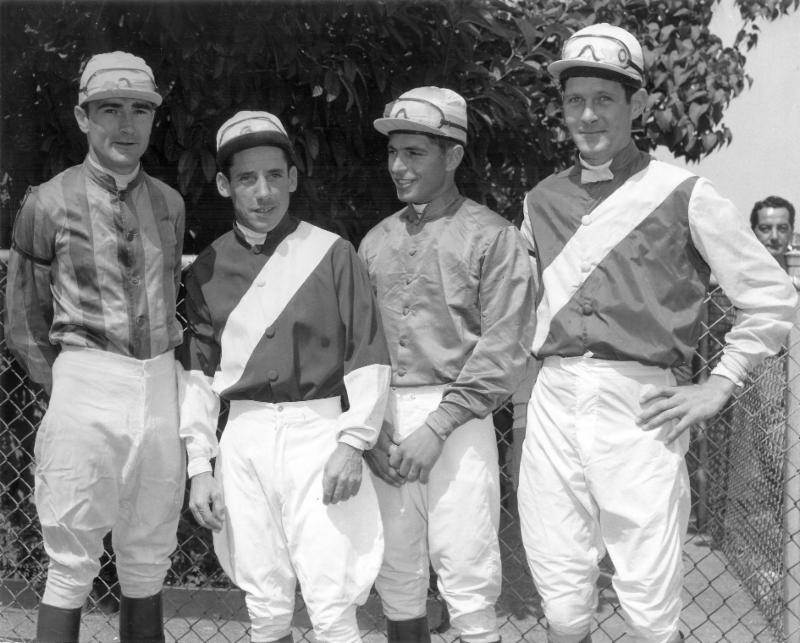
Jockeys Dooley Adams, Albert Foot, Scotty Schulhoffer and Paddy Smithwick. Photo courtesy of Patrick Smithwick.
|
A door closes, a window opens:
Paddy Smithwick was forced to retire from racing abruptly, at the height of his career in 1966. He broke his neck in a rotational fall over a hurdle at Monmouth that July. He was 39. Tommy Walsh, who recalls that “Paddy was like a brother to me,” won that year’s title.
Doctors thought the champion may not even survive.
“At first I was told he might not live,” son Patrick recalls the pang of fear. He was 15. “Then I was told he could be paralyzed for life.”
Paddy spent seven long weeks fully immobilized, but he began to regain feeling and control of his body, and started walking again in September.
His father had no time to be mad or sad, recalls Patrick. “Our whole family was in shock,” Patrick remembers the tense, confusing time. “He threw all the physical therapy equipment away; he went back to working hard in the barn, stacking bales, walking horses, mucking out.”
Paddy took out his trainers’ license, and “soon we had more horses than we knew what to do with,” Patrick says. They had eight at Tom Voss's mother’s, seven at Prospect, 15 at Pimlico.
|
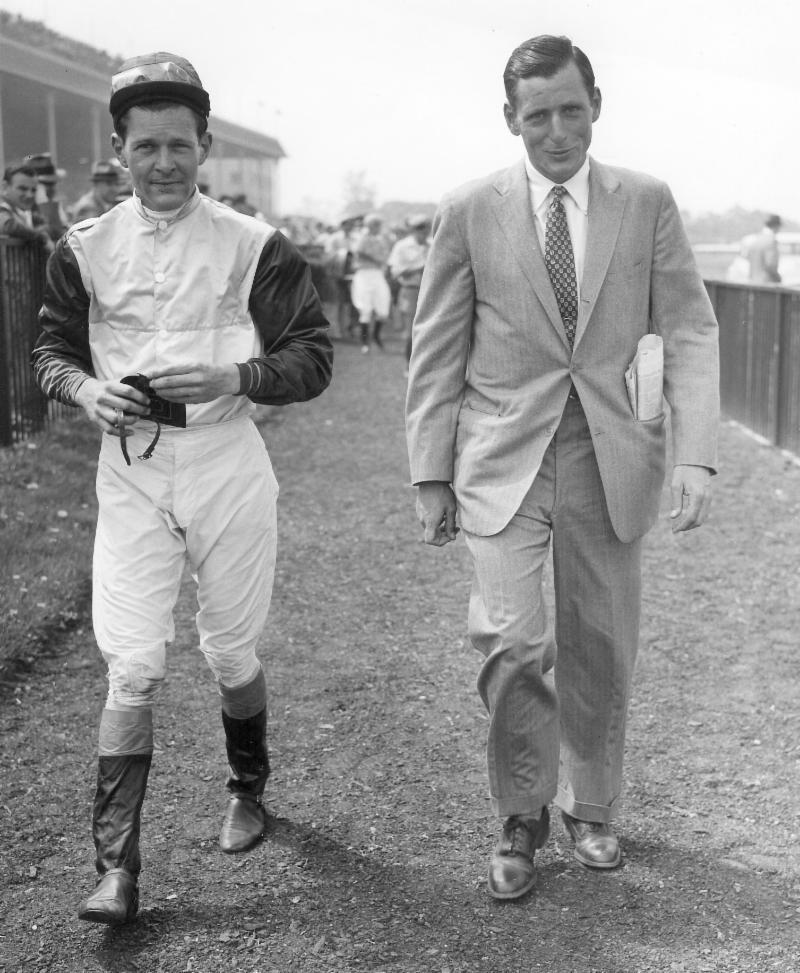
Paddy Smithwick and brother Mikey Smithwick after winning a stakes race at Belmont Park.
Photo courtesy of Patrick Smithwick
|
Ignoring doctors’ orders (why are we surprised?):
After his injury, Paddy Smithwick was told never to get on a horse again.
So of course he did.
Early in his recovery phase late that fall, Paddy was visiting Bobby Burke in Camden, South Carolina.
Bobby suggested they take a hack. Paddy wanted to school a few hurdles on the Carolina Cup course. “He told Bobby ‘I’ve got to see if I can still do it’,” Patrick recounts. “He told Bobby, ‘give me a lead’.”
The pair cantered down over a few hurdles, Paddy Smithwick letting his reins slip and allowing his seat to move with the horse. He recognized his race riding career was over, but it still thrilled him that he still “had the touch,” Patrick says.
|
|
‘Racing Time’ carries the reader
Latest Smithwick memoir isn’t just about horses – it’s about love and life, and everything in between
|
With the fearless eye of a steeplechase jockey, author and lifelong horseman Patrick Smithwick has done it again – produced a memoir linking past, present and future.
“Racing Time,” which joins Smithwick’s “Racing My Father” and “Flying Change,” is a vivid, personal look inside the storied world of steeplechasing, Smithwick’s championship upbringing with his legendary father and namesake, the late A.P. “Paddy” Smithwick, as well as a unique insider's view of Maryland’s hunt country and the English and medieval history pupils he inspires at a Maryland prep school.
“ ‘Racing Time’ is about male bonding–between friend and friend, between family members, between classes, between father and son, mentor and pupil,” scholar Dr. Andrew Lemon writes in a review. “It goes beyond naming these bonds: it enters into the heart of them. Smithwick also explores the love of man and wife, man and mother, man and daughter. He is full of love.”
As in many memoirs, the “I” of Smithwick’s ego veers towards elephantine at times, though indeed the narrative would lose its way without the author’s constant presence. He gives voice to the characters of his story. The honesty, refreshing but at times bracing, reflects a bruised and battered soul, yet hopeful and refreshingly human.
He stitches in a scholarly dose of history and literature, along with a deep understanding of pop culture and sports, to guide the quest.
He knows his writing: Smithwick’s erudite comprehension of storytelling makes what may have been shrugged off as a “horse book” into a galloping tale of love and life, one in which no sentence fails to advance the plot.
Hall of Fame trainer Tom Voss, to whom the book is dedicated, was Smithwick’s cousin, neighbor and friend.
“If you’ve read all his books, you will know Patrick ... holds nothing back,” says fellow writer Cynthia McGinnes, who met Smithwick some 45 years ago when she was a Sports Illustrated turf writer and football reporter. “His latest showcases his relationships with Tommy Voss, Dickie Small and his father’s groom, (baring) his soul and his grief.
“ ‘Racing Time’ combines realism with emotions, truth with fantasy, but most especially is concentrated on love – love of family, of friends, of horses and how you can survive the grief when you lose something you love.
“Is it better to have loved and lost, or never to have loved at all? You will have your own answer to this age-old question by the time you finish the book.”
The father-son relationships lend a familial gridwork to the story, and not just the well-worn tale of Paddy Smithwick, father, and Patrick Smithwick, son. Patrick Smithwick’s adult son Andrew – a decorated two-tour Marine veteran of the Iraq War -- has been missing for three years now, suffering from post-traumatic stress disorder. A study of that father-son relationship, along with brief interludes of “Andrew sightings,” which have tailed off altogether this year, provide a full-stop checkpoint between chapters and sections. The nuggets give balance and breathing room, in a design sense, in the 450-page book.
“Racing Time” also follows the male-male relationship between Smithwick and Speedy Kiniel, one-time stablehand, boxer and musician who Smithwick cares for at the end of his life.
On its broadest level, this is a story of the author's resolving the torments of growing up the only son of a champion in a sort of post-modern American sports capsule. The attention to detail and descriptive narrative puts the reader in the moment. You can actually feel the muscle strain as Smithwick sets fenceposts on the family farm. You feel the pang when he’s chided by other jockeys referring to him as the “old man” when he makes a splashy comeback at age 50. You worry along with Smithwick when Speedy Kiniel gruffly declines support and assistance when his once-strong body begins to fail him at last.
Smithwick's intensity sparkles through a series of letters written “as if” to Voss after his death, insightful reminisces that make up nearly a quarter of the book, scattered among chapters like Raging, Roaring River and We Never Went To Wyoming.
|
|
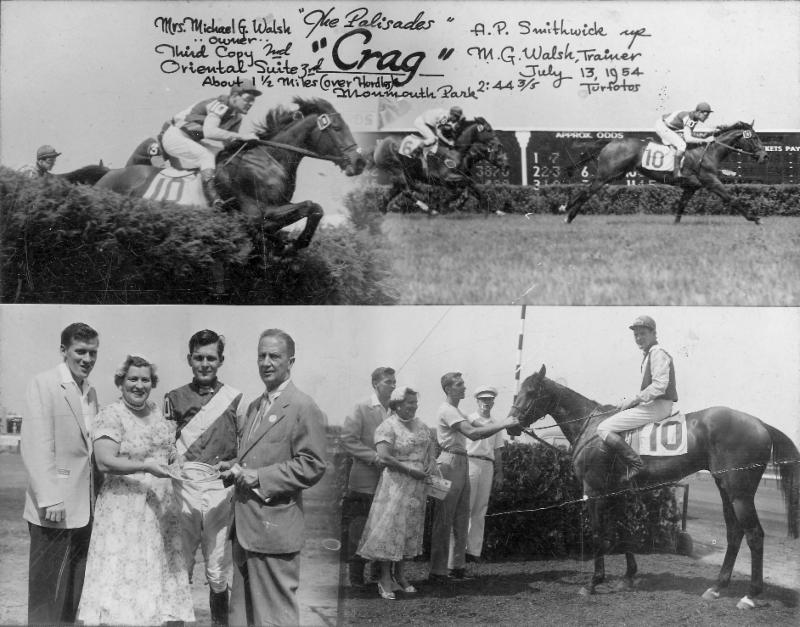
Though the left side of his body was never as strong as it was before the accident, he regularly rode his stable pony – multiple stakes-winner Crag
(pictured left, photo courtesy of Patrick Smithwick), and, sometimes, couldn’t help himself from taking the reins like he used to do.
“In ‘Racing My Father’ there is chapter called A Leg Up where a rider (screws) up schooling a rogue,” Patrick says. “It was a really wild one. Pop pulled him off the horse.
“At this time, he was (weak) from the cancer.
“I gave Pop a leg up, and he schooled that horse over four hurdles. He went better than anything in the barn. It took everyone’s breath away.”
The horse was Totem Home II; Patrick won a race on him for his father that summer at Saratoga.
“Pop could outride anyone, even partly paralyzed and decimated by cancer.”
Paddy died in November of 1973. He was inducted into the National Thoroughbred Racing Hall of Fame in August of that same year. Mikey Smithwick was inducted into the Hall of Fame in 1971. He died in 2006.
Mike left his own legacy: son Speedy was a leading amateur rider in the 1970s and ‘80s, and is now a trainer. Son Roger rode as an amateur and trained some, and daughter-in-law Eva Dahlgren Smithwick is an active trainer on the NSA and mid-Atlantic circuits.
|
|
Off the layoff:
In addition to Paddy’s race saddle, Patrick inherited his father’s racing boots. His favorites are what he recalls Paddy calling his “cheatin’ boots,” paper-thin leather without a sole, just a U-shaped cutout for the heel. They were used to “make weight” – a rider saved a pound or two using them, and they fit like a second-skin, Patrick explains.
Patrick rode as a teen in 1967 and ’68, then turned his attention to his education, career and family. In 1999, he returned to racing off a 30-year layoff, riding a couple dozen races 1999-2009. He won the Grand National timber stake in 2001 with Welter Weight, second with him in that year’s Hunt Cup.
|
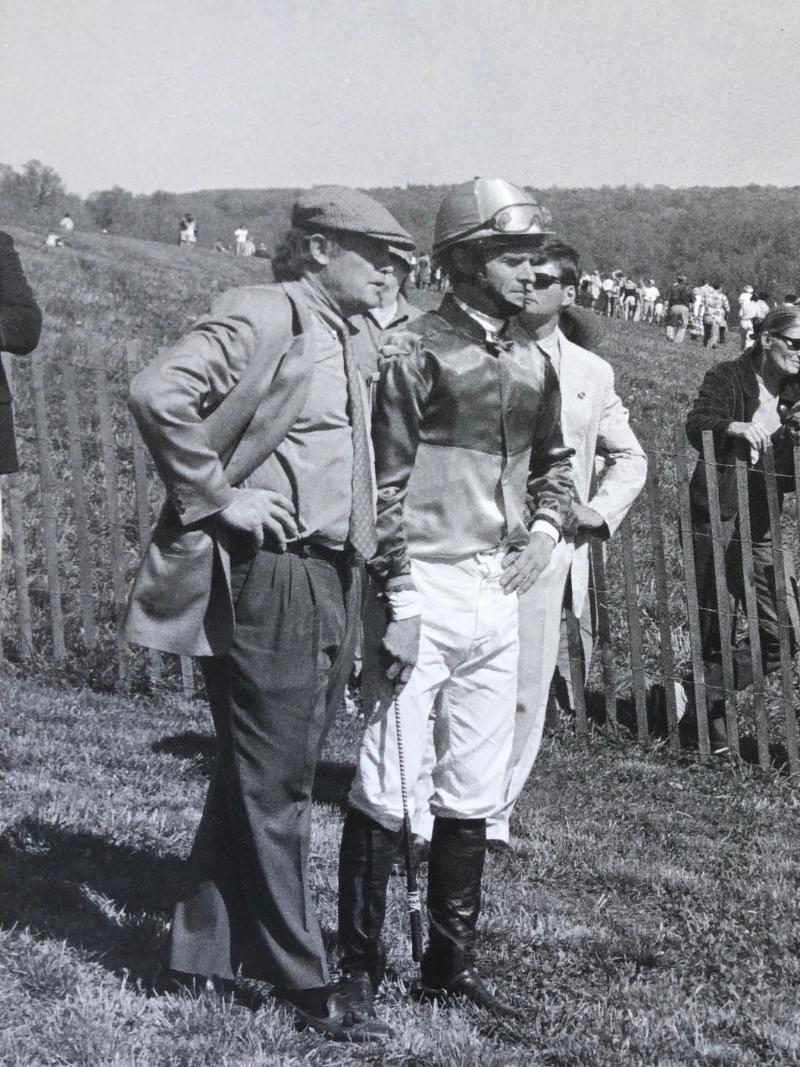
Tom Voss and Patrick Smithwick in the paddock of The Maryland Hunt Cup, before Tom gives Patrick a leg up on Welter Weight. Photo courtesy of Patrick Smithwick.
|
Memoir methodology:
“Racing Time” is wrapped around a series of eulogies Patrick Smithwick wrote for Dickie Small and Tom Voss, and from a series of letters he “wrote” to Voss after his 2014 death. Helping nurse longtime groom and family friend Speedy Kiniel in his final years around the same time served to underline this continuing pattern of love and loss, Patrick maintains, further highlighted by the death that same year of two favorite horses.
“I needed to do it,” Patrick says of the series of “Dear Tom” letters that make up a quarter of the book. “It’s hard when you don’t have time to say goodbye. I needed to tell Tom all those things I never said.”
Tom Voss liked nothing better than winning the A.P. Smithwick, Patrick says, a stake he won four times. Paddy was “a second father to Tom,” adds Patrick. “Tom's father died very young. Tom's philosophy and approach to training and treating horses is based on what he learned from my father.
“These were very special relationships.”
|
Historic Prospect Farm:
For inspiration, Patrick needs look no further than the walls of the handsome writing room he created out of horse stalls in the original stone and timber bank barn at Prospect Farm. The walls are lined with books and archival family photos, with a rowing machine, stationary bike and free weights positioned on the floor. Three windows look out on the stable yard.
Paddy paid $15,000 for 10 acres in 1954. There was – and is – a brown-shingled house dating to the 1800s and a big red barn. There’s a smokehouse, a corn crib and an old milking parlor propped on hand-hewn chestnut beams.
The farm is very much a character in all three memoirs. Two miles cross-country to Voss’s Atlanta Hall and a half-mile from Sidney Watters place, now Joe Davies’ Dunmore Farm, Prospect is just a good gallop from Dickie Small’s Strathmore Stud. It was Paddy’s playground when he was alive, and Patrick takes the responsibility of his legacy very seriously.
Finding his father’s old journals when he moved to the farm helped flesh out timelines and dialogue. A work of literary non-fiction, “Racing Time” employs the techniques of a novelist to make the action come alive for the reader. Characters and scenes are as accurate as Patrick can get them, he says, but, clearly, he’s added some dialogue.
“Racing Time” is about the intensity, beauty and timeless spirituality of friendships and overcoming their loss. “How can you race against time? Who is going to win?,” Patrick asks the rhetorical question. “Like Sisyphus, we must stay in the race.
“Time is like a river, constantly changing, never-endingly moving and transforming. We are caught in its current. As we flow down the river of time, we experience the loss of those closest to us. We age, we keep paddling. We have to … in order to have control.”
|
|
The Smithwick files
A.P. ‘Paddy’ Smithwick
- Rode on the National Steeplechase Association circuit 1947 to 1966
- Winner of 398 races and more than $2 million in earnings, and all-time leading NSA rider until Joe Aitcheson passed him in 1976
- Regular rider of Hall of Fame ‘chasers Neji and Bon Nouvel
- Mrs. Ogden Phipps’ Neji was his all-time favorite ‘chaser; King Commander was his favorite hurdler; June McKnight’s Hill Tie was his favorite timber horse
- Won four runnings of the Temple Gwathmey hurdle stakes, the most prestigious handicap on the steeplechase calendar in the 1950s and ‘60s
- Inducted into the National Racing Hall of Fame in August, 1973
- Died after an extended illness in November, 1973
Patrick Smithwick
- Born 1951
- In 1968 at age 17, won the Murray at the Grand National meet aboard Moonlore for Janon Fisher, and at Fairfax aboard Count Walt for father A.P. Smithwick
- Won races the following year at Saratoga as an amateur-apprentice with Tote’m Home and Wild Amber, both for his father
- After three decades off, returned to racing at age 50 winning the Grand National timber stake with Welter Weight, trained by Tom Voss
- Favorite horse of all times was Crag, a horse his father won with over hurdles and timber. Patrick Smithwick hunted Crag and won an unrecognized “steeplechase” over hay bales (the Rochelle Tin Cup). Smithwick was a 12-year-old sixth grader when he and Crag won the competitive Elkridge-Harford hunter trials.
- Bachelor of Arts from Johns Hopkins University in 1973; Master of Arts in creative writing from Hollins College in 1975; Master of Liberal Arts from Johns Hopkins in 1988; Education for Ministry degree from the University of the South in 2000
- Also author of “The Art of Healing: Union Memorial Hospital” and “Gilman Voices, 1897-1997”
- Lives on his family farm in Monkton, near My Lady's Manor north of Baltimore, Maryland, with his wife Ansley. They have three children: Paddy, Andrew and Eliza.
|
|
Get to know writer-rider Patrick Smithwick
|
|
Age: 68
Home: Prospect Farm in Monkton, near My Lady's Manor north of Baltimore, Maryland.
Family: Wife Ansley. Sons Paddy and Andrew, daughter, Eliza. Son Paddy is a pediatric dentist and an artist in Denver. Eliza works in design and marketing, also in Denver.
Education: A graduate of Johns Hopkins, Hollins and the Univeristy of the South, Patrick Smithwick worked as a newspaper reporter before starting his teaching career. He’s taught English, philosophy, photography, history and journalism at high school and college levels.
Like most literary non-fiction, the stories come from exhaustive personal journals Patrick has kept his whole life. Paddy kept a journal, too, he notes, and it’s from that the writer has been able to piece together extensive dialogue to enliven the prose.
He says he does his best writing in the early morning hours – a racetracker’s throwback, Patrick calls it – working at 4:30 a.m. for a couple hours before work. In the old days, he’d write longhand on a yellow legal pad. Today he uses a laptop.
Teaching career: Before he retired two years ago to concentrate on “Racing Time,” Patrick taught a medieval history class for sixth graders at Harford Day School in Bel Air. He threw himself into bringing to life the “almost unbelievable stories from history” with hands-on, interactive learning and field trips.
Books: Memoir trilogy – “Racing My Father”, “Flying Change”, “Racing Time”, and “Gilman Voices: 1897-1997”, “The Art of Healing: Union Memorial Hospital 150 Years of Caring for Patients”.
Awards: In 2012, Smithwick won the prestigious Tony Ryan Book Award for “Flying Change”. “Racing My Father” was a Ryan award finalist in 2006.
On tap: Middle son Andrew served as a U.S. Marine in Iraq. He returned with post-traumatic stress disorder.
Now 35, Andrew is living “somewhere out west,” says Patrick, a survivalist and, basically a homeless nomad. The father has engineered contact a few times, but Andrew refuses his family’s help.
“Andrew Smithwick – War’s Over, Come Home” is in the works, Patrick says. “My dream is that he’d see the book in a bookstore display one day and come back to us.”
The story has broader reach, Patrick says. “If it can’t reach Andrew, I want to help someone else’s family work through PTSD and its fallout. It’s a huge problem.”
|
|
Meet the author
The date and the setting are significant. A few hours before the 5:30 p.m. book signing and reading by the author, the grade 1 $150,000 A. P. Smithwick Memorial opens the day’s race card.
The race is named for Patrick Smithwick’s father, A.P. “Paddy” Smithwick, focus of the author’s first book, “Racing My Father,” in 2006. Smithwick’s second book, “Flying Change,” won the prestigious Tony Ryan Book Award in 2012.
“Racing Time” is dedicated to the memory of Voss, Patrick Smithwick’s best friend, who died in January, 2014. Voss was inducted into racing’s Hall of Fame in 2017.
Reservations are not required.
“Tom Voss was a dear friend of mine, and I look forward to reading Patrick’s account in ‘Racing Time’,” said National Steeplechase Association President Guy J. Torsilieri. “I urge ... the steeplechase community to support this wonderful opportunity to be with Patrick and to sample some of his latest work.”
"
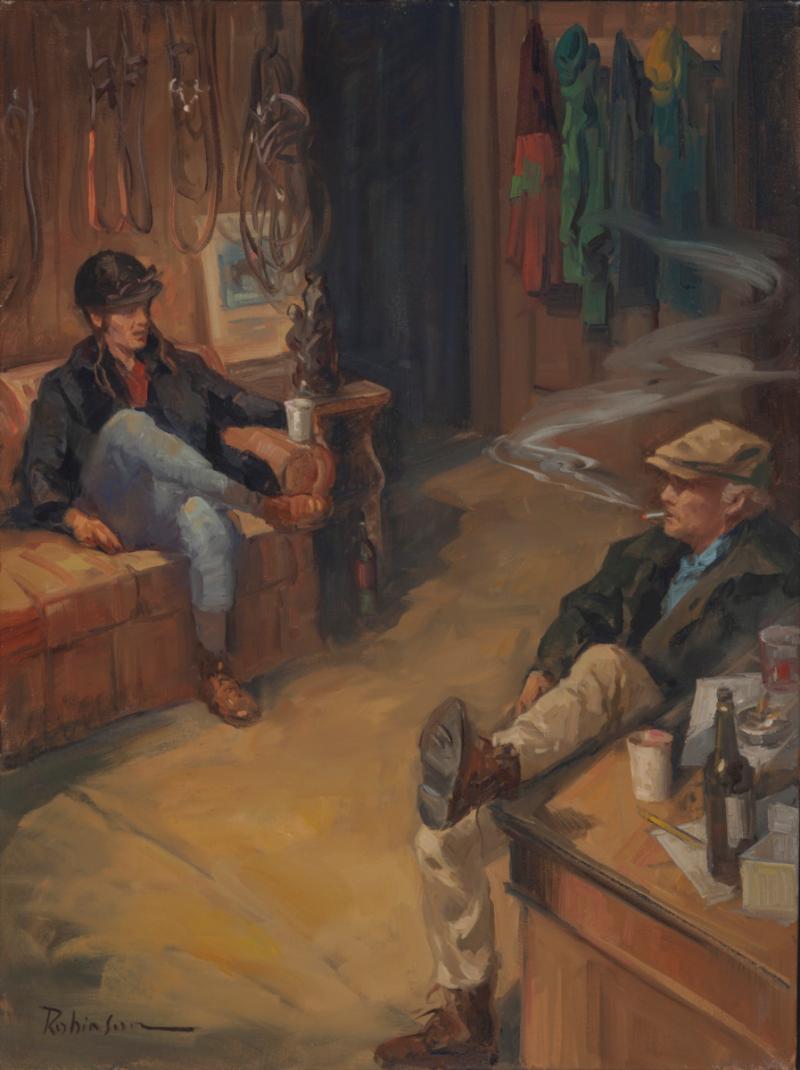
Port Between Sets" (above): In their sixties, Tom and Patrick warm up on a Sunday morning, enjoying a glass of port, before galloping the next set in the snow. Sam Robinson Illustration.
|
|
TGSF Goes to Ireland!
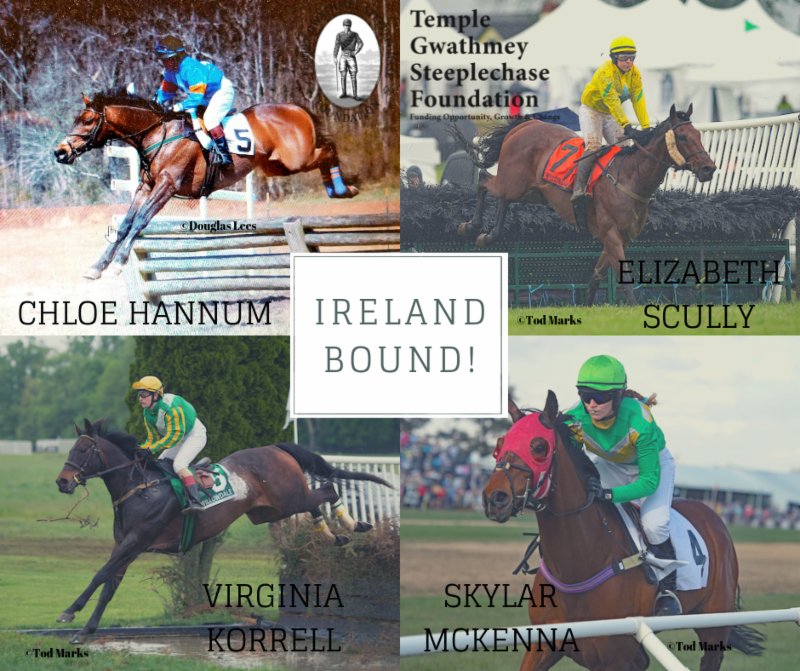
Jockeys Chloe Hannum, Elizabeth Scully, Virginia Korrell, and Skylar McKenna are in Ireland this week with TGSF consultant Regina Welsh. The group will be galloping for several trainers, including Gordon Elliot and Edna Bolger, while also going to several race meets, and touring RACE - the Racing Academy in Ireland. Follow along with their travels on our
Facebook page!
|
|
NSA News
The NSA's Monday Report is
available online for Monday July 22. This issue features the fields for this week's Jonathan Kiser Novice Stakes and the A. P. Smithwick Memorial Stakes (Gr. 1), Cite's victory in Sunday's $65,000 allowance hurdle at Saratoga, and an excerpt from Patrick Smithwick's Racing Time: A Memoir of Love, Loss and Liberation.
The NSA's Official Notices for July 19th are
posted online and include revised closing dates for Saratoga races.
|
|
See what's happening on our social sites:
|
|
|
|
|
|
|