|
WHAT JOCKEY WON FOUR VIRGINIA GOLD CUPS IN FIVE YEARS IN THE 1930'S?
|
|
|
|
The softer side of steeplechase
|
|
Race chairman feels the need to ‘give back’ through his Willowdale meet
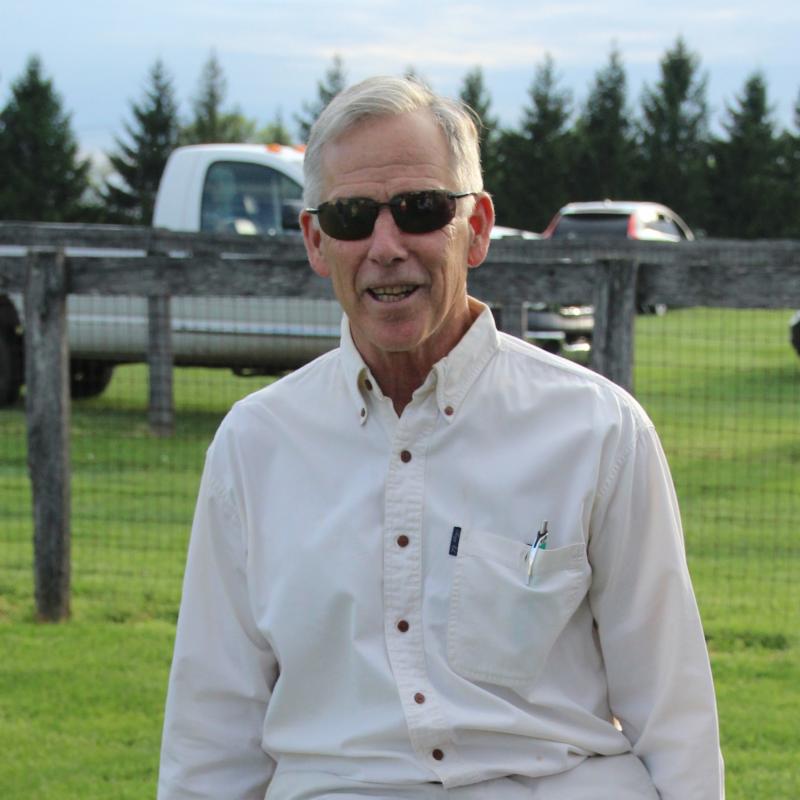
Dixon Stroud feels a strong connection to the land and to his Kennett Square, Pennsylvania community. Twenty-seven years ago, he started the Willowdale Steeplechase, the meet swiftly becoming a placeholder on the sport’s spring calendar, a touchstone of the area’s social scene, and an important supporter of a number of lucky local programs that benefit from Willowdale’s ever-growing popularity.
Discover this deeply entwined business-charity link, something Stroud says connects getting and giving.
|
|
For more than two decades, the Willowdale Steeplechase has been quietly giving back in Pennsylvania.
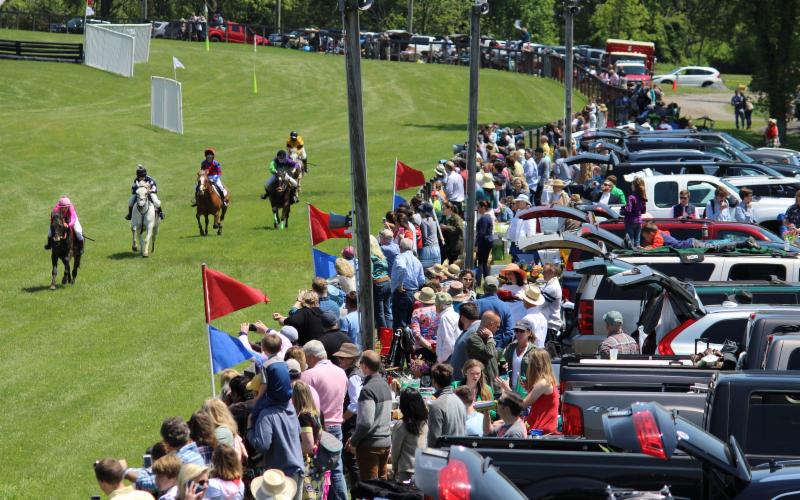
The Chester County event has long been a rite of spring, an annual celebration of pageantry and sport that boasts a medley of races on the course, Mother’s Day fashions and fun at railside and an exclamation of spring with a rich selection of shopping, activities, food and drink under tented canopy on homestretch hill.
Yet it’s more than hats and horses to race chairman Dixon Stroud. Amid the revelry, there’s impact.
Something far deeper is at work, he says.
“We’re about the community. We’re about giving back,” says Stroud, who just turned 73. A long-time steeplechase horseman, polo player and owner of a chain of local convenience stores, he finds the notion of charity charmingly old-fashioned – but critical – in today’s fast-paced world. “It’s the same with our local race meets – Radnor and Winterthur and Willowdale all run in May. We share resources when we can, and cooperate because if one of us wins, we all win.”
For the last few years, three charities dovetail on Willowdale’s homegrown success: the Stroud Water Research Center formed in the ’60s by his parents, Quest Therapeutic Services hippotherapy program, and the University of Pennsylvania School of Veterinary Medicine’s world-renowned New Bolton Center just a couple miles west of the course.
“We’re a volunteer-driven operation,” Stroud explains, volunteers from the charities helping with jobs from working the gate to promotions. It’s a well-established model across the circuit, he adds, many hands making light work, with everybody benefiting.
Stroud calls race director Leslie White “a great asset, (largely) responsible for the success” of the event. “She’s always looking for ways to cross-pollinate (with the other, nearby, race meets.)
When Willowdale first ran in 1993, the only open date on the NSA spring calendar was Mother’s Day Sunday, the day after Iroquois. Rather than fret that running on a holiday would derail the fledgling upstart, Stroud applied his trademark positive spin and whipped the possible negative into an epic positive.
“Bring your mother, bring your grandmother. Bring your girlfriend,” he recalls the relentlessly upbeat initial PR campaign. “We promise to provide the entertainment. Only about 15 percent of spectators come to watch the races, anyway. The rest come to party, to shop, to be part of the community.”
|
|
Willowdale has expanded, with some 15,000 expected at the May 12 meet, and the charities stand to benefit from their take of the gate as well as increased awareness from interactive demonstrations and information booths they’ll set up on the hill, White says.
This notion of giving back to the community extends to the Landhope Farms convenience stores the Stroud family started in 1969. Donation jars are at all the checkouts, shoppers able to support local causes and neighbors in need with their spare change, or more.
It sounds like a little but actually it’s a lot: the Kennett Square Landhope collected more than $1,000 for Family Promise of Southern Chester County, their April “cause of the month.” “It’s because of you!” trumpets Landhope’s Facebook page. “Our customers are so kind and generous.”
“Sometimes we find the charity,” Stroud says. “Sometimes the charity finds us.”
A most natural partner for the race meet came to Willowdale due to fellow steeplechase horseman Buzz Hannum. He’d become involved with Quest hippotherapy almost 20 years ago when his son Corbett was 5. The boy was having trouble with coordination and balance due to autism, Hannum explains. “We discovered the hippotherapy program, (and) we saw such a huge improvement as a result of the riding and physical therapy.” Hannum eventually became Quest's president, a position he held for five years. He says Corbett, now 24, is a college grad with a good job. “He’s doing really well."
“Willowdale has been extraordinarily generous, and continues to be. Quest is very fortunate to have someone like Dixon Stroud on their side,” Hannum says.
Winner of three Maryland Hunt Cups, three Grand Nationals and most of the circuit’s top timber races, Hannum says he well recognizes the therapeutic power of horses. “You see these kids with smiles on their faces. It’s impossible not be (affected.)”
|
|
Other steeplechase horsemen have helped Quest: Sam Slater and Paddy Neilson were on the board, and former champion jockey Craig Thornton volunteered as a leader before he moved back to New Zealand. “One of my favorite (family) photos is of Craig leading Corbett around on a little pony,” Hannum says. “There’s a lot of power in horse therapy.”
How it happened
Stroud is great-grandson of Seth Milliken, founder of one of the world's largest privately held textile companies.
He was born in South Carolina, his family moving to southeast Pennsylvania when he was in grade school. He started hunting with Cheshire. “Ida Lofting, Eve Ledyard and sometimes Barbara West would shepherd me around the hunt field,” Stroud recalls learning the ropes. “This was a big chore because I’d fall off all the time. They were so kind to me.”
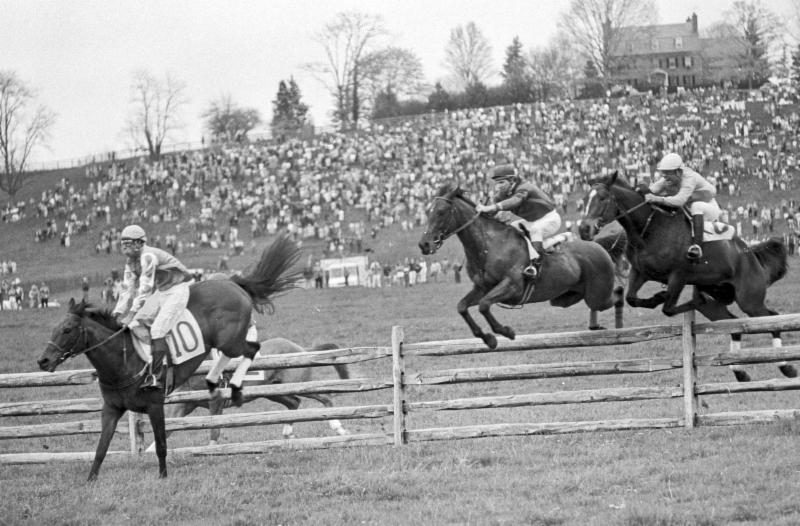
He had no direct ties to jump racing but “everybody around Unionville was steeplechasing,” so he took an active interest. He rode out for Morris Dixon and Burley Cocks, but learned most, Stroud says, from Jonathan Sheppard. Career highlights include winning the 1969 Iroquois with Blockbuster for Jigs Baldwin, and winning the 1984 Maryland Hunt Cup on Pennsylvania-bred Bewley’s Hill owned and trained by his wife, Lisa.
|
Fence 2 at the 1984 Maryland Hunt Cup - Bewley's Hill and Stroud are number 10. Douglas Lees photo.
|
|
Dixon Stroud, if you were the Czar of Steeplechase, what would you do different?
|
“Us retired riders seem to be the ones responsible for keeping the game going these days – a lot of us organize and manage the race meets. I think we need to get people as excited about jump racing as we were when we were racing.
“I don’t think it’s up to NSA, even possible for NSA, to promote our individual race meets as these fun, spring and fall destination events. That’s up to the meets. That’s what we’re good at, and it’s what we should each do, for ourselves and for each other.”
|
|
“Bewley’s Hill was an amazing horse,” Stroud recalls. “What a jumper.” They were second to Our Steeplejack in the ’85 Hunt Cup, and the Strouds sent Bewley’s Hill to England for the 1987 Grand National at Aintree. Stroud got the mount: They fell over a fallen horse at Bechers Brook, but Stroud says the British experience helped shape Willowdale a few years later. “I liked their living hedges,” he says, “and the big stuffed brush. Their courses are interesting – big open ditches, water jumps. I liked the looks of it.”
Stroud also embraced another big part of Pennsylvania’s horse country – polo. He took up with Frolic Weymouth’s Brandywine Polo in the early ‘70s, eventually earning a 3-goal handicap, playing across the nation and across the world, and sponsoring a Landhope team.
|
|
The first Landhope store opened in 1969, created by Stroud and his parents, as a way to market their homegrown dairy products. They sold homemade ice cream as well, and then a business advisor recommended adding convenience items. They expanded to include fuel pumps and delicatessens, and today Landhope now has four locations, each a community hub.
Course development
The Willowdale course is located on an old dairy farm directly behind the original Landhope in Kennett Square. “I asked a lot of other (course developers) for advice,” when he was in the planning stages, Stroud recalls. “I talked to Nick Arundel (who created Virginia’s Great Meadow) and Mason Lampton (who created Georgia’s Callaway Gardens course.) Everything they told me was 100 percent accurate. They were all about safety for the horses, first, but for making it a spectacle for the spectators, too.”
Willowdale is one of the few U.S. steeplechase courses with irrigation. There’s more than a mile of underground piping, with risers at intervals for the big irrigation wheel. The course tops a huge Delaware River watershed aquifer, so the water table is almost never a problem. Still, Stroud is keenly aware of conserving resources, so they incorporated the old dairy barn’s underground sump tank to store thousands of gallons in reserve.
Willowdale debuts a new timber course for 2019, post and slip-rails that Stroud says are easy to fix, with top rails that break if hit hard. The commitment to conservation of resources extends to Stroud’s obstacles: The “new” jumps are actually old, recycled posts and rails he had local fencebuilder Mark Wilson stockpile when he replaced a fenceline on a neighboring property.
Still, racing is just part of the equation. “People are coming for a day in the country. They want to be entertained,” Stroud says. In addition to action on the racecourse, there’s a hive of activity in the boutique area on homestretch hill – shopping, restaurant booths, a kid’s alley with games and activities, an antique car display, terrier races, the Whip Tavern tailgate competition, pony races, a side-saddle race and more.
The new NSA live stream will show on monitors in the sponsor tents, and Stroud solicits active trainers and jockeys to speak to patrons during the racing day.
“People are really excited to be part of something like this,” he says. “It’s become part of the community. We try to be a great neighbor.”
|
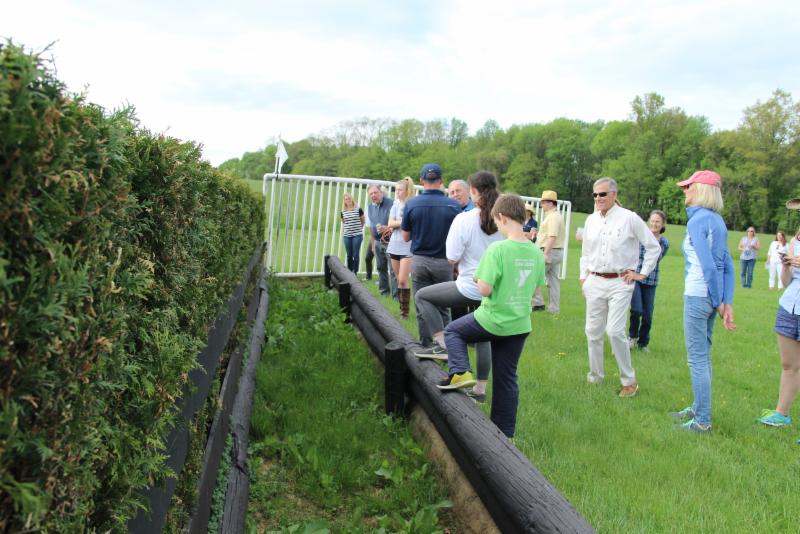
Stroud (center, in white) during a course walk at Willowdale in 2018. He and rider/trainer Ivan Dowling host a course walk a few days before the races, open to anyone who wants to see the steeplechase fences up close. Willowdale Steeplechase photo.
|
|
Great causes: Here are some of the charities supported by the Willowdale Steeplechase
S.A.V.E. – Safety, Agriculture, Villages & Environment was created in 1997, taking on the mighty Pennsylvania DOT when they proposed widening to four-lanes the two-lane Route 41 winding through Chester County’s most actively farmed agricultural land. They won, later vowing to help thwart other rural road expansion.
Quest Therapeutic Services hippotherapy program in West Chester provides equine therapy for kids with physical, mental and emotional disabilities.
The University of Pennsylvania’s renowned New Bolton Center is just a couple miles down W. Street Road from the racecourse, 700 acres dedicated to the most innovative horse and livestock veterinary research in the world.
Founded in 1884, the School of Veterinary Medicine at the University of Pennsylvania – Penn Vet – is one of the world’s premier veterinary schools.
New Bolton handles some 5,300 patient visits a year (and was thrust in to the spotlight when Barbaro was sent there after the 2006 Preakness Stakes) plus more than 38,000 ambulatory treatments at local farms. New Bolton’s campus includes a swine center, working dairy and poultry unit that provide valuable research for the agriculture industry.
The Stroud Water Research Center helped lay the foundation for scientific stream research. From the Rockefeller Studies in 1969 to the ongoing river continuum concept and streamside reforestation, the knowledge acquired via the center is world-renowned.
|
|
Stroud Water Research Center’s story
The story of one of the world’s foremost freshwater research institutions began in the salt waters of the Pacific Ocean.
In 1956 W. B. Dixon Stroud (father of Willowdale founder Dixon Stroud Jr.) joined a snail shell-collecting expedition from the Academy of Natural Sciences and spent two months off the coast of New Guinea diving for live shells.
This was not Dick Stroud’s first immersion in Pacific waters.
Eleven years earlier he had been officer of the deck when the USS William D. Porter was hit by a kamikaze pilot during the Battle of Okinawa. The ship sank in 90 minutes. Astoundingly, none of the crew was killed in the attack, but, as second in command, Lieutenant Stroud was the next-to-last man off.
His subsequent Pacific voyage left a better memory.
It also introduced Dick Stroud to the scientific research efforts of the academy.
That introduction bore fruit nine years later when he and his wife, Joan, met Ruth Patrick, head of the academy’s limnology department. The three quickly became friends, and Dr. Patrick urged the Strouds to build a small laboratory dedicated to freshwater research along White Clay Creek on their farm in southern Chester County.
They were a dream team: Ruth was a relentless worker and one of the country’s foremost scientists. Dick had a head for business, a fascination with science and a love of the outdoors.
Joan brought a deep commitment to education, a drive to get things done and an unquenchable curiosity.
“I remember an early trip to a forestry conference at Oregon State,” said Robin Vannote, the center’s first director. “Joan was studying every inch of the way.”
In the summer of 1966 the Stroud Water Research Center began as a field station of the Academy in a hastily cleared space above the Stroud’s garage.
Dr. Patrick’s first act was to hire Vannote, a young scientist working for the Tennessee Valley Authority. By early fall he’d become a familiar sight in the local streams. What started as a $15,000 project today has a multi-million dollar budget and is world-renowned for critical research into keeping groundwater and waterways safe and viable.
|
|
In last week's newsletter we asked the following question, inspired by Betsy Burke Parker's interview with Race Director Bill Price:
"BILL PRICE THINKS ALL RACE MEETS SHOULD SWITCH FROM USING THE NATIONAL FENCE. WHAT SAY YOU?"
Your answers were as follows:
Yes - we should make a change now: 54%
Maybe - but I'd like to see more research: 34%
No - the current National Fence works fine, why change it: 11%
|
|
Temple Gwathmey Steeplechase Foundation Flat Races Bonus
In an effort to give amateur/apprentice jockeys more experience, the Temple Gwathmey
Steeplechase Foundation will pay a $500 bonus to the owner and trainer of any horse winning an NSA flat race that is ridden by an amateur/apprentice jockey, in addition to any bonus already advertised. The bonus does not apply to races restricted to amateur/apprentice jockeys. A list of amateur/apprentice jockeys can be found
on our website.
|
|
Temple Gwathmey Steeplechase Foundation Developing Rider Flat Race Series
The Temple Gwathmey Steeplechase Foundation's Developing Rider Program presents a series of seven flat races for young riders for the spring of 2019. One race remains in the series, at Willowdale Steeplechase on May 12.
The program was developed to encourage participation of young riders and give them a safe and educational platform on which to compete. The rider competing in the most races in the TGSF Developing Rider Series will receive a Charles Owen skullcap. Ties will be broken based on points earned in the series. Riders do not need to ride the same mount to be considered for the series prize.
The Series standings are currently as follows:
Mell Boucher - 3 points
Charlie Marquez - 2 points
Colin Smith - 2 points
Chase Damron - 1 point
Hannah Belt - 1 point
Parker Hendriks - 1 point
Skylar McKenna - 1 point
Teddy Davies - 1 point
More details about the Developing Rider Flat Race Series can be found on the
TGSF's website.
|
|
See what's happening on our social sites:
|
|
|
|
|
|
|