This is our final "Legends of Steeplechase" piece for the spring. We'd like to thank Betsy Burke Parker for taking over the writing duties for us, and thank Don Clippinger for the articles he wrote at the beginning of the year. Betsy has promised us she will return with more Legends in the fall!
|
|
Following the surprising career trajectory of jockey, artist, physician assistant and steeplechase innovator Gregg Morris
|
|
(Strap in tight – it’s a wild ride)
|
|
Gregg Morris vaulted from reading ‘Misty of Chincoteague’ to topping the jockey earnings table and partnering two Eclipse Award winners. He went from reading about art in an army base library to invitations to exhibit in some of the nation’s top galleries. He made good on an off-the-cuff quip about med school to a lengthy – and continuing – career as one of the mid-Atlantic region’s most respected physician assistants.
Today, he’s commingling them all to spearhead the National Steeplechase Association’s – and American racing’s – innovative new concussion protocol and jockey baseline testing.
Throughout, Morris, 68, has remained reserved, quiet, to the point that while some know pieces of the story, most don’t know the half of it.
|
|
He’s been called the greatest jockey never to claim a races-won title.
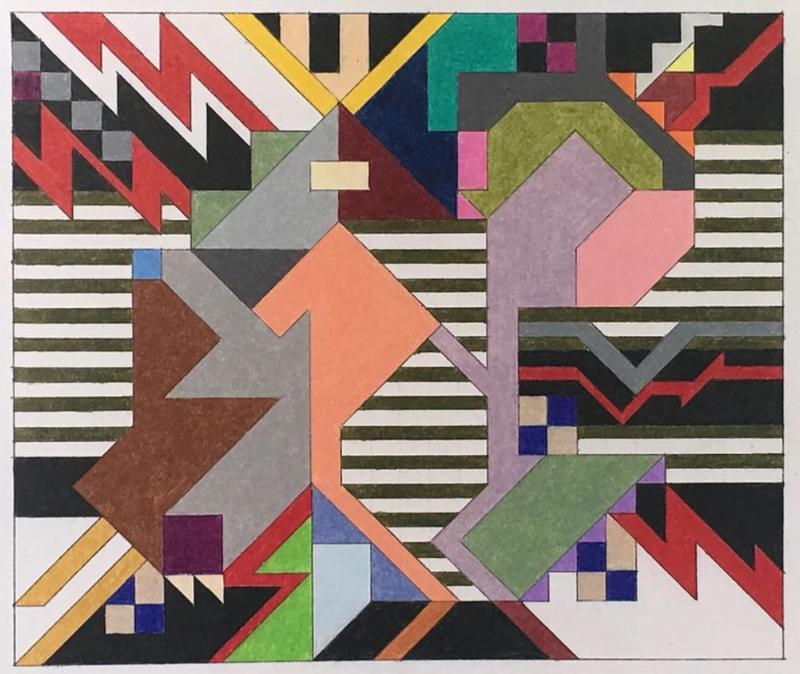
He’s been called a visionary, an artist hitching Picasso's minimalist to Kandinsky's abstract for a unique geometric codified representation.
He’s been called a living angel, cool command and calming presence in the pressure-cooker microcosm of a big city emergency room.
He’s been called “the exact right person at the exact right time” to help nudge horse racing into the 21
st century in terms of protecting the elite human athletes as much as the equine.
Throughout, Gregg Morris has remained firmly rooted, grounded in worlds that appear to butt as much as they blend.
“It was the best education you could ever hope for,” Morris says of what started with Keeneland Pony Club, moved on to pivotal years with racing horsemen Johnny Griggs, Mickey Walsh, Frank Whiteley and more, art degrees from Maryland College of Art and Syracuse, to a physician assistant degree from Arcadia. “I’ve always chased the things that stir me.”
|
|
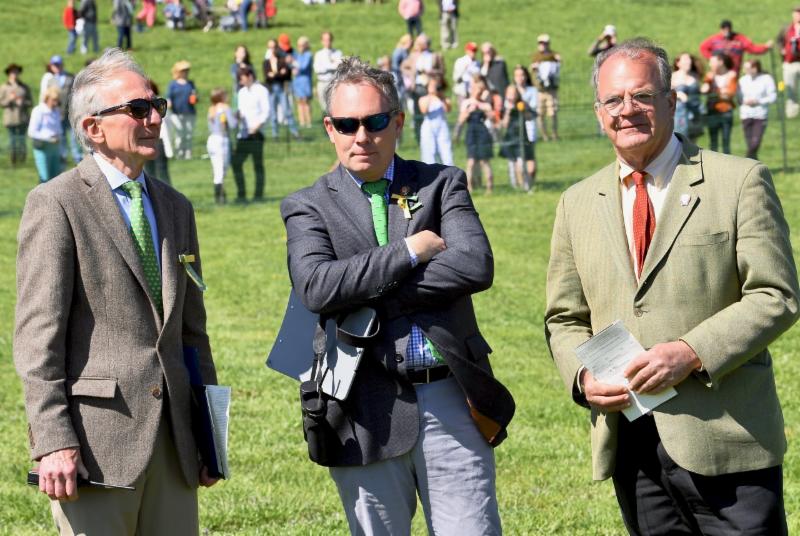
Stewards for the 2019 Maryland Hunt Cup: Gregg Morris, Gus Brown and Tad Zimmerman.
Douglas Lees photo
|
|
|
‘Bumping up and down in the saddle’
Morris was born in 1951, middle of three kids. The family moved from Philadelphia to Lexington when Morris was 9, his father hired to teach at the new dental school at the University of Kentucky. “I was reading ‘Misty of Chincoteague’ at the time, and here we were in horse country. I asked for a horse,” Morris recalls. “He met me halfway and got me riding lessons.”
Morris rode with the Keeneland Pony Club, riding to the B in eventing. “I did some hunter shows but always ended up going too fast,” he says, tracing the steps from pony club to steeplechasing. “We went to a few point-to-points, and I got the idea to jack up my stirrups on my event horses.”
He hooked up with Lexington veterinarian and steeplechase trainer John Griggs when he was 15. “Johnny was a fairly young vet at that time,” Morris says. “He was working long hours for Hagyard Davis, and he’d come home from work and gallop (his steeplechase horses) after dark. I think he was so relieved to have some help, he was happy to take me on, even though I had no (racing) experience.
“Johnny had an interesting way to doing things with his horses, from training to (caretaking) to his way of riding. He was a tall man, and he always rode long, so he’d just crash on the horses’ backs every stride – that’s the way it looked to me, anyway. He never gave me any instruction, just put me up and gave me the opportunity to figure it out on my own.”
The Kentucky Hunt Cup at Iroquois Hunt Point-to-Point was one of his first races. The hurdles were just Christmas trees tied together, and the course went way out into the hunt country, Morris recalls.
|
|
Moving up to the majors -- steeplechasing joins other elite sports for safety protocol
Last year, a group including the Jockeys' Guild, University of Kentucky and New York Institute of Technology drew up racing concussion protocol, the Association of Racing Commissioners International adding guidelines for tracks to employ a medical professional trained in concussions, jockey baseline tests and return-to-ride testing.
Studies show roughly 25 percent of jockey injuries involve head or neck trauma. It's by nature a very dangerous sport, Morris notes. The biggest concern, says Steeplechase Jockeys Association of America founding member Forest Kelly, is repetitive head injury and cognitive deficit in the long term.
|
|
“It was a two-horse race,” Morris remembers the 1967 day. “Just me and Mason Lampton. Mason’s horse fell, and I decided I’d wait for him while they caught his horse.
“They put him back on and he beat me. Johnny said that was nice of me to wait for him, but don’t ever do it again.”
The next spring at the old Oxmoor meet, Morris “figured out” his riding style, all on his own. “I was trailing the field at Oxmoor, and I saw the other riders not bumping up and down in the saddle like I’d been doing, trying to emulate how Johnny Griggs did it.
“I pulled up my stirrups, and it was instantly better.”
He won his first race under rules the following year, Jim Holloway’s Badge of Honor in Stoneybrook’s old timber race. The pair went on to be second at High Hope and second in the timber stake at Iroquois.
Morris enrolled as a freshman at Vanderbilt, but dropped out after one semester. Going straight to college after high school “was a mistake,” he says. “I thought it would be new and different, but it was just the same.”
He got a job in Southern Pines for Mickey Walsh – Morris called him M.G. “The first few weeks I worked for him I didn’t understand a word he said. He had this thick Irish accent. He must’ve thought I was the dumbest kid ever.
“We’d muck the barns, ride all day. He had a set of hurdles on the infield, and we’d school set after set.
“I learned a ton.”
Morris went to New York with the barn that summer, but his number was up in the Vietnam lottery, and he went to train with the U.S. Army in Louisiana.
“I swear it was the most horrible place in the nation. Fort Polk. I hated it.
“The only cool place on the whole base was the library. I spent a lot of time there.”
It provided a surprising stepping-stone to his next phase.
The art of perseverance
Morris says the dogearred art and art history books at the Polk library stirred his soul.
“I never took art in high school,” Morris stresses. “I don’t know where it came from, but I decided to take a course at UK when I got back from the reserves. It was a sculpture class.
“It lit the fire.”
He took the next step and enrolled at the Maryland Institute College of Art in Baltimore, getting a job galloping for Dickie Small and Katie Voss at Pimlico. At the time, the backstretch was jovial, one “big, happy family,” he says. “It was a lot of fun.”
The horses-plus-art schedule suited Morris – he’d gallop a few in the morning and work in his Bolton Hill studio in the afternoons.
He earned a Bachelors of Fine Arts in 1975 and Masters of Fine Arts from Syracuse University in ’77.
“My thought was to land a job at some college teaching art since that was how most artists survived. The two years at Syracuse were interesting and fruitful, but they left me with zero desire to purse a career in academia."
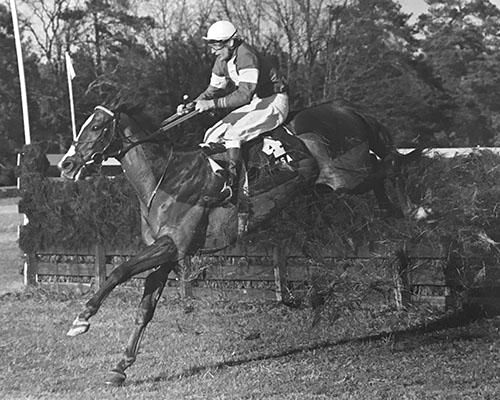
Morris went back to New York and hooked up with Hall of Fame trainer Frank Whiteley at Belmont Park. Several other jump riders worked for Whiteley, both in New York and at his winter base in Camden, Al Quanbeck and Tom Skiffington among them. He was getting on better and better horses, riding for John Fisher, Doug Small and Walsh. He won the Temple Gwathmey Stake, then held at Belmont Park with Fire Control, the Block House at Tryon and the Turf Writers at Saratoga with Popular Hero.
Morris eventually fled New York, citing a “love-hate relationship with the city,” and landed in Fair Hill, Maryland. Morris rode champion Zaccio to his second of three Eclipse Awards in 1981 for Hall of Famer Cocks, later teaming with Charlie Fenwick and Inlander to claim the 1987 Eclipse. The same year he topped the money-won chart for riders with nearly $500,000 in earnings.
“He was the greatest jockey never to win a (races-won) championship,” Fenwick says. “Gregg was a really talented rider, really underrated.”
|
|
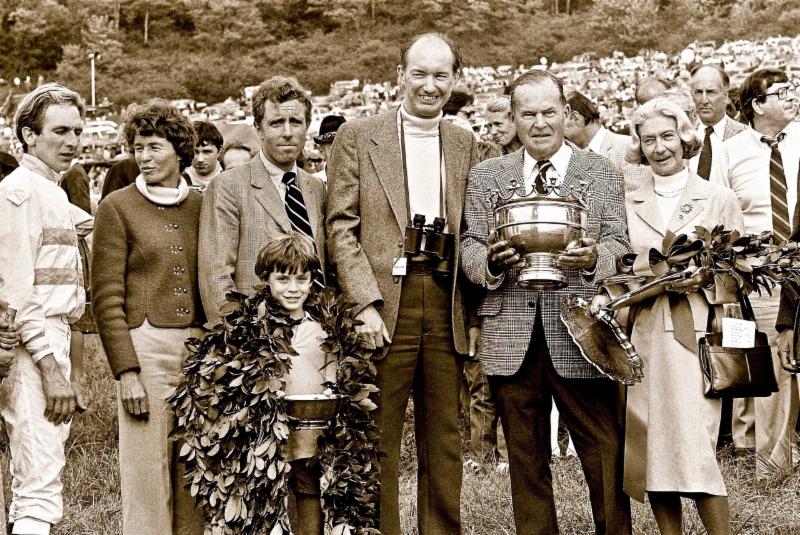
1983 International Gold Cup trophy presentation, held at Rolling Rock. Gregg Morris won the hurdle race aboard Wallace Lanahan's Sugar Bee. The following year the International Gold Cup moved to Great Meadow and became a timber race.
Left to right: Gregg Morris, Ann Fenwick, Charlie Fenwick, Jr., Charlie Fenwick III, Mr. and Mrs. Wallace Lanahan on the right with the trophy.
Douglas Lees photo
|
|
|
Somewhat abruptly, as Morris approached age 40 after the 1989 season, he quit race riding, and he and then-wife Andrea opened a training barn at Fair Hill. They ran some on the flat, some over fences and broke 2-year-olds. He had a studio in Elkton by then, and he was invited to exhibit at the Corcoran Gallery. His art was going great and, at first, the training was going well.
“I thought I was getting too old to (race) ride,” he explains the decision that surprised many at the time. Training, it turns out, was harder on all levels. “Running a barn together … essentially cost us the marriage. Somebody has to be the boss.
“And it was affecting my art. Trouble with galloping horses versus training horses is that training takes more time. An exercise rider is done at 11 a.m. You have lunch, and you’re in your studio by 1.
Training, you’re 24-7.”
He gave up the training and mounted a brief riding comeback in 1994 and ’95, but says it “just didn’t feel right.” He quit for real and took a job as farm trainer for Bob Levy’s Muirfield East in Chesapeake City.
The transformation stage wasn’t over. A short time later hobbling around on crutches with a broken leg, Morris stumbled into his biggest career shake-up of all.
|
|
Giving back
Laid up and not working, Morris went to visit a friend out in Colorado. “She asked me what I was going to do now,” Morris remembers the exact conversation that started the new trajectory. “I don’t know where it came from, but I said ‘I’m going to med school.’ I needed something that stirred me.
“As soon as it came out of my mouth, I knew it was right.”
The next day he enrolled at the University of Delaware to add organic chemistry and microbiology to his existing humanities credits. He took his first hospital job – registration clerk in an emergency room. “Stimulating work,” Morris deadpans. “I felt like I was doing something positive.”
He opted to pursue physician assistant rather than med school, a faster, though more intensive schedule. A physician assistant is licensed to diagnose and treat illness and prescribe medication.
He graduated Arcadia University two years later, at 50 one of the oldest in the class of 2003.
Morris didn’t mind. “I loved the work” in a Delaware hospital emergency room, though it was sooner than he expected that he began to miss the horses, and the horse people. They’d come through his emergency room sometimes, he says with a chuckle. He started considering a way to get back involved.
NSA racing secretary Bill Gallo directed him to the steward program – today he works up to a dozen meets a year, but it was a chance encounter in spring, 2007 with jockey Richard Boucher that at last conjoined two of Morris’ passions.
|
|
High-tech screening
The Vestibular Ocular Motor Screening battery was developed eight years ago to detect signs and symptoms of a concussion.
Systems responsible for integrating balance, vision and movement are impaired in closed-head trauma.
The VOMS test allows a medical expert to be up to 90 percent accurate in identifying patients with concussion, and takes less than 10 minutes to administer.
Required tools are simple:
– A target with a newspaper size font
– A tape measure
– A metronome
Armed with a rider’s baseline scores – soon to be digitized by SJAA, after a fall, VOMS measures eye movement, memory and balance. An injured rider may appear asymptomatic at rest but shows signs of brain trauma when exercising.
|
|
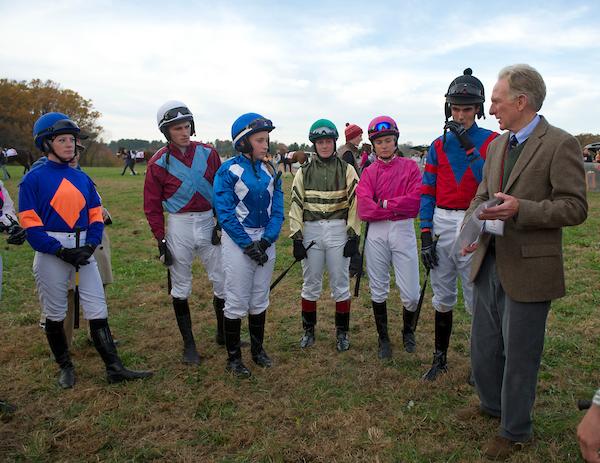
Gregg Morris talks to the jockeys before the Athenian Idol flat race at the Pennsylvania Hunt Cup in November of 2015.
|
|
|
“Richard was telling he he’d had a fall at Atlanta the week before,” Morris says. NSA records indicate it was Riddle in the 2007 Atlanta Cup. “He said the meet doctor didn’t even look at him."
The Steeplechase Jockeys Association of America’s Forest Kelly says the protocol has continued to evolve, and that Morris continues to be “the exact right person at the exact right time” to bring jump racing up to speed with other major league sports like NFL, NBA and Major League Baseball.
“The 30-second rule is now standard at the hunt meets,” Kelly explains. “Any rider that falls anywhere on any course, they need a course physician or an EMT at their side within 30 seconds.
“It took someone with Gregg’s level of understanding, of comprehension of the sport, to make this happen. Some of the courses can’t have medical personnel posted on the infield, other courses needed to special allowances for them around the track. He’s making it work.”
With a digitized database, riders can no longer fib about prior falls, and the baseline concussion data makes it easy to identify closed head trauma.
“A concussion isn’t just ‘knocked out’,” Morris says. “(Riders) get baseline tests on eye movement, balance and memory. These are controlled by different areas of the brain. You can get your head rattled and never be unconscious.”
Today, Morris continues to paint and works in the emergency room at St. Francis Hospital in Wilmington. “Art continues to enrich my life,” he says. “That’s what I do when I’m not doing things to make money.
“The thing about art is that it’s very solitary. It’s all about you.
“Medical is completely opposite. At the same time I wanted to do something that would be for other people. You know, I grew up in the flower-power ’60s – you almost felt compelled to feel like you’re contributing to the greater good.”
|
|
He’s been a vegetarian since he was about 20
|
|
Kip Elser used to love to give me grief. I’d lose a race, and he’d say ‘you need a roast beef sandwich to get your strength.'
A hostess once protested I could ‘fish out the meat’ in the lamb stew she served at a dinner party. She said ‘there’s vegetables in there.’ Yeah, but they were swimming in lamb juice. No, thanks.
|
|
His art runs from Rorscach Test to Electric Kool-Aid Acid Test
|
|
Several years ago when I had been commissioned to develop designs for art quilts, I was given a piece of graph paper to aid in the process. I discovered by accident that between the thin blue lines on the surface of the paper and the actual paper itself there existed an entire universe – like another dimension altogether.
I found that if I was in the right frame of mind, I could coax shapes from this micro-thin dimension onto the paper. These shapes had form but no content, like letters of the alphabet. The shapes were restricted to horizontal, vertical, and 45 degree lines because that made them easier to sew on a machine. I found that if I fiddled with them they began to accumulate content – sometimes funny, sometimes dark.
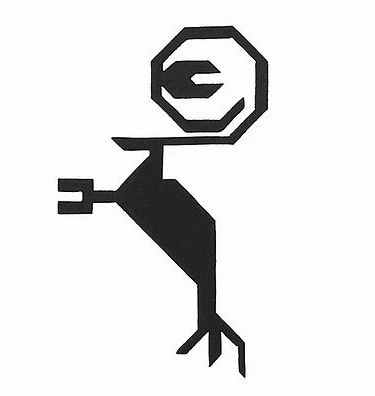
When people ask me what kind of art I do I just say I do geometric codified representation. The black and white stuff is all block printing. I’m trying to invent a new kind of language with the images.
|
|
He is one of three Morris kids involved with horses
|
|
Older brother Jeff wasn’t interested in horses when we were kids. He worked in real estate for a while, but he saw the money moving around in the horse world so he (moved into) bloodstock with Forest Retreat and Highclere. My sister Beth did ride, and she married (Kentucky horseman) Bill Wofford.
|
|
He thinks Zaccio was one of the best ever
|
|
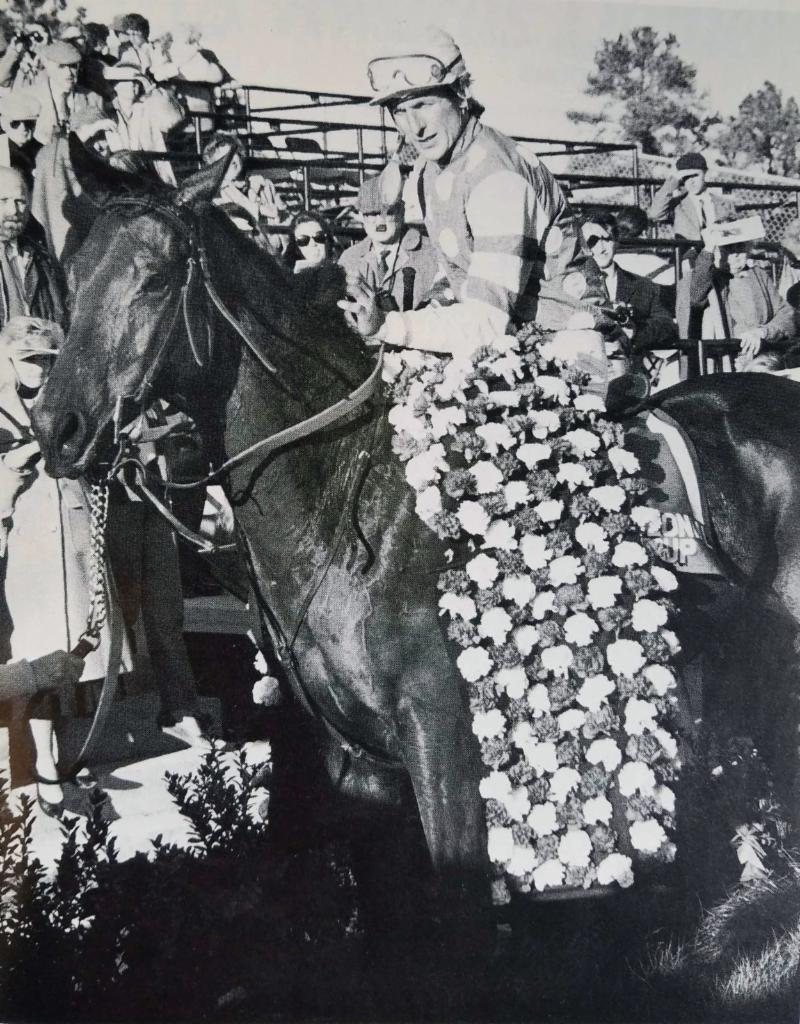
Zaccio was Eclipse champ three times – 1980, ‘81 and ‘82. Richard McWade had the ride for Burley Cocks until he broke his leg midway through the 1981 season. Morris picked up the mount until he broke his arm in a fall in the first at Saratoga in ’82, missing the ride in the third aboard Zaccio in the Turf Writers (
click through for a video about Zaccio). Ricky Hendriks kept the ride, closing the year with five wins in a row aboard the legendary hurdler. Zaccio missed the ‘83 season; Hendriks won one final turf race with him in late ‘84 to close out the horse’s career.
(Photo of Zaccio and Gregg Morris winning the 1981 Colonial Cup courtesy of Milton Toby /
Bloodhorse
)
|
|
His greatest strengths were his heart, determination and his will to win. He was a real street fighter who loved to duke it out with another horse. I don't think he ever lost when he got in a fight.
|
|
He knows there were other good ones, too
|
|
The good horses I rode were all different and great in their own way. Zaccio was the most powerful over a jump, Pont du Loup was the most exuberant, Inlander was the fastest from the last fence to the wire, Steve Canyon was the most honest but always seemed so morose.
|
|
From "American Steeplechasing" 1987: "The 18th running of the Marion duPont Scott Colonial Cup, Saturday, December 5, at Camden, SC, produced the 1987 Steeplechase Eclipse Champion. Dogwood Stable's Inlander, a six-year-old English import trained by Charlie Fenwick, clinched the title with an impressive late move that got him to the wire 3 1/4 lengths in front of Swedish invader Ormus and six American rivals."
Photo of Inlander and Gregg Morris courtesy of Gilmore / NSA archives.
|
|
|
He knows from experience how jockeys often try to minimize injuries
|
|
At Saratoga (a maiden hurdle in 1982), I was on Sugar Bee. He went for a big one, trying to jump with Flatterer, and I flipped off the back of him. That’s a hard fall.
I think I broke my humerus, but I was on Zaccio two races later in the stake, and I was desperate to ride. The course doc asked me to lift my arm over my head. That’s all I had to do. He cleared me to ride.
I went back in the jocks’ room and nearly fainted. I had to take off Zaccio. I got to watch Ricky Hendriks win the Turf Writers on Zaccio before I drove myself to the hospital.
That makes me recognize how important it is to (bring in strong) medical protocol.
|
|
He could be called the Giant Slayer of 1987
|
|
Morris won the Carolina Cup to open the season aboard a
New Zealand import named Gogong. Three weeks later, Gogong upset four-time Eclipse Award winner Flatterer in the handicap at Glenwood Park’s Middleburg Spring Races. By year's end, Morris had set a record for purse earnings by an American steeplechase jockey with $468,363.
All told, Morris rode 136 winners – 103 under rules – from 843 sanctioned and point-to-point rides, 1968-1995. He rode as an amateur until the mid-’70s.
|
|
He has a few ideas as imaginary Czar of Steeplechase
|
|
I think the future is in the uniqueness of steeplechasing in America, back to the old-fashioned hunt meet model. I don’t think ‘jump races’ with five fences at the major tracks are viable, or particularly interesting.
The focus needs to be on keeping all the meets healthy. Some make millions, some are barely scraping by. I’m sure this Communist model may not popular, but it might work if the bigger meets paid into a fund to help support some of the smaller meets to make sure they stay around. We need racing at all levels to make it work.
|
|
In last week's newsletter we asked the following question:
"WHAT OLYMPIC RIDER RODE IN A TIMBER RACE AT THE FAIR HILL RACES?"
You knew your stuff!:
Boyd Martin: 15.7%
David O'Connor: 9%
Frank Chapot: 75.3%
|
|
TGSF Goes to Ireland!
Stay tuned for details about the Temple Gwathmey Steeplechase Foundation Developing Rider International Trip, which will host four young riders this summer. We'll announce the participants soon!
|
|
See what's happening on our social sites:
|
|
|
|
|
|
|