Talent Matters!
Part Two: Building a Talent Culture
In our previous Blueprint, we explored leadership and board evaluation as talent development tools. Here we’ll dive deeper into a systems approach to developing talent throughout your organization.
We know that people are your most important asset. While conversations with boards and leaders about the future often center on issues like funding volatility, political uncertainty, and AI, what soon follows are questions about talent: do we have the people we need to address the challenges ahead? Is our organization ready, and will we be able to effectively respond?
Many of you have shared with us that while change is a constant, finding people who can lead through change is your biggest challenge.
A talent culture, one where people are engaged and actively learning, is the foundation of an organization that thrives through uncertainty and change. How do you build it?
Lots of sports analogies here (which is funny because I know nothing about sports), but I hope they resonate with you as they do with me!
- Stephanie
| | Talent Development: Model the Way | | |
“You’re not a leader simply because you have a rank or a title,” noted Simon Sinek in a recent conversation on the podcast Aspire with Emma Grede. “Leadership is a choice, and it’s a lot of work. It’s the choice to see another person rise and grow—that you’re going to be a part of that journey.” One of the keys, Sinek says, is to “be a student of leadership” because the factors—culture, generations, politics, challenges—are always changing. What stays constant are basic human principles: “People want to know that they matter. People want to know that their work matters. People want to feel trusted and trusting.”
As a leader, the process begins with you. In "How to Build a Superteam That Keeps Getting Better," Ron Friedman writes, “At the center of every learning culture is a leader who makes growth a daily priority.”
Fittingly, with the NBA playoffs starting this month, the example highlighted by this HBR article is the dramatic turnaround and sustained success of Oklahoma City Thunder. In just three seasons, the Thunder went from being near the bottom of the league to winning the 2025 NBA Championship. This season, OKC once again has the best record heading into the playoffs.
In investigating the question: “What do the best teams do differently?” Friedman found a number of common elements, including:
- A commitment to constantly improve over time.
- A willingness to experiment more often.
- Leaders working alongside their teams.
- Team leaders who excel at feedback.
Constantly improve. When asked by Sports Illustrated about OKC’s approach to the 2025 draft, general manager Sam Presti said,
| | “[W]e're never rigid in anything we do, so we don't say this is the way we've done it so we're always going to do it this way. We're always looking to update the way we look at things, try to figure out as much as we can learn. Every draft that we have is an opportunity to reflect back on the others and figure out what we can do better." | | | His next remark sheds light on a key factor: in order to constantly improve, you have to build with people who are willing to grow. Presti said, | | "But the one thing we've never really strayed from, and I don't think we will, is the focus on drafting people and not players. I think the characteristics of winning players, they multiply at a greater level than just talented players. They scale up better." | | | |
At GLP, we regularly emphasize the importance of hiring for mindset. That’s what Presti means by “winning players”: it’s not just their skill today that matters. When you’re building your board and leadership team, start by identifying non-negotiable mindset factors that every member of the team needs to have. How curious are they? Are they willing to grow? Do they value teamwork as core to success? Do they have what it takes to learn quickly and apply that knowledge creatively?
Our paper “Board Composition: Building a Board That Adds and Creates Value” offers a deeper look at actionable steps for assessing mindsets, and, while the paper is focused on boards, many of the insights will apply to leadership teams as well.
Experiment more often. Does your team experiment when things are going well? The most successful teams “evolve by trying new approaches.” Friedman’s research suggests that rather than spending the majority of meeting time on progress reports, high-performing teams shift the focus to problems that need solving by asking, “What are you stuck on?” This one question does two powerful things: 1) it makes it okay to identify what isn’t working well and 2) it drives your team to continually experiment in order to solve new problems.
Working alongside their teams. Our October Blueprint highlighted the article “The Surprising Success of Hands-on Leaders”—reminding us that leaders need to understand the work, to model the standards, and to stay close to those who are directly working with the people your organization serves. In the Thunder case study: “Even now, with a full scouting department, Presti still spends most of his year on the road and in the film room, studying players most fans have never heard of. It’s a choice that sends a clear message to the rest of his team: No task is beneath him,” writes Friedman. “When people see that their leader is willing to do hard and tedious tasks, responsibility feels shared and collaboration deepens.”
Leaders who excel at feedback. The faster you learn what isn’t working, the faster your team can improve. But it takes creativity to analyze mistakes without sending everyone’s nervous system into fight/flight mode where learning is blocked. In the OKC example, watching the game tape is not always easy. Thunder’s head coach Mark Daigneault recalled, “We had a game where we had 30 turnovers, and I did a film edit of the turnovers to a Springsteen song. I told them, ‘If I’m gonna have to watch 30 turnovers again, I at least want to be listening to Bruce Springsteen while I do it.’”
Sports teams watch game film after every game. What would that look like for your organization?
| | Succession Planning is Leadership Development | | |
We often ask heads and boards: Do you make succession planning an expectation for yourself and your leaders? Do you require that leadership development strategies and succession plans be updated and assessed annually for all critical positions?
You can likely predict the answer: No. If this is where your organization is today, you have a tremendous opportunity to reduce risk and strengthen your organization’s greatest asset: its people.
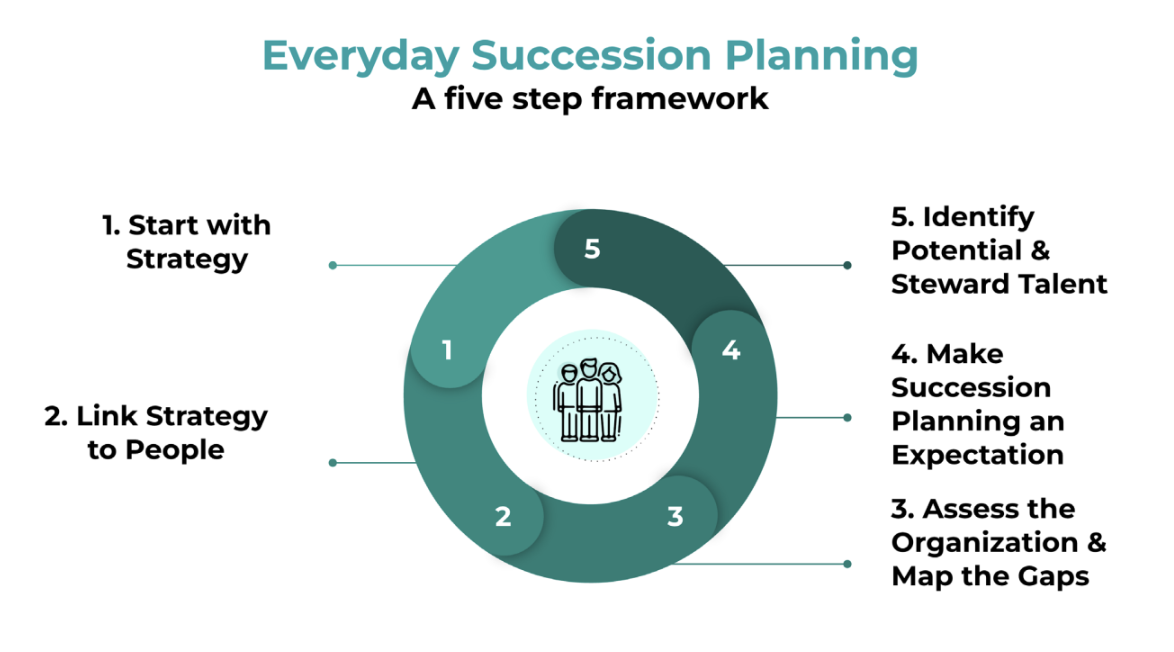
To build an architecture that supports and sustains an effective organization, as highlighted in our most recent white paper, we recommend five steps:
- Start with Strategy
- Link Strategy to People
- Assess the Organization and Mind the Gaps
- Make Succession Planning an Expectation
- Identify Potential and Steward Talent
Start with Strategy
Knowing where you are going and what you need to do to get there is what informs who (what kinds of talent and capabilities) you need. For boards and leadership, this is first-order work—because you can’t build an effective organization if you are not clear on what you are trying to accomplish. Strategy is often misunderstood in schools and not-for-profits: don’t confuse it with planning!
In McKinsey’s study on practices to retain non-profit talent, clear mission and strategy was the number one factor for successful retention. When people know why their work matters, they are able to direct their efforts more effectively—and to find that effort more rewarding.
Link Strategy to People
Real strategy begs important questions to succeed:
- What capabilities do we need?
- Do we have the right people focused on the right work (roles and responsibilities), and are they supported by the right systems and resources?
- What do we need in our Head/CEO and what does that leader need around them to work at their highest potential?
As noted in the HBR article “Where Traditional Succession Planning Falls Short,” starting with strategy guides you to hire (and develop) leaders for the future—not just leaders who fit current needs:
| | “Rather than focusing just on which candidates could step into existing roles, the real opportunity for strategic succession planning is to identify the leaders who can take your company into the future. One way leading companies are starting to do this is through “scenario-driven” succession. … By considering the most likely strategic scenarios of where the company would place “big bets” in the next three to five years, the board evaluated which leader would most effectively succeed in each scenario, then made their selection based on their predicted direction. In this way, succession planning can answer the question, “Who should lead if we take this path?” | | |
Assess the Organization and Mind the Gaps
A well-designed approach to assessment of the organization and its talent is a crucial form of ongoing education and effective oversight—for the board and for leadership. It answers questions that day-to-day demands rarely allow the space to ask: Where are our capacity gaps? Which roles are most vulnerable? Who is ready to grow into greater responsibility, and what do they need to get there?
Assessment is the foundation of intentional talent development. A third-party audit of organizational leadership (talent and structure) can surface opportunities as it spots serious gaps and misalignments. Often, you have the talent you need but they are encumbered by ineffective systems or they are simply in the wrong spot.
Finally, build your own ability to assess. As we emphasized in the earlier Blueprint on evaluation: when you establish evaluation practices, you normalize learning, growth, feedback, and analysis on a regular basis—not just when there is a crisis or things go wrong.
Make Succession Planning an Expectation
At GLP, we’ve coined the term “Everyday Succession Planning” to encourage organizations to shift their focus and approach from reactive (“John is leaving, and we need to replace him—fast!”) to proactive (“When John leaves, we have a strong bench and know how we will address his departure both immediately and for the future.”)
Whether you think of it as “everyday succession planning” or as “leadership development,” it is crucial to frame it as an ongoing part of your leadership responsibilities—not as a response that’s triggered when a key position needs to be filled. Making this shift connects succession planning with the vital, ongoing, “everyday” work of leadership, talent development, and aligning your people and resources with your strategy.
In this McKinsey article, Intuit’s former CEO Brad Smith recalled advice from legendary executive coach Bill Campbell:
| | “The first day I was in the job as CEO he said, ‘I want you not to think of succession planning as replacing yourself. I want you to think about it as leadership development of your team. And we’re OK if we groom CEOs, and you’re not ready to leave or we don’t want you to leave, and they go someplace else. Because then Intuit will simply be known as a leadership factory.’” | | | |
This approach has four powerful components:
- Make it about the position.
- Make it about growth for your team.
- Make it about the future.
- Make it okay to have so many outstanding leaders that they carry the reputation of your organization far and wide.
Your biggest risk right now is not having the talent you need to solve the most vexing problems your organization will face in the future.
As the McKinsey article illustrates, it is worth pausing to reflect on the dynamics encapsulated in the common phrase “passing the baton.”
| | “Like track and field, the goal of the handover is to ensure the next person gets off to a great start and is well positioned to perform even better after the baton is handed off. … In a successful relay, the person receiving the baton starts running well before the baton reaches them. The same can be said for succession planning.” | | | |
Is your organization trying to do the handoff from a cold start? As we emphasized in A New Approach to Leadership Transition, a failed leadership transition can set an organization back both financially and strategically.
Let’s take a look at ways to help your high-potentials start running before they receive the baton.
| |
Identify Potential and Steward Talent
The best part of this work is signaling to your valued high-potential people that you see them and are excited to invest in their future. The pathways and opportunities you open up to them will be informed by your organization’s strategy—and the awareness that not all high-potential people aspire to enterprise-wide leadership roles. Be clear that you have aspirations for them, and check that they are aligned with your perspective. Invite their full participation in developing learning opportunities.
In the 2026 Deloitte study on human capital trends, “Leaders also report that the two most important drivers of success are accelerating how people and resources are orchestrated to perform work and increasing their organization’s and workforce’s ability to adapt to change and speed.” A key part of that is helping people learn better and faster by providing them with the range of experiences and responsibilities that help them grow the relevant skills.
One of the best ways to develop talent is to expose and involve them in enterprise-wide initiatives, helping them see into the work you do as a CEO, Head of School, or functional leader:
- Take rising stars with you to meet with clients, funders, and donors. Introduce them and give them opportunities to plan for the meeting, participate in it, and help with follow-up planning.
- Expose them to board members and other functional leaders. If your leader is program-focused, get them on a team that analyzes the economics of programs, and help them see how program value supports economic health.
- Invite them to board meetings to present, observe, and build relationships. Make sure to explore with them boardroom dynamics and how leaders work effectively with boards.
- Think about what you didn't know when you stepped into leadership. And help your rising stars fill those gaps now!
Don’t leave leadership to chance; an effective human capital strategy takes less time and money than the alternative.
| | We want to know what you think! | | |
Thank you to everyone who has responded to our Blueprint survey—we deeply appreciate your feedback and your generous and thougthtful responses.
And, in case you missed it earlier, below is a link to access the survey. It's short and will only take a few minutes to respond.
We will read every response and your answers will help shape both the Blueprint and some exciting new projects we’re developing. We'll report back what we've learned in an upcoming Blueprint!
| | Please feel free to forward The Blueprint to friends and colleagues who may find it helpful. And if you're not already on our mailing list and you'd like to receive future editions of The Blueprint, click the button below to subscribe! And don't forget to explore our Blueprint Archives. | | | | |