Talent Matters!
Part One: Leadership and Board Assessment
At this time of year, we field a lot of questions about leadership and board evaluation—and these inquiries lead us into conversations with clients about their overall approach to talent and leadership development. As you can imagine, we sometimes uncover the absence of internal strategy or systems to ensure this work happens with intention. Alternatively, we find haphazard approaches that diminish the efficacy of assessment, evaluation, and development.
We appreciate how hard it is to establish healthy evaluation practices that turn goal setting and assessment into a platform for deeper dialogue. Many organizations shortchange the process because they lack systems—and they lose the benefits of effective assessment: growth and development, aligned goal setting, reduction in turnover, an inventory and pipeline for talent, proactive succession planning, strengthened teamwork, and a culture that models the way for the entire organization.
In this Blueprint, we explore why assessment matters and how to approach it in a way that advances leadership, cultivates a depth and breadth of talent, and drives organizational performance. Next month’s Blueprint will dive deeper and swim further on talent matters—into developing learning cultures, supported by effective talent strategies and system-wide succession planning—what we call “Everyday Succession Planning.”
- Stephanie
| | Why Does Assessment Matter? | | |
Institutional performance is directly related to both CEO/Head and board performance. In GLP’s work with non-profits and schools, we consistently see better results when the board and CEO/Head share a consistent approach to assessment; one that strengthens their partnership and informs how each grows and develops—so that they can scale this approach throughout the system.
Relatedly, the importance of a strong partnership between the board and CEO/Head, characterized by effective communication and collaboration, seems obvious—but in the whirlwind realities of life and leadership, it is easy to fall into the trap of focusing only on outcomes at the expense of building the everyday systems that support or enable the outcomes you want. This focus can inhibit the earlier, informal, and more helpful feedback loops that promote effective adaption—before you experience outcomes that disappoint.
Designing and implementing an evaluation process for your board and leadership is one of the most powerful foundations for effective collaboration because it provides the opportunity to:
- Define criteria for success
- Identify (and negotiate) clear expectations and goals
- Determine how both actions and outcomes will be measured
- Establish ongoing communication, information sharing protocols, and feedback loops
- Discuss what the CEO/Head needs from the board and vice versa
- Educate the board on the work of the CEO/Head and educate the CEO/Head on the roles and responsibilities of the board
- Align both leadership and governance work to the mission and strategy of the organization
- Diagnose the dynamics in the board–Head relationship that support or hinder success
At its best, the evaluation process gives you actionable insights and builds momentum (rather than increasing fear and defensiveness). Importantly, you are normalizing learning, growth, feedback, and analysis on a regular basis—not just when there is a crisis or things go wrong.
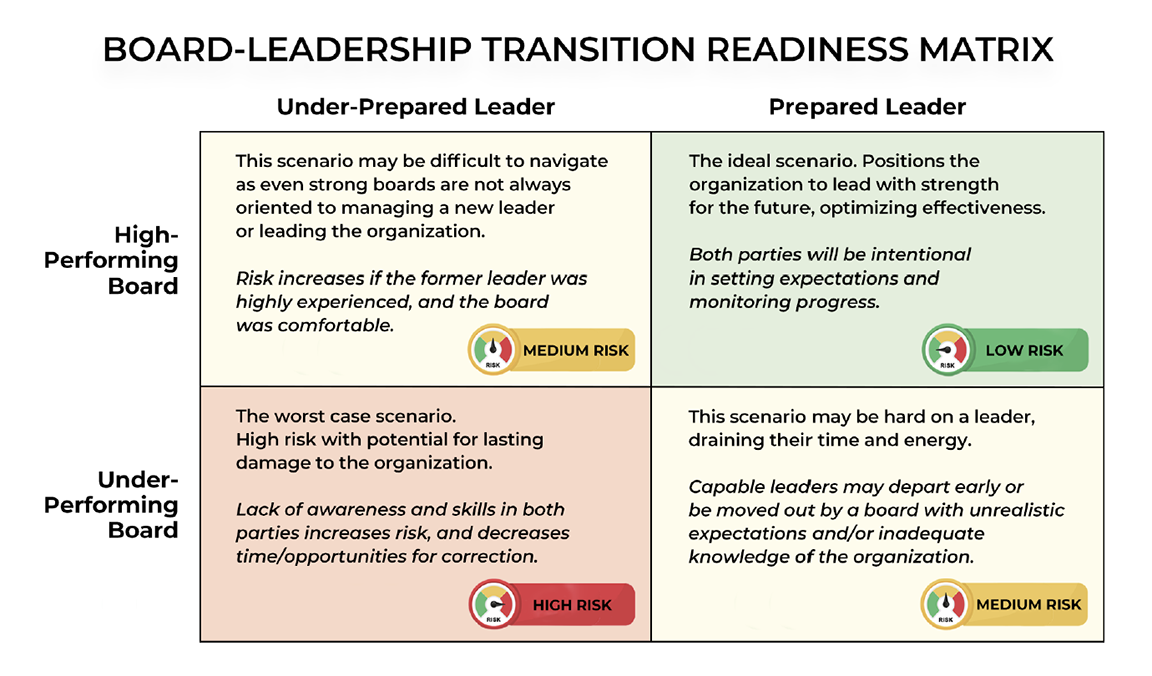
Knowing where you are today is essential to key board responsibilities—such as succession planning and managing effective transitions. As we noted in our paper A New Approach to Leadership Transition, it is the combination of board performance and leader preparedness—not just one or the other—that matters:
| | |
At a glance, you can see why it is important to evaluate your board as well as your leadership: an under-performing board may result in the loss of an excellent leader, and the combination of an under-performing board and an under-prepared leader can cause lasting damage to your organization.
Clear-eyed assessment is not always easy or comfortable, and it can face additional challenges in nonprofits and schools—where the work of leaders and board members is done with great heart. In these situations, it can be tempting to avoid critical feedback in an effort to be supportive. But this approach can backfire because it disguises the feedback people need to excel, harms mission delivery, and can result in unspoken friction and limited growth.
The best solution is to build an evaluation process that inspires positive action and strengthens collaboration—rather than making people feel judged unfairly or misunderstood. And evaluation (tools and processes) is meaningful only if it is supported by evidence, examples, and specific recommendations for improvement. Which brings us to the power of putting dialogue at the center of each step.
| | The best evaluation processes harness a “dialogue” mindset. As Georgy Ann Peluchiwski noted in this GLP blog post, | | “Start by talking to each other. Sounds simple, but this is often the step we see skipped or bungled. Enter the goal setting process in a spirit of partnership and collaboration. Talk less and listen more. Goal setting should be a joint endeavor with the leader. Boards should not ‘present’ goals to the leader, nor should leaders be drafting in a vacuum and ‘presenting’ to the board. Begin with a dialogue about what your shared priorities are, how that will inform the work of leadership, AND the work of governance. Boards should also be asking their leaders what they need and expect and should hold themselves accountable for delivering.” | | | Carry this commitment to two-way communication throughout every part of the process—especially by using follow-up conversations to understand and unpack the formal evaluations. In the HBR article “For Your 360-Degree Feedback to Be Effective, You Need to Discuss It,” the authors emphasize that the evaluation report on its own does not provide the full benefits: | | “The 360 itself didn’t change anything. The follow-up conversations were what made the difference. Indeed, research shows that the biggest predictor of increased leadership effectiveness after a 360 is whether you discussed the feedback with the people who gave it to you.” | | | Discussing the feedback helps you more accurately understand—and more accurately decide how and what to change. | | “Move from assumptions to conversations. When you read your 360 report, you’ll naturally draw assumptions about what people meant. But the worst thing you can do is stay in your own head, interpreting feedback through your own lens and never testing whether you got it right.” | | | The authors emphasize that it is beneficial to approach these conversations in a structured way to reduce blocks to communication (such as defensiveness and justification) and to avoid hastily making promises of change: | | |
“Share your takeaways first. Start by naming what you read: ‘Here are the things that people seem to really appreciate about me’ and ‘Here are the things I heard people saying I could do differently to be more effective.’ This shows you’ve done the work of reflection and that you’re ready to learn.”
“Invite exploration, not justification. Instead of asking ‘Why was I rated this way?’ (which puts people on the defensive) try questions like: ‘People seem to see me in this way. Can you help me understand what they may be noticing?’”
“Focus on impact, not intention. Ask questions like ‘What impact does this behavior have?' and 'In what situations would it be most important for me to be aware of this?’”
“Listen without committing. Your objective is to gather data, not to defend yourself or make promises. Tell people: ‘I’m exploring and trying to learn more. I’ll come back to you once I’ve thought through what changes I want to focus on.’”
| | | |
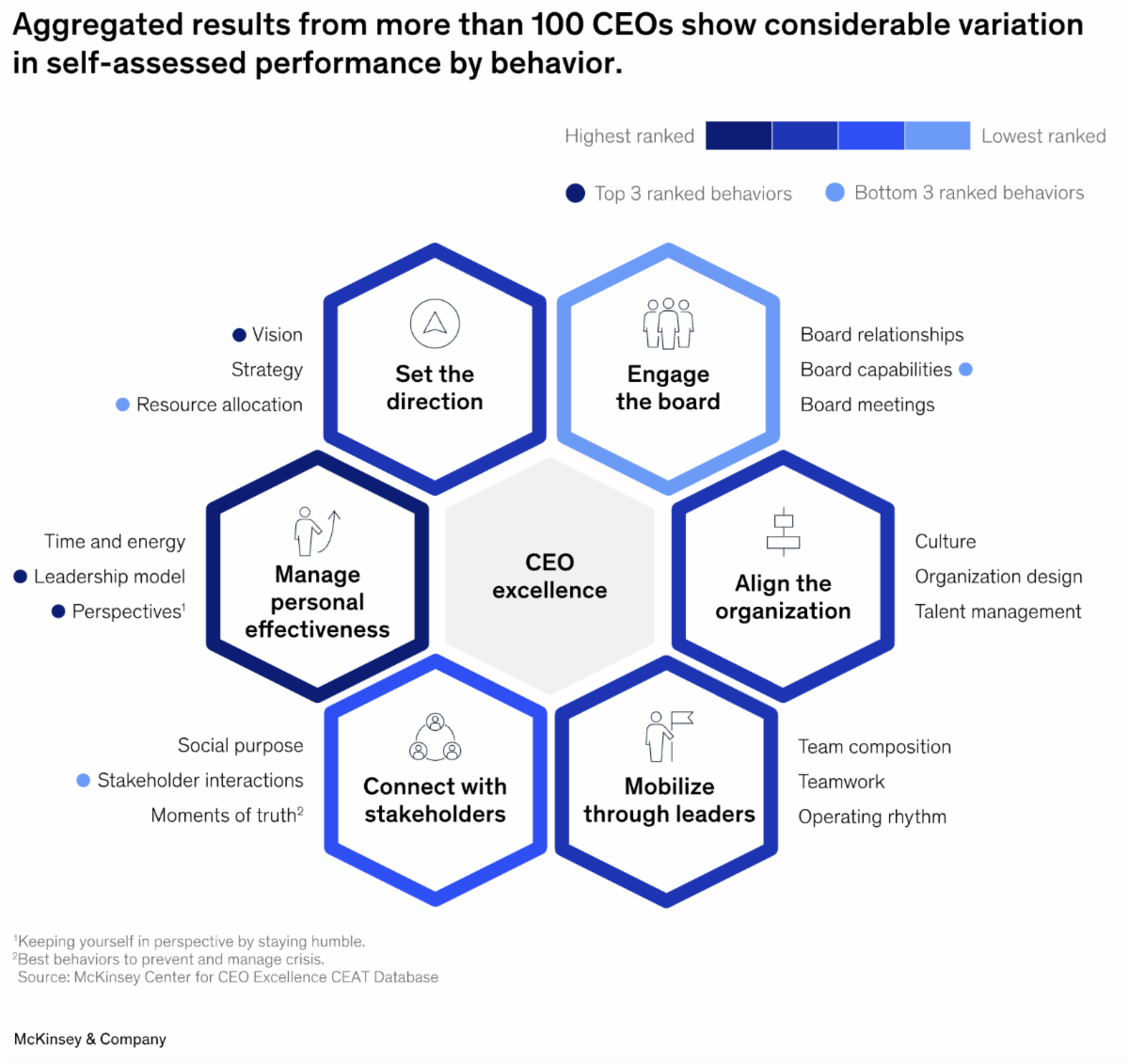
Another context for helpful dialogue is a frank exploration with your leader, Head of School or CEO about how they see the job and assess themselves. This McKinsey article reveals how the conversation may illuminate different perspectives—and build a stronger shared understanding of what matters most in evaluation. The focus is on CEOs mostly from Asia—but the applications to schools and NFPs are immediately recognizable. Not surprisingly, engaging the board and staying connected to external stakeholders rank as the biggest challenges:
| | When you put dialogue at the heart of your evaluation process, you create the conditions for strengthening partnership, teamwork, and understanding. You shift away from a one-time “scorecard” approach to an iterative process that truly advances growth and performance. | | Avoid Feedback Fatigue—Turn It into Action | | “Many HR executives we interviewed said that ‘survey fatigue’ is a misnomer. Rather, employees experience ‘inaction fatigue,' and harnessing their voices requires a long-term investment in building and sustaining trust that their feedback will make a difference.” | | | |
As the HBR article on discussing feedback emphasized, start by thanking people who took the time to give feedback—be specific and reflect back to them insights they shared.
This is not to say that all input is equally accurate or useful. Don't base assessment only on how people feel. Make sure you have examples and evidence for the criteria or goals on which to assess. Consider ways to identify and counteract less than accurate assessments. Measure progress by gathering specific perspectives, examples, and information about leadership that can then be quantified. And don't make feedback anonymous (you want to encourage a culture of honest and constructive feedback) but do ensure confidentiality.
| | Designing an Effective System | | |
Engagement with conversation and listening are not enough—they are best offered within the structure of a well-designed approach to evaluation with effective assessment tools. Successful evaluation processes are systematic, customized, and practical—providing you with the evidence and data to diagnose issues, find opportunities, improve, and make good decisions.
For key steps, let’s return to the GLP blog post:
| | |
Define the process. This includes outlining the roles, responsibilities, and timelines for setting goals—best developed together with your leader. If the process is clear, well-defined, and well-communicated, it allows the focus to be on the quality of the dialogue and reduces anxiety on all sides. Thus, high-functioning boards have structures and practices to support a healthy goal setting and evaluation process.
Ground your work in mission and strategy. Use your strategic plan, vision, mission, and values to agree to shared enterprise-wide priorities. Then carefully delineate what the work of the board will be to support the work of leadership and what work the board needs to attend to itself in order to ensure institutional progress.
Measure activities that drive performance—and the success you envision! Once you have an understanding of your priorities and who will do what, consider what evidence you will seek to demonstrate progress, and how it will be measured and communicated. Know the difference between leading and lagging indicators and set realistic timeframes. Take the time to listen and learn from your leader. Ask: “What do they see as drivers or leading indicators of progress towards success?” Consider that the most valuable “metrics” might be qualitative, but can be measured or tracked.
Create and sustain frequent feedback loops. Consider that informal, ongoing, and “formative” feedback is just as valuable, if not more, than a formal year-end evaluation or “summative” assessment. Be sure you are attending to both in an intentional way. This is the surest way to build a trusting and enduring partnership that drives institutional success.
| | | |
We've learned that assessment needs to tie itself to measurable goals, and effective assessment gathers relevant examples and evidence of progress. But so often what gets assessed doesn't actually measure what matters most. The more clear you are about what matters, and the better able you are to measure effectively, the more you empower everyone in the organization to contribute to the results you want.
Watch out for what this HBR article calls the “superhero scorecard”:
| | “Boards often create unrealistic expectations—listing 12 ‘must-have’ experiences instead of focusing on the four that truly matter or demanding five core competencies when two would suffice. This makes evaluation less meaningful because decision-makers lack the hard step of ruthless prioritization. As an executive, you need to push back. ... Ask: What must I personally excel at versus what can be augmented through my leadership team and outside support? If everything is a priority, nothing is.” | | | The authors highlight four essential questions prospective CEOs should answer before taking the job—and these questions are also helpful to consider when negotiating goals and measurements of success. | | |
Mission: What’s the north star we are all aligned on? This is the overarching goal: the strategic direction for the company. Probe whether the company’s goals match the board’s expectations. Are those expectations realistic given the time horizon, investment capacity, and market conditions?
Mandate: What specific, measurable outcomes am I accountable for, and when? This is where vague aspirations become concrete commitments. What are the three or four things you must deliver as CEO? Under what timeline? With what resources?
Conditions for success: What do you need to do the job well?
Third rails: What’s untouchable? What can’t be adjusted or changed?
| | | Don’t Get Trapped in the Rearview Mirror | | |
When designing assessment, you need to balance your consideration of results with what you want to see happen for the future. To ensure you are growing towards what's next, a key question is: “What assessment drives learning so that the board and leadership feel supported and ultimately advance in their leadership and roles?”
In 2013, Strategy + Business published an article called “Are you Leading Like It’s 1980?” highlighting old approaches to performance management that were no longer relevant. The authors noted:
| | “A key element to making this shift is changing the focus of the annual performance review process from a backward-looking, narrow perspective that answers, ‘What have you done for me lately?’ to a forward-looking, productive conversation that asks, ‘How can you contribute to the company, and how does this benefit your career?’” | | | “[M]any managers make the mistake of doing backward-looking assessments of an employee’s work during the previous year and fail to initiate forward-looking discussions about career advancement opportunities.” | | | |
In contrast, they write, the new system “encouraged feedback in both directions, with employees and managers charting a path together.” Again, the dialogue that follows evaluation is as important as the evaluation itself.
How would your approach to assessment change if you asked, “How can we make assessment a tool for talent retention and leadership development?”
| | Board Members Are Professionals and They Need Feedback Too | | |
Formal assessment of board performance is a more recent development in the last few decades (an HBR article published in 1998 noted that board assessments were rare but arguably the most important). As we emphasized in 5 Essential Mindsets for Board Members, board members must see themselves not as volunteers but rather as unpaid, professional talent hired to lead and govern an organization with a very serious mission.
GLP’s paper on board composition highlights how this mindset shift will help you build a board that adds value. Transforming how you “hire,” assess, and develop board members provides a powerful route to high-performance governance.
Although there is no single “best practice” for assessment that works for all boards, our May Blueprint, described key aspects, including:
- Assess the key criteria for board members, and assess the collective needs of the board
- Assess culture, composition, structures, and function with questions that are clearly stated
- Ask senior administrators to assess the board and compare results
- Use a well-designed tool to provide evidence of year-over-year progress
| | |
We have found that when assessment processes are aligned, the board-leader partnership is strengthened, and governance deepens its understanding of institutional performance as a function of both CEO/Head and board performance.
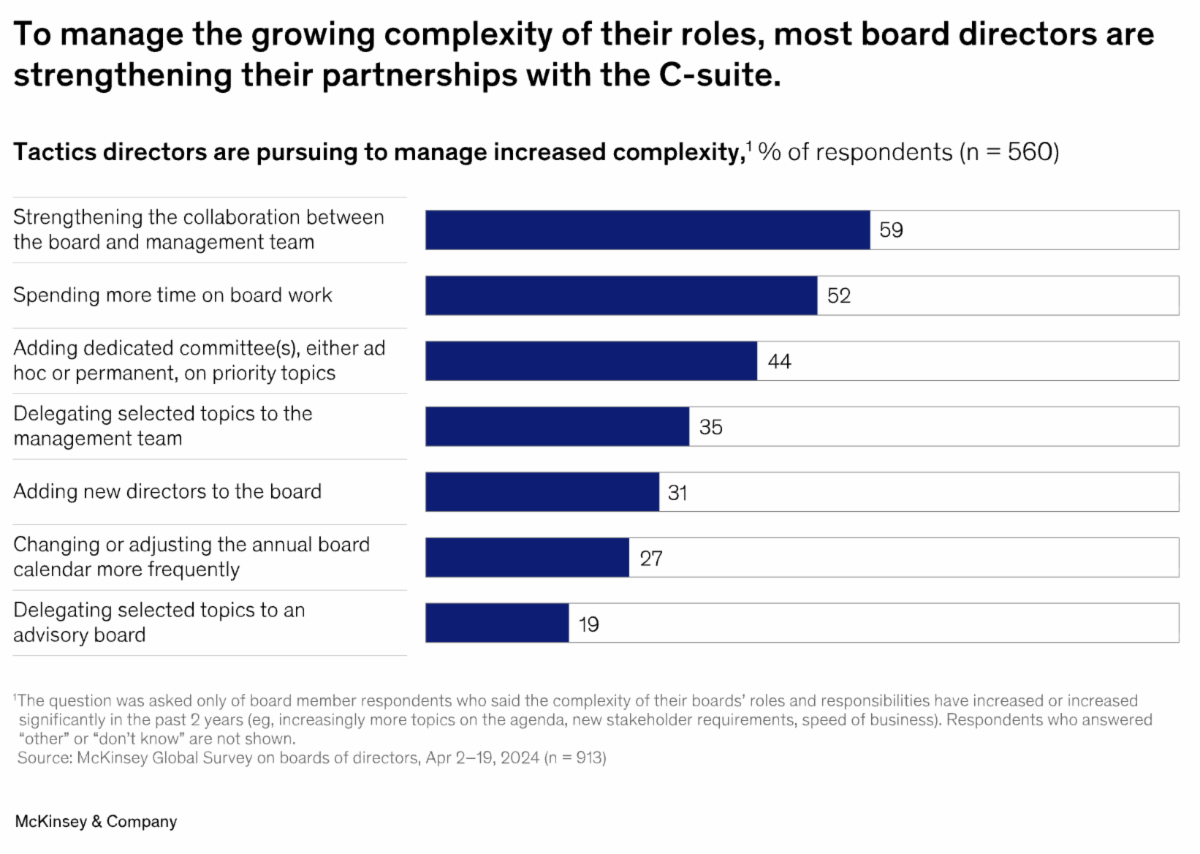
The McKinsey article “Better Together: Three Ways to Boost Board/CEO Collaboration,” notes that “As the board’s role becomes ever more complicated, stronger partnership with management, especially the CEO, can help directors create the most value for their organizations.” Highlighting a survey that asked board members how they have been managing the growing complexity, over half said that their main tactic is to strengthen the collaboration between the board and management team.
| | |
The authors note, “In our experience, management teams and boards most often need advice on how to create a good team dynamic in the boardroom, sometimes with support from a coach, and many CEOs aren’t clear enough about what insights and expertise they need from their boards.”
Establishing and implementing an integrated evaluation process provides numerous opportunities for strengthening trust and collaboration across and within leadership and the board.
| | Diagnose and Decide: The Roadmap for What's Next | | |
The evaluation itself is not a roadmap—and even the discussions to unpack and understand the evaluation won’t automatically produce actionable insights. Effective evaluations are a result of effective tools and processes. You will need to translate what you learn through diagnostics, assessment, and discussion into a road map for what’s next.
When you focus on the stakeholders and strategic context—rather than focusing solely on the tools—you can transform qualitative research into an inclusive learning experience that benefits all. By exploring the evidence and feedback offered within the tool, you uncover new insights and better solutions, creating conditions for deeper relationships and the culture you want. The process itself educates your board members, leaders, and broader organization by asking questions that target the key elements of high-performing leadership and governance.
Building a learning culture helps develop your organization’s most essential asset: its people. Effective assessment is a key building block in learning, and it enables your organization to steward high-potential talent, address gaps in key positions, and proactively plan for the future. In the March Blueprint, we’ll dive more deeply into the purpose and practices of “Everyday Succession Planning.” If you’d like to get a jump start, here is our most recent paper!
| | Please feel free to forward The Blueprint to friends and colleagues who may find it helpful. And if you're not already on our mailing list and you'd like to receive future editions of The Blueprint, click the button below to subscribe! | | | | |