|
How to Measure and Build Trust
|
|
According to a PwC global survey of CEOs, 55% believe lack of trust is a threat to growth. New breakthroughs in neuroscience provide insights on how to build cultures that enhance organizational trust.
According to an article by Paul Zak in the Harvard Business Review, trust also impacts the bottom line. Compared with people at low-trust companies, people at high-trust companies report: 74% less stress, 106% more energy at work, 50% higher productivity, 13% fewer sick days, 76% more engagement, 29% more satisfaction with their lives, 40% less burnout. |
| Designing a Way to Measure Trust |

|
Paul Zak, author of Trust Factor: The Science of Creating High-Performance Companies, developed a mathematical model of the relationship between trust and economic performance. Zak hypothesized that there must be a neurological signal that tells us if it is safe to trust someone. He designed an experiment where study participants could elect how much money to send a stranger over the internet knowing the money would triple in value. Depending how "trustworthy" the recipient, he or she would share the monetary gains. How much did the sender "trust" the recipient to share the profits? Zak knew from other studies that rodents produce the brain chemical oxytocin when another animal is safe to approach. Based on this knowledge, he hypothesized that higher levels of oxytocin would correlate with higher levels of trust. By measuring the oxytocin levels in blood drawn from both email senders and recipients in the study, Zak demonstrated that there is, indeed, a correlation between oxytocin levels and trust. This was further confirmed by administering synthetic oxytocin and again measuring trust. |
| The Factors that Positively Impact Trust |
|
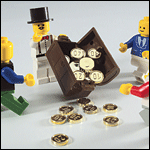
"High trust companies pay employees 17% more a year than low trust companies. The only way this can occur in a competitive labor market is if employees in high-trust companies are more productive and innovative."
|
|
|
Once Zak had confirmed oxytocin as a trust indicator, he could measure the impact of a variety of cultural factors on oxytocin levels. This gave accurate feedback about factors that both enhanced and discouraged trust. Factors that enhance trust include:
- Recognize excellence.
- Induce challenge stress (enough to be interesting, but not too much).
- Give people discretion in how they do their work.
- Enable job creativity.
- Share information broadly.
- Intentionally build relationships.
- Facilitate whole person growth.
- Show vulnerability.
|
| Cultivating Trust by "Building Trust" |
|
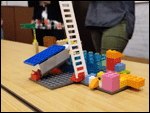
Take a moment to view how the culture of a high trust organization can be expressed in the LEGO SERIOUS PLAY language.
|
|
|
If you have experienced the LEGO SERIOUS PLAY method, you will immediately recognize the connection to this research. According to Zak, former Herman Miller CEO Max DePree once said, "The first responsibility of a leader is to define reality. The last is to say thank you. In between the two, the leader must be a servant". Being a servant among others means giving room for ways of communicating and problem solving that are based on a high level of trust in the organization. The LEGO SERIOUS PLAY method is a way of allowing these factors to influence the bottom line. |
| |
|
|
Contact:
|
Sincerely,

Rasmussen Consulting specializes in using LEGO SERIOUS PLAY to effectively harvest an organization's collective intelligence to enhance strategic behavior for better and faster decision- making. We are based in Denmark with offices in US, Japan and Singapore.www.rasmusssenconsulting.dk. |

