|
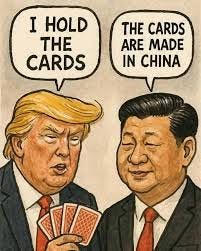
President Xi Jinping of China becomes only the second foreign leader - after King Charles III - to receive the honor of a state dinner in Trump’s second term.
How far we have come since 2016, when Trump accused China of “raping” the United States, or 2024, when he said “They are killing us as a country".
He acted on those concerns in April 2025 when he imposed heavy tariffs on China - up to 145%. China responded with restrictions on exports of rare-earth minerals, which threatened to cripple U.S. manufacturing, and Trump quickly backed down.
Not only did Trump lower tariffs on China (the effective tariff rate is now 23%), but, even more significantly, he also lowered restrictions on U.S. technology exports to China. In December 2025, he approved the sale of Nvidia’s second-most powerful artificial intelligence chip, which has helped China to gain ground on the U.S. in the AI race.
That trade truce paved the way in May for a congenial Trump-Xi summit in Beijing, where Trump gushed to Xi:
“We’re going to have a fantastic future together. It’s an honor to be your friend".
As with North Korean dictator Kim Jong Un, Trump doesn’t seem to notice that the bromance is entirely one-sided; Xi said nothing about being Trump’s pal.
Yet, as a token of his unrequited friendship, the Trump administration announced in May that it was pausing a $14 billion arms sales to Taiwan. He described it as a “negotiating chip” with China - thereby giving Beijing, for the first time, a say in whether the U.S. aids the embattled island democracy.
Trump has delivered even bigger gifts to China this year without meaning to. His unnecessary war with Iran, now in its 7th month, has badly depleted the weapons systems the U.S. would need to fight China. The Congressional Budget Office warns that “the large expenditure of missile defense interceptors” will take years to replenish, while Bloomberg reports that the blockade of Iran requires more than 30 percent of the U.S. Navy’s warships.
Many of those ships come from the 7th Fleet. The redeployment of the USS George Washington to the Middle East has left the Pacific without a single U.S. aircraft carrier.
So much for President Barack Obama’s “pivot to Asia”; Trump is pivoting from Asia.
In another sign of his China weakness, Trump gave Xi a pass despite recent reports that China (along with Russia) has provided satellite imagery that allowed Iran to target U.S. military bases:
“They basically do what we do. We spy on them, too”.
Well, yeah, true. The U.S. does spy on China. But it isn’t helping to kill Chinese soldiers or blow up Chinese bases. Do you get that?
Trump’s shrug about the Chinese threat is mirrored in U.S. strategy documents. Whereas Trump’s 2017 National Security Strategy described China and Russia as America’s primary threats, the Wall Street Journal reported that Trump personally intervened to take out such language from the 2026 National Defense Strategy. It now says:
“President Trump seeks a stable peace, fair trade, and respectful relations with China".
The 2025 National Security Strategy does acknowledge it would be “harmful” to U.S. interests if a “potentially hostile power” were to take control of the South China Sea, but it doesn’t name China as the power in question. In a similar vein, Defense Department leaders barely mentioned China or Taiwan when giving speeches in Asia this year.
Analysts say part of the change is undoubtedly due to the composition of the second Trump administration: China hawks are out, while economic officials like Treasury Secretary Scott Bessent have taken the lead.
Also influential: tycoons such as Elon Musk and Jensen Huang, who do business with China while donating to Trump’s pet causes. Part of the explanation may also be that Trump discovered, during last year’s trade war, the high cost of confronting China; like many bullies, he shies away from a fight if he fears getting hurt.
Finally, Trump is no fan of Taiwan — he imagines that “they stole our chip industry".
Wow, how things change.
Trump is going too far in wooing Xi without getting much in return. China continues to bully U.S. allies, including the Philippines, while providing aid to U.S. enemies, such as Iran, Russia and North Korea. Beijing is also charging ahead in one state-supported technological sector after another (BYD surpassed Tesla this year as the world’s largest manufacturer of electrical vehicles), while Trump remains distracted by his war with Iran and his compulsion to build monuments to himself.
C'est la vie. Trump might want to create a more congenial summit with Xi - but it isn’t good for the long-term interests of the United States or its allies.
|