|
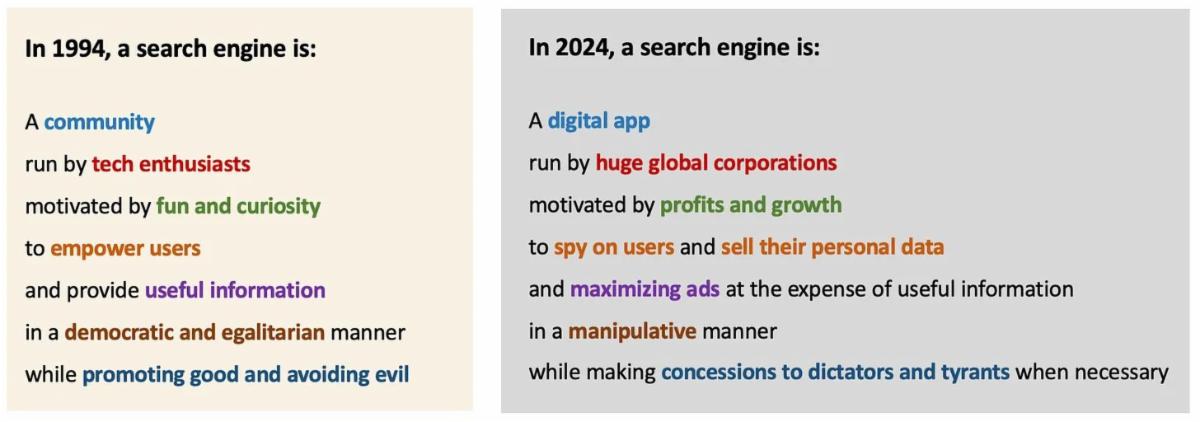
Two things are important in this comparison of the “old” tech and the “new” tech deployed by the estimable Google outfit.
Number one: Search in Google’s early days made an attempt to provide content relevant to the query. The system was reasonably good, but it was not perfect. Messrs. Brin and Page fancy danced around issues like disambiguation, date and time data, date and time of crawl, and forward and rearward truncation. If you have read any of the white papers that explain the anatomy, architecture and history of Google's search engine you know all this stuff, and I have a large contingent of eDiscovery industry readers who used it as a template so I know at least they have read this stuff.
Flash forward to the present day, and the massive contributions of Prabhakar Raghavan and the others “in charge of search” now deliver irrelevant information. Search has been reduced to "what is the top revenue driver?" To find useful material, you need to navigate to a Google Dorks service and use those tips and tricks. Otherwise, forget it and give Swisscows.com, StartPage.com, or Yandex.com a whirl.
You are correct. I don’t use the usual "smart" Web search engines. I am a dinobaby, and I don’t want thresholds set by a 20-year-old filtering information for my commercial benefit. Ok, his employer's commercial benefit. Thanks, but no thanks.
Number two: search today is a monopoly. It takes specialized expertise to find useful, actionable, and accurate information. Most people - even those with law degrees, MBAs, a tech background (or the ability to copy and paste code) cannot cope with provenance, verification, validation, and informed filtering performed by a subject matter expert. Baloney does not work in my corner of the world. Baloney is not a favorite food group for me or those who are on my team. Kudos to Tom who makes this point in his essay. Let’s hope someone listens. I have given up trying to communicate the intellectual issues lousy search and retrieval creates. Good enough. Nope.
Second, Tom gently reminds his reader that most people do not know snow cones from Shinola when it comes to information
Most people assume that a computer output is correct. This is just plain stupid. He provides some useful examples of problems with hardware and user behavior. Are his examples ones that will change behaviors? Nope. It is, in my opinion, too late. Information is an undifferentiated haze of words, phrases, ideas, facts, and opinions. Living in a haze and letting signals from online emitters guide one is a good way to run a tiny boat into a big reef. Enjoy the swim.
Third, Tom introduces the plumbing of the "good-enough" mentality
If we proceed on the assumption that we need better tools to work for us, we will eventually end up degraded to the status of mere consumers. We'll adopt and use just what we need to "get by". We are traveling along a path that leads to a further increase of useful things for useless people.
He is accurate. Some major social functions are broken.
Over the weekend I was at a dinner with chums ... one of those "what-in-hell-is-happening-in-the-world" chat fests we have every few months. Somebody mentioned the writings of Thomas Dewey and William James: their pieces on work ethics and the critical society structure needed for society to flourish and survive.
My point was that these fellows wrote about behavior associated with a world looooong gone. It would be trendy to wear a top hat and ride in a horse drawn carriage. It would not be trendy to expect that a person would work and do his or her best to do a good job for the agreed-upon wage.
One of my chums said "I watched a worker who played with his mobile phone instead of stocking the shelves in the local grocery store. That’s the norm. Good enough is plenty good. Why work? Just pay me, and I will check out Instagram".
I do not agree with Tom closing statement; to wit:
The problem is not that the “machine” of humanity, of earth is broken and therefore needs an upgrade. The problem is that we think of it as a “machine”.
No, the problem is that worldwide shared values and cultural norms are eroding. The glue has given way, and we are in deep doo doo. Just a few observations:
1. No entity, including governments, can do anything to reverse thousands of years of cultural accretion of norms, standards, and shared beliefs. This is what undermines us, and will continue to undermine us.
With a specific application for my American readers: There is an escalating stand off between Texas and the United States government at Eagle Pass, Texas, following a U.S. Supreme Court decision. The decision made clear that the state of Texas does not have the lawful authority to occupy the international border and refuse access to U.S. Border Patrol.
Texas says "screw you, we're Texas". The governor of Oklahoma speculated about sending its own National Guard to Texas, and so we imagine the moment when the Texas National Guard joined by Oklahoma National Guard level weapons at federal officers under orders from Texas Governor Greg Abbott. And 25 other MAGA/GOP governors are jumping on board the bandwagon, all salivating to take part in this performance theater, to gain Trump’s favor.
Yes, there is a great deal of loose talk about civil war in America, and there has been for some time. It seems that civil war is never far from the imaginations of some Americans.
But, here, again, it is about years of cultural accretion of norms, standards, and shared beliefs. Much as the march towards the conflict between the Union and the Confederacy took decades to build up to actual military conflict, this year’s action on the Texas border - but especially this year's election cycle - represents the culmination of a protracted process, characterised by delegitimising national elections, demonising political opponents, an unprecedented use of legal tactics to subvert voter preferences, and the impunity of being able to do what you want unchecked, the Texas border issue just one of 100s. It is all beyond the remit of this post.
2. The vast majority of people alive today are reverting back to some fascinating behaviors. “Fascinating” is not a positive in the sense in which I am using the word.
3. Online has accelerated the stress on social glue; smart software is the turbocharger of abrupt, hard-to-understand change.
And unintended consequences? Technology always slips away from its intended path. Just the nature of technological evolutions and revolutions. Some new idea or innovation comes along, and it is obvious to all that it will up end our world. The internet. Social media. In previous generations, it was the telephone and the automobile.
There's an expectation that because of this new invention, things will get better, more efficient, safer, richer, faster. Which they do, in some respects.
But then things also, invariably, go sideways. At one moment, social media is being hailed as something that will allow ordinary citizens to upend tyranny. And then in the next moment, social media is feared as the platform that allow citizens to tyrannize one another, and multilple bad actors to flood the zone with bile and misinformation.
The automobile was supposed to bring freedom and mobility, which it did for a while. But then millions of people found themselves living miles from their workplaces, trapped in endless traffic jams on epic commutes, upending family and societal structures, etc., etc. How is it that, sometimes, for any number of unexpected and random reasons, technology always slips away from its intended path?
I thought about that this weekend reading these stories:
1. Predictably, we’re now seeing the first (well, continuing) wave of malicious fake content created at scale by generative AI: (a) Twitter had a flood of obscene images of Taylor Swift, (b) there were robocalls using Joe Biden’s voice in an election primary in the US state of New Hampshire, and (c) YouTube has been deleting huge numbers of fake videos of celebrities promoting financial scams.
One could argue that there’s nothing new in principle here: people were photoshopping images of actresses on Usenet 25 years ago.
But we had a long time to get used to Photoshop, and this is happening a lot faster. As the Twitter and Youtube moderators said "This is happening at much greater scale than we expected, and the difference in scale is itself a difference in principle. We also think that this is as much question of distribution as creation. It is out of control".
People posted a lot of "fake" images of the conflict in Gaza on Twitter - the images were real but from Syria or elsewhere and only the captions were fake. A lot of this is about whether platforms can manage how this spreads. Last year Twitter fired almost the team responsible for moderating such stuff, and over the weekend all they could do is block all searches for Taylor Swift, even the legitimate ones. The sledge hammer approach.
2. Predictably and sensibly, most news publishers now block LLM web crawlers (using robots.txt) and everybody said "HURRAH!" However, that left the field clear for far-right news sites to be the only things available, and they want to be crawled because it helps promote their message. As one genAI maven said "it's going to pollute the training sets".
Unintended consequences strike again.
Do take the time to read Tom's essay. You will see the difficulty (impossibilty) of remediating today’s challenges.
|