Evans Incorporated's
25 Year Anniversary is approaching, so we're taking the next few months to reflect on where we are currently and what's to come! This includes highlighting one of our areas of specialization per month through September. The focus for the month of May is
Strategic Planning. Ok, so... vision, mission, capabilities statement... we're all familiar with these words, but
what comes next?
This
Thrive in Five
is focused on what comes after the planning. Read on to learn how Evans helps clients reach their desired goals, with information and tips gathered directly from our in-house strategy expert
Jesse Lambert.
|
|
Do you want to get inspiring and growth-oriented messages to fuel your learning and be your best self? Click below to get the bi-weekly
Thrive in Five
messages sent directly to your inbox!
|
|
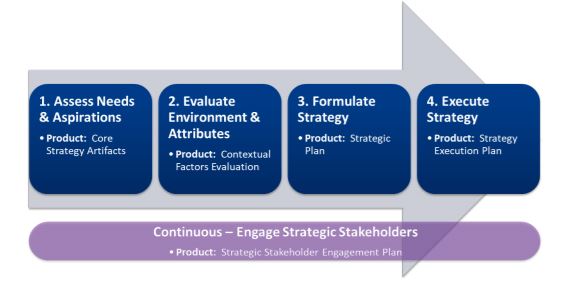
The 4 Phases of Strategic Planning
|
|
The phases of Evans' Strategic Planning are:
|
|
This
Thrive focuses on the
execution, but if you want the learn more about the other phases, click the button below to see each step in more detail.
|
|
So your strategic plan is set, but are you prepared to implement it?
If you’ve made it this far, you’ve probably figured out that the value of strategic planning lies in the exercise, not just the result. Ideally, the planning process has helped you to better understand what’s unique about your organization and its vision, and to gain clarity about the challenges and opportunities you’ll be facing in the coming years. Equally as important, hopefully you’ve taken the opportunity to
craft your plan with the input of key people throughout your organization who you’ll be relying on to turn your plan’s words into reality.
However, even the best articulated plan can be derailed if your strategy isn’t decomposed into manageable pieces of work. This is where
the creativity and ambition of your strategic goals must be translated into tasks with budgets and schedules, supported by an intelligent performance measurement process. During execution, your executive and creative teams will need the full buy-in of your finance and operations resources, so your plan needs to be rewritten in their language.
It helps to think of each task as a different type of work:
- business process improvement
- change management
- strategic communications
- optimized management practices (including risk management)
- development of high-performing teams, and more!
|
|
"If you fail to plan,
you are planning to fail."
~ Benjamin Franklin
|
|
For the strategy to be carried out, first you may need to adjust workflows, restructure organizational units, or implement new management standards.
Don’t rush to do all of the work concurrently. Take a deep breath and a more prudent approach, separating each task, managing it through completion, then reevaluating the remaining work using agile principles. Ensure that each task can be traced to fundamental strategic goals and tie both individual and group performance to their achievement.
Of course, completing a series of tasks and milestones is not enough to truly understand if your strategy is working, so
it’s also important to track quantitative (e.g., financials)
and qualitative data (e.g., employee satisfaction or brand perception) to comprehensively gauge the positive impact of strategic change, then determine whether to re-calibrate over time.
It's also important to understand, like we do at Evans, that
the success of a strategy ultimately depends on the people involved, and not just those at the top of an organization, although that's a great start! This means stakeholder engagement should be a priority, but what is "stakeholder engagement"? Essentially this means making sure those involved and affected by any change have a chance to voice any concerns and participate in decisions that involve them. It also makes sure the people involved are set up for success and have the understanding, training and resources needed to thrive in their new situation. Evans Incorporated takes this human-centered approach in all of our work and also within our organization.
Investing in your people is imperative to the success of any initiative!
|
|
Strategic thinking can be applied in any context – business or personal.
Keeping in mind how important it is to collaborate with the right people as you craft your strategic approach, let’s explore the path to put your goals into action:
Think of one
strategic goal
that requires others' participation for its success.
It can be a professional goal, for either your organization or yourself, or even a goal in your personal life, but the key is that you identify who else needs to be involved to help you attain it.
Break that goal into a few
strategic initiatives
, the SMART actions that you take to drive toward your goal.
Remember, SMART actions are Specific, Measurable, Attainable/Actionable, Realistic/Relevant, and Time-bound.
Finally, think about the people involved in each
strategic initiative
, and outline how you can include their perspectives, giving them a voice in each step.
This will ensure those involved in your goal feel they have the opportunity to participate. This will act to increase their ownership in the goal and will improve the chance of success of your (now collective) goal.
|
|
What better way to inspire you to thrive than to hear about real people making it happen? And what better way to learn about Evans than to make those real people Evans employees and partners?
|
|
Meet Jesse Lambert:
Our In-House Strategy Expert!
|
|
Jesse with his wife Bruna and newborn son Lucas
|
|
At its core, strategy is about establishing the context and purpose for action.
My best laid plans always come apart when I rush into action without that context and purpose, or I fail to talk things through with wife, my colleagues, my friends, etc. When we take the time to think strategically, we execute with more consistency and intention. This amplifies the impact we can have – in our family lives, careers, and beyond.
To kick-start strategy execution with your team, I like these conversation starters:
- Validate whether your current strategic plan is good-to-go by taking a close read yourself, then chatting with your colleagues. See if they were part of its development, get a sense of whether they’re familiar with the underlying mission and vision, and try to identify any holes or weaknesses in terms of external factors (e.g., competition, technology developments) or internal attributes (e.g., workforce needs, leveraging strengths or shoring up weaknesses).
- Talk to your colleagues about past internal activities to change your organization (e.g., organizational realignments, addition of a new capability, merging of two business units). Then research lessons learned from those change initiatives to apply to your strategy effort. Maybe certain parts of your organization have historically been more averse to change then others, so an early campaign to get those stakeholders on-board might be worthwhile.
- Look into software tools that can help you with project management and performance measurement in the context of strategy. An intuitive dashboard that enables you to tie your vision and strategy to executable tasks will help embed strategy into your daily work, so it feels less abstract and more attainable.
Do you want some more guidance and help to implement or plan your strategy?
Contact me directly and I'd be more than happy to help make your vision a reality.
|
|
The Evans Thrive Team
(Nicole, Kaitlin, Laura, Bob, and Sean)
|
|
|
What would you like to learn about in the next Thrive in Five? We want to know!
|
|
Business Process Improvement 101- What is it?
|
|
|
|
|
Improve Business Processes- Where to Start?
|
|
|
|
|
Efficiency: Focal Points for Maximum Improvement
|
|
|
|
|
|
|
(This image was adapted from a commonly shared internet image.)
|
|
All Rights Reserved © 2018 Evans Incorporated
|
|
|
|
|
|
|