Why We Must Protect Science - For People with TMDs and Beyond | | |
A recent article in The Guardian told the story of a patient living with a little-known but life-altering medical condition—one that most people don’t understand, that many doctors fail to diagnose, and that science has too often ignored. As we read it, one truth became heartbreakingly clear: they could have been writing about Temporomandibular Disorders (TMDs).
We saw ourselves in every line. The pain that disrupts daily life. The frustration of being dismissed or misdiagnosed. The financial strain of out-of-pocket treatments that insurance won’t cover. The longing for research, for answers, for hope. And the deep fear that efforts to dismantle science-based public health institutions—like the National Institutes of Health (NIH) and Food and Drug Administration (FDA)—could erase the few gains we’ve fought so hard to achieve.
This is not just their story. It is ours, too. As patients with TMDs, families, and advocates, we know the cost of medical and dental invisibility. That’s why we’re sharing this article with you—not to focus on one condition, but to illuminate the broader crisis that unites so many of us living with poorly understood disorders. We must raise our voices to protect the science, research funding, and regulatory oversight that could finally bring relief to those who have waited far too long.
We urge you to read this article. The first page alone should alarm you to the dire prospects for biomedical science in our country and renew your resolve: to advocate, to educate, and raise your voice to be heard.
"Since Robert F Kennedy Jr assumed control of the US health department in February, with a mandate to “[lower] chronic disease rates and [end] childhood chronic disease”, he has moved quickly to remake the US’s federal health infrastructure. But the Trump administration’s actions on medical research are already threatening that goal – and could end medical progress in this country for good.
Kennedy’s office oversees the National Institutes of Health, the control center of disease research in the United States. Kennedy’s agency has killed almost 800 active projects, according to Nature, affecting medical research into HIV/Aids, diabetes, women’s health, heart disease, cancer, Alzheimer’s and more. The administration wants to cut the NIH’s budget up to 40% while consolidating its 27 agencies – separated by disease area – into just eight. Elon Musk’s Doge has been reviewing previously awarded grant funding, reportedly requiring researchers to explain how they are using their grants to advance the Trump administration’s political goals. (Audio obtained by the Washington Post suggests this “Defend the Spend” initiative may be a smokescreen, with one NIH official admitting: “All funding is on hold.”) Separately, Donald Trump has aggressively targeted universities such as Harvard and Columbia over alleged antisemitism and diversity initiatives, using federal contracts that fund research as leverage. And just recently, the NIH passed a new rule banning any university from receiving future federal grants if the universities use DEI programs or boycott Israeli firms." The Guardian Click here to read more
| | Speak Up for TMD Research Funding! | | |
We need your voice—now more than ever—to advocate for not only sustained, but increased, federal research funding for Temporomandibular Disorders (TMDs), a group of conditions that affects millions yet remains significantly underfunded.
Taking action is quick and easy:
Help Advance Research for Temporomandibular Disorders – Your Voice Matters Now
Please note: We’ve revised our approach after learning that some elected officials may not count prewritten/form letters. Instead, we are providing suggested talking points to help guide you in writing a personalized message to your elected officials. Your unique voice can make a difference.
| | Rethinking the Role of the TMJ Disc in Jaw Disorders: Insights from Recent Research | | |
A recent article in CRANIO, “The temporomandibular joint disc: A complex fable about an elusive butterfly” by Louis G. Mercuri, Charles S. Greene, and Daniele Manfredini, published on April 10, 2025, challenges long-standing beliefs about the temporomandibular joint.
Understanding the TMJ and Its Disc
The temporomandibular joint connects the jawbone to the skull and includes a small soft tissue disc that acts as a cushion and shock absorber between the bones. Historically, misalignment or displacement of this disc has been thought to cause Temporomandibular Disorders (TMDs), leading to treatments aimed at repositioning the disc.
Shifting the Focus: Synovitis Over Disc Position
The authors argue that inflammation of the joint lining, known as synovitis, especially when it becomes chronic, is a more significant factor in TMJ pain and dysfunction than disc position. This perspective suggests that treatments should prioritize reducing inflammation rather than correcting disc alignment.
Implications for Treatment
Recognizing synovitis as a primary cause of symptoms of TMDs encourages the use of non-invasive, conservative treatments focused on managing inflammation. This approach may help patients avoid unnecessary and potentially irreversible and costly procedures aimed at repositioning the TMJ disc.
Conclusion
This research invites both healthcare providers and patients to reconsider the emphasis placed on TMJ disc position in diagnosing and treating TMDs. By focusing on inflammation management, there is potential for more effective and less invasive treatment options.
| | New Imaging Sheds Light on Jaw Pain in the Initial Stages | | |
A study published in the December 2024, issue of PAIN by Son H, Shannonhouse J, Zhang Y, et al., "Elucidation of neuronal activity in mouse models of temporomandibular joint injury and inflammation by in vivo GCaMP Ca2+ imaging of intact trigeminal ganglion neurons" offers promising insights into how nerve cells may be driving jaw pain in Temporomandibular Disorders (TMDs).
Researchers used an advanced imaging technique, GCaMP calcium imaging, to monitor the activity of trigeminal ganglion neurons—the nerve cells that carry pain signals from the face—in live mice following jaw joint injury and inflammation. This allowed them to observe how these cells respond to jaw damage in real time.
What They Found
- Jaw injury and inflammation led to increased and abnormal nerve activity.
- These changes may help explain why some people experience long-lasting or heightened jaw pain.
Why It Matters
By understanding the specific nerve responses involved in TMDs, scientists can work toward developing more targeted, effective treatments that go beyond managing symptoms—and instead address the root cause of the pain.
| | How Two Nerve Systems Interact to Fuel TMJ Osteoarthritis Pain | | |
A team of scientists from Airforce Medical University in China has made a discovery that helps explain why TMJ osteoarthritis (TMJ-OA) is a severe form of TMD. Their study, Effect of regional crosstalk between sympathetic nerves and sensory nerves on temporomandibular joint osteoarthritic pain, published in the International Journal of Oral Science, highlights the role of the sympathetic nervous system in TMJ pain.
The TMJ is different from other joints in the body because it develops from nerve-associated embryonic tissues, rather than the more common mesoderm, the embryonic cell layer which gives rise to muscle. This has led scientists to classify the TMJ as a “neurogenic joint,” meaning it is highly influenced by nerve activity.
The Role of Sympathetic Nerves in TMJ Pain
The study found that the sympathetic nervous system, which controls involuntary functions like heart rate and blood pressure, plays a crucial role in TMJ-OA pain. Researchers discovered that sympathetic nerves in the TMJ releases norepinephrine (NE), which can trigger the growth and activation of sensory nerves. This interaction between the sympathetic and sensory nerves increases pain signals, making TMJ-OA pain.
Why Does This Matter?
This discovery provides a new explanation for why TMJ pain can be so persistent and difficult to treat. By targeting the interaction between sympathetic and sensory nerves, future treatments could be developed to better control or even prevent TMJ-OA pain.
Potential New Treatment Approaches
Now that researchers understand how sympathetic nerves contribute to TMJ pain, they can explore new treatments to block or reduce this nerve activity.
This could include:
- Medications that target nerve signaling
- Therapies that reduce norepinephrine levels
- Nerve-blocking techniques to prevent excessive pain signals
While these treatments are still in development, the findings offer hope for people who suffer from chronic TMJ pain.
Looking Ahead
The discovery of dual nerve system involvement in TMJ pain represents a major step forward in understanding and treating TMJ-OA. As research continues, scientists are optimistic about developing targeted therapies that could significantly improve pain management for patients.
| | Breakthrough in Pain Research from Stanford University Medical School | | |
Researchers at Stanford Medical have made a significant model that could transform how we understand and treat pain. In an innovative study, the scientists successfully recreated a key nerve pathway responsible for sensing pain — all within a laboratory dish.
Recreating the Human Pain Pathway
This recreated pathway mimics how signals travel from the skin to the brain, where they are processed to give rise into the sensation we recognize as pain. Traditionally studied using animal models, pain signaling has been hampered by differences between species. But now, with a human-based lab model, researchers can explore these signals with greater accuracy.
A Miniature Nervous System, Built in the Lab
Led by Dr. Sergiu Pasca and published in Nature on April 9, the study marks the first time scientists have successfully assembled a human-derived system that replicates the full pain-signaling pathway. This lab-grown model includes all four key components that work together to transmit pain signals from the body to the brain:
-
Dorsal Root Ganglion (DRG): A cluster of sensory nerve cells located in the peripheral nervous system. These cells are the first to detect pain signals from the skin, muscles, and other tissues.
-
Spinal Cord (Second-Order Neurons): Pain signals from the DRG are transmitted to second-order neurons located in the spinal cord, which then relay the signals upward.
-
Thalamus: The third stop is the thalamus, a key relay station in the brain that processes and routes sensory information, including pain.
-
Somatosensory Cortex: The final connection where the brain interprets incoming signals as the conscious perception of pain.
“For the first time, we can watch pain signals travel through this whole pathway outside the human body,” said Dr. Pasca, who directs Stanford’s Brain Organogenesis Program. “This could help us discover better ways to treat pain disorders.”
A Compassionate Step Forward
Importantly, this model allows scientists to observe how pain signals move through the nervous system — without the system actually feeling pain. This makes it a powerful, humane alternative to traditional models, aligning scientific progress with compassion.
Leading the Way
The research was conducted by postdoctoral scholars Dr. Ji-il Kim and Dr. Kent Imaizumi, under the guidance of Dr. Pasca. Their work is part of Stanford’s ongoing commitment to advancing neuroscience through innovative technologies.
A Hopeful Future for People in Pain
This new tool will allow deeper understanding of chronic pain and more targeted treatments. For the millions living with pain disorders, it represents hope — hope for faster discoveries, more effective therapies, and improved quality of life.
Watch a short video summarizing this work here:
| | Ehlers-Danlos Syndromes: A Common Overlap with Temporomandibular Disorders | | |
May is Ehlers-Danlos Awareness Month
This month, we’re highlighting the important connection between Ehlers-Danlos Syndromes (EDS) and Temporomandibular Disorders (TMDs). While painful conditions like fibromyalgia and irritable bowel syndrome are often seen alongside TMDs, research has shown that connective tissue disorders—particularly EDS—are also more common among TMD patients than previously understood.
EDS, which affects an estimated 7 million Americans, is a group of inherited disorders that impact connective tissue. It is characterized by symptoms such as joint hypermobility, fragile skin, and tissue fragility, often accompanied by chronic pain. These connective tissue differences can contribute to joint instability and dysfunction—including in the jaw—placing individuals at increased risk for TMDs.
Lisa Schmidt, TMJA Board Member and patient advocate, was diagnosed with EDS at age 47. Her tireless advocacy earned her an invitation to speak at The Ehlers-Danlos Society’s Global Learning Conference in August 2022, where she helped raise awareness about TMDs within the EDS community. During her presentation, Lisa shared her personal journey living with both conditions, highlighting the overlapping challenges and underscoring the urgent need for greater awareness and collaboration across patient communities. Click here to watch Lisa’s presentation
| | Shared Genetics Found Between Migraine and Digestive Disorders: A Connection Relevant to Those Living with Temporomandibular Disorders | | |
We are sharing this article because migraine headache and digestive disorders often occur along with TMDs. We hope this information will provide greater insight and support to those living with these conditions.
A recent study, "Shared Genetics of Migraine and Gastrointestinal Disorders Implicates Underlying Neurologic Mechanisms Yet Heterogeneous Etiologies" by Chasman, D. I., Guo, Y., Chan, A. T., Rist, P. M., & Staller, K. (2024), published in Neurology: Genetics, has uncovered an important connection between migraines and several gastrointestinal (GI) disorders, including irritable bowel syndrome (IBS), gastroesophageal reflux disease (GERD), and peptic ulcer disease (PUD).
Genetic Overlap Suggests Common Root Causes
By analyzing data from large-scale genetic studies, researchers discovered that migraines and non-immune-related GI conditions share common genetic factors. The strongest link was found between migraine and IBS. In practical terms, this means that individuals with a genetic tendency toward migraine may also be at increased risk for experiencing GI issues such as IBS, GERD, or PUD.
The Nervous System at the Center
The study highlights the involvement of the central nervous system (i.e., the brain and spinal cord) in both migraine and these GI conditions. Specific genes connected to nervous system function were identified as being associated with both types of disorders. This finding adds to growing evidence that the gut and brain are closely connected — sometimes referred to as the "gut-brain axis."
Could Digestive Issues Trigger Migraine?
Interestingly, the research suggests that GI conditions may not only be associated with migraine, but might also play a role in triggering them. This opens the door to the possibility that treating digestive issues could help reduce migraine symptoms — a promising direction for future therapies.
Hope for Holistic Treatments
Understanding the shared genetic and neurologic mechanisms between migraine and GI disorders could lead to more holistic treatment approaches that address both sets of symptoms. For those living with both conditions, this integrated approach could mean better symptom control and improved quality of life.
A Step Forward for Millions
Millions of people suffer from both migraine and GI disorders. This new understanding of their genetic and neurologic overlap brings hope for future therapies that target the root causes — not just the symptoms — of these life-disrupting conditions.
| | |
Hello everyone. My name is Foram, and I am from India. I am a technical research analyst in the stock market and an entrepreneur. Today, I want to share my journey with TMJ dysfunction, hoping it will inspire and help those who are navigating similar challenges.
For several years, I experienced unrecognized jaw pain. When I initially shared my discomfort with my family, they, like me, didn’t understand the underlying issue. It wasn’t until 2021-22, when I could no longer enjoy a favorite Indian snack—pani puri—that I realized something was seriously wrong. My family and I turned to online research and discovered TMJ dysfunction.
I consulted a maxillofacial surgeon in Mumbai, who recommended several diagnostic tests. Surgery, the doctor explained, wasn’t the best option. The condition could be attributed to various factors like childhood braces, trauma, clenching, or stress. An MRI confirmed disc displacement on both sides of my jaw—the left side was in an advanced stage, while the right was in an intermediate stage.
Seeking a second opinion, another doctor advised making lifestyle adjustments. Following this advice, I left my stressful corporate job to start working independently. I made significant changes, such as avoiding hard foods and actively reducing stress, which provided noticeable pain relief.
However, the journey wasn’t without setbacks. In 2024, I began experiencing frequent ear infections and constant ringing sounds—complications linked to TMJ. By November, the pain intensified, radiating to my neck and spine. Physical activities like exercising or carrying heavy objects became impossible. A new MRI revealed further degeneration in my jaw joints over three years. Additional tests, including X-rays, highlighted spinal misalignment and spasms in my neck and back, alongside widespread inflammation caused by years of neglecting the condition.
I also underwent a test related to arthritis, which came back positive. This has prompted further investigations into the condition. I began physiotherapy, which has been instrumental in managing the pain and improving mobility. This journey has taught me invaluable lessons:
- Stress Management: Reducing stress is critical for those with TMJ dysfunction. It’s a major factor in pain management and overall well-being.
- Lifestyle Adjustments: Small but consistent changes, such as avoiding hard foods and incorporating basic mobility exercises, can significantly improve quality of life.
- Timely Intervention: Ignoring early symptoms can lead to more severe complications. Seeking medical advice early is vital.
Living with TMJ dysfunction requires resilience, but it is manageable. With the right lifestyle changes and support, it is possible to lead a fulfilling life.
I hope my story resonates with and inspires others who are coming to terms with TMJ. Remember, small steps can make a big difference.
Warm regards,
Foram
| | Research Studies Recruiting Patients | | |
University of Connecticut School of Dental Medicine (Participate In-Person)
This federally funded research project provides non-surgical treatments to persons with pain in the area of the temporomandibular joint. The purpose is to test a new treatment approach. All volunteers will get an X-ray of the face. They will also receive a splint (a mouth guard) and non-steroidal anti-inflammatory drugs (like Advil), and weekly monitoring, as well as additional instruction in coping and managing the pain of temporomandibular dysfunction.
Those eligible for participation must meet the following conditions:
• TMD-related pain for at least 3 months.
• Must live in proximity to UConn Health, Farmington, CT, to allow for treatment, progress monitoring, and follow-ups.
To view the patient consent form, click here. Call 860-679-2745 for more information or visit: https://health.uconn.edu/dental/patient-services/oral-and-maxillofacial-surgery/tmj-treatment/.
| | Middlesex University, London and Uppsala University, Sweden (Participate Online) | | |
The TMJ Association was invited to help share a research opportunity for adults living with fibromyalgia.
A team of researchers from Middlesex University and Uppsala University, collaborating with experts from multiple institutions, is conducting an online survey to better understand fibromyalgia and its connection to gastrointestinal conditions. If you have been diagnosed with fibromyalgia, you are encouraged to participate by completing the survey here: https://eu.surveymonkey.com/r/WXGS5PR
Your input could provide valuable insights that may improve care and support for those affected by fibromyalgia.
| | |
University of Belgium (Participate Online)
A research team from the Faculty of Rehabilitation Sciences of Hasselt University in Belgium is investigating the relationship between the intensity of daily physical activity and chronic musculoskeletal pain. They will be looking at fibromyalgia, chronic temporomandibular disorders, osteoarthritis, chronic neck pain, chronic shoulder pain, and chronic low back pain. The study involves an online survey which will take approximately 50 minutes to complete. More details and a link to the study is available at: https://uhasselt.qualtrics.com/jfe/form/SV_etl78e58y2YeUDQ
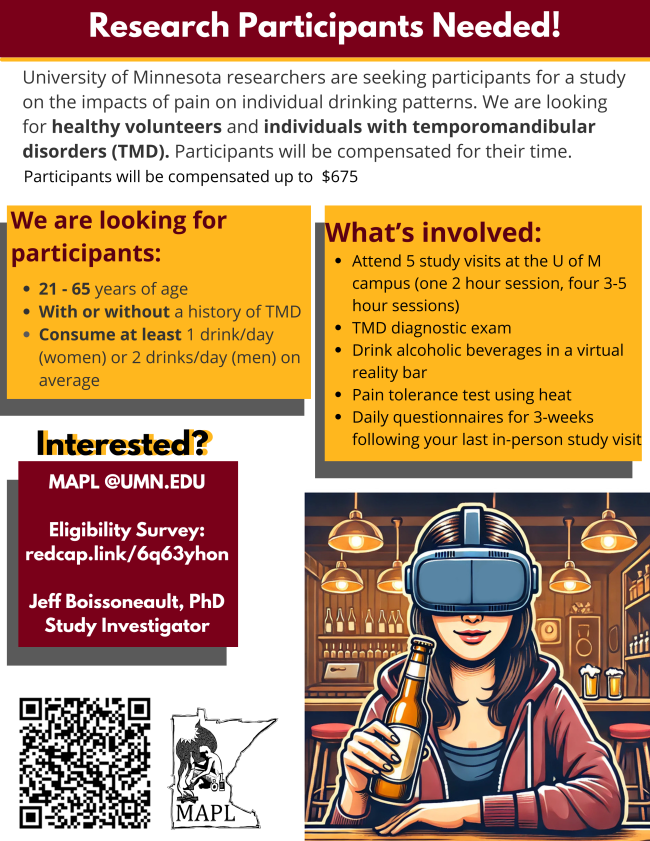
| | University of Minnesota (Participate In-Person) | | |
Emory University (Participate In-person)
Researchers at Emory University in Atlanta are in need of patients with temporomandibular disorders (TMDs) to participate in their study. They are investigating people who experience chronic pain in the head and/or face in everyday life. They are using unique tests to find out how the brain processes chronic and acute pain messages and will observe patients to see how pain and sensory processing differs in TMDs. Click here to view the informed consent form for this study. Contact Daniel Harper, PhD (Principal Investigator) at 404-727-7789 or daniel.harper@emory.edu with any questions and to participate.
| | |
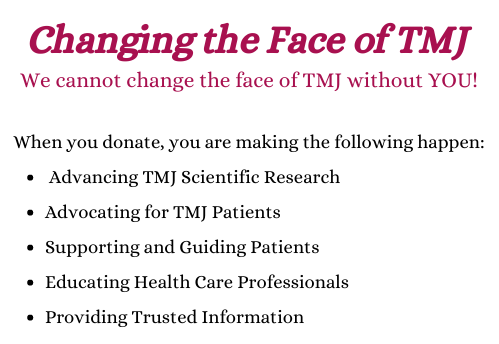
The TMJ Association is the ONLY patient advocacy organization fighting for the best science that will lead to a greater understanding of Temporomandibular Disorders and related conditions, as well as treatments that will help and not harm patients.
We cannot change the face of TMJ without YOU. Make a tax-deductible contribution today! Your contribution is more than a donation. It is how we will ensure that patients with TMDs have a voice — through education, patient support and advocacy.
We cannot do this important work without you! Thank you for your generosity.
| | |
About The TMJ Association ... Changing the Face of TMJ
The TMJ Association, Ltd., is a nonprofit, patient advocacy organization whose mission is to improve the quality of health care and lives of everyone affected by Temporomandibular Disorders (TMDs, aka "TMJ"). For over 35 years, we have shared reliable information on TMDs with people like you. We invite you to visit our website, www.tmj.org.
| | |
The TMJ Association, Ltd., P.O. Box 26770, Milwaukee, WI 53226
info@tmj.org | www.tmj.org
The TMJ Association, Ltd., is a nonprofit 501(c)(3) tax-exempt organization.
Copyright © 2025. All Rights Reserved.
| | | | |