TMJ News Bites

Issue 4, 2025

Living with Temporomandibular Disorders:

Why We Need Research

By Lisa Schmidt, TMJ Patient and TMJA Board Member

We often hear from patients who are frustrated and confused:


“Why is there a mystery around temporomandibular disorders (TMDs)? Who treats it? How is it treated? It causes real pain and is an important joint in the body—used every day to eat, sleep, and talk. Help me understand this problem.”


These questions are valid, and they reflect what so many patients living with TMDs experience: real pain, real disability, and far too little clarity from the healthcare system.


Living with the Complexity of TMDs Can Be Burdensome

Living with the complexity of TMDs can be burdensome, forcing patients to bear a significant emotional toll. Many patients feel frustrated and overwhelmed by too many treatment options, often unsure of which path to take. TMDs have long been misunderstood and neglected in research.


Why Do We Deserve Better Science?

You would think that a joint crucial to eating, speaking, and daily living would be prioritized in research; TMDs have historically been under-researched compared to other joints.


One contributing factor is that TMDs disproportionately affect women, and conditions affecting women have often been neglected and underfunded in scientific research. Women with chronic pain are frequently not taken seriously by medical and dental professionals, further hindering research progress. Unfortunately, some researchers and clinicians continue to attribute TMD symptoms solely to stress, anxiety, or clenching. This oversimplifies the condition and discourages further research.


TMDs deserve better science because this is a complex condition that can impact the joint, muscles, and nerves. Many times, systemic issues are involved in the disease process, such as connective tissue disorders (e.g., Ehlers-Danlos syndrome), fibromyalgia, rheumatological conditions such as rheumatoid arthritis, and other autoimmune conditions, as well as trauma. There are also many overlapping pain conditions. This complexity makes it hard to study TMDs.


Currently, there are no widely accepted diagnostic standards for TMDs, which makes it a challenging problem to study. There is no medical specialty that “owns” this condition. Instead, TMDs sit in the chasm between dentistry and medicine. Many different types of dentists claim to be “TMJ specialists,” each with their beliefs and methods for treatment. Because dentists are often the primary providers for TMD care, the condition remains somewhat separated from broader medical research efforts.


What Is Evidence-Based Medicine?

Evidence-based medicine is what healthcare providers and insurers use to make decisions. They incorporate the best available scientific research, along with their own expertise and their patients' preferences.


Evidence-based medicine is not determined by a provider’s personal beliefs or individual experiences in treating TMDs; that approach is unscientific. Carefully designed studies with large numbers of patients provide the data needed for valid statistical analysis of outcomes. That is what is referred to as "evidence-based science." Without this, patients often undergo unnecessary and sometimes invasive treatments that can lead to harm.


Why Is Science So Slow?

Scientific studies, especially clinical research, are slow and difficult. A study often requires multiple collaborations among researchers, patient follow-up, and extensive data analysis. All of this takes years and requires considerable funding, most of which must be procured through grants from the National Institutes of Health (NIH).


Another reason specifically related to TMDs is that the National Institute of Dental and Craniofacial Research (NIDCR), a division of NIH, has historically underfunded research on TMDs. This has led to fewer studies, slower progress in developing evidence-based treatments, difficulty determining root causes, and an increased burden on patients.


Additionally, research is often siloed, meaning that different researchers study different aspects of TMDs in isolation.


Overall, research is slow and challenging, but necessary. Every step forward in scientific research can lead to meaningful change for patients.


How Registries Help: Turning Patient Experience into Data

The TMJ Association, in collaboration with patients, healthcare providers, the Food and Drug Administration (FDA), and the National Institutes of Health (NIH), has been working to develop a national registry for individuals with TMDs.


A medical registry collects long-term patient data on a condition. For TMDs, it could track patient demographics, TMDs onset and severity, diagnostic methods (e.g., imaging), treatments received (e.g., splints, Physical Therapy, or surgery), and treatment outcomes over time, such as pain reduction, jaw function and quality of life. It could also capture comorbid conditions such as chronic pain disorders, anxiety, or sleep disturbances.


Such a registry can uncover meaningful patterns in patient experiences and responses to treatment in the broad population. Registries also promote collaboration among providers and ultimately help standardize care, reduce reliance on trial-and-error approaches, and advance the development of evidence-based treatments. The data in such registries provides clues which can serve as hypotheses for exploring causal factors leading to TMDs.


How Patients Can Make a Difference

Patients can make a huge difference in the future of scientific research on TMDs by participating in registries and sharing their experiences with scientists. Congressional leaders need to understand why more research funding is needed to support evidence-based care. By staying informed, patients are empowered to thereby influence our funding agencies.


A Better Future for Care

Progress is happening. This month, two large national research center grants, called the IMproving PAtient-Centered Translational Research (TMD IMPACT) grants, will be awarded. These funding opportunities, supported by the NIH and FDA, will help researchers better understand TMDs, uncover its root causes, develop new treatment options, improve diagnostic tools, conduct long-term outcome studies, and advance multidisciplinary care.


While scientific research takes time, it is moving forward, and it is moving because of you: the patients who speak out, participate in research, and advocate for change, and by supporting The TMJ Association. Tools like the TMDs patient registry represent a critical step toward gathering the data needed to drive real, evidence-based progress.


Together, we are building a future where TMDs are finally understood, respected, and effectively treated.

Columbia Builds a TMJ "Joint-on-a-Chip"

Chang Lee PhD

A recent news article published by Columbia University highlighted an exciting advancement in TMJ research: “Columbia Researcher Awarded NIH Grant to Advance TMJ ‘Joint-on-a-Chip.’” Chang Lee, PhD, associate professor of craniofacial engineering at Columbia University’s College of Dental Medicine, has received a $3.8 million, five-year grant from the National Institute of Dental and Craniofacial Research (NIDCR) to develop the first-ever “TMJ-on-a-chip.”


What Is an “Organ-on-a-Chip”?

An organ-on-a-chip is a miniature human body part built using living human cells and tiny channels that allow fluids to move through it, much like blood flows in the body. Scientists use these chips to mimic how an organ works, which helps them study disease and test treatments without needing to rely only on animal models or invasive procedures.


Why This Matters for TMJ Patients?

  • The TMJ-on-a-chip will enable researchers to see how jaw disorders begin and progress.
  • Therapies can be tried on the chip before moving into experimental animal and clinical studies, lowering risks for patients.
  • Because the model can be made from a patient’s own cells, it could one day help doctors design treatments tailored to individual needs.
  • Hope for new therapies: The chip expands the field, allowing therapies to be tested and applied at various stages of disease.

Patterns of Pain Can Yield More Precise Care

Living with temporomandibular disorders (TMDs) can mean constant jaw pain, headaches, and difficulty with simple daily tasks like eating or speaking. A new study provides encouraging insights into why this pain happens and where new treatments may result.


In the December 2024 issue of PAIN, Hyeonwi Son, John Shannonhouse, Yan Zhang, Ruben Gomez, Felix Amarista, Daniel Perez, Edward Ellis, Man-Kyo Chung, and Yu Shin Kim (from the University of Texas Health Science Center at San Antonio, and University of Maryland at Baltimore) looked closely at how nerve cells in the face of a mouse model react to jaw injury and inflammation.


What They Found

  • Overactive: The study showed that jaw injury and stress cause the nerves that sense pain in the face to “fire” more easily.


  • Pain Spreads: Nerve changes spread to other facial areas, helping explain why TMD pain often radiates into the head and face.


  • New Treatment Possibility: A medication that blocks a pain-related pathway called CGRP (Calcitonin Gene-Related peptide) already used in migraine care reduced some of this nerve overactivity, pointing to a possible new TMD therapy.


Why This Matters

By watching nerve cells in action, scientists can see why TMDs pain can be so widespread and stubborn and, importantly, how it might be stopped. Treatments that target the same pathways already helping migraine patients might help TMDs.


Source
Son H, Shannonhouse J, Zhang Y, Gomez R, Amarista F, Perez D, Ellis E, Chung MK, Kim YS.
Elucidation of neuronal activity in mouse models of temporomandibular joint injury and inflammation by in vivo GCaMP Ca 2+ imaging of intact trigeminal ganglion neurons. Pain. 2024 Dec 1;165(12):2794-2803. doi: 10.1097/j.pain.0000000000003421. Epub 2024 Oct 1. PMID: 39365648; PMCID: PMC11562762.

Why Pain Feels Different for Everyone

In July 2025, The Guardian’s Celina Ribeiro (Sydney, Australia) explained why pain is never “one-size-fits-all.” The brain, emotions, past experiences, and life circumstances shape how each person feels pain. Two people with the same condition may report very different levels of suffering, and both are real.


For TMJ patients, this science matters. It validates what many already experience: jaw pain is not just physical but deeply personal. That’s why a biopsychosocial approach, treating stress, mood, and social support alongside jaw care, is essential for better outcomes.


Source

Ribeiro, C. (2025, July 14). The fascinating science of pain – and why everyone feels it differently. The Guardian. https://www.theguardian.com/australia-news/2025/jul/14/the-fascinating-science-of-pain-and-why-everyone-feels-it-differently

Patient Spotlight: Meet Christie

I was first diagnosed with TMJ at the age of 21, though my symptoms began when I was 18. Today, I am 39 and still living with this condition.


When I first sought help, a TMJ doctor recommended braces. I wore them for many years, which put my family in debt. When the braces finally came off, nothing had improved.


Over time, my pain has only gotten worse. I can’t function the way I used to, and along the way, I also developed fibromyalgia. Now my joints are bone-on-bone. The pain is unbearable.


Without the funds to pursue further treatment, I feel stuck. My condition continues to decline, but the cost of care is simply out of reach. If you’ve been through this, you know how isolating it feels. 

Patients as Partners in Clinical Research: NIH Draft Report Released

We’re excited to share that the National Institutes of Health (NIH) has released a landmark draft report outlining a new Framework for Clinical Research Engagement.


Co-chaired by Christin Veasley, Co-founder and Director of the Chronic Pain Research Alliance (an initiative of The TMJ Association), the report reflects a two-year effort by a national working group of 21 experts, including patient advocates, community members, clinicians, researchers, and nonprofit leaders.


Informed by public input - including written comments, an online listening session, and six in-person Community Conversations across the US - this initiative presents the first NIH-wide vision and framework to transform clinical research from a model where studies are designed and conducted solely by researchers to one in which researchers and patients collaborate at every stage, from planning through dissemination.


The report also includes bold recommendations to tackle key barriers - such as limited funding, training gaps, and organizational challenges - so that NIH can fully realize this vision and make meaningful bi-directional engagement a standard part of every NIH-funded clinical study.


If adopted, these recommendations have the potential to transform clinical research to be a more team-oriented and inclusive process - one that better reflects the needs, priorities, and real-life experiences of the patients it is meant to help. This shift will help rebuild and sustain trust, make research more impactful and accountable, and accelerate the translation of scientific discoveries into better health for communities that need them most.


You can read or download the draft report here.


Public comments on the report may be submitted via email (SciencePolicy@od.nih.gov) by Wednesday, September 24, 2025, 5 PM EST.


Co-chairs Christin Veasley, BS, and Suzanne Bakken, PhD, RN, will publicly present the initiative and report on Monday, September 29, 2025, at 1:25 PM EST. If you would like to tune in, the agenda and videocast link are available here.

Your Trusted Source for Information on Temporomandibular Disorders

A 2020 study entitled Content and Quality Analysis of Websites as a Patient Resource for Temporomandibular Disorders looked at websites providing information on temporomandibular disorders (TMDs) and found that the overall quality was low to moderate. Many sites were missing important details—like who wrote the content, when it was last updated, or references to reliable sources. Key information about TMDs was often incomplete, and some sites could even be misleading.


At The TMJ Association, we make sure all our materials are reviewed by scientists and patients so that patients and providers can trust the information we share—it reflects both the latest science and the real experiences of people living with TMDs.

The TMJ Association is the ONLY patient advocacy organization fighting for the best science that will lead to a greater understanding of Temporomandibular Disorders and related conditions, as well as treatments that will help and not harm patients.


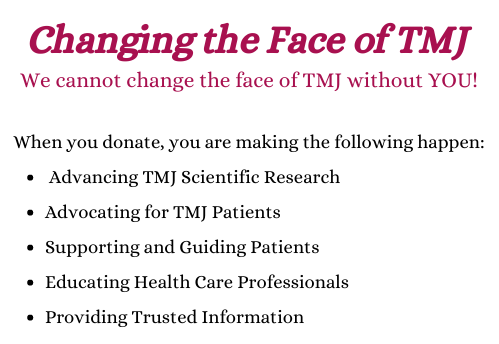
We cannot change the face of TMJ without YOU. Make a tax-deductible contribution today! Your contribution is more than a donation. It is how we will ensure that patients with TMDs have a voice — through education, patient support and advocacy.


We cannot do this important work without you! Thank you for your generosity.


About The TMJ Association ... Changing the Face of TMJ


The TMJ Association, Ltd., is a nonprofit, patient advocacy organization whose mission is to improve the quality of health care and lives of everyone affected by Temporomandibular Disorders (TMDs, aka "TMJ"). For over 35 years, we have shared reliable information on TMDs with people like you. We invite you to visit our website, www.tmj.org.

 
Facebook  Linkedin  Instagram

The TMJ Association, Ltd., P.O. Box 26770, Milwaukee, WI 53226 

info@tmj.org | www.tmj.org 

The TMJ Association, Ltd., is a nonprofit 501(c)(3) tax-exempt organization.

Copyright © 2025. All Rights Reserved.