Advancing TMD Pain Research: NIH-Funded Study Explores New Paths to Non-Opioid Treatments | | |
A major new investment in chronic pain research is helping advance the understanding of temporomandibular disorders (TMD) and other painful conditions that affect millions of people worldwide. Back pain remains the most commonly reported chronic pain condition, followed closely by head and face pain associated with TMJ disorders, highlighting the significant impact these conditions have on daily life.
At The University of Texas at San Antonio, researchers led by Armen N. Akopian are continuing work supported by a five-year, $9 million grant from the National Institutes of Health, specifically the National Institute of Neurological Disorders and Stroke. The project recently passed a key milestone review, allowing the team to move forward with the next phase of research as part of a national consortium studying chronic pain.
This work focuses on understanding how pain begins at the level of sensory neurons, particularly those connected to the face, jaw muscles, and temporomandibular joint. By mapping how these nerves function and change over time, researchers hope to better understand why some pain becomes chronic and persistent. The team is also studying how pain signals differ among individuals and how changes in gene expression and cellular behavior may contribute to heightened pain sensitivity.
Importantly, this research aims to identify new, targeted, non-opioid treatments for chronic pain. Current therapies often only mask symptoms and may carry risks, particularly with long-term use. By contrast, this effort seeks to address the underlying biological mechanisms that drive chronic pain, with the goal of preventing it from developing, or even resolving it once established.
For patients living with TMD and other chronic pain conditions, even modest improvements can be meaningful. This research represents an important step toward a future of more effective, personalized, and safer treatment options.
Source: University of Texas at San Antonio. “Major NIH grant renewal fuels next phase of chronic pain research at UT San Antonio.”
| | Temporomandibular Disorders: An Overlooked Epidemic | | |
Temporomandibular disorders affect an estimated 11–12 million people in the United States, often causing significant pain, disability, and reduced quality of life.* Despite the essential role of the temporomandibular joint (TMJ) in everyday functions like eating and speaking, these conditions remain underrecognized and under-researched compared with other musculoskeletal disorders. Women are disproportionately affected, and many patients experience a progression from localized symptoms to chronic, complex pain.
A major challenge for patients is the lack of coordinated care. TMDs sit at the intersection of dentistry, medicine, neurology, and pain management, yet no single specialty takes clear responsibility. As a result, patients are frequently referred between providers, often receiving inconsistent diagnoses and treatment recommendations. This fragmentation reflects longstanding structural divides in the U.S. healthcare system, particularly the separation of medicine and dentistry, which has limited access to comprehensive care, standardized diagnosis, and insurance coverage.
Patients have shared powerful accounts of this experience, describing confusion, poor communication among providers, and difficulty finding knowledgeable care. These challenges highlight the need to recognize TMDs as complex, multisystem conditions requiring coordinated, interdisciplinary management, similar to other chronic diseases.
Encouragingly, efforts are underway to address these gaps. The National Institute of Dental and Craniofacial Research, the U.S. Food and Drug Administration, and The TMJ Association are working together to build a national research infrastructure, including patient registries and collaborative networks to better understand and treat TMDs. The National Academies of Science, Engineering and Medicine have also called for integrated care models, improved education across health professions, and the development of specialized centers that combine clinical care with research innovation.
Advancing care will require sustained commitment to breaking down silos between medical and dental education, increasing research investment, and ensuring that patients receive coordinated, evidence-based treatment. Addressing these systemic issues is essential to improving outcomes and restoring quality of life for those living with TMDs.
Source: Bond EC, Cowley AW Jr. Temporomandibular disorders: An overlooked epidemic, The American Journal of Medicine, (2026).
*National Academies of Sciences Engineering, and Medicine. Temporomandibular Disorders: Priorities for Research and Care, National Academies Press, Washington, DC, 2020. Available from: https://www.ncbi.nlm.nih.gov/books/NBK557987/
| |
Standing-Room-Only TMJ Session Draws Strong Interest at Orthopaedic Research Society Meeting | | |
A major role of nonprofit health organizations like The TMJ Association is to promote awareness and research on conditions affecting a large number of patients. In keeping with this mission, TMJA President Allen Cowley and Association Administrator Deanne Clare attended the annual meeting of the Orthopaedic Research Society in Charlotte, North Carolina, on March 30 of this year.
This marked only the second consecutive year that the society included the temporomandibular joint (TMJ) in its annual meeting program. The inclusion is particularly significant because it reflects a growing recognition that the TM joint should be studied alongside other musculoskeletal joints in the body rather than a part falling solely within the traditional boundaries of dentistry. Historically, many approaches to TMJ disorders focused primarily on dental and bite relationships, including changing tooth positioning. However, the temporomandibular joint is among the most complex joints in the human body. It is a uniquely paired joint with extensive nerve involvement that plays essential roles in breathing, eating, speaking, and making facial expressions.
The standing-room-only attendance of some 150 people at the workshop reflected a clear and welcome shift to integrating TMJ research with broader musculoskeletal and chronic pain research. The featured workshop, “Decoding Musculoskeletal Pain: Advances in Imaging and Translational Tools for the Intervertebral Disc (IVD), TMJ, and Knee,” brought leading experts from across the country to discuss new approaches to understanding and treating chronic joint pain.
Organized by Kyle Allen, PhD (University of Florida); Alejandro Almarza, PhD (University of Pittsburgh), who also heads the TMJ research team awarded a five-year TMJ IMPACT grant from the National Institute of Dental and Craniofacial Research (NIDCR) at NIH; Dmitriy Sheyn, PhD (Cedars-Sinai Medical Center); and Dino Samartzis, DSc, PhD (Rush University), the session focused on the challenge of chronic pain affecting the spine, jaw, and knee, and the urgent need to turn scientific discoveries into better diagnostics and treatments.
The session also focused on a major challenge in musculoskeletal health: chronic pain affecting the spine, jaw (TMJ), and knee. While science has made important progress in understanding how these tissues become damaged, there remains a critical need to translate these discoveries into better diagnostic tools and treatments. A key area of focus was how nerve pathways signaling joint pain change over time with injury, aging, and disease.
Presenters highlighted new imaging techniques that make tissues transparent and reconstruct them in 3D, revealing previously unseen nerve networks involved in chronic pain. The workshop also showcased emerging translational research tools, including advanced animal models and laboratory systems built from human stem cells, designed to study joint injury, inflammation, and pain progression. Together, these approaches are helping bridge the gap between fundamental discoveries and real-world therapies for patients.
Speakers included Dino Samartzis, who provided an overview of spine pain research; Dmitriy Sheyn, who discussed outcomes in disc-related back pain; Candace Floyd, who described animal models of chronic pain and inflammation; Alejandro Almarza, who presented new 3D imaging methods for studying nerve structures in the knee and TMJ; Hai Yao, who discussed links between joint structure, function, and pain; Kyle Allen, who described how biological changes relate to patient pain experiences; and Hang Lin, who presented laboratory-based systems for studying musculoskeletal pain outside the body.
NIAMS Attendance
In addition to the researchers at the workshop, TMJA representatives also invited Dr. Anna Mazzacco, Acting Director of the National Institute of Arthritis and Musculoskeletal and Skin Diseases (NIAMS), to attend the TMJ-focused symposium associated with the workshop. She participated in the session, met with TMJ researchers, and expressed strong enthusiasm for the work and its potential to improve patient care.
On to Washington, D.C.
Following the Orthopaedic Research Society meeting, Dr. Cowley and Ms. Clare traveled to Washington, D.C., where they joined their colleague Christin Veasley and met with a health legislative staff member from the office of Wisconsin Senator Tammy Baldwin. These meetings help update Congressional offices on important health issues, scientific advances, emerging data, and the continuing need for TMJ research. Congressional committee reports can, in turn, include language recommending that federal agencies undertake specific actions using funding proposed in the fiscal year 2027 budget.
The discussions focused on continued support for the National Institute of Dental and Craniofacial Research (NIDCR) and the Food and Drug Administration (FDA), reinforcing the importance of sustained federal investment in TMJ research.
Additionally, TMJA representatives met with Dr. Jennifer Cyriacq-Webster, Acting Director of NIDCR, who expressed encouragement for continued collaboration and progress in the field.
Together, these engagements reflect meaningful momentum in both scientific discovery and federal advocacy, underscoring the growing recognition of TMJ disorders and the importance of advancing research to improve patient outcomes.
| | Important FDA Update Regarding Stryker TMJ Implant Devices | | |
The U.S. Food and Drug Administration (FDA) has issued a recall notice providing updated instructions related to the placement of Stryker Corporation patient-fitted unilateral or bilateral temporomandibular joint (TMJ) prostheses.
The concern does not involve the implant materials or overall design of the device, but rather the selection and placement of a fixation screw used during implantation. The prosthesis is secured using a small screw- only a few millimeters long - that is inserted through the hole in the implant and screwed into the temporal bone of the skull.
The FDA alert followed a review of a case in which the screw length extended beyond the thickness of the temporal bone into the outer parts of the brain space. In this situation, the screw tip would first encounter cerebrospinal fluid, which bathes and cushions the brain, followed by three protective membranes, the meninges, before potentially reaching the brain itself.
Indeed, adverse reactions to an extended screw length are exceedingly rare, and FDA reports that Stryker Corporation has notified healthcare providers of the potential risk.
Eric Granquist, DMD, MD, Associate Professor of Clinical Oral & Maxillofacial Surgery/Pharmacology at the University of Pennsylvania, offered the following explanation: "In general, screws in the temporal bone that are bicortical (span the entire length of the bone) have an extremely low risk of resulting in a complication or adverse outcome. In fact, it is common in neurosurgical and craniofacial procedures for biocortical screws to extend 1-2 mm beyond the cranial bone without causing an adverse issue for the patient. The complications listed in the FDA notice are potential risks associated with the screws being too long, but again, these complications would be extremely unlikely to occur in a TMJ implant."
What this means for patients:
For individuals who have had or are considering TMJ replacement surgery, this update highlights the importance of individualized care and open communication with your surgical team. If you have questions about your implant or experience any new or unusual symptoms, consider contacting your healthcare provider.
We will continue to monitor this issue and share updates as more information becomes available.
Read the FDA alert:
https://www.fda.gov/medical-devices/medical-device-recalls-and-early-alerts/reconstruction-prosthesis-correction-stryker-updates-use-instructions-patient-fitted-tmj-implants?utm_medium=email&utm_source=govdelivery
Note: A millimeter is an extremely small measure- approximately the size of the tip of a sharpened pencil or one to two grains of sand.
| | Patient Spotlight - Meet Laila | | |
My name is Laila, and I’m a resident physician in pediatrics. I’ve been living with debilitating temporomandibular joint disorder (TMD) for over four years — a journey that has completely reshaped my life and perspective both as a doctor and a patient.
My symptoms began during my first year of medical school, when I developed jaw pain and lost the ability to chew hard foods. Despite trying every therapy imaginable — mouth guards, Botox injections, physical therapy, acupuncture, and massage — nothing brought lasting relief. Over time, I became underweight and malnourished, and by my fourth year of medical school, I felt I had no choice but to undergo surgery. That operation, unfortunately, was unsuccessful. My jaw misaligned postoperatively, and since then, my pain and ability to eat have worsened beyond my preoperative state.
Starting residency while recovering from such a complication has been a tremendous challenge. I often feel like I’m mourning the loss of my old self – the spontaneous, social person who could eat, laugh, and speak freely. As my symptoms worsened, I had to take a two-month leave of absence to seek answers. For months, I lived on blended foods, embarrassed and exhausted, as my bite progressively worsened and my pain intensified.
Advocating for myself during this time has been challenging, even as a physician. I traveled across several states, consulting multiple specialists, surgical and non-surgical, and received a different explanation from nearly every provider. Some blamed the joint, others the muscles, or the teeth. I was offered everything from total joint replacement and orthognathic surgery to braces, arthroscopy, arthroplasty, and custom mouth guards that cost thousands of dollars. It felt less like medical care and more like being sold solutions.
I recognized the lack of solid evidence guiding TMD treatment, especially in complex post-surgical cases like mine. I ultimately decided to step back and focus on symptom management rather than chasing a cure. Through myofunctional therapy, I’ve relearned proper tongue posture and achieved some improvement. I still live on a soft diet, but I’m learning to adapt. When possible, I fit in physical therapy for posture and acupuncture for pain and muscle release. Though my bite remains misaligned, I’m cautious about pursuing further interventions without a clearer understanding.
Throughout this journey, I’ve encountered unnecessary obstacles beyond the pain itself, including feeling unheard and unsupported by the specialists I turned to for help. My complications were poorly documented, my concerns dismissed, and there was a striking discordance between the severity of my symptoms and my providers’ understanding of what I was going through.
Similarly, my insurance companies have not recognized TMD as a medical condition, so none of my care has been covered. These experiences were devastating, while also transformative. They have not only strengthened my commitment to being an empathetic, transparent, and patient-centered physician, but they have also fueled my desire to be an advocate. I also participate in the TMJ Patient-Led RoundTable and work with The TMJ Association, where patients, advocates, and professionals collaborate to elevate patient perspectives and improve awareness of the challenges faced by those living with TMD.
I now channel my energy into projects that bring meaning and connection. I created a soft food blog on Instagram called @TheSoftFork, where I share recipes and hope to raise awareness about living with TMD. I also hope to advocate for resident physicians coping with chronic health issues or pain, because managing both is an almost impossible task. I would also like to help advocate for research funding and insurance coverage for TMD.
My goal is to help others who feel like they’ve lost their quality of life. I know how isolating and defeating that can be, and I want to remind others that they are not alone — and that, together, we can be stronger.
| | Continuing Education Opportunities | |
Harvard Interdisciplinary Pain & Headache Rounds
The Harvard Interdisciplinary Pain and Headache Rounds is a complimentary, year-long lecture series dedicated to advancing evidence-based education in pain and headache care. Through interactive seminars and forums, the program brings together clinicians, researchers, students, patients, and policy leaders to foster collaboration and thoughtful discussion.
With a history spanning more than 20 years, including programs originally held in the historic Ether Dome at Massachusetts General Hospital—the Rounds now reach participants in over 80 countries through a virtual format, expanding access for clinicians and patients worldwide.
Presented through a collaboration between Mass General Brigham and Harvard School of Dental Medicine, with additional academic partners, the series explores both established research and emerging approaches to patient care.
Pre-registration is required for each session to receive the Zoom link. Participants seeking CME/CE credit will receive credit information at the beginning of each lecture. Zoom Registration
Learn more: https://www.painandheadacherounds.com/
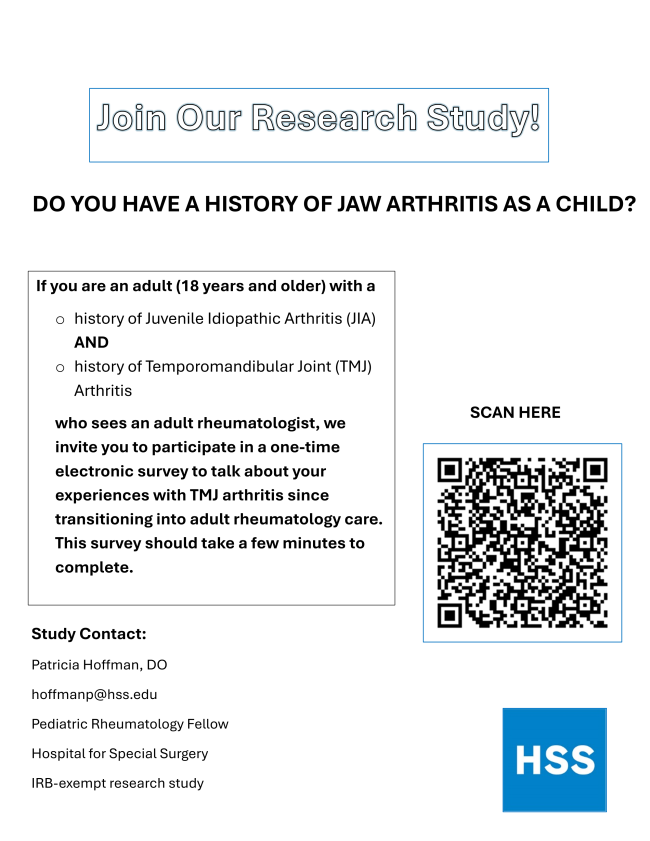
| Online Research Survey - Juvenile Idiopathic Arthritis and TMJ Arthritis | |
The Childhood Arthritis and Rheumatology Research Alliance (CARRA) is a non-profit organization throughout North America whose goal is to improve research in pediatric patients with rheumatic diseases. One of CARRA's subgroups, the TMJ (temporomandibular joint) Arthritis Workgroup, is conducting a one-time survey.
This study is looking at inflammatory disease of the TMJ, which is known as TMJ arthritis.
The terminology of "TMJ" and "TMD" is oftentimes used interchangeably but usually refers to non-inflammatory causes of diseases of the jaw. TMJ arthritis, however, can be seen in patients with a history of childhood-onset inflammatory joint disease called Juvenile Idiopathic Arthritis (JIA). If you are an adult who has a diagnosis of JIA and has seen a pediatric rheumatologist (past or current), we invite you to participate in this survey to better understand the care of TMJ arthritis.
Please see the flyer below for more information.
| |
The TMJ Association is the ONLY patient advocacy organization fighting for the best science that will lead to a greater understanding of TMD and related conditions, as well as treatments that will help and not harm patients.
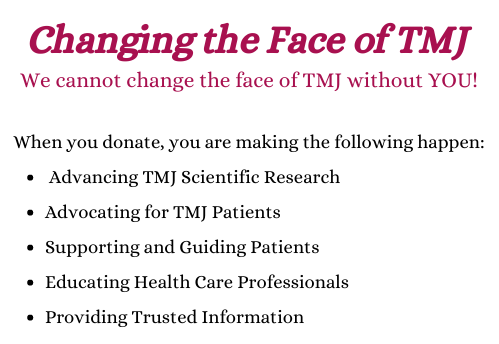
We cannot change the face of TMJ without YOU. Make a tax-deductible contribution today! Your contribution is more than a donation. It is how we will ensure that patients with TMD have a voice — through education, patient support, and advocacy.
We cannot do this important work without you! Thank you for your generosity.
| | |
About The TMJ Association ... Changing the Face of TMJ
The TMJ Association, Ltd., is a nonprofit, patient advocacy organization whose mission is to improve the quality of health care and lives of everyone affected by Temporomandibular Disorders (TMDs, aka "TMJ"). For over 35 years, we have shared reliable information on TMDs with people like you. We invite you to visit our website, www.tmj.org.
| | |
The TMJ Association, Ltd., P.O. Box 26770, Milwaukee, WI 53226
info@tmj.org | www.tmj.org
The TMJ Association, Ltd., is a nonprofit 501(c)(3) tax-exempt organization.
Copyright © 2026. All Rights Reserved.
| | | | |