In Brief

November 12, 2024

Hope everyone had a safe and meaningful Veterans Day. Thank you to all who served.


Welcome to the latest Members-Only Tuesday Telegraph, brought to you by the Texas Propane Gas Association (TPGA).


This edition covers essential accident and incident reporting requirements for both state and federal agencies:

  • First, TPGA outlines Railroad Commission incident reporting requirements.
  • Next, we cover OSHA requirements for serious work-related injuries.
  • We also review reporting obligations for vehicular accidents with the Federal Motor Carrier Safety Administration (FMCSA).
  • Finally, we explain when to report to the Pipeline Hazardous Material Safety Administration (PHMSA).


In Quick Links, find November propane pricing, Propane Service Corp (PSC), the GeneratioNext Texas Job Board, and the Texas Duty to Warn Safety Mailing Program.

In this issue

  • In Brief
  • RRC Incident Reporting
  • OSHA Requirements
  • FMCSA Vehicle Accidents
  • PHMSA Incidents
  • Open Autogas Grants
  • Quick Links

Calendar

November 12, 2024

NPGA Post Election Analysis Zoom Call


November 19, 2024

BPN NPGA ACE ELDT Webinar


November 28 - 29, 2024 Closed Thanksgiving

November 30, 2024

Heat Pump Helper Interest Forms Due

ANNUAL CALENDAR

§9.36 Report of LP-Gas Incident/Accident to RRC

In the event of any significant LP-gas incident, the Railroad Commission of Texas must notify the Alternative Fuels Safety (AFS) division.


Initial Notification: A licensee owning, operating, or servicing LP-gas equipment or installations must notify the AFS by telephone within 2 hours of discovering any event involving LP-gas that:

  1. Results in death or hospitalization.
  2. Requires facility shutdown.
  3. Involves unintentional gas ignition requiring emergency response.
  4. Occurs at an LP-gas vehicle installation.
  5. Causes property damage of $5,000 or more.
  6. Is significant due to traffic rerouting, evacuations, or media attention.
  7. Is required to be reported to another state or federal agency.


The telephone notification to the Railroad Commission's 24-hour emergency line (512-463-6788 or 844-773-0305) must include:

  1. Reporting operator's name
  2. Incident location
  3. Date and time of the incident
  4. Fatalities and/or injuries
  5. Operator's phone number
  6. Immediate hazard status
  7. Other relevant details


Initial Report: A completed LPG Form 20 must be submitted to AFS within 14 days of the initial notification or 5 business days after receiving the fire department's report, whichever is earlier. AFS may grant extensions.


AFS Review: AFS will review the report within 5 business days and notify the submitter of any required additional information. Incomplete reports may delay LP-gas operations.


Category P Licensee Incidents: Category P licensees must immediately notify their Category E or J supplier, who is responsible for reporting the incident to AFS.


OSHA Reporting Requirements for a Fatality or Severe Injury

All employers, regardless of size, are required to notify OSHA when an employee is killed on the job or suffers a work-related hospitalization, amputation, or loss of an eye.

  • A fatality must be reported within 8 hours.
  • An in-patient hospitalization, amputation, or loss of an eye must be reported within 24 hours.
  • All employers under OSHA jurisdiction must report these incidents to OSHA, even if they are exempt from routinely keeping OSHA records due to company size or industry type.
  • OSHA defines in-patient hospitalization as a formal admission to the in-patient service of a hospital or clinic for care or treatment. Treatment in an Emergency Room only is not reportable.


How to Report an Incident

  • Call the nearest OSHA office.
  • Call the OSHA 24-hour hotline at 1-800-321-6742 (OSHA).
  • Report online


Be prepared to provide the business name, names of affected employees, location and time of the incident, a brief description of the incident, and a contact person and phone number.

When OSHA Reporting is Not Required


Motor vehicle accidents. For motor vehicle accidents, employers of commercial drivers are not required to report an event to OSHA if the incident occurred on a public street or highway and the employee was in the cab or driving.


Due to U.S. DOT jurisdiction, these incidents do not need to be reported telephonically to OSHA; however, they must be recorded on your OSHA 300 log as work-related injuries.

Motor Vehicle Accidents: U.S. DOT FMCSA Employer's Responsibilities in Accident Reporting

When a commercial motor vehicle (CMV) is involved in an accident, specific reporting and record-keeping steps are required by the U.S. Department of Transportation (DOT) to ensure compliance and assist with safety investigations. Here’s a straightforward guide for employers.


Definition of an Accident

Under Title 49 CFR, an accident involving a CMV includes:

  • A fatality.
  • An injury requiring immediate medical treatment away from the scene.
  • A vehicle is incurring disabling damage that requires towing.


Accidents do not include incidents solely related to boarding, exiting, or loading/unloading cargo for FMCSA.


Maintaining an Accident Register

Employers must keep an Accident Register for three years following an accident. This register should contain:

  • Date and location of the accident (city, state).
  • Driver’s information: name and contact details.
  • Injury and fatality count.
  • Hazardous materials involved, if any (excluding fuel spills from tanks).
  • Vehicle condition and witness contact information.

This register provides crucial information for federal and insurance investigations.


Mandatory Accident Information

Accident reports must include:

  • Driver and vehicle details.
  • Exact location and date.
  • Severity of injuries and fatalities.
  • Hazardous materials released, if applicable.
ACCIDENT REGISTER FORM

§ 382.303 Post-Accident Alcohol and Drug Testing

DOT mandates that employers conduct post-accident testing for alcohol and drugs when:

  • There’s a fatality.
  • A driver is cited for an accident involving injuries requiring off-site medical care.
  • A vehicle is disabled and requires towing.


Timing for Testing:

  • Alcohol testing: within two hours or up to eight hours if delayed.
  • Drug testing: within 32 hours. Employers must document reasons if tests are delayed beyond these periods.


Driver Disqualification:

Drivers can be disqualified from operating a CMV for various offenses, including:

  • Driving under the influence of alcohol or drugs
  • Refusing a drug or alcohol test
  • Leaving the scene of an accident
  • Serious traffic violations


Employer’s Role

Employers must provide drivers with post-accident testing procedures and ensure compliance, especially in remote operations. Keeping thorough records and responding swiftly to accidents are essential to meet DOT regulations.

U.S. DOT PHMSA Hazmat Incident Reporting

The Hazardous Materials Regulations (HMR) require that certain types of hazmat incidents be reported.


Telephone report. Section 171.15 of the HMR requires an immediate telephonic report (within 12 hours) to the National Response Center (NRC) following an incident (49 eCFR 171.15). You may call the NRC at 1-800-424-8802.


Reportable incident. A telephone report is required whenever any of the following occurs during the course of transportation in commerce (including loading, unloading, and temporary storage):


(1) As a direct result of a hazardous material—

  • A person is killed;
  • A person receives an injury requiring admittance to a hospital;
  • The general public is evacuated for one hour or more;
  • A major transportation artery or facility is closed or shut down for one hour or more; or
  • The operational flight pattern or routine of an aircraft is altered;


(2) A situation exists of such a nature (e.g., a continuing danger to life exists at the scene of the incident) that, in the judgment of the person in possession of the hazardous material, it should be reported to the NRC even though it does not meet the criteria of paragraphs the above.


Written Report. Section 171.16 requires incidents to be reported through PHMSA within 30 days of the incident and a follow-up written report within one year of the incident, based on certain circumstances outlined below, to be reported to PHMSA through the Hazardous Materials Incident Report Form DOT F 5800.1 (49 eCFR 171.16).


What is the Incident Report Form 5800.1?

The Incident Report Form 5800.1 is a written report required by Section 171.16 of HMR that must be submitted within 30 days of a hazardous materials transportation incident, as defined by the HMR. The information collected on the report is used by PHMSA and other agencies to mitigate risk, analyze gaps, and enhance safety.


Form 5800.1 is required to be completed if:

  • Anytime you are required to make a telephonic notification
  • Any unintentional release of propane during loading, unloading, or storage incidental to transportation, regardless of quantity.
  • Any damage to the lading system of a specification cargo tank 1,000 gallons or greater resultant from a vehicle accident, even if no product is released


171.16 Exceptions (you don't need to report):

A release of a minimal amount of material from—

  • A vent for materials for which venting is authorized;
  • The routine operation of a seal, pump, compressor, or valve; or
  • Connection or disconnection of loading or unloading lines provided that the release does not result in property damage.
FAQs
DOWNLOAD 5800.1
REPORTING INSTRUCTIONS
REPORT 5800.1 ONLINE

Featured Open Autogas Grants

EPA Clean School Bus Grant

LEARN MORE

TCEQ NGV Grant (includes LPG)

LEARN MORE

Quick Links

Check out November 6, 2024 

Weekly Propane Prices, Supply, NOAA Forecast & Heating Degree Days

VIEW PRICE AND SUPPLY

Shop propane & transportation compliance items at

Propane Service Corporation (PSC), Your One-Stop Shop

BROWSE STORE NOW

Review 450 TX Job Candidates,

Post a Job or Participate in an Outreach Session. It's FREE.

Access Nextgenpropane.com

LEARN MORE

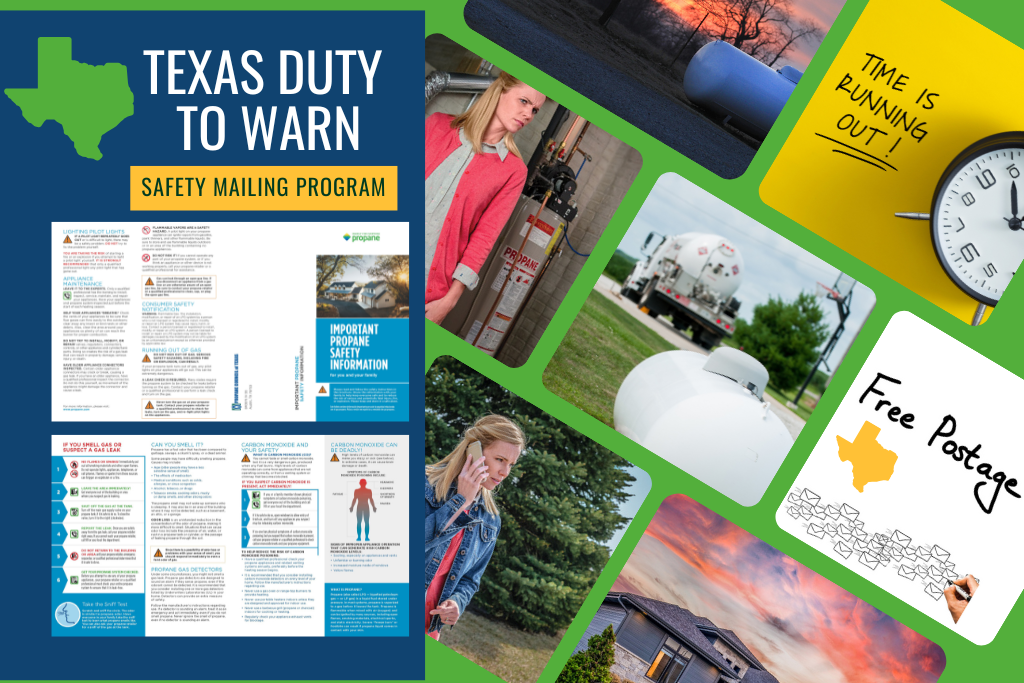
Don't miss out on getting safety information to your customers this heating season with the Texas Duty to Warn Safety Mailing Program

SIGN UP NOW

Affinity Partners