|
World Terror Coalition: The COM's Violent Networks Move Towards Coordination
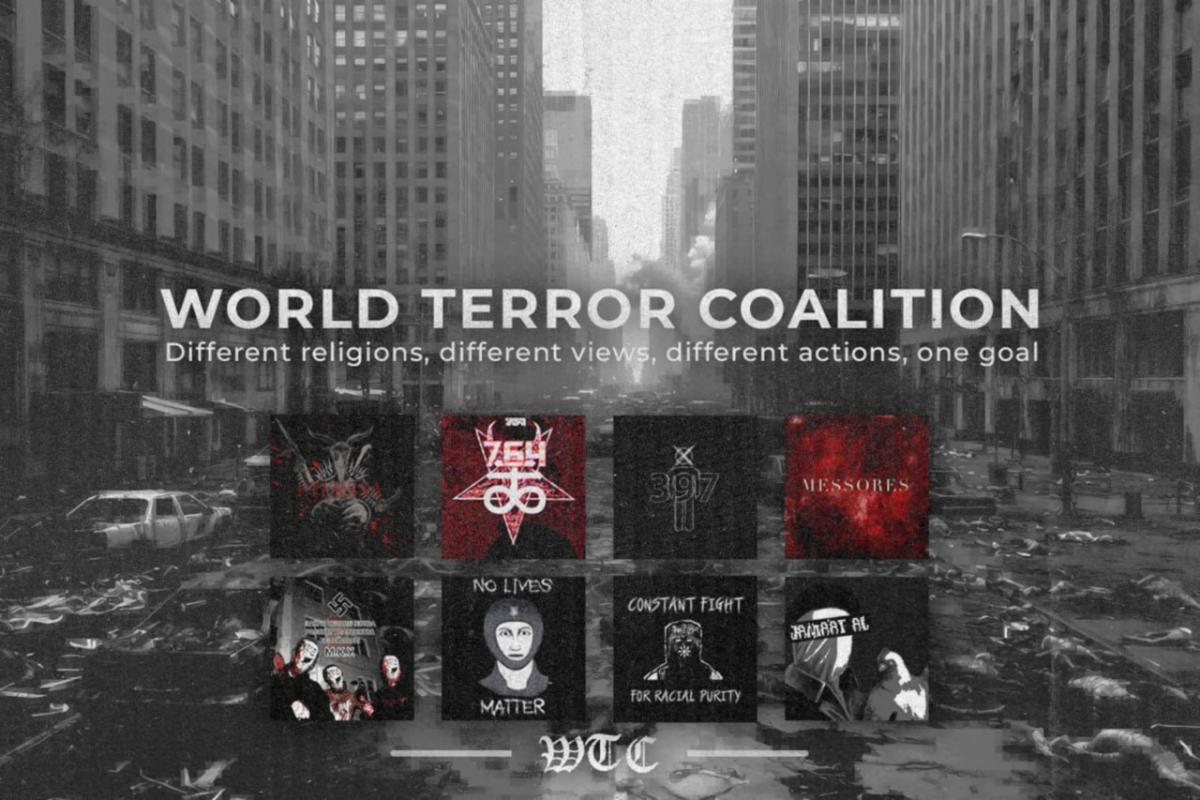
On 6 October 2026, Ukraine's Security Service (SBU), working with the FBI, arrested a suspect in Kyiv accused of operating a Telegram network distributing instructions for manufacturing improvised explosive devices (IEDs). Two days later, the World Terror Coalition (WTC) claimed the suspect as one of its members. TRAC identified links to Messores, a Russian-speaking extremist group associated with WTC, including previously circulated imagery depicting similar laboratory equipment and explosive materials. The suspect's precise role within the coalition remains unverified.
The arrest draws attention to a broader development within The COM, the transnational online ecosystem increasingly associated with violent nihilism, neo-Nazi accelerationism, Satanic extremism and criminal exploitation: an attempt to turn fragmented extremist networks into a more coordinated, enduring structure.
One Coalition, Eight Groups, One Objective: Chaos
WTC brings together eight advertised member organisations: Maniacs Murder Cult (MKY/MKU), No Lives Matter (NLM), 764, THEÓS, Eterssa, Messores, 397 and Jama’at Al. Their ideologies and activities differ considerably, ranging from neo-Nazi accelerationism and violent nihilism to coercive exploitation and alleged cyberterrorism. What unites them is not ideology, but a declared commitment to violence and chaos. WTC explicitly dismisses religious and political differences, promoting the slogan “Different religions, different views, different actions, one goal.” This reflects an increasingly concerning development within The COM: ideological consistency is becoming secondary to the willingness to engage in or glorify violence.
Beyond Telegram: Building a Shared Extremist Infrastructure
Unlike many short-lived extremist alliances, WTC has taken steps to establish organisational infrastructure beyond propaganda channels. Its recruitment process includes applications, evidence of previous activity and membership votes, while its clear-web website and restricted dark-web forum provide platforms for communication and resource sharing. The forum hosts extremist ideological material alongside content concerning weapons, arson, hazardous substances and other criminal activity. WTC has also advertised media production and cybersecurity roles, while Jama’at Al's inclusion signals ambitions to expand into cyber-related operations.
The significance lies in the attempt to pool knowledge, resources and capabilities across otherwise separate extremist networks, potentially increasing the reach of individuals and small groups that previously operated in isolation.
Violence as a Measure of Credibility
WTC's propaganda places particular emphasis on demonstrating real-world violence. TRAC has documented coalition-branded imagery depicting arson, vandalism, assaults, weapons and suspected hazardous devices. Although individual images and claims remain unverified, their purpose is clear: violence is presented as proof of legitimacy, a recruitment tool and a means of gaining status within the coalition. Of particular concern are WTC's explicit threats against civilians in retaliation for law-enforcement action. In a statement addressing the FBI, SBU and FSB, the coalition threatened civilian populations rather than the security agencies themselves, reinforcing its rejection of conventional ideological and moral restraints.
TRAC Assessment: MEDIUM–HIGH Threat
TRAC assesses the World Terror Coalition (WTC) as posing a MEDIUM–HIGH threat, reflecting its explicit threats against civilians, cross-network recruitment and expanding organisational infrastructure. While its operational capabilities remain unverified, WTC represents a concerning evolution within The COM, where neo-Nazi accelerationism, Satanic extremism, violent nihilism and criminal exploitation networks are increasingly converging around a shared objective of violence and chaos. Of particular concern is the coalition’s attempt to transform fragmented online communities into a more coordinated network that facilitates the exchange of knowledge, resources, and potentially operational capabilities.
|