|
Islamic State Offensive in Deir Ezzor
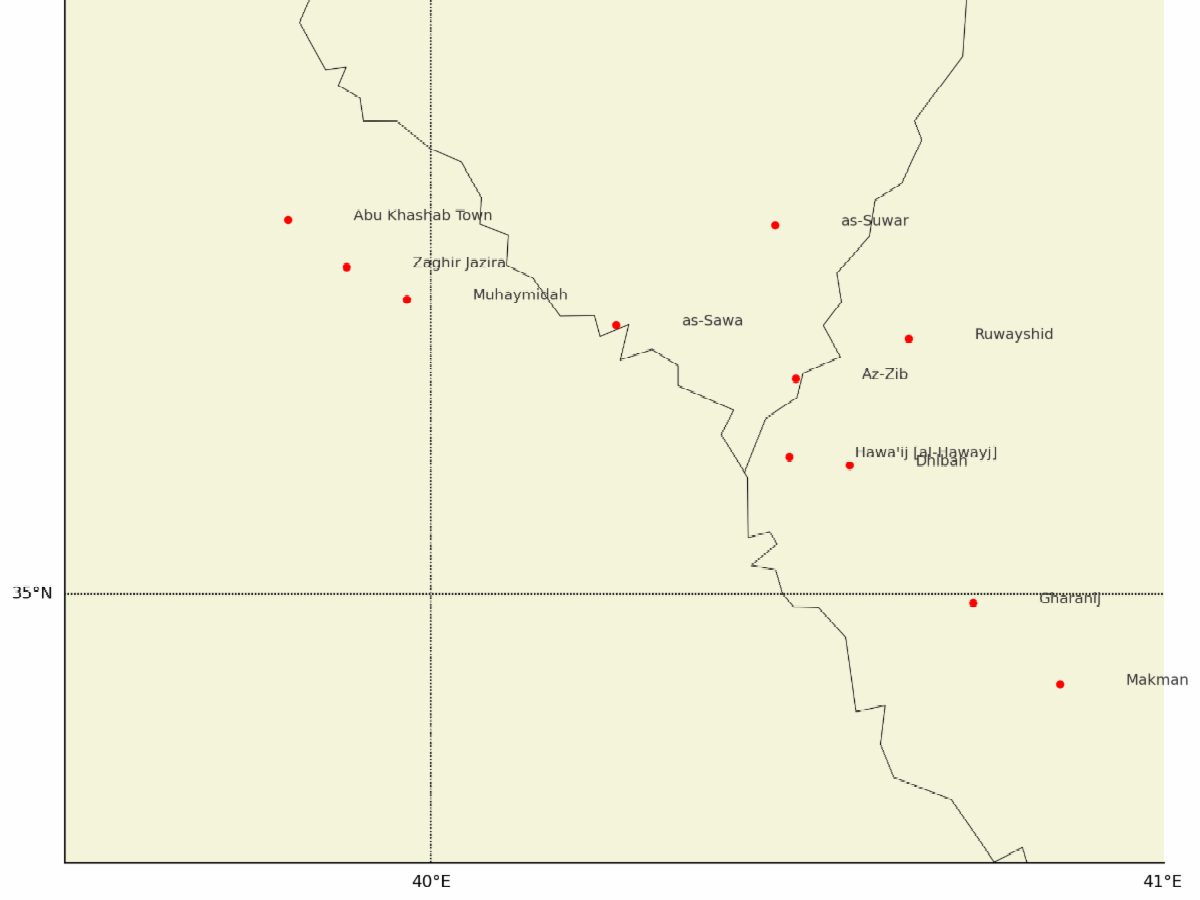
Between 22 and 30 July 2025, the Islamic State (IS) launched what appears to be a renewed and highly coordinated offensive in Syria’s Deir Ezzor Governorate. In just nine days, IS officially claimed responsibility for nine attacks, while TRAC documented an additional six suspected IS operations within the same geographical corridor. These 15 incidents, occurring within a 10 to 30-minute motorcycle ride of one another, depending on terrain and road conditions, were concentrated along the right bank of the Euphrates River and near critical logistical arteries such as the M4 Highway. They clearly signal more than isolated violence; they mark the revival of a targeted insurgency campaign aimed at destabilising Syrian Democratic Forces (SDF) control in eastern Syria.
The offensive began on 22 July, with a targeted assassination of an SDF member near Makman in Abu Khashab, setting the tone for a wave of ambushes, checkpoint assaults, and sniper attacks. The following days saw a rapid escalation, including multiple attacks in Dhiban on 24 July, a checkpoint ambush near Hawa’ij on 26 July, and a sustained assault on SDF headquarters in Ruwayshid and Dhiban on 27 and 28 July. The most recent attack occurred on 30 July in Muhaymidah, where an SDF fighter was injured in a close-range shooting, marking the fourth IS-claimed incident in that town alone within three weeks.
The focus of this offensive is not arbitrary. Deir Ezzor’s riverine and agricultural landscape, situated along the right bank of the Euphrates River, is both resource-rich and tactically advantageous. The area offers concealment, access to rural support networks, and proximity to key infrastructure like the M4 Highway, a critical artery connecting northeastern Syria’s military and economic logistics. This terrain allows IS cells to strike rapidly and retreat into difficult-to-police zones, exploiting the limits of SDF reach and surveillance. Moreover, the attack locations, such as Dhiban, Hawa’ij, Az-Zib, Suwar, and Zaghir Jazira, form a tight operational cluster, reflecting a deliberate choice to focus on zones where SDF governance is thinnest and local allegiances may be fragile. IS is no longer pursuing territorial control; rather, it is executing attrition tactics, targeting patrols, assassinating personnel, and undermining administrative and security infrastructure through persistent low-intensity violence.
The method of attack also reflects a maturing insurgency strategy. IS is relying heavily on mobile shooters, often on motorcycles, armed with automatic weapons and occasionally explosives. Their engagements are typically short, sharp, and intended to maximise casualties while minimising risk. The July 23 triple-assault (Gharanij, Izba, and as-Sawa) and the 27 July vehicle ambush in as-Suwar are prime examples of IS’s use of hit-and-run raids, sniper fire, and well-timed checkpoint ambushes. These tactics disrupt SDF movement, instil fear, and signal that IS remains operational and adaptive.
This string of attacks is the most concentrated in Deir Ezzor since early 2024, suggesting IS is testing and successfully exploiting gaps in SDF control. While the SDF continues to focus on civil governance and U.S.-backed stabilisation efforts, this campaign undermines those foundations and projects IS's strength to potential recruits and sympathisers in the area. Additionally, by targeting not just combat forces but also alleged spies, vehicles, and headquarters, IS is challenging the legitimacy and operational efficacy of SDF governance itself. The implications are significant: if left unchecked, this offensive could pave the way for greater IS operational depth, recruitment from disaffected tribes, and the erosion of hard-won stability in eastern Syria.
| | | TRAC Incident Report: Jaish al-Adl (Army of Justice) Militants Storm the Courthouse in Zahedan, Iran | | |
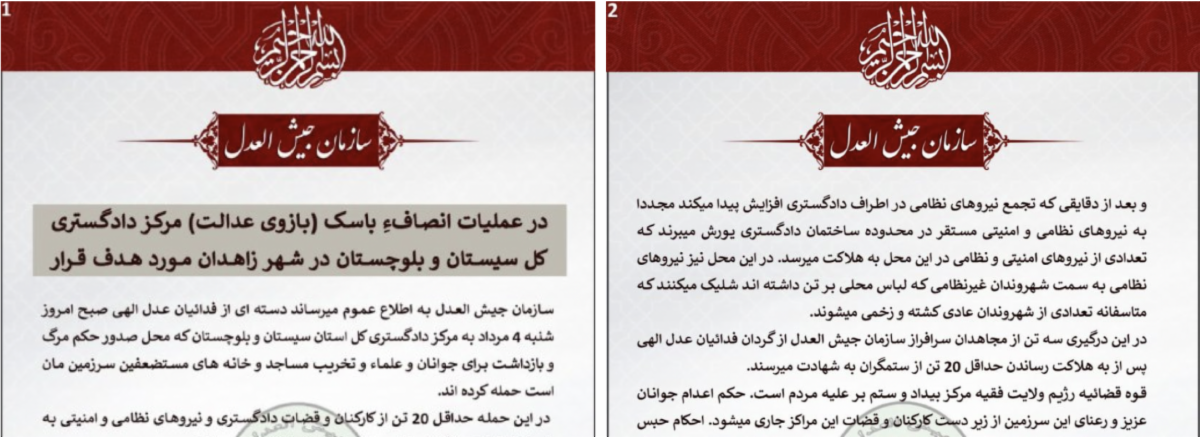
On 26 July 2025, Jaish al-Adl militants carried out a deadly assault on the Central Judiciary complex in Zahedan, the capital of Iran’s Sistan-Baluchestan province. The group dubbed the coordinated attack "Operation Arms of Justice", signalling its intent to frame the operation as retribution against the Iranian state’s judiciary apparatus. The militants initiated the assault by lobbing grenades and opening automatic fire inside the courthouse, leading to at least five civilian deaths and injuring between 13 and 22 others, including bystanders and courthouse personnel. Iranian security forces responded swiftly, killing all three assailants on site. The complex was rapidly evacuated as intense clashes broke out in the surrounding area.
This marks Jaish al-Adl’s most high-profile operation in nearly six months, breaking a long public silence from the group during a time when Iran has been preoccupied with external tensions, particularly with Israel, and internal economic crises. While TRAC has previously flagged this unusual quietude, it remains plausible that the group was active in less visible ways, including failed or suppressed attacks. The Iranian state is known to enforce strict media blackouts in the border provinces, especially Sistan-Baluchestan, as part of a broader effort to control the public narrative and avert further unrest. Such opacity often leads to underreporting or delayed acknowledgement of militant activity in the region.
Zahedan itself is both symbolically and strategically significant. As the capital of Sistan-Baluchestan, the city represents Iranian state authority in a province rife with sectarian and ethnic fault lines. The area is predominantly Sunni Baloch, a minority long subjected to systemic marginalisation, economic neglect, and religious discrimination by the Shia-dominated central government. This backdrop has allowed Jaish al-Adl to frame itself as a defender of Baloch rights and religious identity, gaining a measure of local support or at least passive tolerance. Furthermore, the geographical realities of Sistan-Baluchestan, its rugged terrain, porous borders with Pakistan and Afghanistan, and deeply entrenched smuggling networks, provide operational cover and access to weapons and fighters.
| | (Right Wing Extremism / Poster) Neo-Nazi Accelerationist Telegram Channel Shares Poster: ‘Embrace Tradition Reject Perversion’ | | |
A neo-Nazi accelerationist Telegram network circulated a poster promoting a radical traditionalist, white supremacist worldview. Bearing the slogan “Embrace Tradition, Reject Perversion”, the poster centres on a stylised, 1950s-style white heterosexual couple, symbolising an idealised racial and gender norm. The man is depicted holding a large shield emblazoned with a rainbow flag crossed out, directly vilifying LGBTQ+ identities as threats to societal values.
The poster reinforces a dichotomy between “purity” and “perversion.” Above the couple are five circular icons, each containing banned symbols: LGBTQ+ insignia, trans symbols, a cannabis leaf, and two crossed-out symbols relating to anti-fascist or left-wing activism. These icons collectively designate the group’s ideological enemies: queer people, drug users, feminists, leftists, and anyone who deviates from the group’s narrow ethnonationalist definition of “tradition”.
This image is part of a broader pattern of annual digital hate campaigns coordinated by right-wing extremist groups. TRAC has documented that each year, beginning in June, a wave of propaganda floods right-wing Telegram channels, ranging from more normie groups like the Proud Boys to covert accelerationist cells. These campaigns often carry recurring slogans like “Take Back June,” “Pride Offensive,” and “Reclaim the Rainbow.” The goal is always the same: to ridicule LGBTQ+ visibility during Pride Month and to embolden offline acts of intimidation or violence against the community.
| | TRAC Incident Report: Baloch Republican Guards (BRG) Targeted the Jaffar (Jaffer) Express Train with a Remote-Controlled IED at the Humayun Sharif Area in Shikarpur, Sindh, Pakistan | | |
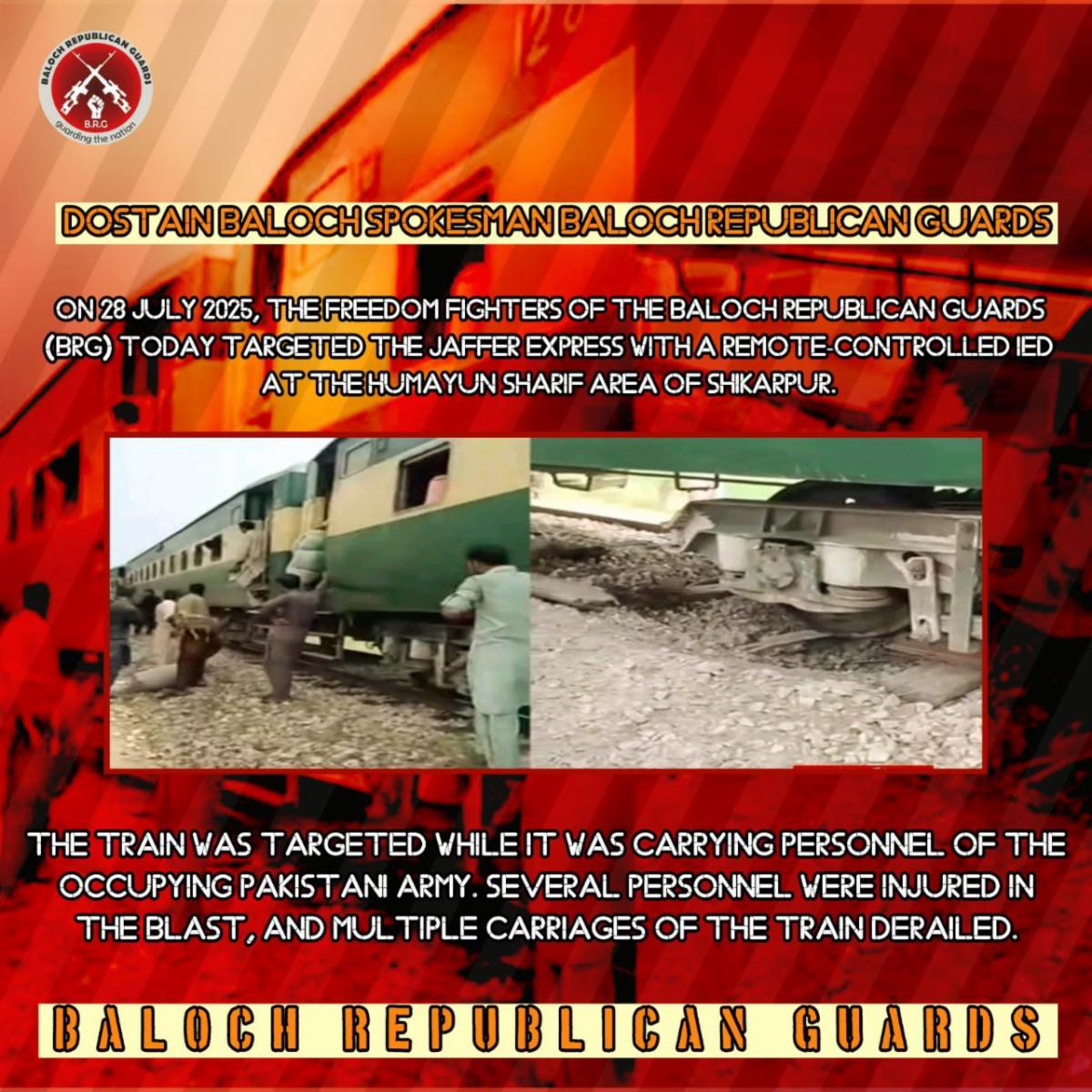
On 16 July 2025, Baloch Republican Guards (BRG) militants targeted the Jaffer Express train with a remote-controlled improvised explosive device (IED), near Humayun Sharif village, located in Shikarpur district, Sindh province. The train was transporting Pakistani military personnel, resulting in at least eight killed and injuries to several others, including soldiers. The powerful blast caused multiple carriages to derail, disrupting both civilian and military logistics. This operation once again highlights the technical proficiency and escalatory intent of the BRG. Their use of remotely detonated IEDs on high-speed rail lines demonstrates an evolving capability to strike critical infrastructure with precision. The BRG's focus on remote IEDs has become its signature tactic, distinguishing it from other Baloch insurgent factions.
This is not the first time the Jaffer Express has come under attack. Since its hijacking in March 2025, the train, symbolic for its military use and strategic route, has been targeted multiple times by Baloch insurgents, including the BRG. These repeated assaults underscore the group’s focus on crippling state mobility, morale, and military logistics, particularly on routes perceived as vital to occupation or suppression efforts in Balochistan.
Strategically, the location of the attack is highly significant. Shikarpur sits at the junction of Balochistan, Sindh, and South Punjab, serving as a vital transit and logistical node within Pakistan’s national infrastructure. The targeted site, Humayun Sharif village, lies just southeast of central Shikarpur and is connected to regional networks via local roads and the N-65 National Highway, a major route linking Sindh to northern and western Pakistan. By striking a train in this area, the BRG effectively extended its operational theatre beyond its traditional strongholds in Balochistan, signalling its ability and willingness to export the insurgency deeper into mainland Pakistan.
The targeting of military assets outside of Balochistan sends a strong message: nowhere is off-limits for the militants. The attack undermines state authority in areas previously considered peripheral to the Baloch nationalist conflict and complicates the security calculus for Pakistani forces. It also reinforces the BRG’s narrative that resistance to state forces is justified and will not be geographically contained.
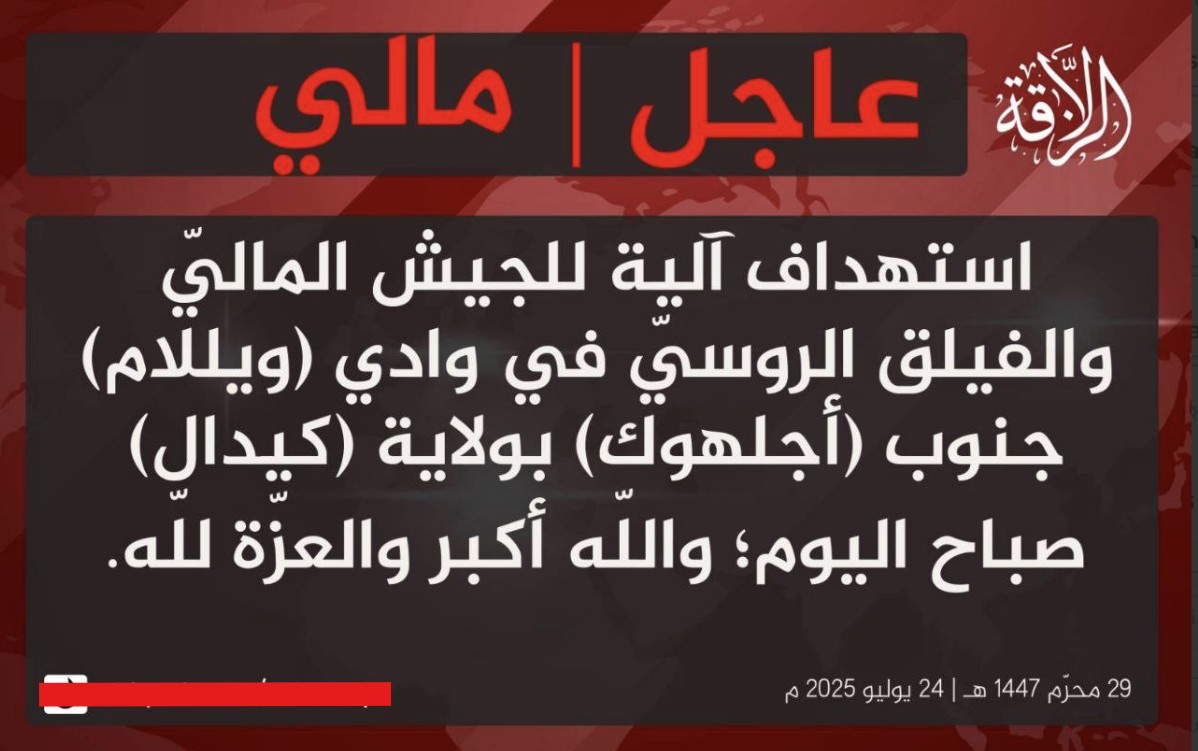
| | TRAC Incident Report: Jama’a Nusrat ul-Islam wa al-Muslimin (JNIM) Militants Target Malian Forces (FAMA/Africa Corps) in an Armed Assault South of Aguelhok, Kidal, Mali | | (Chatter) Al-Shabaab Reshuffled Leadership Positions and is Exploring Using Drones as Part of Its Warfare Strategy in Somalia | | TRAC Incident Report: Islamic State Mozambique (IS-M/Shabaab Cult/Wilayat Muzinbik) Armed Assault on Police, Freeing Prisoner & Seizing Weaponry in Chiúre Velho, Chiure District, Cabo Delgado, Mozambique | | | | |