|
Islamic State October 2026: Africa Drives Global Operations as Iraq and Syria Remain Comparatively Quiet
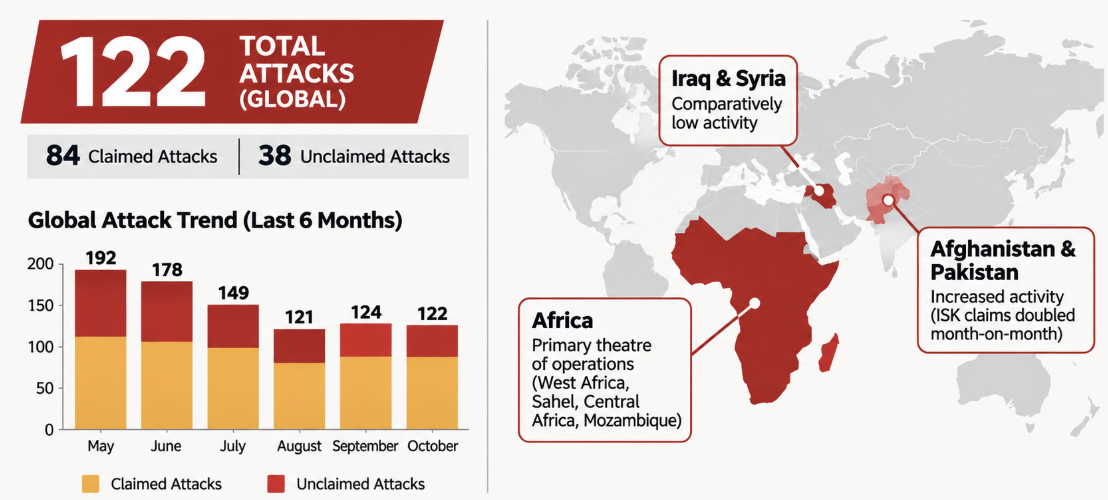
Islamic State (IS) recorded 122 attacks in October 2026, including 84 claimed and 38 unclaimed incidents, maintaining a relatively low but steady operational tempo. Africa continues to drive the group's global activity, with affiliates across West Africa, the Sahel, Mozambique and Central Africa sustaining attacks despite internal setbacks, while its traditional Iraq–Syria stronghold remains comparatively quiet. Increased security pressure in Syria contrasts with weak state control and persistent instability across parts of Africa, where IS affiliates continue to exploit local vulnerabilities. This shift reflects not an organisation in decline, but an increasingly decentralised and resilient insurgency, with Africa emerging as its principal operational theatre.
Areas of Interest
Iraq & Syria
Islamic State activity in Iraq during October was marked by renewed attacks in Kirkuk Governorate, particularly around Hawija, where approximately four incidents targeted military positions and checkpoints, including repeated attacks on the same locations. This suggests persistent weaknesses in Iraqi force protection and local intelligence. Amid the ongoing withdrawal of US forces, IS may seek to exploit security gaps and challenge perceptions that the organisation no longer poses a significant threat in Iraq.
In contrast, IS has not claimed an attack in Syria since 20 June 2026, despite 22 incidents suspected of involving the group during October alone. This contrast suggests that while IS's Iraqi network has become more visibly active, its Syrian counterparts remain under greater pressure. The pattern may also reflect the group's shift away from traditional Badiya desert strongholds towards a greater urban presence, announced in March 2025.
IS's targeting in Syria continues to evolve, with suspected assassinations of ethnic and religious minorities and former Syrian Arab Army personnel, attacks on energy infrastructure and IED operations in Damascus. Ongoing tensions involving foreign fighters, Druze communities, Kurdish groups and former SDF elements present opportunities for exploitation. IS remains in an adaptive phase, testing vulnerabilities in Syria's post-Assad security environment while maintaining pressure through smaller-scale attacks.
Nigeria
Islamic State West Africa (ISWA) remained IS's most active affiliate in October, claiming 36 attacks, despite significant internal divisions that emerged in September and weakened its position across parts of the Lake Chad Basin. Despite these setbacks and the earlier death of its leader, al-Mainuqi, ISWA has maintained a high operational tempo, suggesting that internal fragmentation has not significantly undermined its wider attack capabilities.
Of particular interest is an apparent tactical adjustment in ISWA's coordinated IED and armed assaults. Two October incidents suggest the group is reversing its established double-tap sequence, detonating an IED first before launching a follow-up armed assault, rather than using explosives against responding reinforcements. This potential tactical shift may be designed to exploit the immediate confusion caused by an initial explosion, allowing militants to engage disoriented security personnel more effectively.
A particularly concerning development is ISWA's continued southward expansion into Adamawa State. Previously sporadic incursions increasingly suggest efforts to establish a sustained operational presence beyond the group's traditional strongholds in Borno and Lake Chad. The growing emphasis on attacks against Christian communities, rather than primarily security forces, also indicates a possible shift towards more overtly sectarian targeting and propaganda in southern areas.
Afghanistan & Pakistan
Islamic State Khurasan (ISK) more than doubled its claimed attacks in October, signalling renewed activity across Afghanistan and Pakistan. Although overall numbers remain modest, the increase demonstrates the group's continued ability to operate despite sustained counterterrorism pressure and its efforts to reinforce its standing within the wider IS network. ISK nevertheless faces limitations in manpower, equipment, and operational freedom, which restrict its ability to conduct large-scale assaults. Instead, the group increasingly relies on targeted assassinations, bombings and smaller hit-and-run attacks, allowing it to maintain pressure on security personnel and government officials without committing substantial resources.
|