Protestors Gather Against Reintegration of Assad-Era Officials into GSS
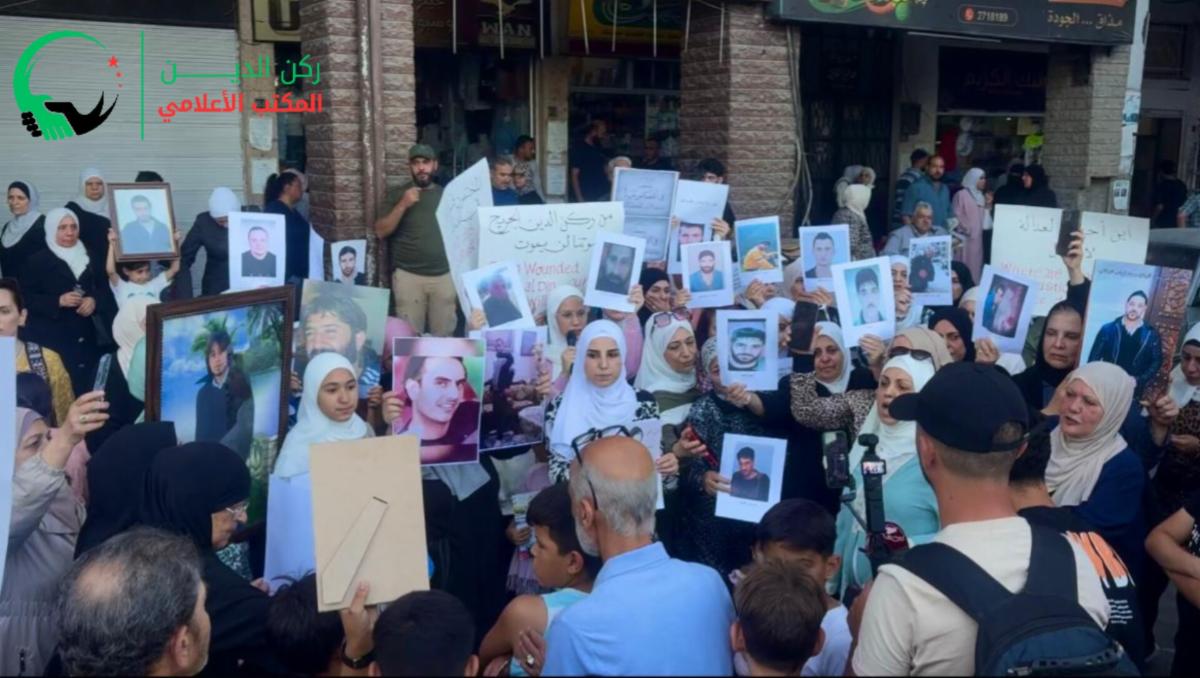
On 18 June 2025, residents of Rukn al-Din in northern Damascus held a protest vigil opposing the reintegration of former Assad-era security officers into the newly formed government. Once known as the “Kurdish Neighbourhood,” Rukn al-Din is home to a demographically diverse population, including many Kurds who have gradually assimilated into the broader urban fabric. Protesters carried portraits of disappeared relatives and Syrian revolutionary flags, demanding accountability from a government they otherwise support. Their outrage followed the Supreme Committee for Preserving Civil Peace’s decision to release a group of former Syrian Arab Army (SAA) officers, officially for lack of evidence. However, sources claim some secured release through intelligence deals or by surrendering military infrastructure during recent HTS advances.
The committee overseeing these decisions is led by a controversial trio: former Ahrar al-Sham leader Hassan Soufan, HTS-aligned cleric Anas Ayrout, and defected Assad insider Khaled al-Ahmad. Their pragmatic collaboration signals the government's willingness to trade transitional justice for short-term stability. Soufan has explicitly stated that civil peace must take precedence over retribution, indicating a reconciliatory stance toward elements of the former regime. This approach has enabled the reintegration of military personnel into the General Security Service (GSS)—the only fully loyal security branch—while mitigating potential threats by offering employment and protection. Yet, this leniency generates significant friction with civilians who endured years of violence at the hands of Assad’s apparatus, many of whom now feel betrayed by a government that promised justice.
Meanwhile, HTS and its affiliates continue to commit abuses, from secret prisons and torture in Idlib to extrajudicial killings in Homs and Hama. As mass dismissals affect former public employees in areas like Tartous and Quneitra, accusations of sectarian bias and political favouritism intensify. At the same time, vigilante killings and assassination campaigns—some driven by personal vendettas, others by sectarian or ideological motives—reflect a population increasingly disillusioned with both the past and the present. While Damascus seeks to stabilise through compromise, it must also contend with a civil society mobilising for justice and transparency. The legitimacy of the new government hinges on navigating the competing pressures between former regime loyalists, revolutionary ideals, and everyday Syrians who demand meaningful change.
Though Damascus has attempted to project an image of reconciliation and institutional reform, these moves must be taken with caution. The current administration has clear incentives to present itself as stable and cooperative, both to its citizens and the international community. But beneath this surface lies a patchwork of backroom deals, selective justice, and continued reliance on old tactics, casting doubt on whether Syria’s future will genuinely break from its repressive past.
| | | TRAC Incident Report: Jama’a Nusrat ul-Islam wa al-Muslimin (JNIM) Fighters Target a Provisional Police Station in an Arson Attack, Kouarfa, Toucountouna, Atakora Department, Benin | | |
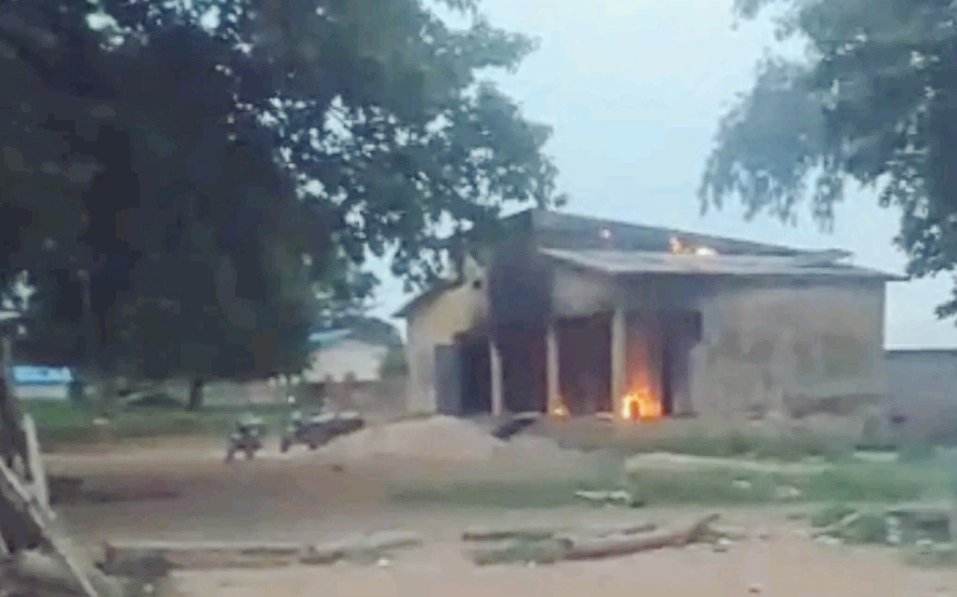
Between 18 and 19 June 2025, suspected Jama’a Nusrat ul-Islam wa al-Muslimin (JNIM) militants launched an arson attack targeting the Kouarfa district offices in the Toucountouna commune, Atakora Department, Benin. The blaze reportedly destroyed the facility, which was being used as a temporary base for a local law enforcement unit. No casualties were reported. In addition to the administrative office, reports indicate that an elementary school was also burned down, signalling the militants' broader intent to disrupt civilian infrastructure and governance.
In response to the attack, the Beninese Armed Forces (FAB) deployed both an H125M helicopter—equipped with night vision capabilities—and ground troops to the affected area. The operation reportedly resulted in the destruction of three militant encampments near the Triple Point region, where Benin, Burkina Faso, and Niger converge. Several JNIM fighters were allegedly neutralised, with no reported casualties among the security forces. These troops were already active in the Pendjari and W National Parks, regions previously identified by TRAC as staging grounds for JNIM operations targeting northern Benin.
Since 2022, FAB has conducted Operation “Mirador,” a counter-terrorism initiative aimed at securing the northern border and curbing jihadist expansion. TRAC has long assessed that JNIM elements maintain concealed bases within these parks, from which they launch cross-border attacks and destabilise local communities. Notably, Kouarfa, the location of the 19 June arson attack, lies just 57 km from the Togo border. This geographic proximity underscores JNIM’s likely objective of extending its operational reach into Togo, while simultaneously strengthening its grip on southern Burkina Faso through Beninese territory.
| | Suspected Female Boko Haram Militant Detonated a Suicide IED Killing 20 in Konduga, Borno State, Nigeria | | |
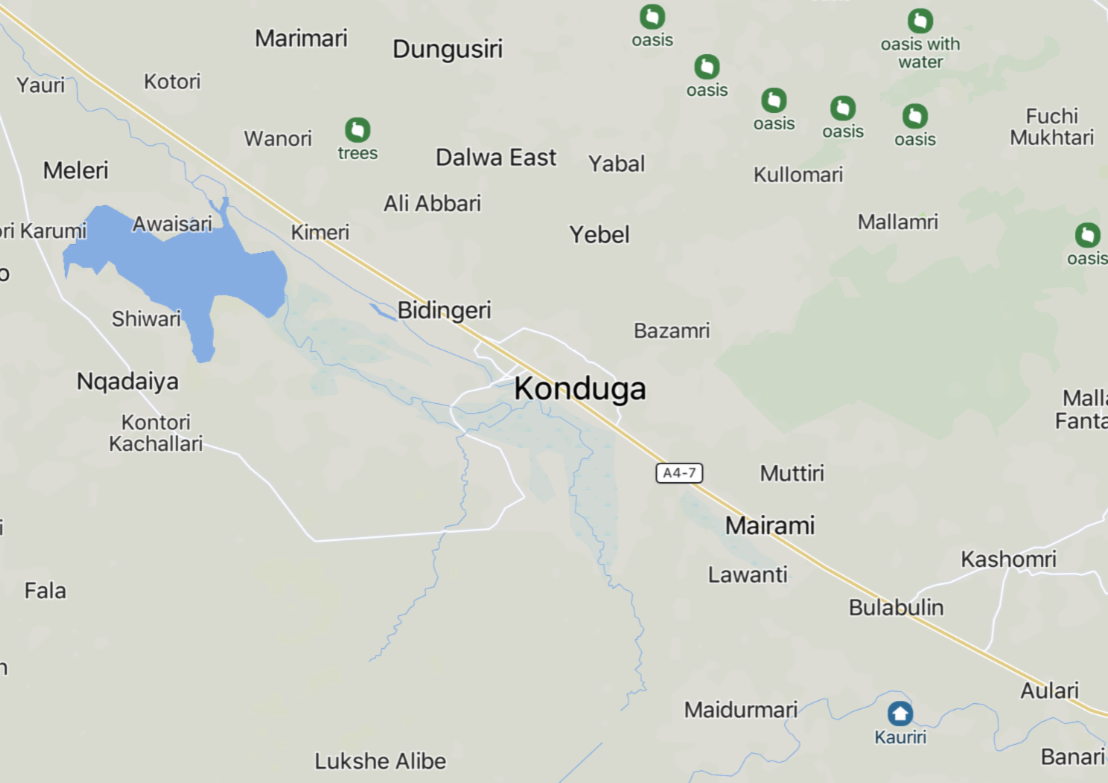
On 20 June 2025, a suspected female Boko Haram militant detonated a suicide vest at a fish market in Konduga, Borno State, Nigeria. The blast killed approximately 20 individuals, most of whom were members of local militia forces. The choice of target, a well-known gathering point for pro-government militias, suggests a calculated strike designed to maximise psychological and operational impact.
Although Boko Haram's operational tempo has diminished compared to its more dominant regional rival, Islamic State West Africa (ISWA), this bombing underscores their continued ability to execute precise and deadly operations. Boko Haram frequently targets soft targets, particularly those seen as collaborators with government forces or, at times, even sympathisers of ISWA, reflecting the multi-dimensional complexity of the insurgency in northeastern Nigeria.
The use of a suicide bomber remains one of the most effective asymmetric tactics available to militant groups. These attacks are notoriously difficult to detect in advance and typically require minimal logistical investment, making them a preferred strategy despite the sacrifice of personnel. The reported identity of the attacker as a female further suggests a common tactic employed by Boko Haram: the use of women, often widows of fallen fighters or those coerced into compliance, who are less likely to raise suspicion and can move more freely in crowded civilian areas. Besides the fact that a female was used, the cover provided by a heavy downpour of rain made this attack especially effective.
Significantly, the location of the attack points to a recurring vulnerability among regional security forces. Across many African conflict zones, operational security (OPSEC) remains poor; soldiers and militia members are often seen congregating publicly with weapons, openly discussing plans, and engaging in predictable routines. Such behaviour enables militant groups to gather intelligence and plan attacks with greater accuracy, as seen in this deadly incident.
| | (Claim) Baloch Nationalist Army (BNA-Beebarg) Militants Conduct Armed Assault on Iranian Military in Khash-Saravan-Souran Junction at Sistan & Baluchestan Province, Iran | | |
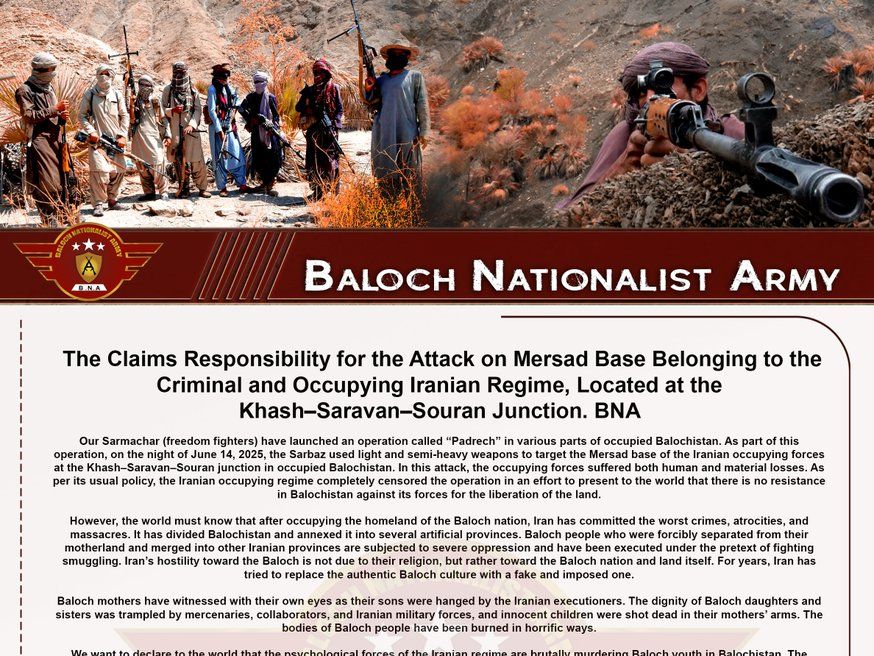
On the night of 14 June 2025, Baloch Nationalist Army (BNA-Beebarg) militants used light and semi-heavy weapons to launch an armed assault on the Mersad base of the Iranian armed forces. They claim to have inflicted both human casualties and material losses on Iranian personnel stationed at the site.
The BNA has framed this operation as part of a broader ideological campaign against what it describes as Iran’s “regional adventurism,” particularly in the context of the ongoing Israel–Iran conflict. They argue that Iran’s interventionist policies come at the expense of marginalised communities, both within its borders and across the region. It uses this rhetoric to call for the formation of a unified opposition front, urging other ethnic and dissident groups in Iran to rise against the central regime.
Though the BNA remains a relatively minor actor compared to other insurgent movements in the region, this attack highlights its increasing willingness to project force across international borders. The expansion of BNA-Beebarg operations into Iranian territory is especially significant in light of the November 2024 joint Iran–Pakistan airstrikes targeting Jaish al-Adl hideouts in Pakistan. Notably, the BNA-Beebarg faction's last operation in Iran was on 12 April 2025, when militants executed eight Pakistani labourers in Mehristan, accusing them of collaborating with Iranian and Pakistani intelligence services. That attack also highlighted the BNA's intent to punish those it views as enablers of regional repression.
The BNA-Beebarg faction, a breakaway group from the main Baloch Nationalist Army, is distinguished by its transnational militant strategy. Unlike the BNA-Anwar faction, which primarily targets Pakistani state forces, BNA-Beebarg has widened its scope to include Iranian military and political targets, particularly in Sistan and Baluchestan Province. The group portrays its campaign as a cross-border resistance movement, defending Baloch populations in both Pakistan and Iran and confronting what it sees as joint repression by Tehran and Islamabad.
| | TRAC Incident Report: Detonation of Three Improvised Explosive Devices (IEDs) Injures Police Officers and Vendors at the Red Cross Fair, Muang District, Pattani Province, Thailand | | (Video) New Group ‘Grupo Cobra’ Declares Itself to Hunt Down Hitmen & Armed Groups, in Veracruz, México | | TRAC Incident Report: Authorities Detain 20-Year-Old 764 Member for Coercing 13‑Year‑Old American into Live-Stream Suicide and Committing Child Abuse in Hamburg, Germany | | | | |