|
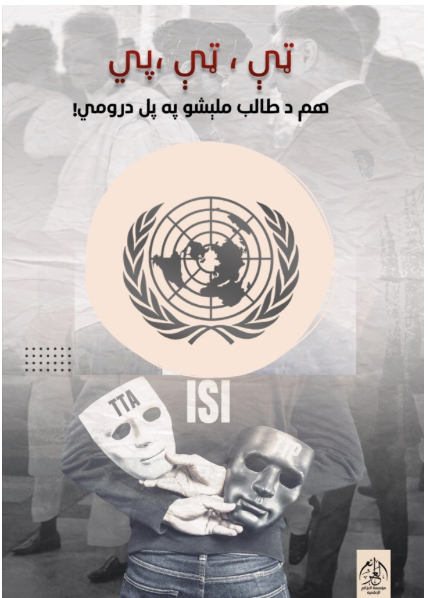
On 14 July 2024, al-Azaim Media of Islamic State Khurasan (ISK) released an article titled, “TTP is Also Standing on the Bridge of the Militia,” which examines the relationship and strategic interactions between ISK and Tehreek-e-Taliban Pakistan (TTP). The article delves into how these groups, despite their ideological and operational differences, navigate coexistence and occasional cooperation within the complex militant landscape of the region. The piece strongly suggests the formation of an alliance between TTP and ISK.
Firstly, the article outlines ISK's ideological foundation and religious justifications. It discusses the group's interpretation of Islamic principles, emphasizing their commitment to jihad and the establishment of an Islamic caliphate. ISK's narrative is portrayed as one of resilience and steadfastness in the face of adversity, positioning itself as the true vanguard of Islamic militancy in the region. This is contrasted with the TTP, which is depicted as having fluctuating allegiances and pragmatic adaptations to the shifting political and military environment. Both groups do not envision the Taliban's government as a Caliphate.
Secondly, the author delves into the historical context of the TTP, tracing its evolution from a loosely connected network of militant factions to a more structured and ideologically coherent organization. The article explores the TTP's fluctuating relationship with the Pakistani state, its internal divisions, and the impact of military operations against it. The narrative underscores the TTP's strategic realignment, including its temporary truces and peace agreements with the Pakistani government, which are depicted as tactical efforts rather than genuine attempts at peace.
Moreover, the article examines the operational dynamics between ISK and TTP. It highlights instances of cooperation and conflict, noting how both groups occasionally align their efforts against common enemies, such as the Afghan government and NATO forces, while also competing for recruits, resources, and territorial control. The text emphasizes the rational considerations that drive these interactions, suggesting that ideological purity often takes a backseat to strategic imperatives in the harsh realities of militant insurgency.
Lastly, the article concludes by considering the future prospects of ISK and TTP. It speculates on the potential for these groups to either converge or diverge further in their strategies and operations. The text posits that while ideological differences may persist, the practical realities of survival and expansion in a contested environment may continue to drive occasional collaborations and opportunistic alliances.
This analysis underscores the complexity of militant group dynamics in the region. It reveals how strategic imperatives can often override ideological commitments, leading to fluid alliances and conflicts. By exploring the nuanced relationship between ISK and TTP, the article provides insights into the broader patterns of insurgency and counterinsurgency in South Asia. The interplay between these groups highlights the challenges faced by regional and international actors in addressing the multifaceted threats posed by militant organizations.
| | |
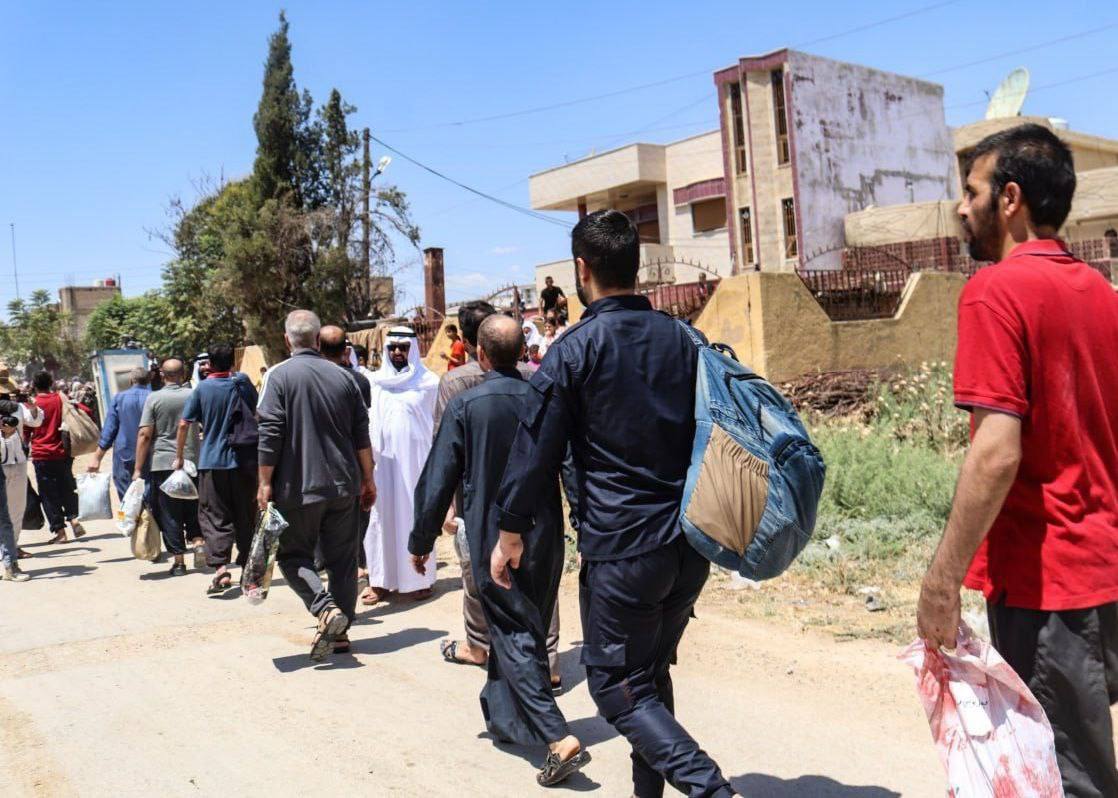
(Chatter) Syrian Democratic Forces (SDF) Released more than 200 Islamic State (IS) Militants from al-Sina’a Prison, in Gweiran (Ghweran/Ghuweiran) Area, Al-Hasakah Governorate, Syria | |
|
The Syrian Democratic Forces (SDF) have released over 200 Islamic State militants from prison under an amnesty granted by the Arab-Kurdish administration. This pardon is limited to Syrian citizens involved in terrorist activities but not implicated in violent crimes. Authorities hope these individuals will seize the opportunity to reintegrate into civilian life. Some of the pardoned had spent up to six years in prison, many serving their sentences in the notorious Ghuwayran prison in Al-Hasakah province, which was attacked by IS militants in 2022.
The decision to grant amnesty followed negotiations with tribal leaders, who assured that the released jihadists would not rejoin terrorist ranks. By the end of July, the SDF plans to release around 1,500 prisoners from various prisons and camps housing relatives of IS militants.
The SDF has also announced an amnesty resulting in the release of several detainees from al-Hol Camp in Hasakah Governorate, Syria. It should be noted that the majority of the detainees were Iraqi nationals. The al-Hol Camp is a significant detention facility in northeastern Syria, primarily holding individuals with suspected ties to the Islamic State (IS). This camp has been a focal point in the broader conflict against IS, as it houses thousands of detainees, including foreign nationals who were captured during the campaign against the IS caliphate.
The decision to release detainees, particularly Iraqi nationals, could be seen as a strategic move with several implications. Firstly, the release may be part of a broader effort to address diplomatic and humanitarian concerns, possibly in response to international pressure or negotiations with Iraqi authorities. The SDF’s action might also reflect internal policy shifts or efforts to manage the camp’s overcrowding and the complex security challenges associated with it.
Overall, this release of prisoners represents a significant shift in the approach towards dealing with former militants. The SDF and the Arab-Kurdish administration appear to be prioritizing reintegration and reconciliation over prolonged incarceration. This strategy is likely influenced by the complex social and political dynamics in the region, where tribal affiliations and local support can play critical roles in maintaining stability and security. However, this move is not without risks. While the assurances from tribal leaders are crucial, there remains the possibility that some individuals might revert to extremist activities. The success of this amnesty program will depend heavily on effective monitoring and support mechanisms to facilitate the reintegration process.
| |
TRAC Incident Report: Jama’at Nusrat al-Islam wa al-Muslimin (JNIM) Militants Take Over a Togolese Army Barracks, Kpankankandi, Kankanti, Togo – 20 July 2024 | |
|
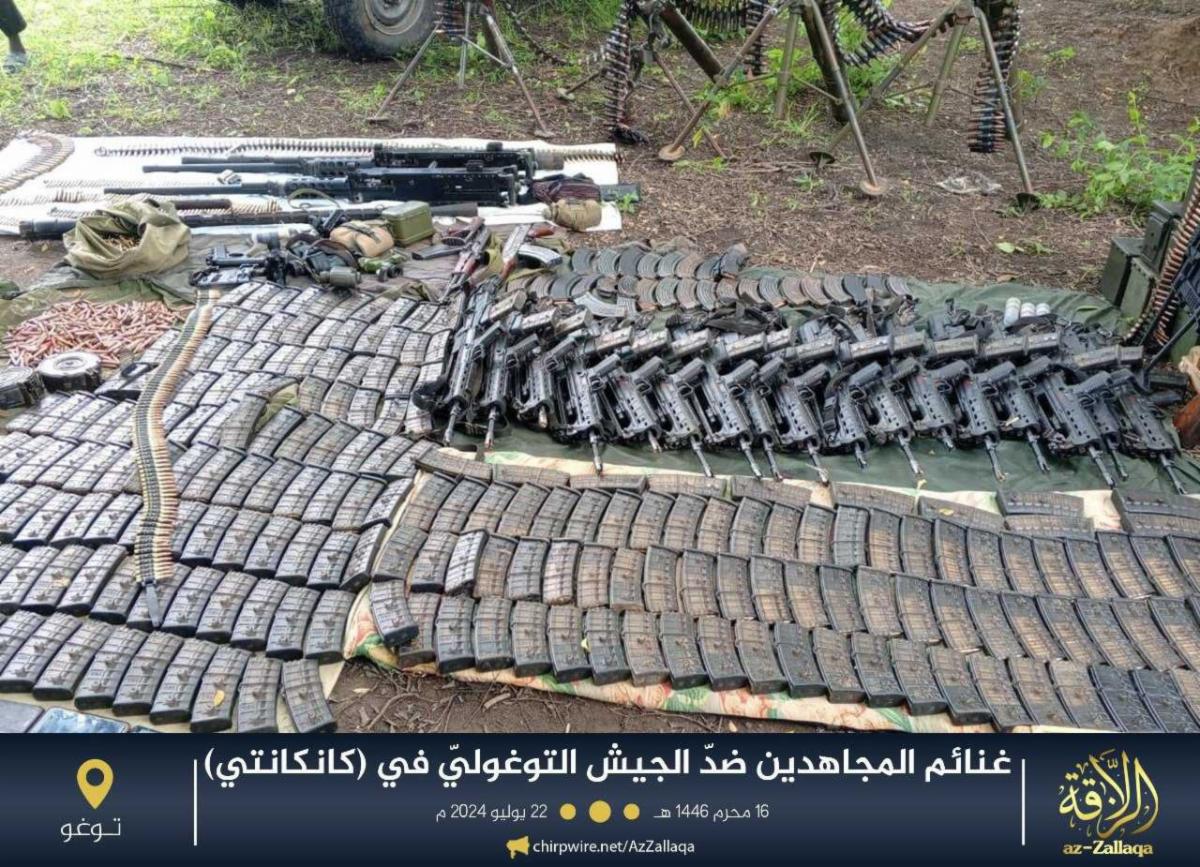
On the afternoon of 20 July 2024, over 1,000 well-equipped Jama’at Nusrat al-Islam wa al-Muslimin (JNIM) fighters, rumored to be assisted by Ansar ul Islam, launched an assault on a Togolese Army barracks in Kpankankandiin, within the Kankanti area of Northern Togo. The attackers, armed with heavy weapons and vehicles, temporarily took control of the barracks for several hours. Following an intense battle involving Togolese special forces, the militants withdrew back to Burkina Faso. The attack resulted in at least 15 soldiers killed, several others reported missing, and the capture of military equipment.
This sequence of JNIM attacks on Togolese troops indicates the group's strong presence south of Kompienga, where they have maintained a blockade. JNIM frequently employs the tactic of storming military bases in large numbers due to its high success rate and the significant advantage it provides in resupplying arms and equipment for future operations.
The notable aspect of the 20 July cross-border attack is the temporary takeover of the Kankanti barracks, suggesting JNIM's intention to establish a permanent presence in Togolese territory along the Burkina Faso border. This strategic move would facilitate the movement of supplies and militants in and out of the country at their convenience.
The attack occurred around 20km from the Burkina Faso border, in the Kankanti area. Considering recent clashes between JNIM and Burkinabe forces in Kompienga province, it is asserted that the militants travelled along the N19 Road from Kompienga village to the Togo border to execute the 20 July attack.
Previously, JNIM targeted Togolese soldiers in Kpendjal, within the Savanes Region of Togo, near Waldjoaga in Koulpélogo Province, Burkina Faso, on 11 July 2024.
| |
TRAC Incident Report: Suspected Sicario Beheaded for Betraying Jalisco New Generation Cartel (CJNG) Leader ‘Comandante 88,’ Macuspana, Tabasco, Mexico | |
|
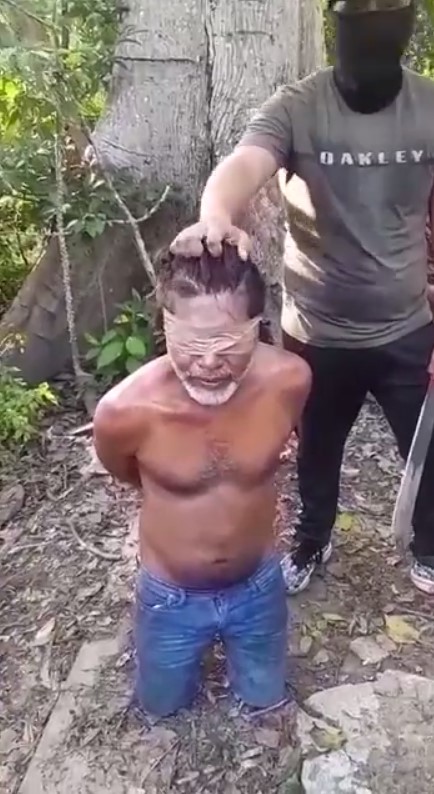
On 09 July 2024, a video circulated online showing the decapitation of a man suspected to be a sicario who betrayed ‘El Señor de Macuspana,’ a nickname for ‘Comandante 88,’ the regional leader of the Jalisco New Generation Cartel (CJNG). The victim is alleged to have defected from the CJNG, likely to join a rival faction,. The defector's motivations were presumably higher pay and better opportunities with the rival group. His brutal execution serves as a stark warning to other members about the consequences of betrayal.
The CJNG has been intensifying its campaign to ‘cleanse’ the state of Tabasco of rival criminal organizations. This surge in activity followed a particularly violent incident on 13 June 2024, carried out by a smaller regional criminal group. This earlier event appears to have galvanized the CJNG's efforts to assert dominance and eliminate any competition.
The CJNG, under the leadership of ‘Comandante 88,’ is notorious for its violent enforcement tactics. This incident is part of their broader strategy to maintain and expand control in the region, reinforcing their influence through fear and ruthless actions.
TRAC anticipates further violent incidents involving ‘Comandante 88’ and the CJNG as they continue their aggressive campaign for territorial control. The cartel’s relentless pursuit of defectors and rivals is expected to escalate violence in Tabasco, exacerbating the already precarious security situation in the region.
| |
TRAC Incident Report: Somali Forces Killed 80 Al-Shabaab Militants in Armed Assault & Seized Their Weapons, in Jubaland, Southern Somalia | |
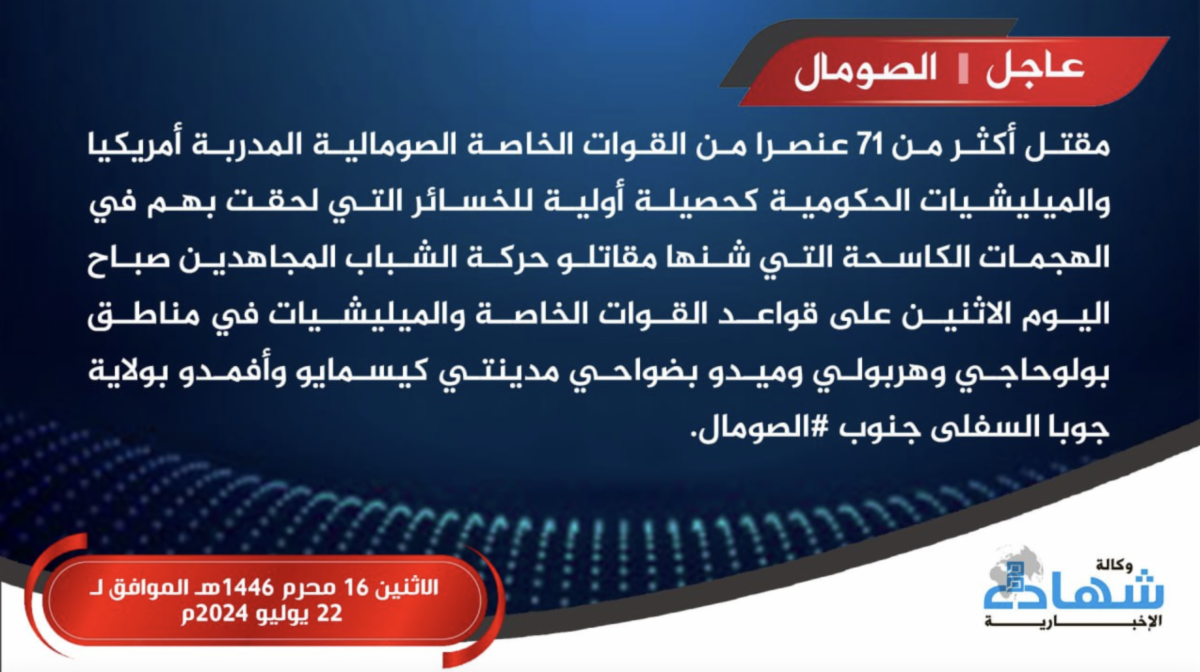 | |
On 22 July 2024, Al-Shabaab launched coordinated attacks on three Somali Forces military bases, resulting in the reported deaths of 71 government troops. The attacks targeted bases on the outskirts of Kismayo, specifically in the towns of Bulo Haji, Harbole, and Miido.
Al-Shabaab has claimed that they have taken full control of the targeted military bases and defeated Somali troops, who had been trained by the United States. This assertion is significant, as it highlights the ongoing involvement of American forces in training Somali soldiers as part of the Somali government’s counter-terrorism operations following the withdrawal of ATMIS forces from the region.
The towns of Harbole, Bulo Haji, and Miido, all strategically located near Kismayo, are significant due to their proximity to this key port city. Kismayo is vital for Al-Shabaab’s revenue, as the group imposes taxes on goods and people moving between Kismayo and Dhobley on the Somali-Kenyan border. Maintaining a presence in and around Kismayo is crucial for Al-Shabaab’s operational and financial stability.
Nevertheless, the Somali government’s statement regarding the attack paints a completely different picture compared to the success that Al-Shabaab claimed. Farah Hussein, a Somali government military official, claims that only five soldiers were killed in the attack. Furthermore, Hussein states that when “we got the information that al Shabaab was coming, we deserted the three bases and then encircled their fighters, killing dozens of them. I counted 30 dead al Shabaab and I could see even more bodies lying ahead of me”. Although there are two wildly deferring recounts of the attack that occurred against the three military bases, TRAC suspects that Al-Shabaab’s claim holds the most accuracy compared to the Somalian government’s assertion of the attack.
| |
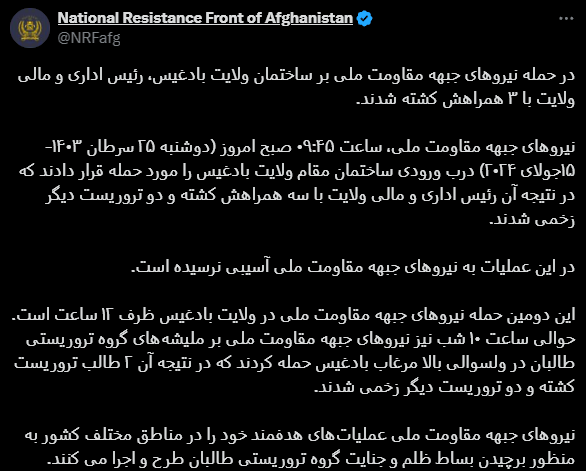
TRAC Incident Report: National Resistance Front (NRF) Militants Conduct Complex Armed Assault & Assassinating the Head of Administration and Finance, in Badghis, Afghanistan | |
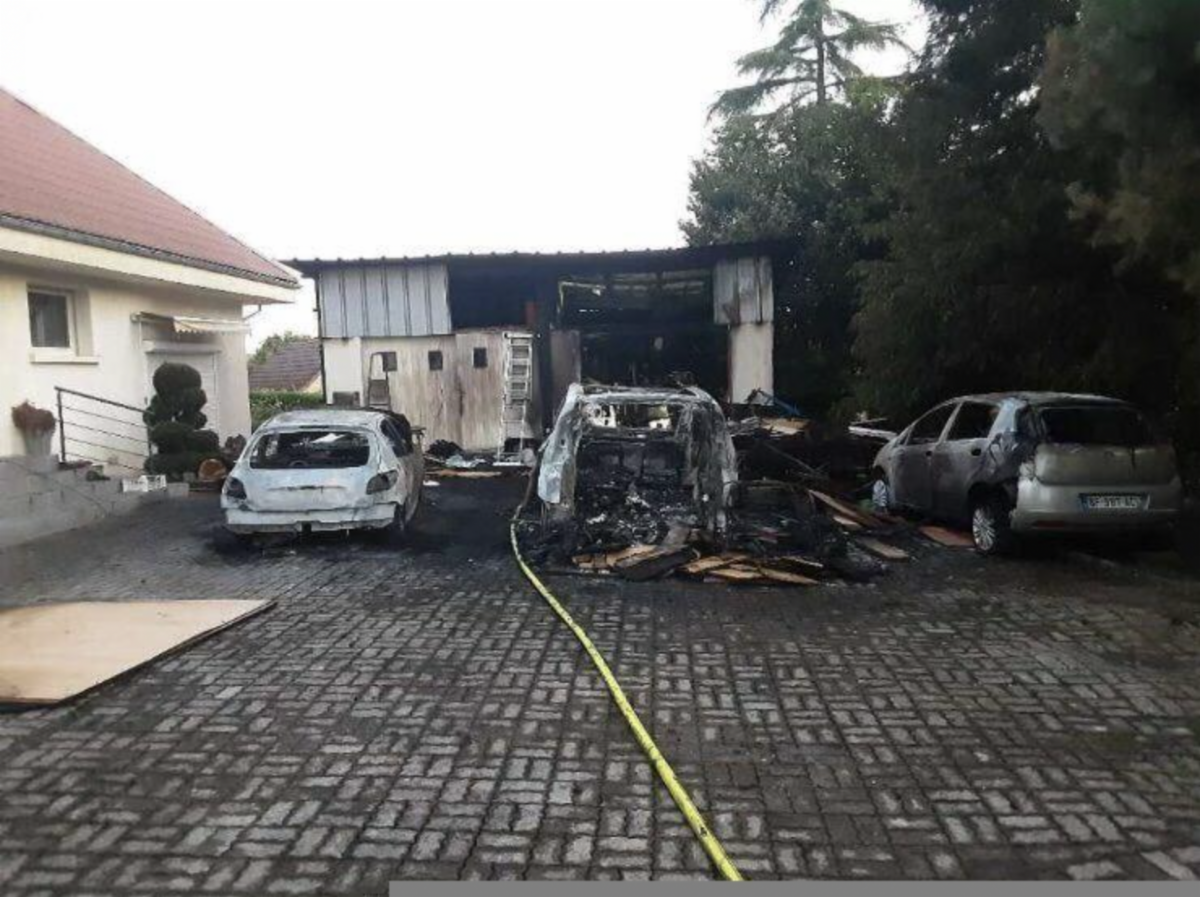
TRAC Incident Report: Anonymous Anarchists Torch 571 Vehicles in Annual Bastille Day ‘Tradition’, in the Alsace, Lyon, and Ile-de-France Region, France
| |
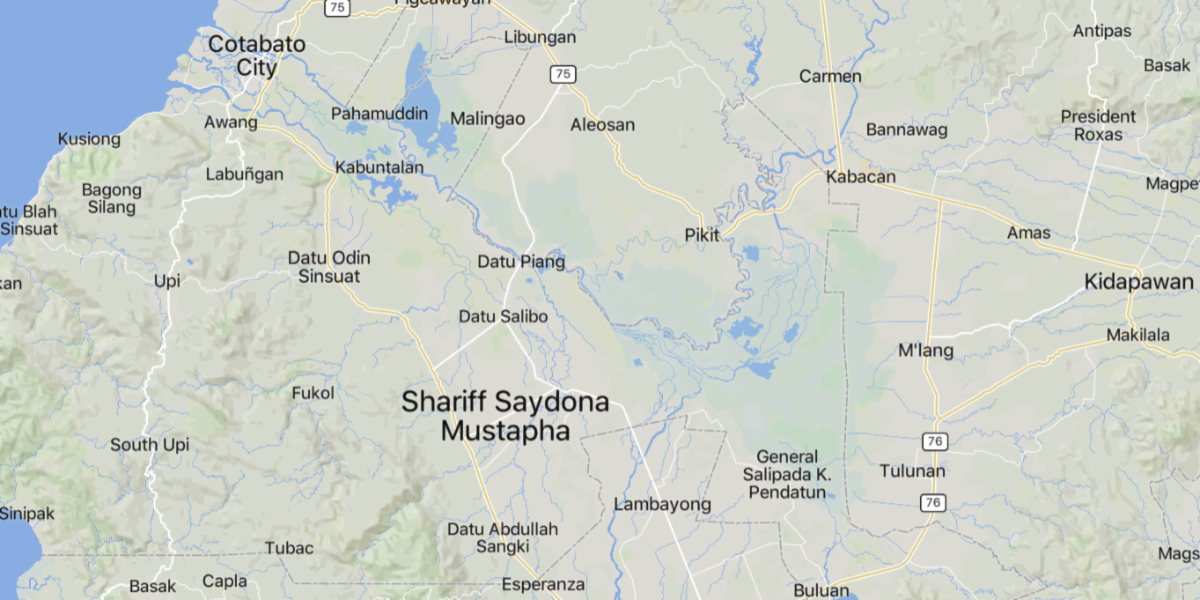
TRAC Incident Report: Maute (ISEA) Elements Leads an Armed Assault on Army Troops, Killing One Soldier, Shariff Saydona Mustapha, Maguindanao del Sur, Philippines | | | | |