On Global Trade & Investment
Published Three Times a Week (with occasional bonus quotes) by
The Global Business Dialogue, Inc.
Washington, DC Tel: 202-559-9316
|
|
SATURDAY, APRIL 4, 2020
Click
HERE
for Wednesday's NAM quote on
the virus and manufacturing
|
|
ON TRADE AND DEPENDENCY - THE VIEW FROM VIETNAM
"Not being dependent on any market is impossible ... but ..."
Tran Quoc Khanh
April 4, 2020 (Publication Date)
|
|
Nhân Dân
describes itself as “the central organ of the Communist Party of Vietnam.” Today’s (March 4) on-line edition includes an interview with
Tran Quoc Khanh,
Vietnam’s Deputy Minister of Industry and Trade. As one would expect, the interview opens with Deputy Minister Quoc Khanh’s comments on Vietnam’s responses to the coronavirus, and we’ll touch on those. Today’s featured quote, however, comes at the tail end of the interview, at a point where the deputy minister is talking about free-trade agreements, especially Vietnam’s soon-to-be-implemented FTA with the European Union. Here is a bit on both topics.
On the Coronavirus,
Mr. Quoc Khanh said his ministry “took early action” and had “sent a warning to provinces during the Lunar New Year [late January] about the possibility of disruption of the flow of goods at the Northern border gates … .” Further, he said,
“the ministry
… called on supermarket chains to distribute excessive agricultural products and
encouraged textile and garment companies to produce face masks
to service increasing demand while strengthening supervision over the domestic market.”
Vietnam to date has been one of the more fortunate countries. They have only had 240 reported cases and no deaths. That works out to just 2 cases per million of the population. These are the comparable figures, cases per million, for China, Germany, Italy, South Korea, and the United States as of March 4:
Italy:
124,632 total cases or 2,061 per million people,
Germany
: 92,150 cases or 1,100 per million people,
United States
: 300,164 cases or 907 per million people,
South Korea
: 10,156 cases or 198 per million people,
China
: 81,639 cases or 57 per million people, and
Vietnam
: 240 cases or 2 per million people.
|
|
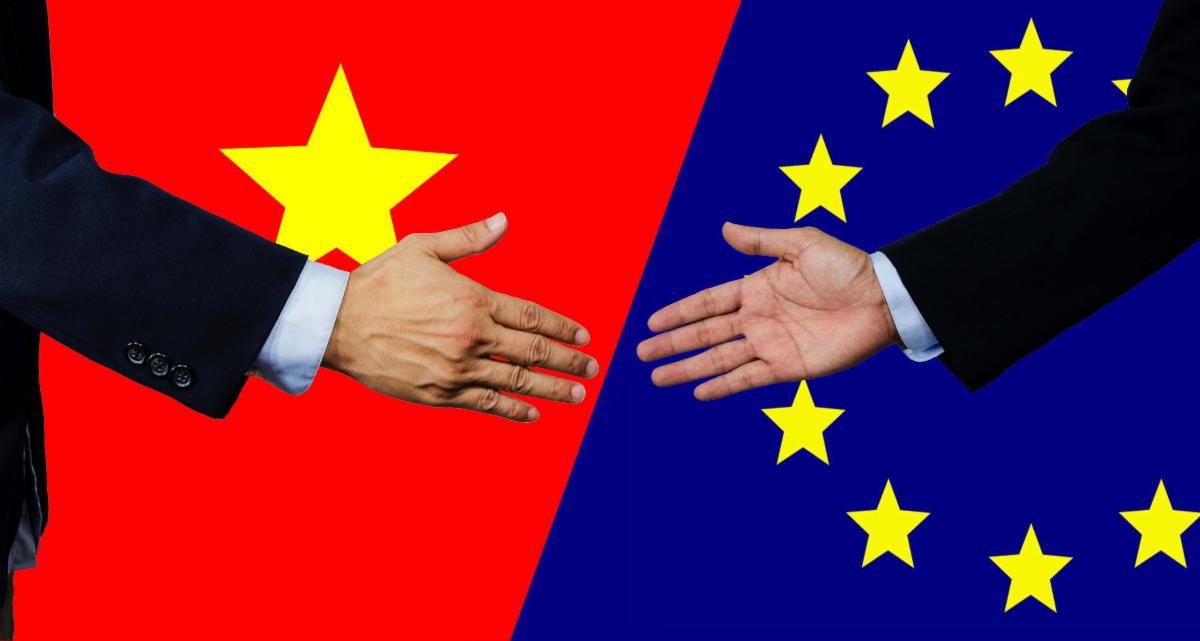
The EU-Vietnam Trade Agreement.
These days, we are all acutely aware that the world is full of unforeseen developments, developments that can obliterate solid expectations in the blink of an eye. Still, barring something major and truly unforeseen, the new trade agreement between the EU and Vietnam will go into effect this summer. The EU Parliament approved the FTA and a related investment agreement on February 12. The European Council gave its final approval on Monday, March 30. Vietnam’s National Assembly is expected to follow suit in May, and soon after that the agreement should enter into force. Any chronology would include these dates:
January 11, 2007
— Vietnam becomes a member of the World Trade Organization.
June 2012
— FTA negotiations between the EU and Vietnam begin.
June 30, 2019
— The EU-Vietnam free trade agreement (EVFTA) is signed at a ceremony in Hanoi.
February 12, 2020
— EU Parliament approves the FTA with Vietnam.
March 30, 2020
— The EU Council completes the EU’s ratification process.
May 2020
— Ratification anticipated by Vietnam’s National Assembly.
Character and Content of the Agreement
. Croatia’s foreign minister,
Gordon Grlić-Radman
has described the EU’s agreement with Vietnam as “the most ambitious free trade agreement ever concluded with a developing country.” The full text of the deal is available on the EU website (see the link below). An EU press release of March 30 provides the following overview:
The FTA provides for the almost complete (99%) elimination of customs duties between the two blocks. 65% of duties on EU exports to Vietnam will disappear as soon as the FTA enters into force, while the remainder will be phased out gradually over a period of up to 10 years. As regards Vietnamese exports to the EU, 71% of duties will disappear upon entry into force, the remainder being phased out over a period of up to 7 years.
The Deputy Minister on FTAs
. Now we come to the heart of the matter, namely what Deputy Minister Quoc Khanh had to say about national independence and free-trade agreements. Here, in full, are the last question put to him by the Nhân Dân nterviewer and his response:
THE QUESTION: How can we be an independent and self-reliant economy without dependence on any market amid the effectiveness of a number of FTAs, including the EVFTA this summer?
DEP. MINISTER QUOC KHANH:
Not being dependent on any market is impossible in this era of globalization.
The best approach is to accept economic links as an objective practice
but there should be solutions so as not to rely too much on any one market
. The signing of FTAs with key markets such as Europe and America is among the solutions to promote trade diversion and market diversification.
|
|
This entry is mainly about Vietnam’s all-but-implemented new trade agreement with the European Union. To name the topic is to suggest the subject is an economic one. But the question above was a political one, and the deputy minister's answer was both political and geopolitical. The focus wasn’t economic efficiency but sovereignty in the sense of maximizing Vietnam’s scope for independent action. Even so, the deputy minister began by recognizing that there are limits “in this era of globalization.”
That said, and as economic stories go, Vietnam’s is impressive. One observer we know talks about Vietnam as the new Japan, that is, as a country moving at an incredible pace from poverty to prosperity. This paragraph from the World Bank underscores the point:
Vietnam’s development over the past 30 years has been remarkable. Economic and political reforms under Đổi Mới, launched in 1986, have spurred rapid economic growth,
transforming what was then one of the world’s poorest nations into a lower middle-income country. Between 2002 and 2018, more than 45 million people were lifted out of poverty.
Poverty rates declined sharply from over 70% to below 6% (US$3.2/day PPP), and GDP per capita increased by 2.5 times, standing over US$2,500 in 2018.
Kudos to the EU for forging an FTA with such a key country.
***
But what of the United States? There was a time when we hoped that TPP would be America’s FTA with Vietnam (and Japan, and New Zealand). This is not a Maud Muller lament over the Trump administration’s decision to withdraw from TPP. That ship has sailed, and we don’t think it is coming back. (Besides, if we lament anything, it is less the loss of TPP than the loss of the universal applicability of GATT/MFN tariff rates, rates which are now, for many, a fallback, a second best.)
So we come to the question, does the United States need a new trade agreement with Vietnam? After all, America is Vietnam’s top trading partner. And Vietnam is clearly an important factor in U.S. thinking and planning about the Asia Pacific. The American aircraft carrier
USS Theodore Roosevelt
– yes that USS Roosevelt – made a port call in Da Nang in early March. Symbols like that are important and welcome, but commercial realities are important too. If, for example, the EVFTA, means that U.S. companies ultimately lose out to their European rivals, that can only complicate the overall U.S.-Vietnam relationship. This is one of those many issues which is not urgent but could be critical. So we shall come back to it.
In the meantime, our congratulations to both/all parties to the EU-Vietnam Free Trade Agreement.
|
|
The EU and Vietnam
is a link to a page on the EU website devoted to this relationship. Here you will find links to the texts of the new trade and investment agreements with Vietnam, among other things.
From Maud Muller
. This poem by
John Greenleaf Whittier
was once a staple of American education. It’s most famous lines are:
For of all sad words of tongue or pen,
The saddest are these: “It might have been."
|
|
TO GET THE TTALK QUOTES IN YOUR INBOX
Or Other GBD Notices, click below.
|
|
©2020 The Global Business Dialogue, Inc.
1717 Pennsylvania Ave., NW, Suite 1025
Washington, DC 20006
Tel: (202) 559-9316
R. K. Morris, Editor
Joanne Thornton, Associate Editor
|
|
|
|
|
|
|