|
Understanding Resistance to EAB
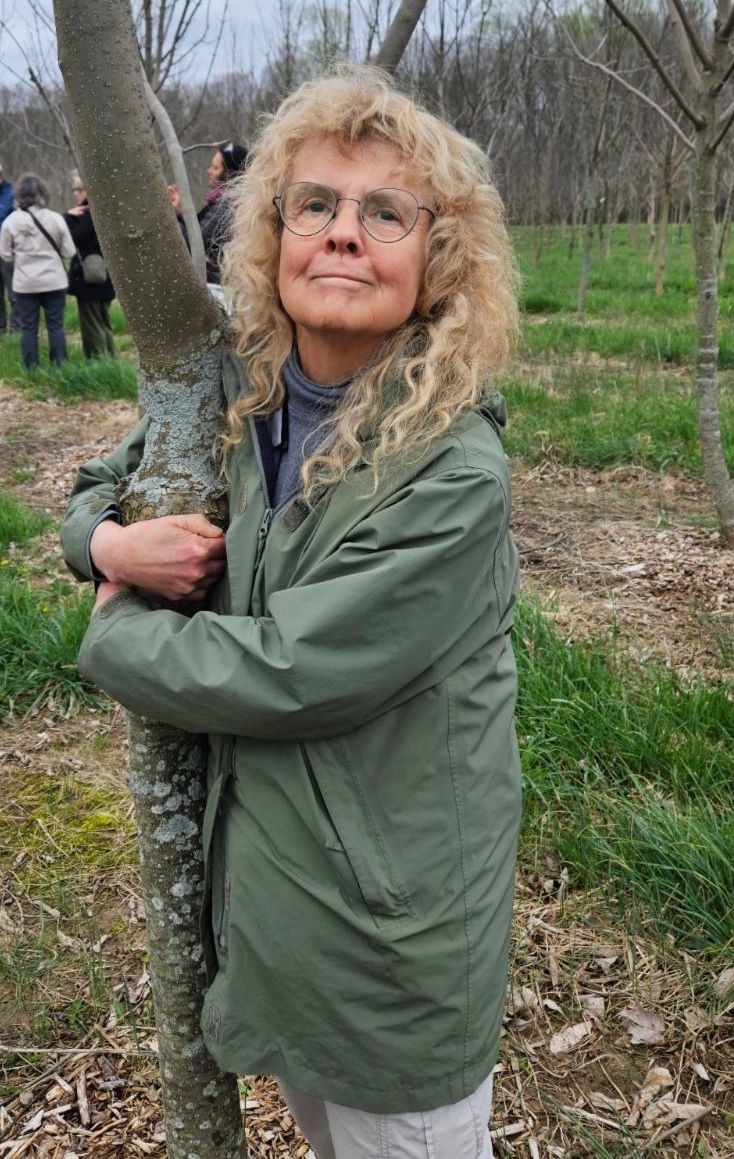
Dr. Jeanne Romero-Severson
University of Notre Dame
Dead trees, once green and beautiful, lined the city streets in Ohio. Dead trees, once providing welcome shade, lined the riverbanks in Michigan. Dead trees in parks, in back yards and in forests. These trees, white and green ash, were killed by emerald ash borer, an invasive insect accidently imported over twenty years ago into Michigan and Ontario.
The emerald ash borer (EAB) kills almost all of the native North American ash species within three to six years of the initial infestation. Tens of millions of trees have died and millions more will die, despite heroic efforts to contain the insect and to suppress the population with tiny wasps whose larvae eat EAB eggs or larvae. Over 15 years ago, US Forest Service scientists monitoring the spread of EAB began to notice that a tiny minority of ash trees did not die in the first three years after infestation. In fact, a few of these trees remained alive eight or more years after EAB arrived.
A dedicated group of Forest Service scientists thought that this ability to stay alive might be due to genetic resistance. These survivors were named ‘lingering ash’. The Forest Service team, Jennifer Koch, Kathleen Knight, Mary Mason, David Carey, Therese Poland, and others, worked diligently to establish research plots of lingering ash, find a way to systematically test them by infesting grafted clones of these trees, and make the crosses necessary to scientifically demonstrate that the survival of at least some of these lingering ash was due to good genes rather than good luck.
In 2015, Jeanne Romero-Severson, a quantitative geneticist at the University of Notre Dame, joined the team. Her student Robert Stanley, an analytical biochemist, chose this project as the focus of his PhD thesis. The skepticism of the scientific community and necessarily slow pace of a tree breeding program meant that funding was slow in coming for the lab work and meager in amount. Almost at the point when funds to continue DNA and biochemical testing were exhausted, TREE Fund saved the day. Dr. Stanley applied for and was awarded a TREE Fund grant that enabled the work to continue and even flourish, assisting all the collaborators to attract other sources of funds and to publish data that indicated that yes, there is genetic component to EAB resistance, genetics that can be passed onto progeny.
The EAB resistance program, now supported by The Nature Conservancy, the US Forest Service’s Northern Research Station and Forest Health Protection Programs[LG1] , and many other sources[LG2] , now rests on firmer, more long-term footing. A long-term footing is essential, as populations of trees from a diversity of lingering ash parents must be established and evaluated. Their descendants will be the source material used for restoration of green and white ash to the rural forests and urban landscapes that lost their less fortunate ancestors.
|