TSG's Guide to the 2024 Federal Election | |
|
For most of us, the end of this election season cannot come soon enough. Regardless of how one wants the election to turn out, this cycle seems to have been the most emotionally exhausting cycle yet, leaving most of us without fingernails. With polls tightening on what seems to be a daily basis, clients, friends, and family have been asking us what to watch for on Tuesday, so we have tried to compile a brief overview of what to watch for, what to expect, and a few useful resources.
Keep in mind: Top intel officials have been warning of an increase in cyber disinformation the 72 hours before to the 72 hours following the election, with a focus on disrupting confidence in the electoral system. While specific campaigns certainly remain a target, it seems most of our foreign adversaries are mostly intent on sowing doubt in our election integrity across the board.
That being said: We’re watching to see if the “red mirage,” a recent phenomenon where Republicans show a lead as polls close, and Democrats pick up speed as mail-in ballots are counted, actually comes to fruition this year.
Order of results: Remember the shock of waking up on November 7th, 2000 to find no determined winner in the Bush v Gore presidential election? While the days of shock in an undetermined race seem to be gone, we are all prepared for this year’s results to be the longest yet. But what can we expect? We predict the Senate will be called first, followed by the White House, and then the House. Why? Both California and New York will go to Vice President Harris, but some of their House districts will be some of the most tightly contested races, and with tricky ballot counting procedures, they will likely determine the control of the House after drawn out results.
With that, here is the Tremont Strategies Group 2024 Federal Election Guide.
| |
|
Every major presidential prediction model is calling the race a tossup. Each of the 7 swing states (The Blue Wall of Pennsylvania, Wisconsin, and Michigan and the Sun Belt states of Nevada, Arizona, North Carolina, and Georgia) have polling averages showing less than a two-point difference between former President Trump and Vice President Harris.
Late Saturday, the gold-standard Iowa Selzer Poll was released showing Vice President Harris with a three point lead in Iowa, a state President Trump won by nine points in 2020. While this poll is likely an outlier, what has pundits paying attention is the fact that Vice President Harris has a significant lead among voters over 65, a group President Trump won by seven points in 2020, and an almost a 2-1 lead with women over 65. This trend of women over 65 voting heavily for Vice President Harris is echoed in other recent polling.
Early yesterday, the top-rated New York Times/Sienna Poll of the seven swing states was released, showing the race tied in Michigan and Pennsylvania, Vice President Harris with a slight lead in Wisconsin, North Carolina, and Nevada, and President Trump with a lead in Arizona. Vice President Harris now appears to have a path to 270 through the Sun Belt and the Blue Wall, a major change from late October polling favoring President Trump.
Vice President Harris’ strongest lead over President Trump occurred in mid-October. During the past two weeks, Vice President Harris’ lead has steadily eroded to either a dead heat or a slight deficit. Polling since mid-week has shown the Vice President once again gaining ground, likely buoyed by the contrast between the closing arguments Harris and Trump delivered from the Ellipse and at Madison Square Garden, respectively. President Trump’s recent rallies have focused on 2020 election denialism, talk of protecting women “whether the women like it or not”, and of being the “father” of in vitro fertilization do not appear to be helping. While it is extraordinarily difficult to poll voters who have not yet made up their mind in the last week, scattered internal and public polling shows that this demographic is breaking towards Harris. All of this should be strongly considered in the context that pre-election polling underestimated Trump’s support by 4 points in 2020.
After the 2020 election, pollsters made a concerted effort to change their protocols to better capture “shy” voters. When President Biden was the Democratic nominee, pollsters used assumptions about the demographics of the “Biden Vote.” When Vice President Harris became the nominee, virtually every major pollster continued to use the expected President Biden electorate in their polling. There is now growing evidence that there are significant differences between the “Biden electorate” and the “Harris electorate.” It is not yet clear what impact those differences may have on polling results.
Vice President Harris’ early polling lead in Pennsylvania (19 electoral votes) has eroded over the past month, and President Trump’s polling lead in North Carolina (16 electoral votes) has eroded over the same time. Those two states, which are key to determining the winner, are now polling even.
Republicans are optimistic about their chances to win Pennsylvania in part because the Democrats’ 630,000 registered voter advantage in 2020 has been cut in half over the last three years. Democrats are optimistic about North Carolina because of the changing demographics due to annual in-migration of over 200,000 people per year. These new residents are primarily white-collar professionals working in the financial services, biotech, and higher education sectors. In addition, the meltdown of the Republican Gubernatorial candidate Mark Robinson following his “Black Nazi” comments is expected to take a toll on the top of the ticket.
In 2016, the election was decided by just over 80,000 votes and in 2020 by just over 44,000 votes. In 2024, the election will likely be decided by less than 250,000 votes. In very close elections, the "ground game" and Get Out the Vote (GOTV) efforts can move margins by one to two percent. Both parties have had problems with their ground game. In February, President Trump canceled the entire Republican National Committee field operation, and using a newly created loophole in campaign finance laws, outsourced his entire voter turnout operation to Elon Musk. This has resulted in conflict and lack of coordination with state and local parties, problems with data sharing, and months of delay in commencing canvassing. Democrats have largely had effective GOTV operations, but the Democratic network of state and local parties, labor unions, and grassroots C3 and C4 groups, despite raising billions of dollars for the Harris campaign and its allied Super PACs, are facing funding shortfalls and have begun to scale back GOTV efforts. The money raised has largely been spent on TV and digital media.
The fundamental dynamic of the 2024 election is the growing gender gap which favors Harris and Trump's growing support among younger Black and Brown men. While making predictions based on early voting is problematic, early voting can indicate trends. Almost 14 million people have voted early in the 7 swing states. Thus far 1,387,977 more women have voted early in those states than men (55.1% to 44.9%). Currently, the gender turnout gap is F+13% in Pennsylvania, F+12 in Michigan and Georgia, F+11 in North Carolina, F+8 in Wisconsin, and F-1 in Nevada. Thus far, women have proven more motivated voters than men. Nationally, 57 million people have voted early. 72% of the national early voters are over 50 years old. While this is not unusual, Vice President Harris will need a much greater under 35 turn out in order to win.
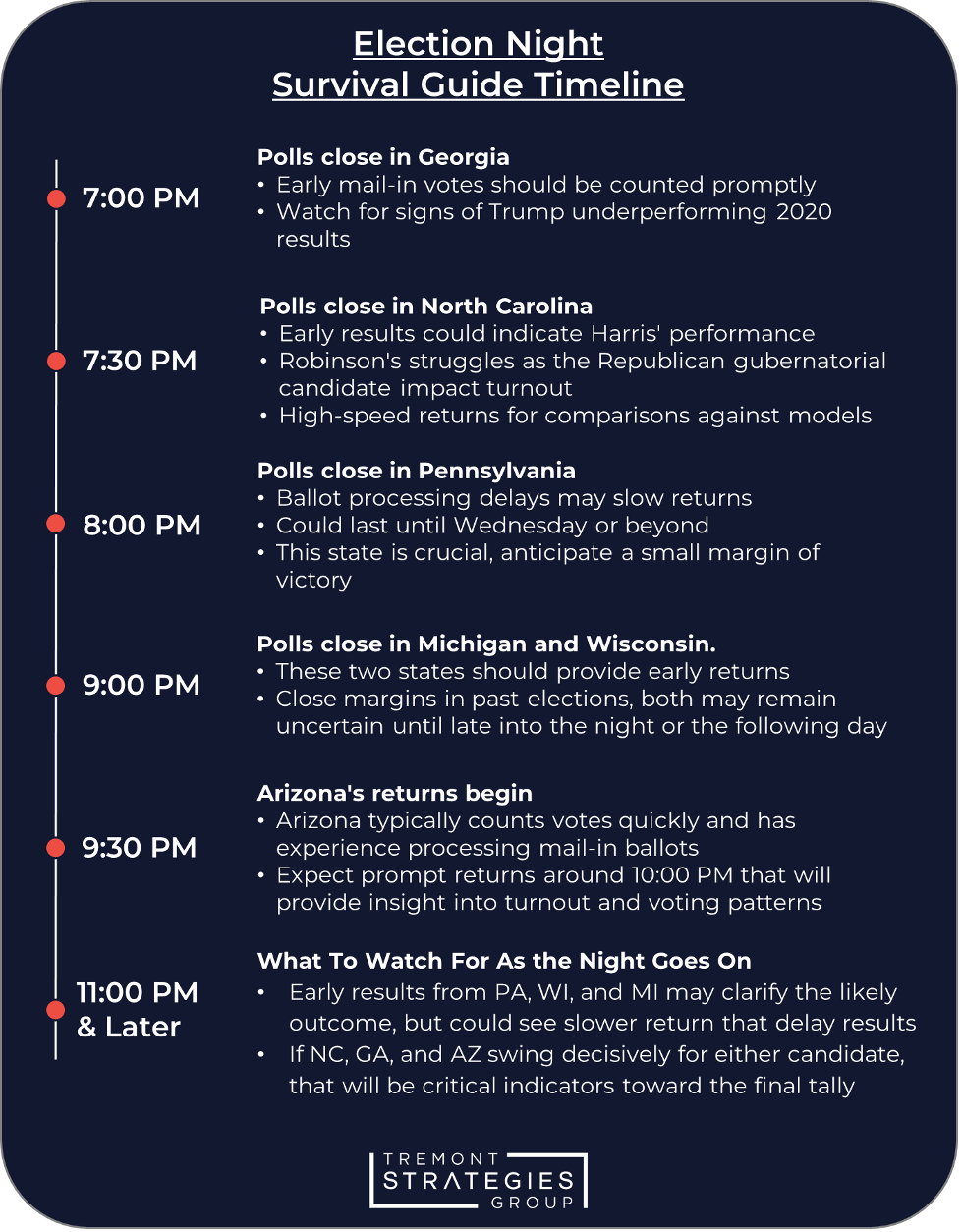
Finally, the trend for early voting has made exit polling less useful and networks are increasingly reluctant to call results until close to 100 percent of the votes have been tallied. By 11:30 pm EST, the tally will likely be Trump 188 and Harris 199. After that, it’s a question of how quickly North Carolina, Pennsylvania, Wisconsin, and Michigan get called. If Vice President Harris is doing well in North Carolina, Nevada or Georgia, or President Trump is doing well in North Carolina, Pennsylvania, or Michigan, then the outcome of the election will be relatively clear. Below is a summary of a guide to election night, written by TSG friend Evan Grossman (all times Eastern). See here for a link to his full analysis.
| |
|
Conventional wisdom, the Senate map, and polls over the last year predict that both Chambers of Congress will flip – the House to Democratic control and the Senate to Republican. Different this year than most presidential years, however, is that both are expected to maintain a slim majority for the party in power – the Senate with only a seat or two and the House with somewhere around five seats. While these predictions remain true, polls have been tightening in recent days and weeks, making some key Senate races (Pennsylvania and Nevada, for example) and about two dozen House races true nailbiters. The key: watch for divergence from the presidential vote to Congressional votes.
Senate
In the Senate, the Democrats currently hold a 51-49 majority. West Virginia is all but certain to flip Republican with the retirement of Democrat-turned Independent Senator Joe Manchin. Closely contested races for currently Democratic seats are in Ohio, Montana, Michigan, Wisconsin, Pennsylvania and Nevada, while Democrats are hoping (but not necessarily favored) to pick up a seat or two in Florida and Texas. Arizona was expected to be a closer race, but Congressman Ruben Gallego is now highly favored to beat Kari Lake, keeping the seat Democratic.
Key to watch: In Ohio and Montana, incumbent Senators Brown and Tester are both polling ahead of their Republican challengers, making both states appear to be very actively in play. Pennsylvania, probably the most important state this cycle, is also top of the list. Some key things to think about:
Ohio: Senator Sherrod Brown is polling within the margin of error – some polls showing him up two points and some polls showing him down by two points. Senator Brown is an anomaly in Ohio, a strong candidate who remains a favored politician in the state despite his liberal lawmaking in an increasingly red state. While Senator Brown’s campaign says they can win as long as they stay within eight points of President Trump, challenger Bernie Moreno is polling exactly where Senator Vance, R-OH, was last cycle before he ultimately beat Democrat Tim Ryan by four points. It’s clear voters are regressing to the mean in recent Ohio polling, favoring Moreno. The question is, can Brown’s ground game counter that.
Montana: This seat is viewed as the most likely Senate seat to flip. Senator Tester maintained an extremely slim lead in the polling until last month and has lagged by four points in recent polls. However, in each of Senator Tester’s past four elections, he has entered election day down in the polls and won each time. Insiders say Senator Tester needs to poll within three points of his opponent to win.
Pennsylvania: Likely to be the determining state for the presidential race, this state has been flooded by volunteers in recent days and weeks, where our folks on the ground tell us Trump dominates the yard signs but Harris wins in volunteer ground game. Senator Casey is slightly favored to win re-election as a result, but Dave McCormick is running a solid campaign, formidably appealing to Trump loyalists as well as carving out slight differences between himself and the former President to appeal to voters – mainly women – who might split their vote between the top of the ticket and the Senate race. It is for this reason McCormick has been holding closing rallies with endorsements ranging from Senators Todd Young, R-IN, and Pat Toomey, R-PA, who refuse to support President Trump, to the former President and his children themselves.
Nebraska: Lots of rumors are flying about Nebraska’s senate seat being “in play,” following recent polls show the Independent candidate, Dan Osborn, within striking distance of incumbent Republican Senator Deb Fischer, something that caught Washington by surprise. But don’t let this messaging confuse you. Democrats have taken the opportunity to create a landslide of PAC support for Osborn, hoping they might knock Fischer out of a potential Republican majority. In reality, however, while the seat might be “in play” in moving from Republican to Independent, it does not significantly impact Democratic odds of controlling the Senate, because one of Osborn’s primary campaign messages has been that Senator Fischer does not embrace President Trump closely enough, indicating a slim to none chance that Osborn would caucus with Democrats. The only scenario where an Osborn win helps Democrats with the majority is a 50 – 49 seat majority for Democrats with Dan Osborn remaining an Independent rather than caucusing with Republicans. Keep in mind that Senate Rules require you to caucus to get Committee seats, so we remain skeptical that a Senator Osborn would not actually caucus, again leaving him unlikely to create any advantage to the Dems.
House
While Democrats are favored (albeit, slightly) to take control of the House, there is an interesting dynamic playing out where Democratic candidates are generally polling better than Vice President Harris, and the Republican candidates are polling worse than President Trump. That being said, dozens of races are polling within the margin of error, and the majority, regardless of Party, is highly likely to be as tight as it is now, with either party expected to only hold a four or five-seat margin. Democrats hold the advantage here in needing to net only four sets to take the majority and look favorable to knock off several vulnerable Republicans in New York and California districts. But Democrats should be sure they don’t count their chickens before they’re hatched here. Republicans are feeling confident enough that they are discussing what a reconciliation package might look like if they do capture the House (and take the Senate back, as expected).
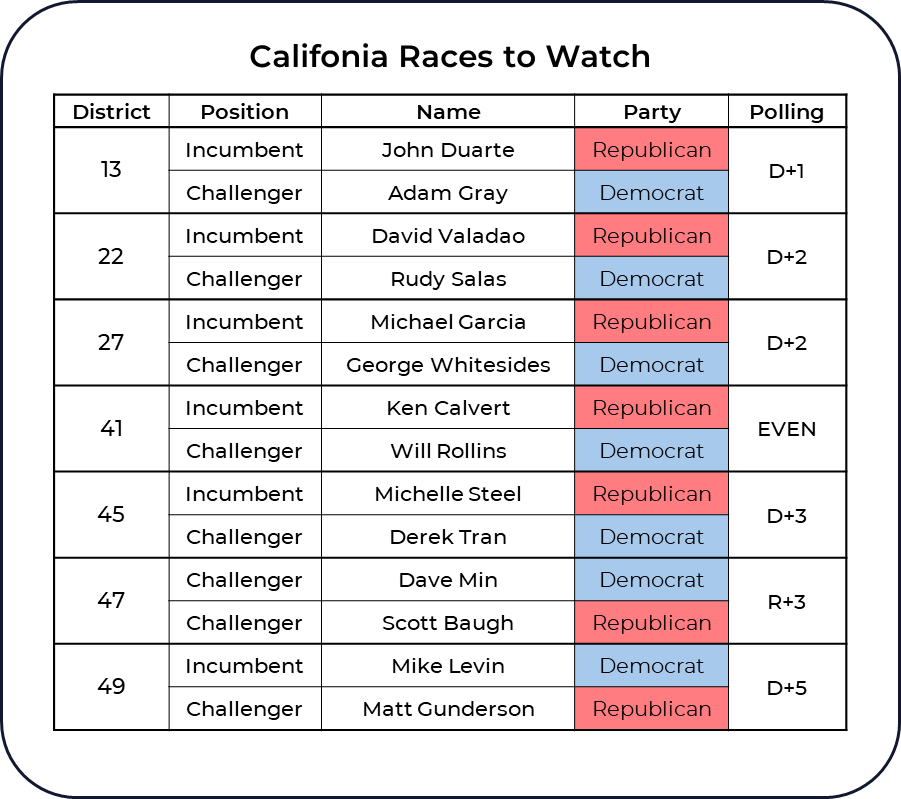
Some of the California races to watch that will likely delay the House majority being named include:
|  | |
|
Remember: In 2022, Rep. John Duarte’s win over opponent Adam Gray was not decided until last week of December!
We’re also watching the New York 4th district, where Congressman Anthony D’Esposito is expected to lose his race to Laura Gillen, and Iowa’s 3rd, where Democrats are expected to flip Congressman Zach Nunn’s seat. In New York’s 19th district, where Congressman Marc Molinaro is being challenged by Josh Riley, the race is so tight that both Speaker Johnson and Minority Leader Jeffries made campaign stops on Friday.
What surprises might be in store? In Connecticut, we’re closely tracking the 5th district where incumbent Congresswoman Jahana Hayes is white knuckling her race against George Logan. Republicans have not won a federal election in Connecticut since 2006, so this race has drawn in Speaker Johnson and his fundraising allies. Meanwhile, Alabama’s recently redrawn 2nd District may bring Congresswoman Terri Sewall some company in the caucus, with Obama alum Shomari Figures set to pick up this seat, which has been held by the GOP since 2010.
Where’s the money? Mostly in Democratic ads. Punchbowl news recently reported that in 22 of the 25 toss-up House races, Democrats have outspent Republicans in ads during October in a cumulative $173 million to $138 million - a staggering $35 million gap in one month, alone. But Democratic leadership is not taking this for granted – just this past Tuesday, only a week out from the election, they held a call asking for Members in less competitive races to donate more money to leadership PACs for last-minute ad buys.
On Tuesday, watch for: Look out for early calls in the races of Congressman Jared Golden, D-ME 2, Congresswoman Marcy Kaptur, D-OH 9, and Congressman Matt Cartwright, D-PA 8. If these seats flip early in the evening, the Democrats are likely in for a rough night. If they hold, we’re likely going to see a split Congress.
| |
|
Congress
Showing their confidence in election night outcomes, Republican leadership in both the House and Senate have scheduled leadership elections for Wednesday, November 13th, their second day back in session. This feels slightly bullish for the House side but likely safe for the Senate. The Senate question looming large is would Senator Vance be permitted to vote in leadership elections if the presidential race remains uncalled on November 15th. To vote in the election, the individual must have a seat in next session’s Senate – and Senator Vance would lose his seat if he is to become Vice President. If there is no call yet for the presidential race, however, he would be slated to a sitting Member of the 119th Congress.
In the Senate, Leader McConnell is wrapping up his long tenure as caucus leader, leaving a close race between Senators John Thune, R-SD, John Cornyn, R-TX, and Rick Scott, R-FL. We rank their likelihood of winning Majority or Minority Leader in that order.
What’s one of the big impacts here? The future of Congressional “earmarks.” Senator Thune has been an advocate for Congressionally Directed Spending (the new name for Senate earmarks), requesting significant funding for his home state since the return of earmarks. Senators Cornyn and Scott, on the other hand, remain adamantly opposed to the spending mechanism, having refused to bring home the bacon for their states while other Senators snatch it up. Senator Scott went so far as to introduce a resolution that expressed opposition to earmarks earlier this year (see this press release from March 2024).
In the House, we expect Congresswoman Rosa DeLauro, D-CT 3, or Congressman Tom Cole, R-OK 4, to take (or in Cole’s case, keep) the gavel for the Appropriations Committee. Both have historically supported earmarks (or, as the House now calls them, Community Project Funding (CPF)), with Chairman Cole submitting the maximum of 15 funding requests in FY24 and FY25. However, Cole also changed the appropriations process this past April so that non-profits were no longer eligible for CPF in the Economic Development Initiative account. Should he maintain chairmanship of the House Appropriations Committee it remains to be seen what the future of non-profit eligibility would be. You can count on Congresswoman DeLauro to eliminate this prohibition, however.
| |
|
The White House
One of the first things the President-elect will do this fall is begin to name their Cabinet. These individuals will of course have significant input in the policy direction of the country. To provide a better understanding of who might be named and what decisions they might be making, we have put together an overview of potential nominees, which can be found here.
| | | | |