|
Are you a research-minded person? Every time we put together this research newsletter, I picture YOU. You are curious. You are engaged. And you care deeply about the future of Turner syndrome research - not just for yourselves, but for everyone who will grow up with TS in the years ahead.
Thank you for walking alongside us, for your trust, and for your willingness to help advance understanding in ways big and small.
With appreciation,
| | |
Cindy Scurlock
President/CEO
| | About this Research Newsletter | | |
This newsletter is designed to keep our Turner syndrome community informed, empowered, and inspired by sharing the latest research that can improve health, quality of life, and long‑term outcomes for people with TS. Each issue highlights studies that deepen our understanding of Turner syndrome—from medical advances to daily‑life insights—so individuals, families, and healthcare providers can stay up‑to‑date on what’s new and what’s possible.
We also hope these stories spark interest in participating in TS research. Every study needs volunteers, and every volunteer helps move us closer to better care, earlier detection, and stronger support for the TS community. Together, by staying informed and getting involved, we can accelerate progress and shape the future of Turner syndrome research.
| | NASCARR, Turner Syndrome, and Discovery | | |
NASCARR is a consortium bringing together experts in cardiology, endocrinology, neurodevelopment, and genetics, along with patient organizations like TSSUS, to support the development of shared registries, natural history studies, and cross institutional clinical trials that were previously impossible due to fragmented, small cohorts.
NASCARR is part of the Rare Diseases Clinical Research Network and was established in September of 2025 through funding by the National Institutes of Health (NIH). The NIH’s 5-year investment is especially important to the TS community because it accelerates high quality, collaborative research across all sex chromosome aneuploidies, including Turner syndrome.
Researchers may apply for NASCARR funding, participate in multisite study design, access NASCARR’s coordinated data systems, contribute to natural history projects, and collaborate with advocacy partners like TSSUS to expand recruitment and community engagement - all of which move the field toward earlier detection, better treatment strategies, and improved lifelong outcomes for people with Turner syndrome.
This month, the Turner Syndrome Society of the United States endorsed 3 exciting TS research applications related to NASCARR.
|
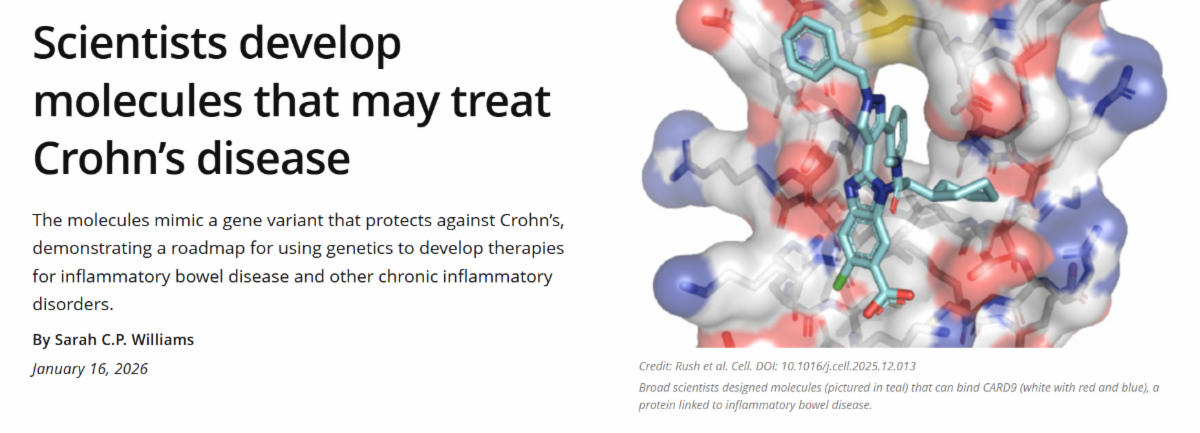
| Scientists Develop Molecules that may Treat Crohn’s Disease | Broad Institute | | |
Summary- Hope for those with Irritable Bowel and Crohn’s Disease
The TS Clinical Practice Guidelines report that inflammatory bowel disease (IBD) is more common among individuals with TS than in the general population. Analysis shows that the prevalence of IBD in TS ranges from 0.67% to 4%. Studies differ in the distribution between monosomy and structurally abnormal X chromosomes. IBD may also present at a younger age, 3-41 years, be more severe, and/or have unique treatment complications.
The hope. Scientists at the Broad Institute and collaborating institutions have developed new small molecules that may one day help treat Crohn’s disease by copying the effects of a rare genetic variant that naturally protects some people from developing inflammatory bowel disease. These molecules were designed to mimic the protective behavior of a variant of the CARD9 gene, which helps prevent persistent inflammation in the digestive tract; in tests, the compounds successfully reduced inflammatory signaling in human immune cells and lowered inflammation in mice.
This work represents a major step forward because it shows how discoveries in human genetics can be turned into potential medicines through a “genetics to therapeutics” pipeline, offering hope for future treatments for Crohn’s and similar chronic inflammatory conditions.
| | Corneal Health in Turner Syndrome | | |
A recent study, from Poland, revealed that people with Turner syndrome may have unique differences in the shape and flexibility of the cornea—the clear front surface of the eye—which may increase the risk for a condition called corneal ectasia. This condition causes the cornea to thin and bulge, which can affect vision over time.
Because these changes can develop gradually, the researchers recommend regular, detailed eye exams for individuals with TS, including specialized scans that measure corneal thickness and structure. Early monitoring can help eye doctors catch any changes sooner and protect long‑term vision.
| | TSSUS Thanks Participants in this Study | | |
Researcher, Brady Evans of Northwestern Medicine, fulfilled her recruitment needs for a study we recently promoted. She is currently conducting interviews with parents, whose daughter’s had a gonadectomy (removal of the ovaries to prevent gonad blastoma).
She hopes to understand the experiences of family members and share insights with medical professionals. Thank you to those in the TS Registry who received an invitation and agreed to share their personal experiences. She will share research findings in a few months.
| | The TSSUS Turner Syndrome Research Registry (TSRR) | | |
Individuals with Turner syndrome (TS) and their families are so very important to advances in care brought about through Turner syndrome research. To all of our community who make successful studies possible, thank you for your invaluable participation.
TS Researchers encouraged the Turner Syndrome Society of the United States (TSSUS) to collect health information from people with Turner syndrome (TS) to identify the number of people with certain conditions and those willing to participate in various studies. More than 1,400 people are now enrolled in the Turner Syndrome Society of the United States TS Research Registry, helping to advance research for this multi-faceted condition.
The exciting part of the TSSUS Turner Syndrome Research Registry (TSRR) is that the information a TSSUS-approved researcher collects about you is saved in the registry and available for future research teams. Any TS researcher can apply to use the registry, and the TSSUS Scientific Advisory Board reviews and approves the research proposals. People like you have already supported many studies, including brain and behavior, estrogen, diabetes, heart, and more!
Why all of this matters? Turner syndrome is complicated, from physical traits, medical complications, and psychosocial and learning differences, there is still much to be learned and studied.
Every new finding, every new discovery, and every new insight can contribute to improving and enriching the lives of those with Turner syndrome - and your participation is the key that unlocks them all.
If you haven't already, please add yourself or your child to the TSSUS Turner Syndrome Research Registry, It takes about 20 minutes to start, and there are several questionnaires you can complete along the way. It's important, and Turner syndrome researchers need people with Turner syndrome to make new discoveries.
The Tuner Syndrome Research Registry is hosted and funded by the Turner Syndrome Society of the United States in collaboration with UTHealth in the Texas Medical Center in Houston, Texas - the largest medical center in the world.
Let's make advancements together! Let's help TS researchers unearth new findings about Turner syndrome.
| Please fill out General Survey 4. All TS Research Registry participants received an email asking them to fill out Survey 4. For new people, your first survey will be Survey 4 and for “old timers” Survey 4 captures health changes over time. | | New Findings from the Turner Syndrome Research Registry (TSRR) | | |
Our current analysis uses data from the TSSUS Turner Syndrome Research Registry (TSRR) cardiovascular questions asked in Survey 4.
The REDCap export contained 254 unique Survey 4 participants. Because this survey allowed participants to select more than one cardiovascular diagnosis (“check all that apply”), individuals could contribute multiple conditions.
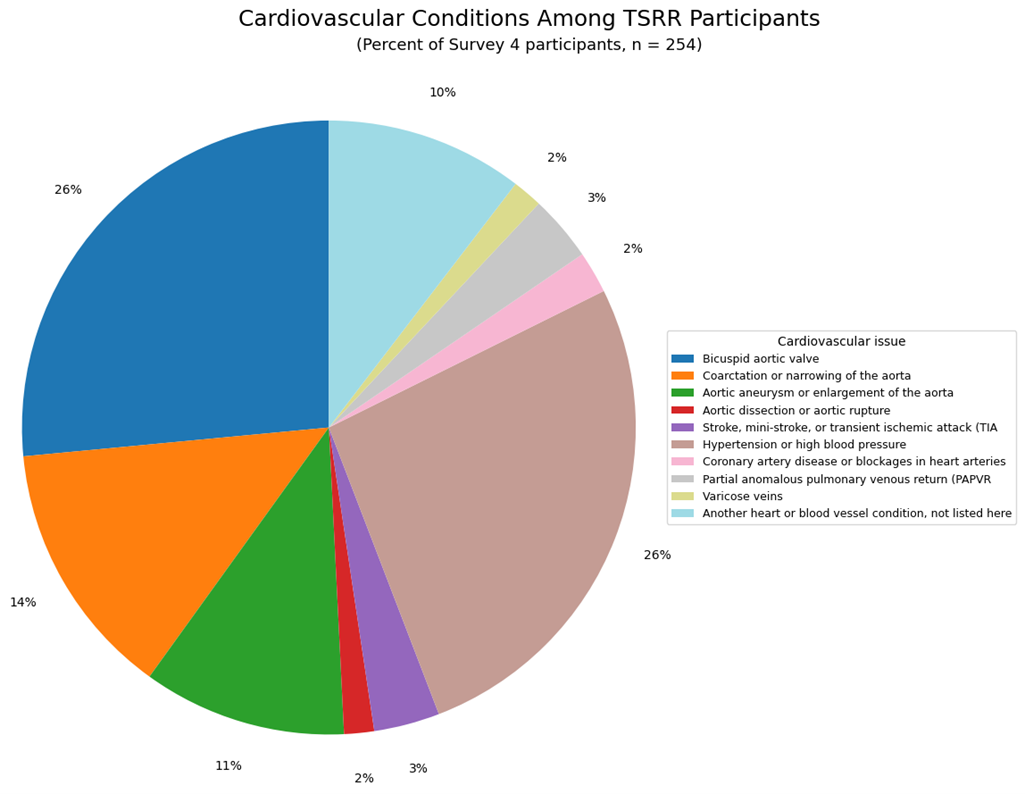
To ensure clinical interpretability, the overall pie chart in this report presents the percent of Survey 4 participants (n = 254) reporting each cardiovascular condition. In other words, percentages represent the proportion of participants with that diagnosis, rather than the proportion of total responses
| | |
Figure 1: Distribution of cardiovascular diagnoses reported in Survey 4 among 254 unique TSRR participants.
| |
Key findings (Survey 4; n = 254 participants):
The overall pie chart shows the percentage of Survey 4 participants reporting each cardiovascular issue:
-
High blood pressure was the most commonly reported condition, affecting approximately 26% of participants.
-
Bicuspid aortic valve was also reported by about 26% of participants.
-
Coarctation or narrowing of the aorta was reported by roughly 14% of participants.
-
Aortic aneurysm or enlargement of the aorta affected approximately 11% of participants.
- “Another heart or blood vessel condition” not listed was reported by about 10% of participants.
- Less common but clinically important conditions included:
- Stroke, mini-stroke, or TIA: approximately 3% of participants.
- Coronary artery disease or blockages in heart arteries: approximately 2% of participants.
- Aortic dissection: approximately 2% of participants.
- Partial anomalous pulmonary venous return (PAPVR): approximately 3% of participants.
- Varicose veins: approximately 2% of participants.
-
Heart attack or myocardial infarction was reported by a very small proportion of participants (<2%).
-
Hypoplastic left heart syndrome (HLHS) was not reported among Survey 4 participants in this dataset.
Overall, Survey 4 findings demonstrate that hypertension and structural aortic abnormalities remain the most frequently reported cardiovascular conditions among TSRR participants.
While major vascular events such as stroke, myocardial infarction, and aortic dissection were less common, their presence underscores the continued importance of long-term cardiovascular monitoring in this population.
| | | | |