|
When the Bees Gather
A Lesson in Communication from Nature
Recently I was given the honor of being a “foster parent” to two bee hives. This seemed like a perfect opportunity for the bees since there are plenty of flowers, clover and bee friendly food on our organic farm. Also, this seemed a perfect chance for me to support nature. Everything was going well; the bees were busy, flying in and out of their hives. Then one afternoon during my “rounds” I noticed something very different.
At first, I thought something was wrong.
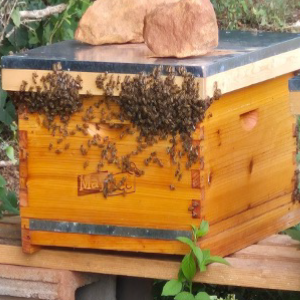
There they were, spilling out of the hive entrance and covering the front of the hive in a thick, living mass. Hundreds of bees clustered together, their bodies overlapping, some hanging beneath the others in layers.
It looked almost like the hive had grown a beard.
I stood there watching, fascinated—and a little concerned. Why were so many bees outside? Why weren't they inside the hive, where I expected them to be? Or flying in and out of the hive as I had observed many times before?
Then I learned about bearding.
Bearding is one of those remarkable behaviors that reminds us just how much is happening inside a bee colony that we cannot immediately see. When bees gather outside the hive in this way, they may be responding to heat, humidity, crowding, or the need for better ventilation. The colony is sensing its surroundings and adjusting.
In other words, the bees were communicating.
Not with words, of course. Their communication is expressed through movement, scent, touch, vibration, temperature, and countless other signals. Each bee responds to information from the environment and from the bees around her.
And somehow, collectively, they figure out what needs to happen next.
Watching the bees bearding changed the way I looked at that cluster. What initially appeared to be disorder began to look like communication, cooperation, and resilience.
There was something beautiful about standing quietly beside the hive and watching thousands of individual bees participate in one collective response. No one appeared to be giving instructions. No one bee seemed to be in charge. Yet the colony was responding together.
Their lives are always connected to what is happening around them.
Watching them bearding at the entrance of the hive reminded me that communication doesn't always look like conversation. Sometimes it looks like gathering. Sometimes it looks like making space. Sometimes it looks like responding to a change that everyone can feel, even if no one can explain it.
And perhaps that's a lesson worth carrying with us beyond the hive.
We live in a world filled with noise—so many words, notifications, opinions, and demands for our attention. It can be easy to forget that communication also requires listening.
The bees don't have the luxury of ignoring the signals around them. Their survival depends upon paying attention.
Maybe ours does, too.
The next time you see something in nature, pause before deciding that something is wrong. Slow down. Take a closer look. Listen for the messages.
That is what the bees gave me that day: not an answer, but an invitation—to slow down, to observe, and to listen for the messages that don't arrive in words.
Sometimes, if we are quiet enough, we notice the natural world has been communicating with us all along.
We warmly invite you to visit the Well of Mercy and experience the quiet, the beauty, and peace of nature. A visit offers an opportunity to step away from the busyness of everyday life, reconnect with nature, and reflect on our responsibility to care for creation.
Call to Make Your Next Reservation
704-539-5449
|