|
I find the process of discovering interesting cars (or them discovering me), sorting them out, and selling them to be quite satisfying. Between 2009 and 2011, I was running the Cars & Coffee at Distinctive Collection which gave me a nice venue to display the finished articles. When the RUF-Porsche and the Alpina BMW sold I started looking for replacements, and it didn’t take to long to find one.
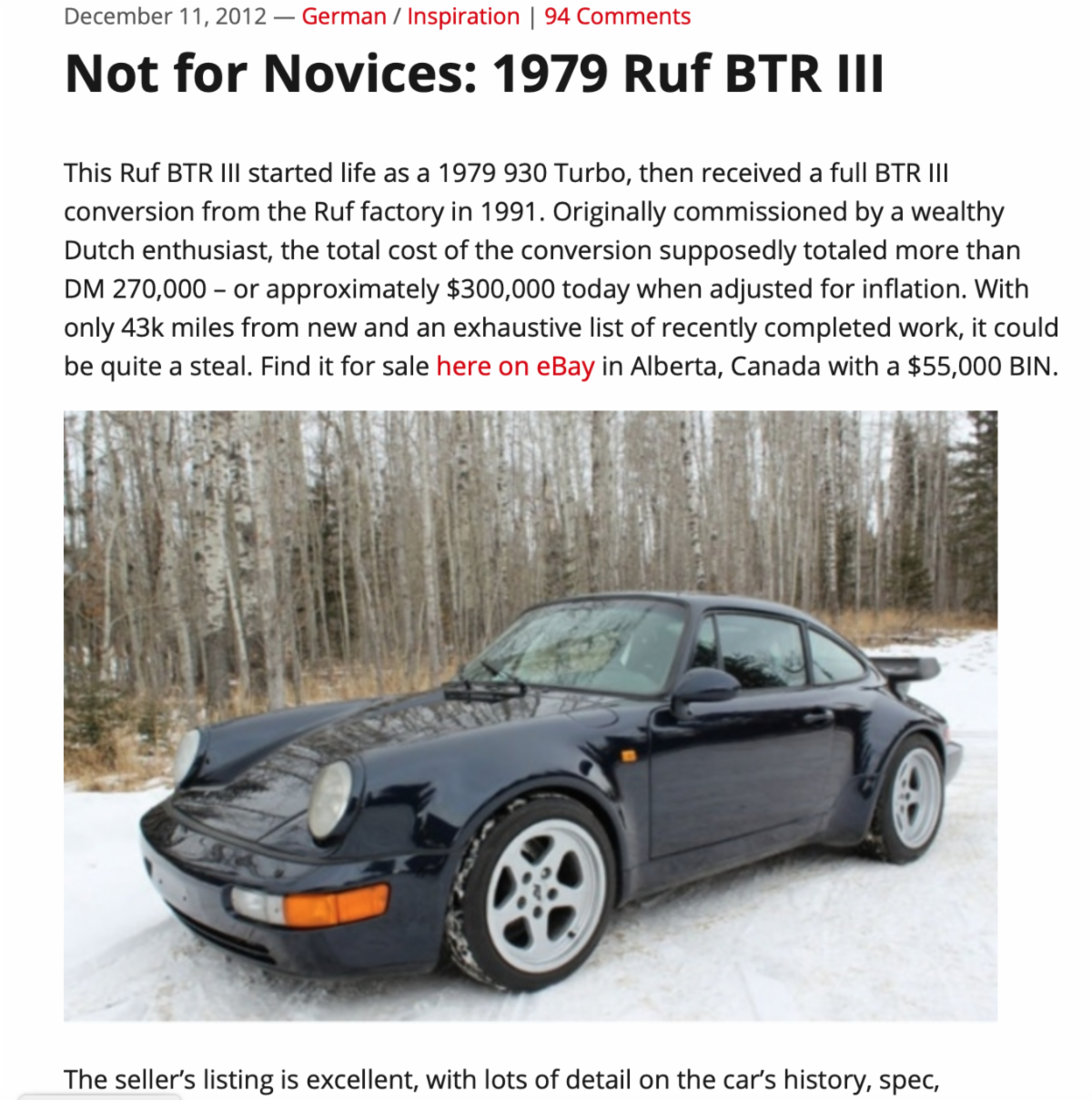
The next car to come along was another RUF Porsche, but it had a much higher spec than the first one I had, which was a BTR conversion of a 930 Turbo done at one of RUF’s distributors in Scottsdale, AZ. This car was a factory conversion that had a bunch of optional CTR pieces on it. I had seen it before at the Okotoks car auction where it was looking pretty scruffy and failed to meet reserve. I remember it had a big stack of Ruf factory invoices on the dash. The owner found me through my other RUF videos and offered me the car for about $50,000. It had all kinds of problems and he had given up trying to get it to run properly. He accepted my offer which was quite a bit lower than what he was asking.
RUF BTR's and CTR's
The RUF story is pretty well known, but essentially what Alois Ruf did in the late 1970’s and 1980’s was adapt Porsche Motorsports parts to road-going 911’s and make ‘Super Porsches’. These were the fastest cars in the world in the 80’s, with the CTR ‘Yellowbird’ hitting 211mph in Road & Track’s famous magazine test in 1987.
The CTR’s had a short production run of 29 vehicles made between 1987 and 1990 and used the narrow body Carrera bodyshell. They were built up from bodies-in-white supplied by Porsche, and carried RUF VIN numbers. All were nearly identical mechanically, with twin turbo 3.4 litre engines rated at 469hp (but producing over 500hp) with Bosch Motronic engine management, a Getrag-Ruf 5-speed gearbox, lightweight aluminum body panels, enlarged 330mm brakes, Matter roll cage, lightweight Recaro seats, full instrumentation etc. They had all the goodies from the best of the German racing car suppliers. When new, they were about three times the price of a 911 Turbo, and now sell for over $1M.
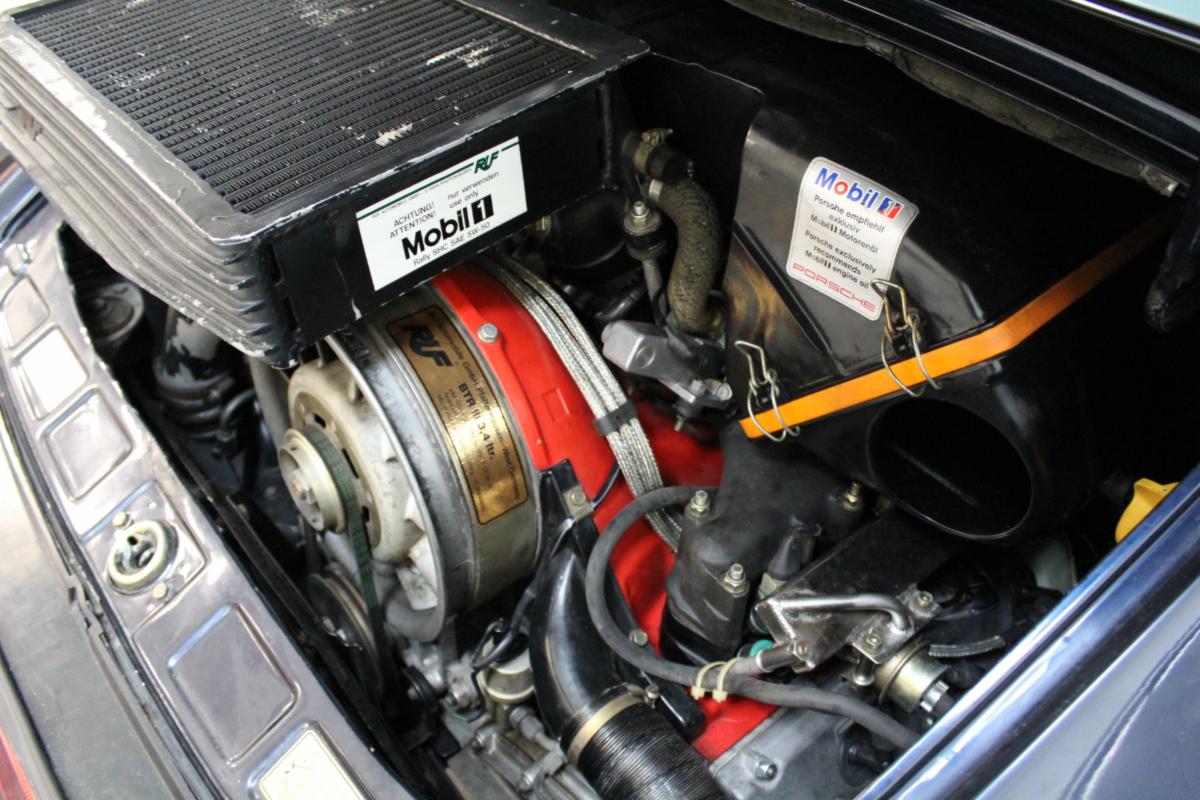
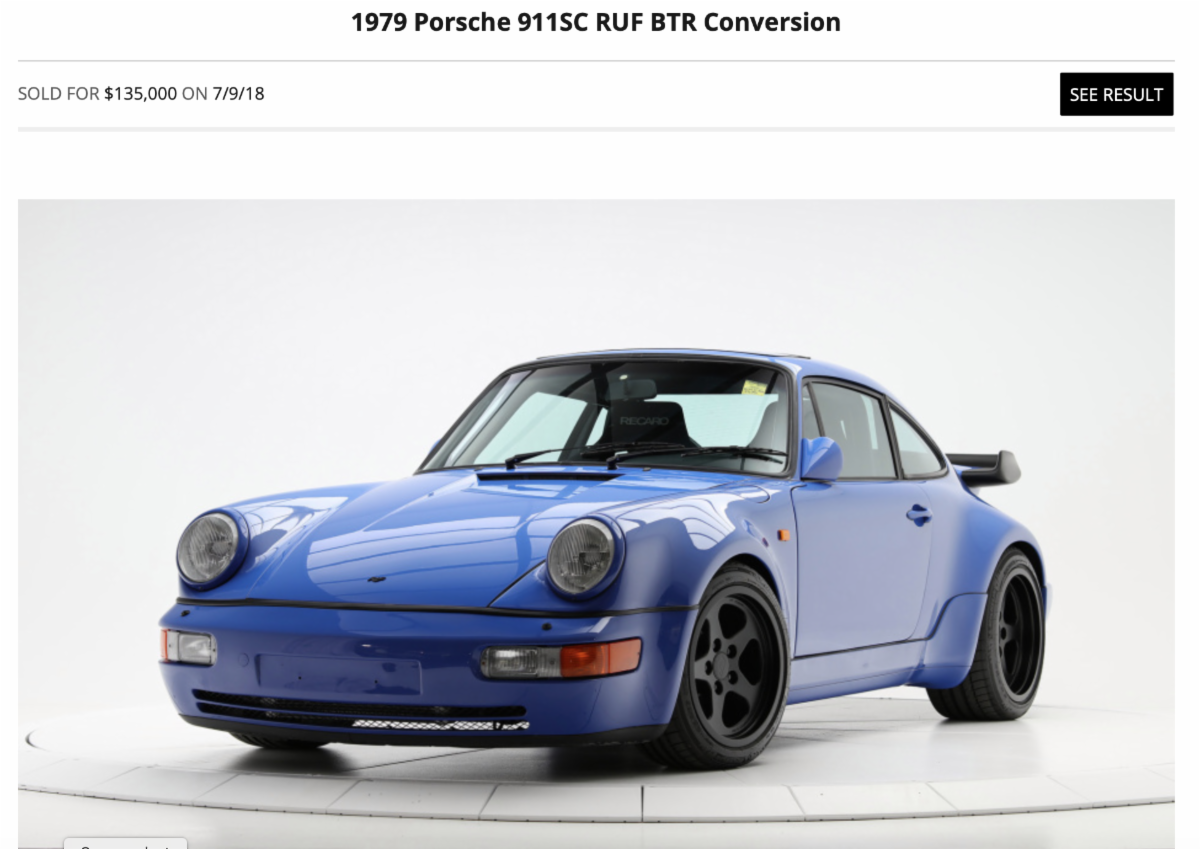
RUF made some BTR’s from bodies-in-white, but not many - perhaps 20 or 30 with RUF Vins. About 200 more were made that were conversions; either by the RUF factory in Pfaffenhausen, or at one of three distributors in the US. These builds used customer supplied cars, and varied widely depending on what the customer wanted. There are narrow and wide-body BTR’s, slant-nose versions, cabriolets and different mechanical specifications. The ‘Base’ BTR had a single turbo 374hp engine, RUF 5-speed gearbox, front oil cooler, 17” RUF Speedline wheels and the RUF tachometer which was turned so that the 6,800rpm red line was at 12 o’clock. A BTR conversion would double the cost of a 911 Turbo donor car. Optionally you could specify the CTR brakes, alumunim panels, slant nose, roll cage, special interiors etc. and make it more expensive. Also optional was the Bosch Motronic injection system that replaced the Bosch CIS system, in which case the car was called a BTR III.
Any BTR will run away from a stock 930 Turbo like it was tied to a tree. In 1984, in Road & Tracks first ‘Fastest Cars’ issue, a narrow body BTR won the contest at 184 mph. The 930 Turbo managed 'only' 158mph. Today a RUF BTR conversion would cost in the $200k range, and the factory VIN cars would likely be double that, depending on spec and condition.
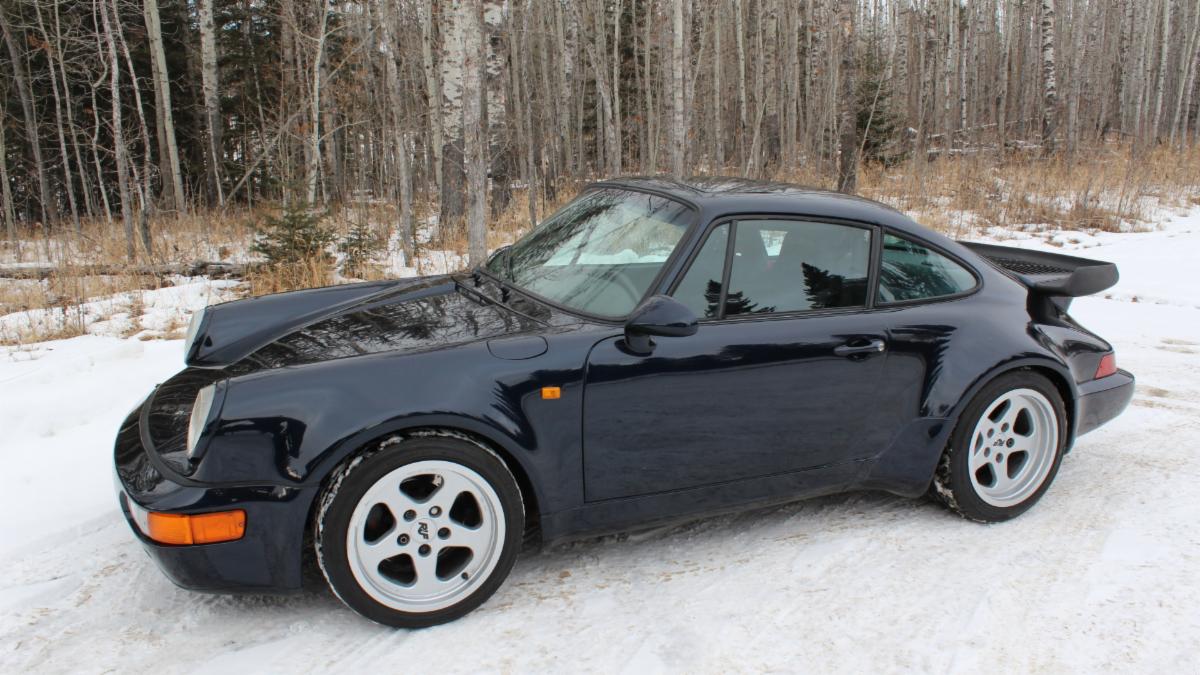
This car, painted dark blue with a grey leather interior, was a fully optioned BTR III.
Sarah wasn’t impressed. She asked what the bars in the interior were for. I told her it was a roll cage. She asked why it had a fire extinguisher. Standard racing car practice hunny. She responded, “Why would I want to ride in a car that was going to roll over and catch fire!” I took her for one ride, and she wouldn’t get back in it - not that there was much opportunity as I was about to embark on an epic challenge to get the Motronic to work properly.
Bosch Motronic
The late 1970’s and early 1980’s was the Turbo era in international racing. Porsche would dominate endurance racing with their 934/935/936 racing cars in the late 1970s that used the 930 Turbo engines as their base. New regulations, named Group A, B and C would come into effect for 1982. Porsche had come up with water-cooled 4 valve cylinder heads for their ‘Moby Dick’ 934/78 which was the basis for the 956 and 962 Group C Cars. The 959 was the Group B effort, though it was never completed in time to compete in it. That’s where the BTR and CTR names come from - Group B Turbo Ruf and Group C Turbo Ruf.
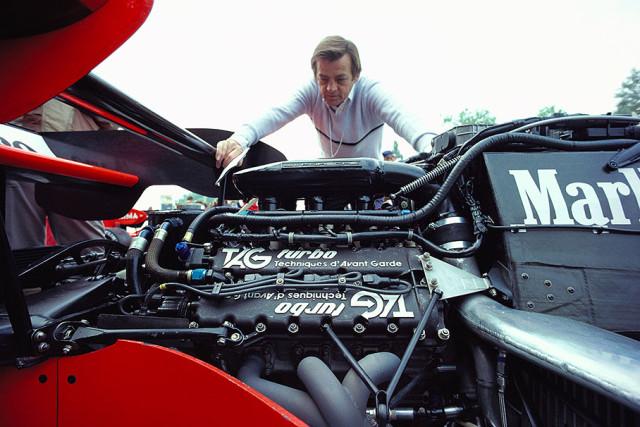
In Formula 1, Renault would win their first race for the RS01 in 1979 - the first for a Turbocharged Car. Ferrari would move to the 1.5 litre turbo in 1982, and Porsche was paid by McLaren-TAG to produce a 1.5 litre turbo F1 engine for the 1983 season.
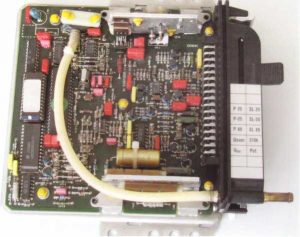
The engines in these cars were getting extremely powerful, and the racing regulations were reacting by reducing the allowable fuel allotment per race to keep the speeds down. Fuel consumption was becoming critically important. Bosch came up with their first digital engine management (DME) for motorsports in the early 1980’s for use in F1 and Group B/C, called the Motronic MP1.2, that promised significant gains in efficiency. This ‘black box’, actually grey, would measure rpm, boost, throttle position, temperature etc. and then control the fuel and spark in a much more accurate way than the mechanical injection systems could. It is what every new car has today, but back in the early 80s it was unproven technology.
The MP1.2 ‘box’ consisted of a printed circuit board and a removable EPROM chip that contained the engine mapping data. The various sensor data was fed to this box via cabling and it sat in a place in the race car that would be least disturbed by heat and vibration. The MP1.2 used twin fuel injectors per cylinder (though with a single spark plug) that were run as two 6-cylinders in parallel - using one set of 6 for low boost, and both sets for high boost. The system was good for over 1,000hp.
Ruf adopted this system for the Yellowbird, and made it a $10,000 option for the BTR, which so equipped was rated at 408hp, up from 374hp for the CIS version.
This system worked well on the bench, but it would have significant issues when installed in the car. The system would crash easily, be erratic and inconsistent, or worse - not even start the car at all. It was judged too risky to equip the 1982 956’s with it for Le Mans, and the frequent failures almost derailed the entire Porsche TAG Turbo F1 engine program. In 1983, after yet another practice session missed because they couldn’t get the car going, Ron Dennis go so mad that he started contacting Magneti Marelli, Lucas and Fords’ electronic division for an alternate solution. In the end some ‘emergency’ meetings were called, a host of revisions made, and the system would become reliable for the 1984 season which saw Alain Prost win the first race for the McLaren TAG-Turbo.
The system would really pay dividends in F1 where fuel allotment was dramatically reduced and drivers had to carefully monitor their turbo boost and engine power in order to make it to the finish line. Motronic was able to calculate the laps remaining at the current boost, and display this to the driver in real time. Niki Lauda and Alain Prost were two drivers who could make the most of this and won 25 races in 3 seasons, netting 3 drivers championships between them.
Sorting The Car Out
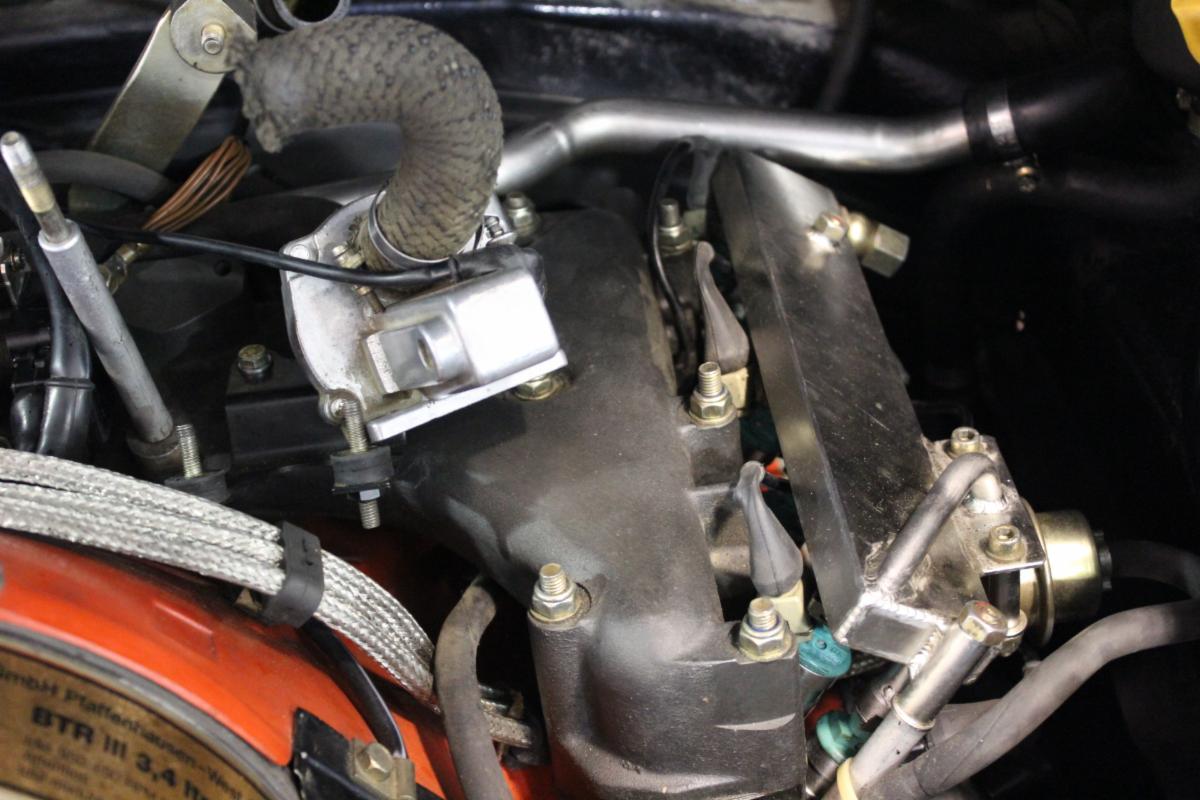
They must have put one of the early Motronics in my car! I would have something of an idea of how frustrated Ron Dennis would get as I was having the same issues. The car would either start or not start, and when it ran it would either be OK, or start popping and backfiring in an alarming fashion. I replaced everything around the fuel injection system, sometimes twice, and only with great difficulty and expense came to the conclusion that it was the DME itself that was misbehaving.
You don’t go to Napa to get a new Bosch MP1.2 Motronic. I found my way to Bosch Motorsports in Germany, where I was pleased to find out that they still work on these units in their support of vintage racing cars. I was told that they could service the unit, but it was critical that I had the correct EPROM chip containing all the data mapping for the single turbo BTR engine. I didn’t - the chip was re-programmed and I had no idea why or how the previous owner changed the data.
I contacted RUF hoping they could help me with the data file. I wound up talking to a guy named Alan Brown, who was their electronics expert. He came from the McLaren F1 team as their chief electrical engineer, and was tasked with the engine mapping of RUF’s new V8 engine, and integrating it with the Porsche 991 electrical architecture. If he could figure that out, I was pretty sure he could help me get my car running! Although the car was before his time, he gave me a lot of practical advice in how to resolve complex electrical issues - namely to keep the car in one piece so that the failure could be repeated, and thus identified. Alan looked into it, and Ruf had the data file, but it was on a mainframe computer tape, but there was nobody in Germany who could read it!
Okay. My brother Sasha is a data security expert, who at the time was working at the Pentagon in Washington DC. I asked him what to do, and he gave me the name of a few companies in the US that retrieve data. Ruf agreed to loan me the computer tape and send it to the US to retrieve the file.
As all this was going on, I found a reference to another BTR Motronic DME on one of the Porsche forums. The post was a few years old but I contacted the guy anyway. He still had it and would sell, and it was in Victoria! The province of Victoria, Australia I found out. That arrived a few weeks later. When this was installed the car would finally start and run, but it too had a re-programmed EPROM. I still was missing the correct data file, and this engine was one that I didn’t want to fool around with.
Also, much to my surprise, another BTR came up for sale locally, or at least a Porsche with a BTR III engine - their may have been as few as 50 BTR III engines made so the odds of two of them coming to Calgary were pretty rare. This car, much to my relief, had the un-touched EPROM data file. I sent two Motronic units with the correct EPROM chip to Bosch Motorsports and for 750 Euros they would recalibrate the DME’s with the correct data, and then I would be sure we were feeding the RUF engines correct fuel and air. After paying several thousand dollars and waiting 3 months, I got both units back and installed them in the cars. One still didn’t work.
I emailed by contact at Bosch back, and said the DME still didn’t work. In that typical German way, he said that of course it did and gave me 25 pages of graphs to prove it. But it didn’t work when I put it in the car.
In a BTR the Motronic box lives under the drivers seat and the EPROM is accessible underneath the metal cover - you just unplug it. I now had at my disposal 2 RUF BTR III cars, 3 Motronic DME units, and 3 EPROM chips - 18 different combinations in total. We mixed and matched combinations of car, DME and EPROM to figure out where the problem was. Sure enough, one of the ‘rebuilt’ DME’s didn’t work. I sent the whole lot back to Bosch in Germany to sort out, again...
Well this time the DME failed for them and they had to admit that it was faulty and they didn’t know why and couldn’t fix it. They said that they could send it to one of their retired electronics experts, and maybe he could find out what was wrong with it. That’s the last I heard of that Motronic DME, but that’s OK, I don’t ever want to see it again! If I didn’t happen to find the additional Motronic box in Australia, the car would still be off the road!
And that is what it took to get my RUF-Porsche BTR III working correctly. The car was featured on Bring a Trailer (in the days where it was just an email list), sold into Ottawa, bought back by Porsche Centre Calgary, cosmetically restored, sold on Bring A Trailer, and is now in a good home being looked after by Bruce Canepa in California. I’ve done multiple restoration videos of it, and it well as posted much information on various Porsche web forums.
I got lucky with the bespoke system in the Alpina with its AFT spark control and Pierburg injection which mercifully didn’t need any attention. Not so lucky this time. Fooling around with limited production high performance cars using new-at-the-time technology proved to be a lottery. I wonder if today’s ‘future classics’ will give their new owners similar grief in 30 or 40 years?
|