Influencing Steam Surface Condenser Performance


March 2025

Hello Eric,


A steam surface condenser is a crucial component in steam turbine systems. It condenses the exhaust steam from a turbine, which can maximize efficiency by reducing the backpressure and recover condensate for reuse. This month’s article will discuss the different operating factors that influence the performance of a properly designed steam surface condenser.  When designing a surface condenser, the required surface area will vary as a result of these operating factors and desired turbine backpressure.


The power produced by a turbine is a function of the change in enthalpy between the turbine’s inlet and discharge conditions. The greater the pressure differential across the turbine and the associated difference in enthalpy, the greater the amount of power is produced. Stated another way, it can be seen that with greater pressure differential, less steam is needed to produce the required power. So with deeper vacuum at the turbine outlet, operating efficiency is increased. A general rule of thumb is for every 1" Hg increase of surface condenser operating pressure, the turbine will require 3% higher operating cost in additional steam.

Fouling or Plugging Tubes


As debris and deposits from the cooling water build up on the tube wall, heat transfer is impeded. As fouling on the tube wall builds, the operating pressure of the surface condenser will degrade. Tube side fouling can be mitigated by maximizing tubeside velocity to reduce the deposits that accumulate. It is common to design a steam surface condenser with an 85% clean rate to allow for some level of fouling which still allows for the design operating pressure to be achieved.


Plugging tubes can be necessary when there are tubes that have failed. Plugging tubes reduces the total effective surface area of the surface condenser and will increase the operating pressure if done in excess. If more than 5% of the tubes are plugged, a rebundle kit should be considered that includes new tubes, tube supports, air shroud and other necessary items.

Cooling Water Temperature


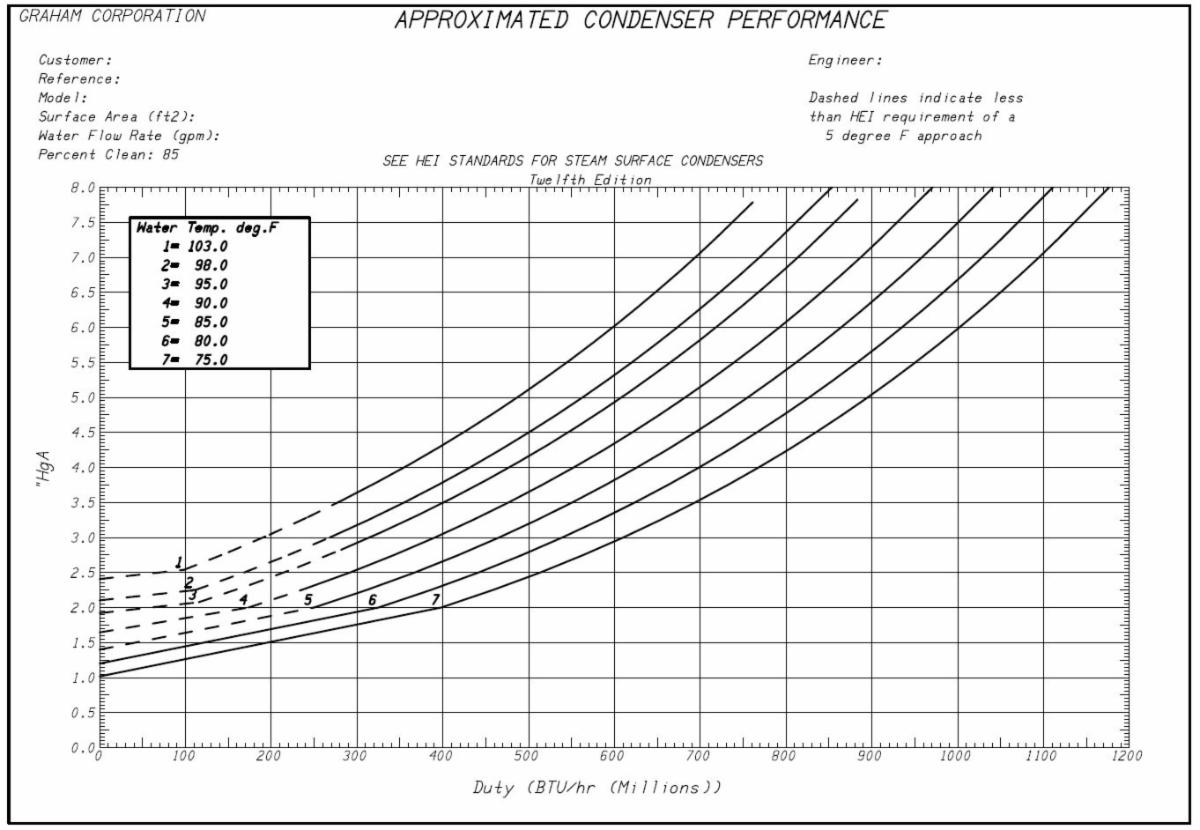
The cooling water temperature is a critical parameter to a surface condenser’s effectiveness. In summer time operation, as cooling towers are pushed to the limit and cooling water temperature increases, it will result in higher turbine backpressure. With higher than design cooling water temperature, LMTD is negatively affected, so the operating pressure of the surface condenser must increase. See below figure for the family of curves showing different cooling water inlet temperatures. Supplying colder cooling water can compensate for some of these other factors mentioned in this article if those factors are worse than design. 

Cooling Water Flowrate


As the cooling water flowrate decreases, the pressure of the surface condenser increases. Again this is due to LMTD being negatively affected as lower cooling water flow limits the amount of heat removed from the condenser.


Lower cooling water flow also reduces the tube velocity which may cause additional fouling. 

Steam Load


The steam load or amount of exhaust steam entering the condenser, directly affects the duty of the condenser. With all other variables held constant, when increasing or decreasing the steam load to the condenser, the operating pressure will follow. In addition, the velocity of the steam coming into the condenser increases as steam flow increases which may result in added pressure drop and ultimately an increase of backpressure to the turbine when steam flow exceeds design loading.

Air Leakage and Air Removal Equipment


Surface condenser performance is hindered by non-condensable build up inside of a condenser. In vacuum service, air will inevitably leak into a condenser through flanges, connections, turbine seals, and with the incoming steam. Even though these flows are normally small, they can accumulate over time. This air negatively impacts the condenser performance by blanketing the tubes and displacing surface area inside the condenser. The air removal equipment continually removes the air leaking into the condenser. If the venting equipment is unable to vent the air due to an issue, or is over loaded from excess air leakage, the condenser pressure will degrade until the air can be removed. The air removal equipment does not control the main condenser pressure, but can be a limiting factor if it is not functioning properly or is over capacity. A few major items that will impact the performance of the venting equipment are air leaks, off design ejector motive conditions, and wear on the equipment degrading the performance.

Conclusion 


The performance of a steam surface condenser can largely affect the efficiency of a steam turbine. The factors that drive the performance of a steam surface condenser can easily change the turbine backpressure. All of these items are specified in the design of every condenser and they should be monitored to ensure maximum efficiency of a steam turbine.  

VacAdemics

Operation of vacuum equipment can be challenging. Our goal is to help you find value from the information provided in Graham's series of Technical Articles. In addition, we offer hands-on training at our facility in Batavia, NY through our VacAdemics program.


Graham VacAdemics training classes are now in our 23rd year and feature two days of classroom training combined with hands-on operation of vacuum equipment. Steam ejectors, condensers and liquid ring vacuum pumps built in glass are used to demonstrate the inner workings of these machines and illustrate the concepts discussed in the classroom.


Troubleshooting operating units is part of the seminar, presenting real world situations as the class is tasked with solving common vacuum system issues.


Cost for the two-day course is $2,000 per person. Remaining class sessions for 2025 include May 28-29, Jun 3-4 Oct 1-2, and Oct 7-8. To sign up for a class or for further information, please visit:


Graham-mfg.com/VacAdemics


Graham Houston Office

333 N Sam Houston Pkwy E

Ste 850

Houston, TX 77060


Tyler Rusher

585-536-9818

Instagram  Linkedin  Youtube