|
8330 U.S. Highway 42
Florence, KY 41042
859.282.1003
| |
Keep up with Innovative Education in Boone
County Schools. Get this newsletter emailed to you.
SUBSCRIBE HERE
| |
|
Teen Mental Health
Part 2
Monday March 3, 2025
| |
|
The Link Between Bullying and Teen Mental Health
Navigating the Mine Field we call the Teen Years
In part 2 of our 3 part series on Teen Mental Health we focus on the contributing themes and causal factors by providing a variety of external resources, publications and information for families on how to navigate the minefield we call the teen years. This information is for parents and students alike. Parents and guardians are encouraged to review all materials to determine their suitability for their children.
| |
|
FOREMOST FOR STUDENTS AND PARENTS OF BOONE COUNTY SCHOOLS
The Boone County School District maintains a zero-tolerance policy for bullying in its schools. Every allegation of bullying brought to the district is thoroughly investigated and addressed pursuant to Board Policy 09.422, state and federal law.
The District also has a long history of creating and providing mental health and suicide prevention and awareness programs used in our schools. We have school counselors in every school. Those counselors encourage open communication and offer safe spaces for teens to express their feelings and concerns.
Boone County Schools prioritize health, wellness, and safety by implementing comprehensive prevention strategies supported by clear policies and procedure. Key components include but are not limited to:
-
Access to School-Based Health Services: Every school is staffed with dedicated professionals, including school nurses, psychologists, counselors, and School Resource Officers (SROs), ensuring immediate support for physical, emotional, and safety needs.
-
Proactive Mental Health Initiatives: Collaborative relationships with community mental health partners, access to specialized resources and services, fostering early intervention and support for students facing mental health challenges.
-
Education and Training: Training for staff, students, and families focuses on recognizing and addressing health and wellness concerns, promoting resilience, and ensuring safety.
-
Integrated Safety Measures: Comprehensive safety plans and partnerships with SROs enhance emergency preparedness and create a secure school environment.
-
Health and Wellness Programs: School-wide initiatives promote physical activity, nutrition education, and mental well-being, fostering a culture of overall health.
By embedding these strategies into the school environment, Boone County Schools provide a holistic approach to maintaining a safe, healthy, and supportive learning atmosphere.
Any student who feels bullied, abused, sad or depressed, or who has experienced threats of violence or concerning behavior while at school should reach out to a school administrator, counselor, or trusted teacher for assistance. Anyone can also make an anonymous report on the KCSS S.T.O.P. Tipline found on the Boone County School’s website, or by calling/texting 866-EYE-on KY (866-393-6659).
| |
|
Teenage years are a formative time for emotional, social, and psychological development. However, this period can also be fraught with challenges that have long-lasting effects on mental health. One of the most significant issues affecting adolescents today is bullying. Whether in person, online, or a combination of both, bullying can leave a deep impact on a teenager's mental well-being. In this article, we will explore how bullying is intricately linked to teenage mental health, examining the consequences, the factors that contribute to its damaging effects, and how to provide support for those who experience it.
Source: McLean Hospital
| |
Understanding the Impact | |
|
|
What is Bullying?
Bullying involves repeated aggressive behavior intended to hurt or intimidate others. It can take many forms, including physical violence, verbal abuse, social exclusion, or cyberbullying (which occurs online through social media or other platforms). For teenagers, bullying is often part of navigating school life, and while it can sometimes be seen as a rite of passage, the reality is far more troubling. Victims of bullying, especially during their formative years, are at risk of significant emotional and psychological harm.
The effects of bullying on teenage mental health are profound and wide-ranging. Adolescents who are bullied experience higher rates of mental health issues than those who are not subjected to bullying. Some of the most common effects include the following below:
| | | |
-
Depression and Anxiety: Bullying often leads to feelings of worthlessness, sadness, and isolation. Many teens who are bullied experience symptoms of depression, such as persistent low mood, loss of interest in daily activities, and difficulty concentrating. Anxiety, including social anxiety and generalized anxiety, can also develop as a result of ongoing fear of being hurt or ridiculed.
-
Low Self-Esteem: Constant bullying can erode a teenager’s self-confidence, leaving them with a poor self-image. Feeling unwanted or unloved can make them believe they are not worthy of respect or kindness, leading to a sense of hopelessness and self-doubt.
-
Post-Traumatic Stress: In extreme cases, prolonged bullying can result in post-traumatic stress disorder (PTSD), where the teenager relives the traumatic experiences of being bullied through flashbacks, nightmares, and hypervigilance.
-
Suicidal Thoughts and Behaviors: One of the most severe consequences of bullying is the development of suicidal ideation. Studies show that teens who are bullied are more likely to have thoughts of suicide or attempt suicide. The emotional pain from bullying can feel unbearable, and for some teens, suicide may seem like the only escape.
-
Substance Abuse: To cope with the emotional pain caused by bullying, some teenagers may turn to substances like alcohol or drugs as a form of self-medication. This can worsen their mental health and lead to long-term addiction problems.
Source: Stop Bullying.gov
| |
The Role of Social Media in Teen Bullying
The rise of social media has added a new and concerning dimension to teenage bullying. Cyberbullying, which takes place over the internet or through mobile devices, allows bullies to harass their victims 24/7. This constant access to a victim can increase feelings of helplessness and vulnerability. Additionally, social media platforms often perpetuate unrealistic beauty standards and social comparisons, contributing to low self-esteem and body image issues among bullied teens.
Cyberbullying can also be more isolating than traditional bullying because it’s harder for adults to monitor and intervene. The anonymous nature of online platforms makes it easier for bullies to target their victims without facing direct consequences. This contributes to the difficulty teens face in escaping from their tormentors, even after they leave the physical school environment.
Source: Pew Research
| |
|
|
|
|
The Impact of Bullying on Academic Performance
Teenagers who experience bullying often struggle with their academic performance. The anxiety, depression, and stress they experience can affect their ability to focus, retain information, and participate in class. This can lead to a decline in grades, which may further exacerbate feelings of failure or inadequacy. In extreme cases, bullied teens may skip school altogether, either out of fear of being targeted or due to feelings of depression that make them reluctant to engage in daily life.
Source: National Institutes of Health
| | | |
Steps to Take Immediately
First, block from all social media platforms, the person or persons who are cyberbullying. Then record the dates, times, and descriptions of instances when cyberbullying has occurred. Save and print screenshots, emails, and text messages. Use this evidence to report cyberbullying to web and cell phone service providers and social media sites. You can make an anonymous report on the KCSS S.T.O.P. tip line found on the Boone County School District website or click here.
| |
|
|
CONCLUSION Part 2:
Bullying is not just a temporary challenge—it has lasting consequences on a teenager’s mental health. The emotional scars left by bullying can hinder a teenager’s social development, self-esteem, and overall well-being. It is critical that we recognize the profound link between bullying and mental health and take proactive steps to prevent and address this issue. By fostering a supportive and inclusive environment, we can help ensure that all teens feel safe, valued, and empowered to thrive.
In part 3 of this 3 part series we will provide prevention and intervention resources to support your teen.
| |
The above resources in this newsletter are provided for informational purposes only and do not constitute an endorsement by the Boone County Public School District. The district does not create, control, or guarantee the accuracy, relevance, or completeness of the information presented. Parents and guardians are encouraged to review all materials to determine their suitability for their children. | |
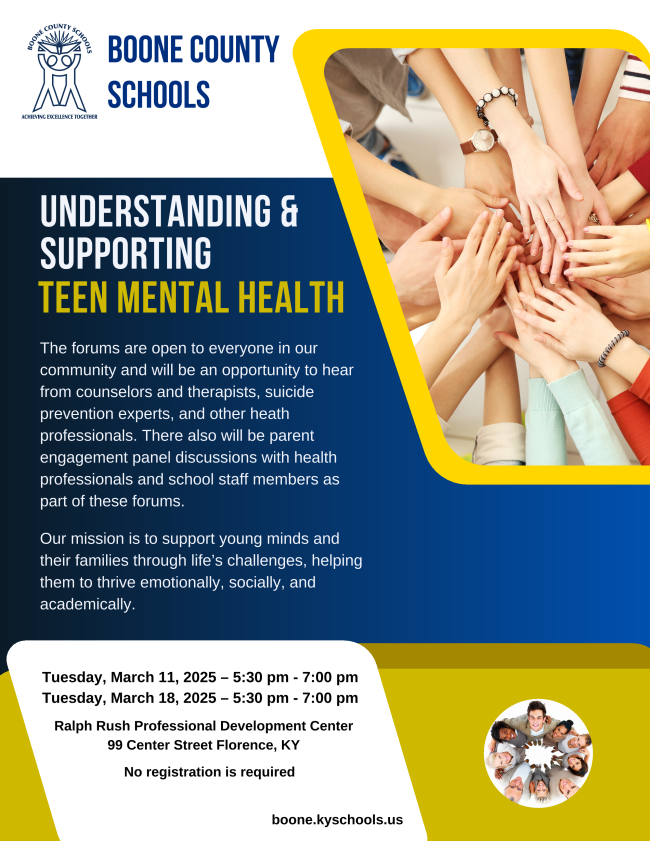
MARK YOUR CALENDARS FOR THESE UPCOMING EVENTS | | | | |