Telling Stories
Edith Halpert and Her Artists
October 9 through December 11, 2020
|
|
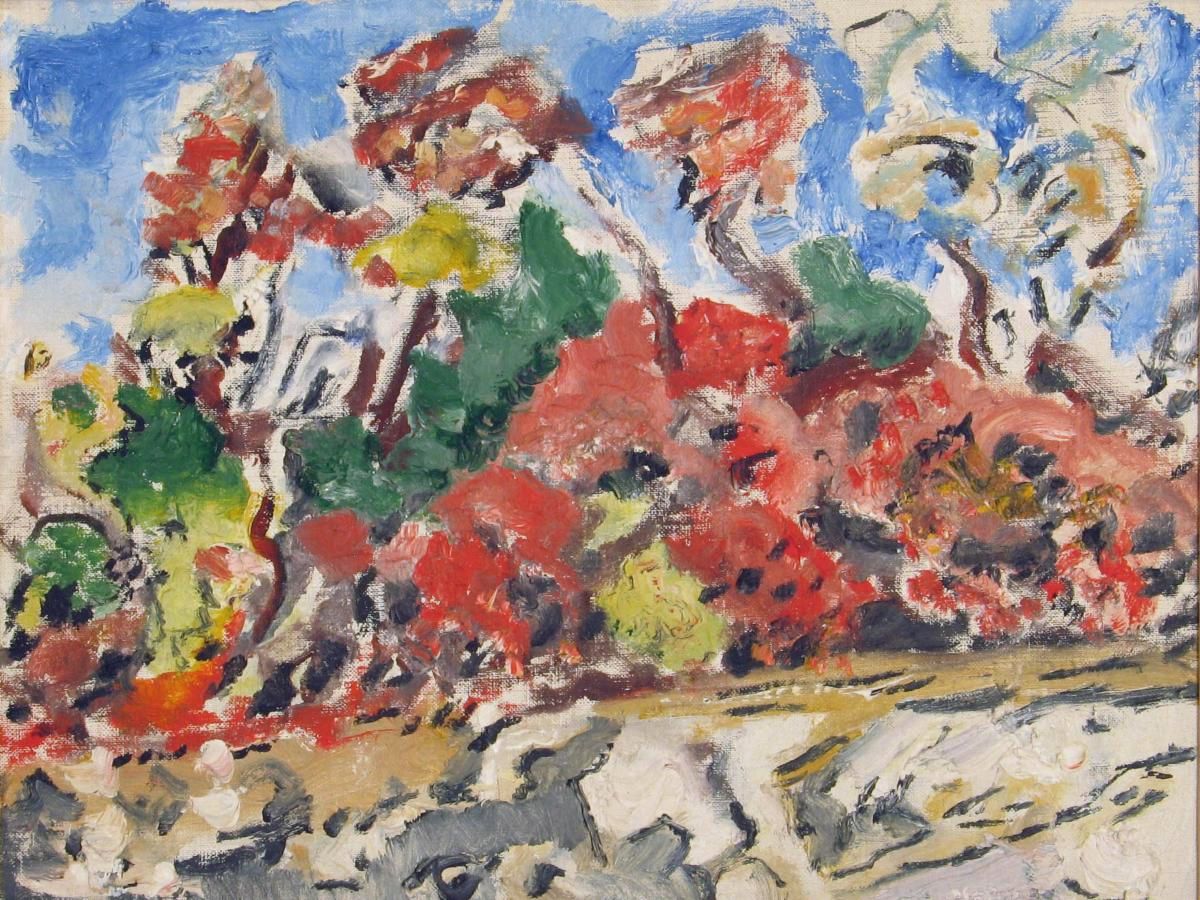
John Marin (1870-1953), Autumn, 1939, oil on canvas board, 14 x 18 inches
|
|
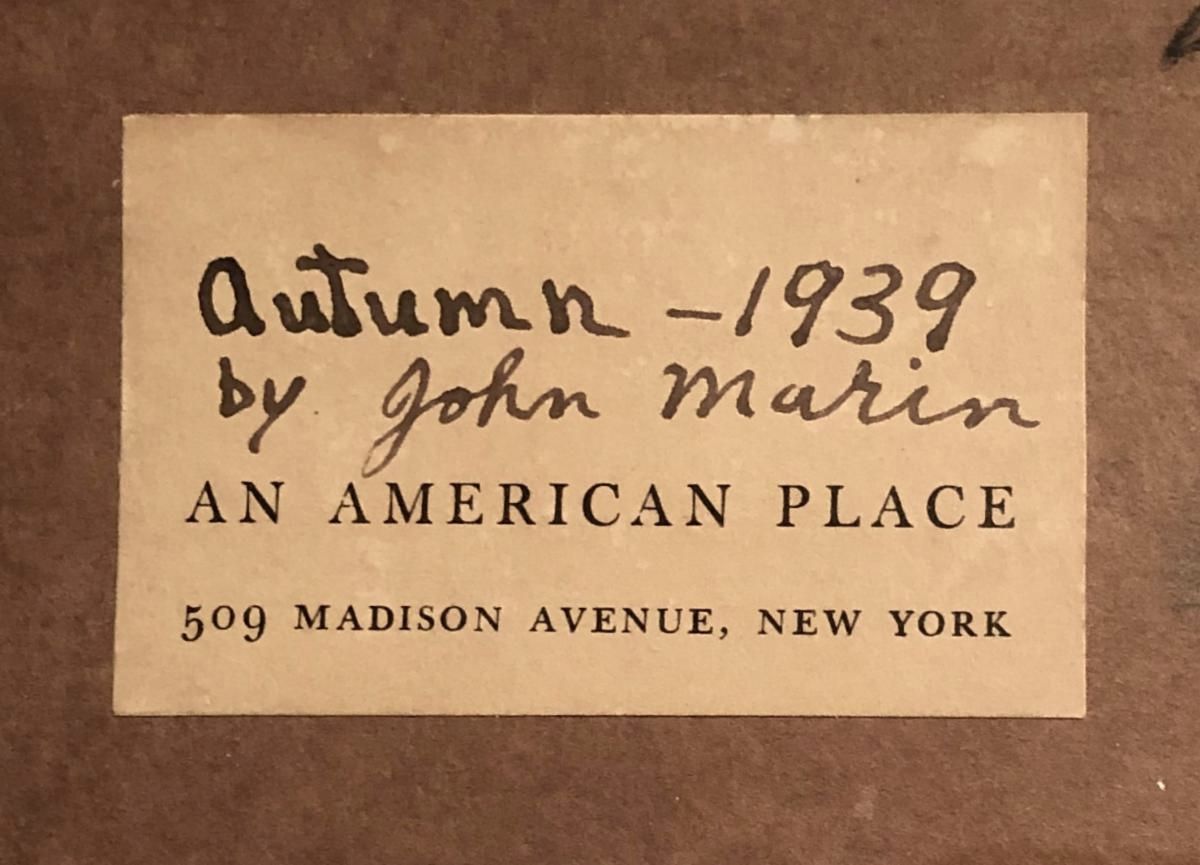
An old label on the back of John Marin’s oil Autumn, 1939, shows that the painting spent time at Alfred Stieglitz’s gallery, An American Place. However, the work likely wasn’t shown to clients until Edith Halpert received it at the Downtown Gallery. Stieglitz had represented Marin since 1909 and insisted on marketing him as a watercolorist, refusing to show or sell his oil paintings, despite the fact that Marin had been working in oil for decades. As Halpert explained in an interview for the Archives of American Art, Stieglitz’s bias irked her to no end:
|
|
Label on the back of "Autumn" |
|
It bothered me dreadfully because if an artist is good and has been painting long enough, no medium evades him. He's good in any medium he chooses. After all his creativity is not bound by technique any more at that stage . . . and whatever he uses to express himself, it's equally good, and I always get absolutely violent when someone says, "He's better in this than in that" (AAA interview, p. 262). |
|
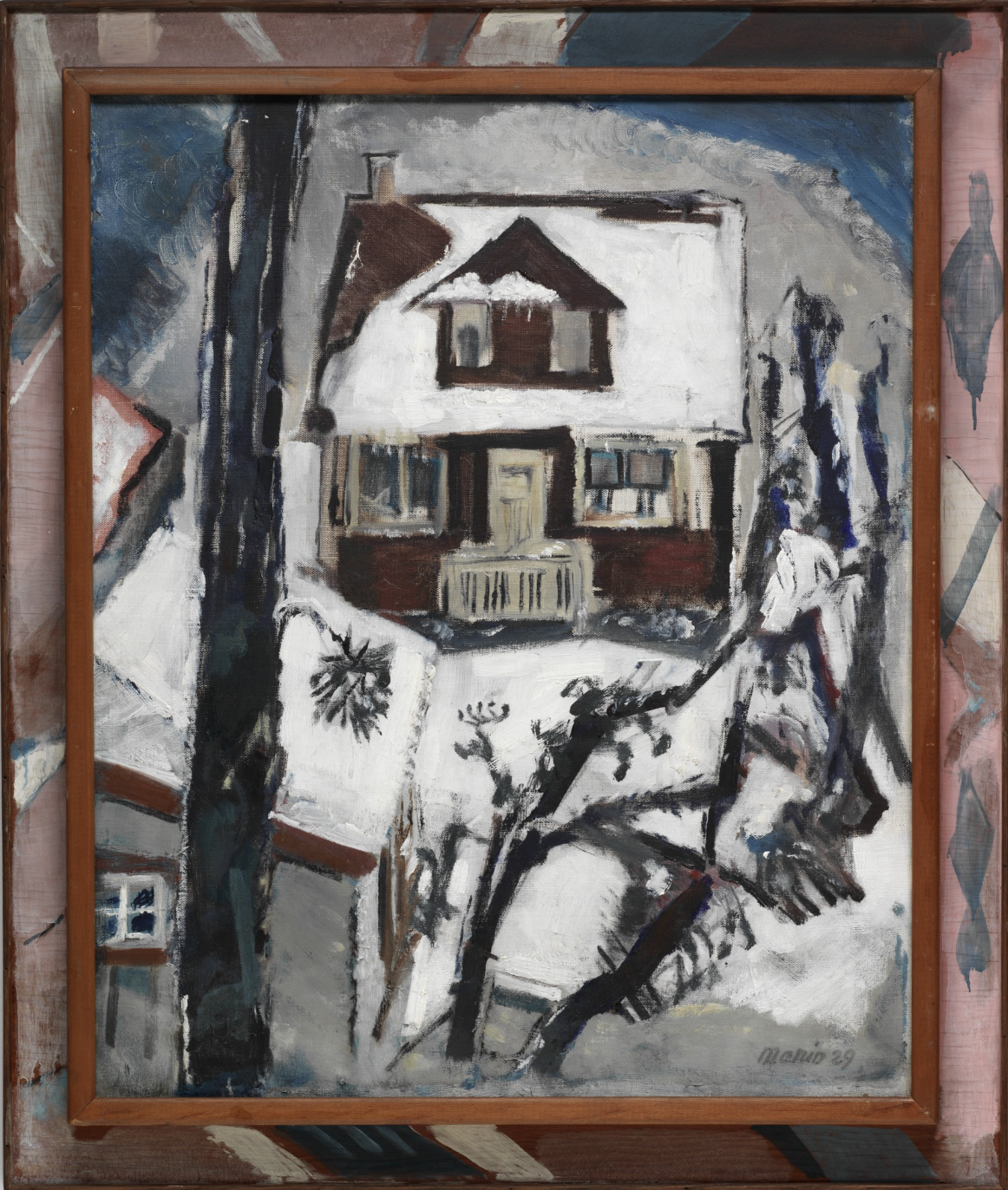
According to Halpert, she was the first to sell a Marin oil painting. After some pressing, Halpert received several works from Stieglitz, including an oil, From My Window, Cliffside, New Jersey, 1929, for the First Municipal Art Exhibition held at Rockefeller Center in 1934. Stieglitz did not loan art to other dealers often, but loaned to Halpert regularly, knowing that she was an excellent salesperson in spite of her youth. When she promptly sold From My Window to the prominent Detroit collector Robert Tannahill, Halpert reported that instead of being delighted with the sale, Stieglitz was furious and demanded, "Why didn't he buy the watercolor? . . . Do you think you can get him to change to watercolor?" (AAA interview, p. 262-263). After Stieglitz’s death in 1946, Halpert eventually inherited his big three – Arthur Dove, John Marin, and Georgia O’Keeffe.
|
|
John Marin, "From My Window, Cliffside, New Jersey" 1929,
Detroit Institute of the Arts, bequest of Robert H. Tannahill
|
|
In 1962, Halpert sold Autumn to Walter Buhl Ford and his wife, Josephine Clay Ford, the granddaughter of Henry Ford. Halpert first met Henry Ford in 1932 when he asked her to walk him through her folk art exhibition at the Detroit Society of Arts and Crafts, and bought several pieces for his living-history museum in Dearborn, Michigan. But it was his son, Edsel Ford, Josephine Clay Ford’s father, who formed a friendship with Halpert. At Halpert’s urging, Edsel expanded his collection of folk art and started a collection of American contemporary art as well. Edsel Ford’s cousin, Robert Tannahill, was the first to purchase a Marin oil and became a regular client of the Downtown Gallery. Through her carefully developed network of collectors, Halpert helped to build important American art collections, many of which were later donated to American museums.
|
|
Sources
Downtown Gallery Records, Archives of American Art, Smithsonian Institution, Washington, D.C.
Oral history interview with Edith Gregor Halpert, 1962-1963, Archives of American Art, Smithsonian Institution, Washington, D.C.
Lindsay Pollock, The Girl with the Gallery: Edith Gregor Halpert and the Making of the Modern Art Market (2006).
Rebecca Shaykin, Edith Halpert, The Downtown Gallery, and the Rise of American Art (2019), Exhibition catalogue, The Jewish Museum, New York.
|
|
We are pleased to present the online exhibition Telling Stories: Edith Halpert and Her Artists. Over the coming weeks, we will be sharing stories about Halpert and her artists told through artworks at Meredith Ward Fine Art.
|
|
|
|
|
|
|