Telling Stories
Edith Halpert and Her Artists
October 9 through December 11, 2020
|
|
Joseph Stella (1877-1946), Pittsburgh II: Italian Labour Leader, 1908,
crayon on paper laid down on board, 23 1/2 x 19 3/8 inches
|
|
According to Edith Halpert, the Downtown Gallery began handling Joseph Stella’s work after he chased Stephan Bourgeois down Fifth Avenue with a knife. Bourgeois Gallery was one of a handful of established galleries showing modern American art in the early 20th century, and had even held a Stella retrospective in 1920. Several New York galleries that sold European and Asian art would use less expensive American art as “puller inners.” Halpert recalled how Stella had discovered this after sending a buyer to Bourgeois Gallery: |
|
In Stella's case it was pretty rough because Stella needed the money. He went up there and grabbed a knife—he was going to kill Bourgeois for killing this sale. Stella had a readymade sale. This man came to his studio to buy a Stella, and he sent him up to Bourgeois who switched him to Chinese paintings, and he didn't buy anything. He told Stella, so Stella went up there with a knife, and Bourgeois ran out of the gallery and down the stairs with Stella after him . . . A few weeks later, after I heard this story, Stella comes into the gallery, and he says, "You will handle my work." I didn't want his work. He was then painting still lifes and so on, but what he was painting then I did not like. I looked at him. He pointed his finger, and I could see the knife coming at me, and I said, "All right." This was one time I took an artist when I didn't want him, but I did want him later. (AAA interview, p. 120) |
|
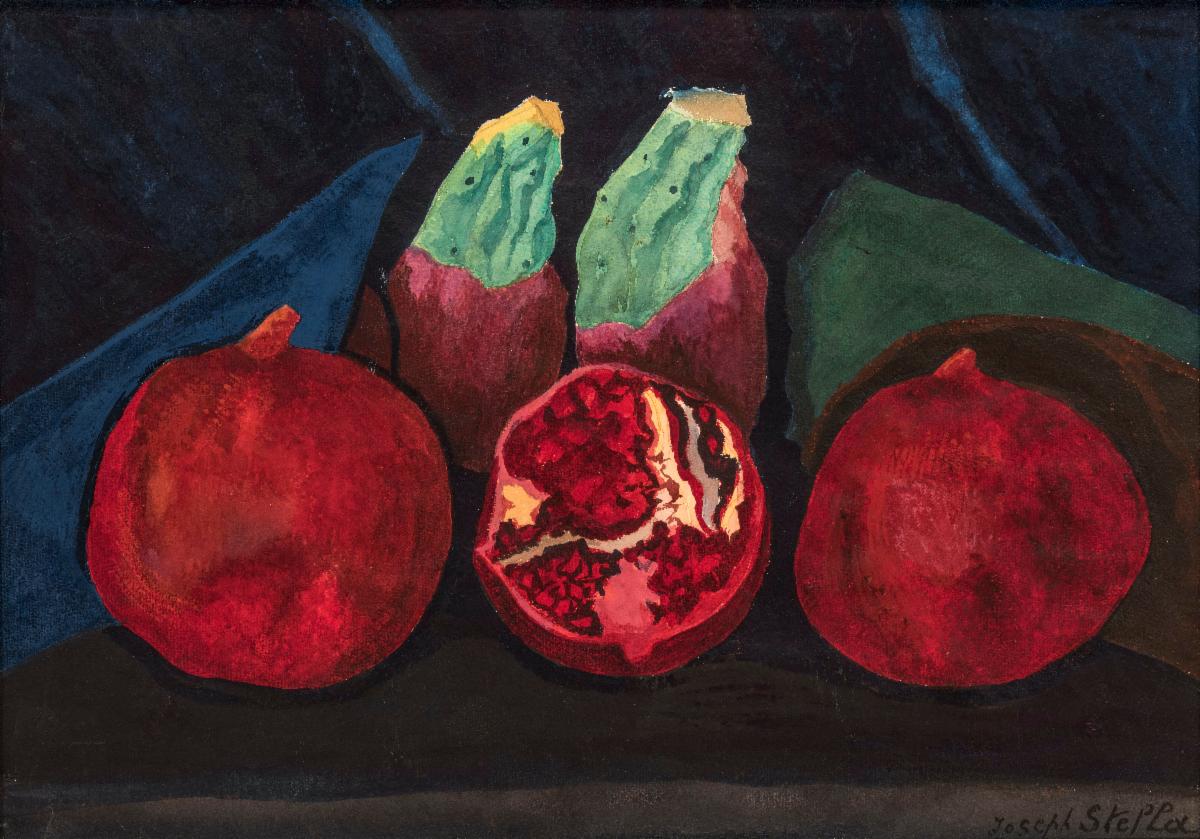
Joseph Stella, "Tropical Fruits" c. 1929, Meredith Ward Fine Art |
|
Despite her claim to not like Stella’s still lifes, Halpert ended up with three of them in her personal collection. She certainly recognized Stella's place in American art history, as an important member of the New York Dada circle and the Société Anonyme. Halpert also understood the plight of the financially strapped and underrecognized American artist. Perhaps this is why she agreed to handle Stella’s work but did not consistently include him in group shows at the Downtown Gallery until the 1950s, after his death. |
|
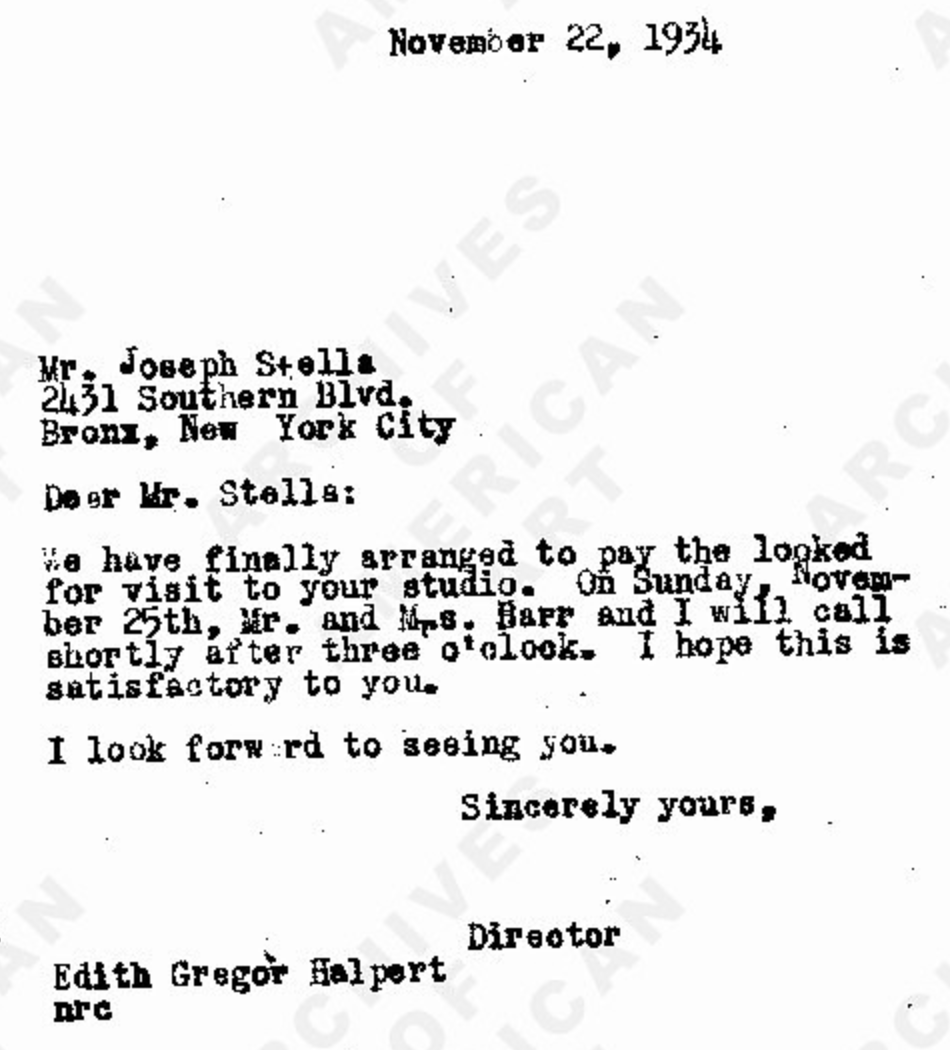
Halpert's letter notifying Stella of Barr's impending visit. Courtesy of the Archives of American Art. |
|
To support Stella, Halpert arranged for Alfred H. Barr Jr., director of the Museum of Modern Art, to visit his studio in November 1934. Although she had assured Barr that, “Mr. Stella understands very definitely that there is no business associated with this visit and that there will be no obligation involved other than looking at his work and occasionally saying a word of admiration,” undoubtedly she hoped Barr would be interested enough to buy (Downtown Gallery Records, AAA). |
|
While a museum acquisition did not immediately materialize, Halpert was determined to make the most of Barr’s visit. In a letter to her reliable client Abby Aldrich Rockefeller, Halpert wrote, “we now have in the gallery a group of paintings and drawings by Joseph Stella . . . Mr. Barr had seen the Stellas at his studio and I chose all those which he had liked particularly" (Downtown Gallery Records, AAA). Two months later, Mrs. Rockefeller purchased two Stella oil paintings. |
|
Sources
Downtown Gallery Records, Archives of American Art, Smithsonian Institution, Washington, D.C.
Oral history interview with Edith Gregor Halpert, 1962-1963, Archives of American Art, Smithsonian Institution, Washington, D.C.
Lindsay Pollock, The Girl with the Gallery: Edith Gregor Halpert and the Making of the Modern Art Market (2006).
Rebecca Shaykin, Edith Halpert, The Downtown Gallery, and the Rise of American Art (2019), Exhibition catalogue, The Jewish Museum, New York.
|
|
We are pleased to present the online exhibition Telling Stories: Edith Halpert and Her Artists. Over the coming weeks, we will be sharing stories about Halpert and her artists told through artworks at Meredith Ward Fine Art.
|
|
|
|
|
|
|