Telling Stories
Edith Halpert and Her Artists
October 9 through December 11, 2020
|
|
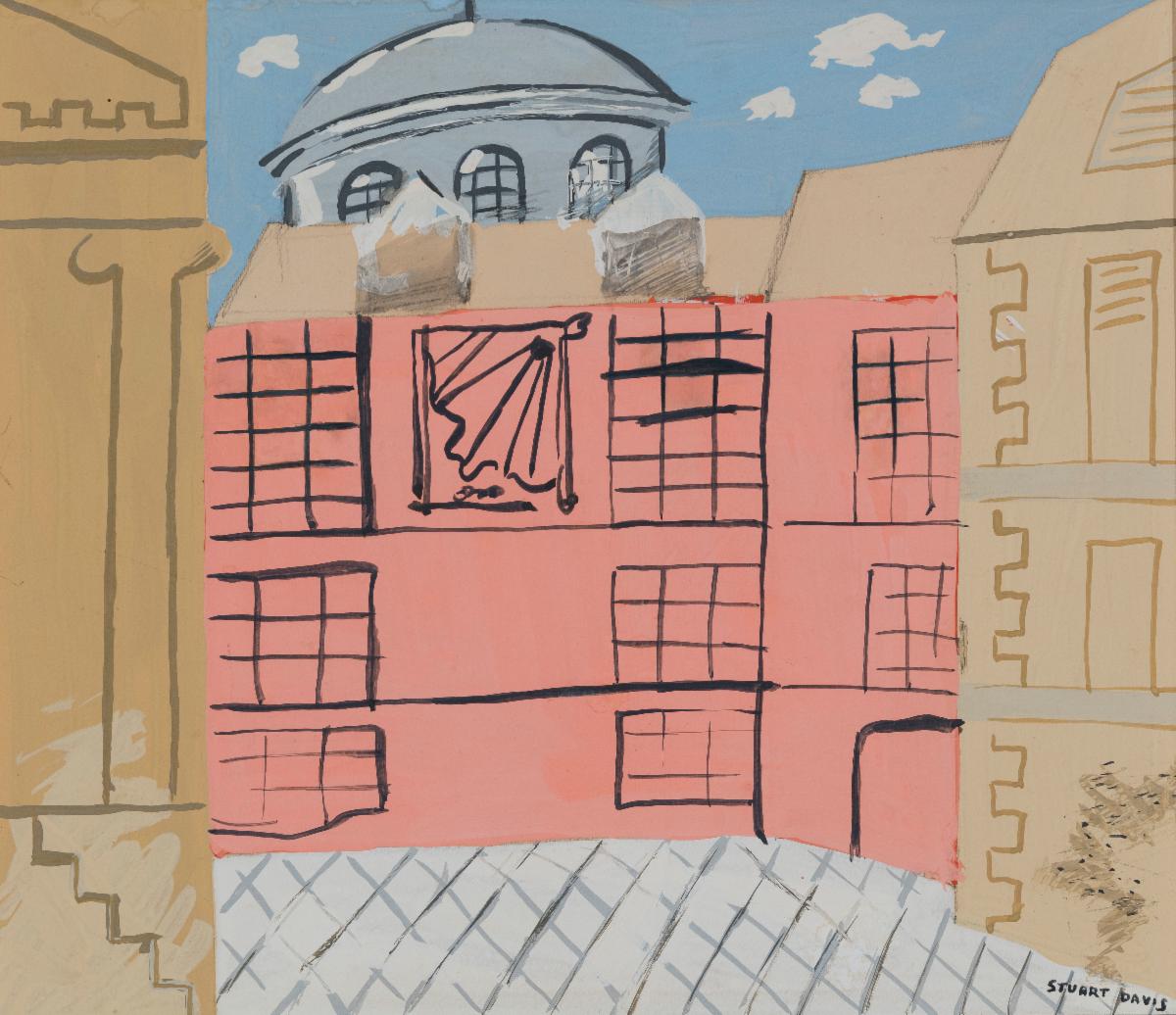
Stuart Davis (1892-1964), Institut de France, 1928,
gouache and traces of pencil on paper, 9 1/2 x 11 inches
|
|
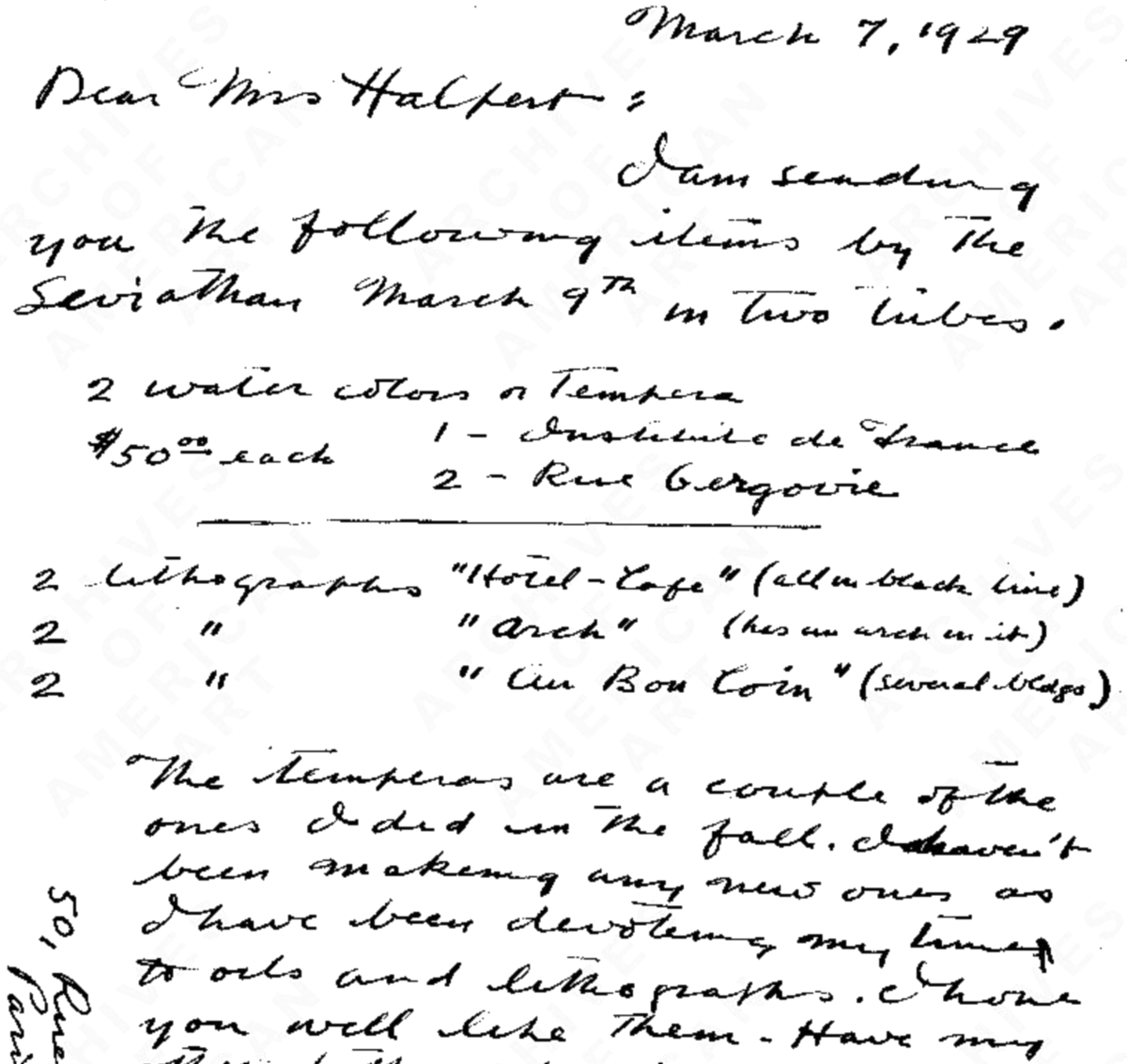
“Are you planning to stay in Paris indefinitely? Every once and a while we hear some rumor about your returning to this country. Is there any truth in it?,” Edith Halpert asked in a letter to Stuart Davis in early May 1929 (Downtown Gallery Records, AAA). Enthralled with Paris, Davis had been there for almost a year. Buoyed by the success of his Egg Beater series and Halpert’s support, he sent avant-garde cityscapes rolled up in tubes to the Downtown Gallery, including Institut de France, 1928, his only painting of a major Parisian monument. While Halpert believed in Davis’ work, there was little demand for abstract art. She reported to Davis that she had sent his work out to exhibitions at other museums and galleries, hoping for a sale. By mid-May 1929, Davis responded:
|
|
I am glad to know that my work is being shown around at different places. What surprises me is that they don’t sell better . . . Anyway it is nice to know that you are in back of them. It now happens that I am devoid of finances . . . If you can arrange to invest any money in my work yourself I will leave the price up to you. (Downtown Gallery Records, AAA)
|
|
Ultimately, Halpert proposed a $50 per week stipend for Davis’ entire output. This was an unusual arrangement for Halpert, who preferred to take work on consignment and charge a commission, but she knew that Davis was an investment in the future of American art. |
|
Davis's letter notifying Halpert that he is sending her "Institut de France"
among other works from Paris. Courtesy of the Archives of American Art.
|
|
As the Depression bore down on the New York art scene in the 1930s, Halpert forged on. Despite being horrified at the abysmally low art budget for the 1932 opening of Radio City Music Hall, Halpert secured commissions for several of her artists, including Davis, and encouraged them to take this opportunity to show their work publicly. She fought to raise Davis’ pay from $400 to $700 for his mural, Men without Women, for the men's smoking room there, writing to him:
|
|
I am especially eager to see your mural and am doing all I can to convince the crew how important it is to increase the appropriation . . . Pointing out the quality of an artist’s work is just a futile effort. That is what we have to cope with and we must make the best of the situation. It is more important to produce the work of art and to show it than to convince these idiots of the quality. (Downtown Gallery Records, AAA) |
|
Despite her mostly successful efforts to get dwindling commissions and lobby government support for her artists, it wasn’t enough. By late 1933, Halpert was unable to consistently pay Davis’ stipend of $50 per week. With tensions rising, Davis ended his relationship with the gallery in 1936, only to return in the early 1940s after trying unsuccessfully to be his own dealer. As he later admitted to Halpert, “painting pictures and selling pictures are two different branches of activity within the field of art . . . I have come to realize that it is hard to sell pictures and that the dealer’s failure to do so is not necessarily an indication of conspiracy” (Downtown Gallery Records, AAA). |
|
|
|
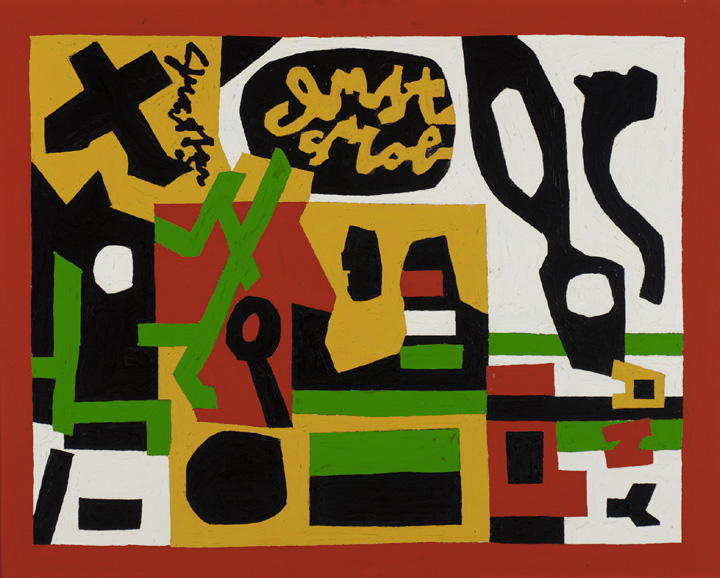
Halpert sold Davis' 1962 oil, "Letter and His Ecol," to the Pennsylvania Academy of the Fine Arts in 1964 for $9,350. The letters "Inst" and "Ecol" at the top of this painting refer to the Institut de France, which oversaw the Ecole des Beaux Arts and Davis painted in his 1928 gouache. |
|
Sources
Downtown Gallery Records, Archives of American Art, Smithsonian Institution, Washington, D.C.
Oral history interview with Edith Gregor Halpert, 1962-1963, Archives of American Art, Smithsonian Institution, Washington, D.C.
Lindsay Pollock, The Girl with the Gallery: Edith Gregor Halpert and the Making of the Modern Art Market (2006).
Rebecca Shaykin, Edith Halpert, The Downtown Gallery, and the Rise of American Art (2019), Exhibition catalogue, The Jewish Museum, New York.
|
|
We are pleased to present the online exhibition Telling Stories: Edith Halpert and Her Artists. Over the coming weeks, we will be sharing stories about Halpert and her artists told through artworks at Meredith Ward Fine Art.
|
|
|
|
|
|
|