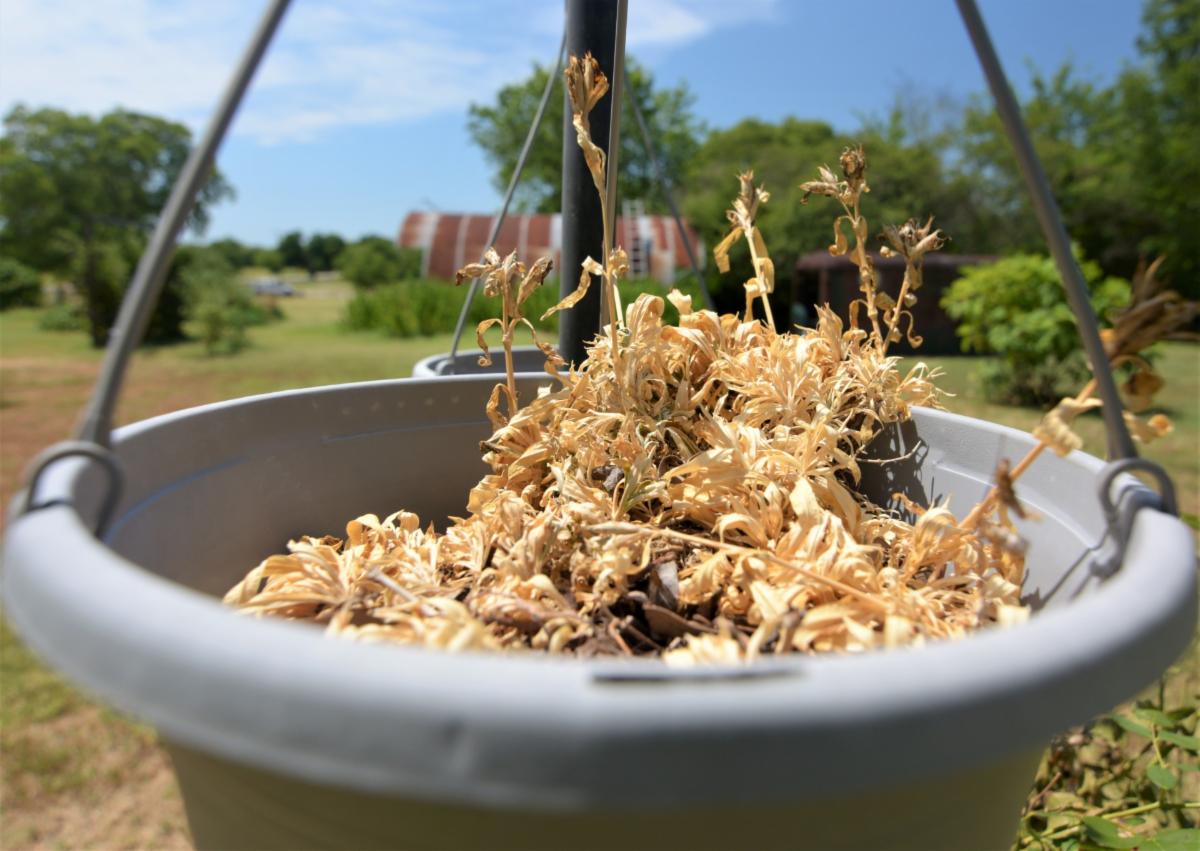
Plants scorched by the summer sun in hanging baskets. Many plants need help to survive during an extended period of high temperatures and drought. (Texas A&M AgriLife photo by Adam Russell) |
|
Tips for gardeners during a Texas heat wave |
By Adam Russell
Texas A&M AgriLife Extension Service
Summer is always a challenging time for Texas ornamental and vegetable gardens, but a record heat wave and drought have made it especially difficult to keep plants from turning brown and crispy. So, how can we manage our gardens until rain and cooler temperatures bring relief?
“Conditions are severe. If we were dealing with typical heat and mild drought, I would say ‘Be patient,’ but we are dealing with an extended period of drought and extreme heat stress,” he said. “The priority might be to keep vegetables producing or to salvage ornamentals and make sure our perennials and trees see another year.”
Arnold said these are generalized recommendations, and gardeners should seek local assessments and advice from Texas A&M AgriLife Extension Service agents and/or horticulturists sooner than later in some cases where high-value plants and trees are stressed.
Take care of yourself first during heat wave
Safety should always be the top priority for home gardeners, Arnold said. While plants, landscapes and gardens are a concern, gardeners should be mindful to avoid overexertion and heat- or sun-related injury as they tend them.
To stay cool, Arnold recommends wearing a broad-brimmed hat and loose-fitting, breathable, light-colored clothing and to complete more strenuous activities in the early morning hours while temperatures are cooler. Sunscreen is always a good addition to avoid sunburn and overexposure.
But two of the most important precautions to take during extreme heat are staying hydrated by drinking plenty of water and avoiding alcoholic and caffeinated drinks and taking intermittent breaks to cool down inside or in a shady, breezy location.
“Think of breaks as strategy time where you can plan your efforts,” he said. “I also recommend a garden buddy in extreme heat. You can keep an eye on each other, and it gives you someone to complain about the weather with.”
Keeping plants alive during heat wave, drought
To save gardens and landscapes, Arnold said the obvious solution is irrigation. But managing water resources wisely is critical for plants, water costs and to conserve a finite resource.
“Once we pass the upper-90s during the day and mid-70s at night, plants can struggle with natural processes like photosynthesis, and that reduces vigor and increases susceptibility to other stresses. We’re just looking to reduce as much stress as possible by watering and tending to the plants’ individual needs while avoiding adding stress.”
Drip and low-flow irrigation, such as spray stakes below the plant canopy or bubblers, are advantageous, Arnold said. They reduce evaporative water loss, help prevent overspray on foliage and provide directed application to an area or individual plants. They can also be hidden from view.
Mulching helps to conserve applied soil moisture, Arnold said. Placing 2-3 inches of leaves, straw, homemade mulching mixes or bagged products around plants and trees helps provide a layer to protect and preserve soil moisture.
A light application of organic mulch over drip lines, not more than 2-3 inches deep, can help reduce moisture loss from the soil, Arnold said, but excessive mulch applications can impede water filtration and gas exchanges needed for healthy plant root growth.
Remember to check the system’s water pressure when using low-flow irrigation, he said. If the pressure is higher than recommended, installation of an inexpensive pressure regulator will save headaches from blown drip lines.
Arnold said to be sure to monitor both landscapes and vegetable gardens for pest and disease infestations because heat- and drought-stressed plants may be more susceptible to infections.
“A well-watered and maintained garden attracts many insects and insect predators,” he said. “But the benefit to gardening and helping vegetables and flowers through a tough summer, beyond the production and aesthetics, is you’re providing an oasis for native pollinators and honeybees.”
Timing is everything
Timing is an important factor for overhead and spray water applications, especially for larger areas like turfgrass, Arnold said. Watering during the morning or evening hours reduces losses to evaporation. Be sure and allow time for leaf surfaces to dry before dark to avoid fungal pathogen infections on foliage.
In areas of the state with salty irrigation water, Arnold said it is critical to avoid contacting the foliage during irrigation because leaves are much more sensitive to salt exposure than the roots of most plants, he said. Subcanopy application methods will reduce the adverse impact of salty irrigation water.
This also applies if a gardener is using recycled water as irrigation because these sources are often high in dissolved salts, Arnold said. Plants vary tremendously in their ability to tolerate salt exposure, so it is important to reserve the best quality water, such as captured rainwater, for use on the most sensitive plants.
“Regardless of the application technology you choose to use, the best results typically occur when we water thoroughly, but less frequently,” he said. “This encourages deeper root development and helps to wash any accumulated salts out of the upper layers of the soil where most of the roots develop.”
Moisture monitoring devices can help with timing of irrigation, but for landscape beds, vegetable gardens and containers, Arnold said the finger method is pretty reliable. Push your finger in the soil or pot substrate, if it is moist, there is no need to water, but if the soil is dry, apply water.
For the lawn, seeing footprints when you walk is a sign that grass may need water. The efficiency of overhead water applications can be maximized by performing an irrigation audit and making needed adjustments to risers or sprinklers and run times.
Arnold said gardeners should test their soil before applying fertilizers. Frequent irrigations can leach minerals from the soil, but it is important to avoid over-applying fertilizers because they contribute to salinity issues.
“Fertility and irrigation can be tricky in this type of drought,” he said. “You can love plants to death or create a victim by trying to keep other plants alive. These are the considerations that may require some specific regimens.”
Planning for future heat waves
Arnold said saving plants this summer will take prioritization, time, effort and likely a higher water bill. But gardeners can plan for future heat waves by introducing heat- and drought-tolerant plant varieties and choosing beneficial planting sites for more sensitive plants.
“Selecting heat-tolerant plants like tropicals and summer-loving annuals will improve success,” he said. “Many xeric plants suited for the Hill Country and West Texas can be winners in the severe heat.”
Many Texas Superstar plants display drought- and heat-tolerant characteristics because varieties chosen for the designation perform under summer conditions across the state, Arnold said.
Xeric plants will need locations with good drainage to avoid root rot due to saturated soils, he said. This can be a concern when balancing turfgrass water needs with sensitive plants and trees like post oaks, which can be easily overwatered.
On the other hand, placing plants in locations that receive afternoon shade can also help varieties that prefer milder conditions, Arnold said. Emergency shade can be provided to sensitive plants by erecting shade cloth over them but be sure to avoid direct contact of the shade cloth with the foliage.
A similar strategy can be applied with ornamental plants, shade and fruit trees and vegetable gardens, he said. Plants like okra and peppers thrive in the heat provided they have sufficient soil moisture. Vegetable gardens are ideal locations for drip and low-flow irrigation uses.
“It’s a stressful time for our plants and trees, and that can put pressure on gardeners and homeowners,” he said. “There are different philosophies to planting and maintaining gardens and landscapes, and I think it comes down to personal preference regarding how much time, energy and resources we employ to achieve our goals. But it shouldn’t add to our stress.”
|
|
Sod webworms in home lawns |
|
By Valerie Smith
Sod Solutions Content Strategist
Now is the time to be on the lookout for several different lawn pests, including the sod webworm. With several different species of caterpillars that come out as it warms up, it may be easy to confuse the sod webworm with the fall armyworm. They are both pests commonly found throughout the United States that damage turf extensively. However, they’re different types of worms that can evolve into very different looking moths. Learn more about fall armyworms here.
Read on to learn about what a tropical sod webworm is, how to search for symptoms of an invasion and how to treat an infestation.
What are sod webworms?
The tropical sod webworm (Herpetogramma phaeopteralis Guenée) is a lawn caterpillar that invades and damages your lawn usually between the months of May–July and will reappear in the fall. In some of the southern-most areas, however, sod webworms can be active year-round with peak season occurring between September–November. They mostly reside in the southeastern regions of the United States as well as other tropical areas including Hawaii, Puerto Rico, Guam, Jamaica and Australia.
Tropical sod webworms tend to prefer newly established warm season turfgrass found in lawns, parks, commercial landscapes, sports fields and golf courses. They’re not to be confused with the fall armyworm or black cutworm.
What does a sod webworm look like?
In the adult form, the webworm is a small beige moth, sometimes called a lawn moth or crambus, that has a wingspan of 3/4 of an inch. It’s the moth that begins the lawn damage process. The adult female moths fly at dusk, dropping eggs on the grass blade surfaces and thatch area of your lawn.
The eggs are yellow in appearance and turn brown as they mature. Each female moth can lay as many as 200 eggs; however, they’re usually laid in clusters of 10–35 on the surfaces of grass blades. After the eggs hatch, remarkably within 7–10 days, very small juvenile caterpillars, about 1/2 inch in size, emerge and begin to feed.
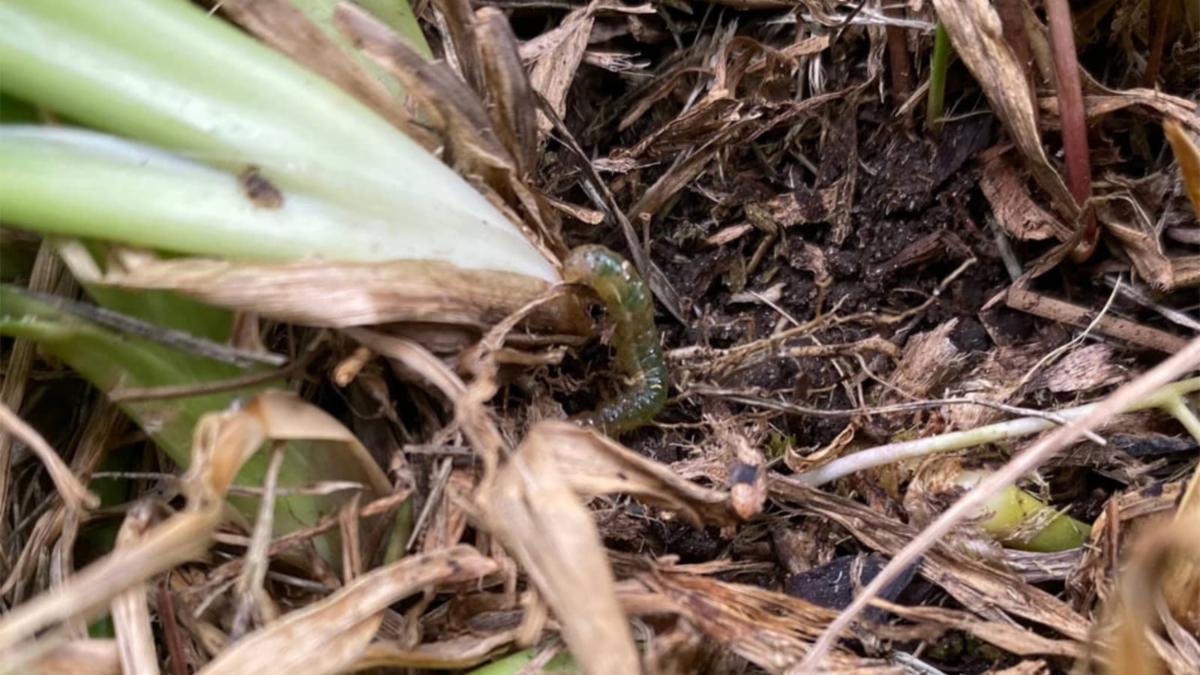
During their larval stage, full grown caterpillars are 3/4 to an inch in length and have four parallel rows of dark spots along their abdomen. They are solitary and move around individually. They also live in individual burrows in which they emerge from and feed during the night. It’s possible to have as many as five separate hatches throughout the year.
What do sod webworms feed on?
The larval form of sod webworms does the most damage to turfgrass. Sod webworms live and feed above-ground on the blades of warm season lawns including St. Augustine grass, centipede grass, zoysia grass, seashore paspalums, carpet grass, bahia grass and Bermuda grass. According to the University of Florida, they can also cause damage to the cool-season grass, bentgrass.
What are the signs of a sod webworm infestation?
The first sign of an infestation of sod webworms is noticing transparent grass blades. The juvenile caterpillars do what is called “skeletonizing” a grass blade so that only the veining structure remains. They do this by eating the green out of the blade and leaving it transparent looking.
The second indication will be the notching of the grass blades. The older, mature caterpillars will feed on the blades and leave notches on the sides. The caterpillars mostly feed at night. During the day, they curl up in a fetal position in the thatch layer of turfgrass. You can occasionally spot them surrounded by their frass. Frass is moist, fresh, green fecal pellets that are found in the thatch and is another indication of the presence of sod webworms.
Another way to detect a problem is to do a soap flush. Before preparing the solution, determine whether you’ll be monitoring a small or a large section of your lawn. For small areas (typically 1 sq. yd. of grass), add 2 ounces of liquid dish detergent to 1 gallon of water, then mix. Soaps such as Lemon Joy, Ultra Dawn and Ivory Clear are excellent options as they cause the least damage to turfgrass. Go to the area in your yard where you suspect a problem and pour the mixture within a 12-inch circle.
You might consider taking a piece of rope to make a 12-inch circle so you can observe the area easier. It could take as much as five minutes, but this mixture will force the insects within the 12-inch circle to the surface where they will be visible on the blades of grass. You can use this to flush other harmful insects to the top for identification as well.
If you plan on monitoring a large section of your lawn, prepare at least 1 gallon of a solution containing two parts water to one part liquid dish detergent. Note that soap solutions with higher rates than these can cause serious damage to turf. Applying the solution to a smaller area of the lawn allows the mixture to be more concentrated in that spot.
Turfgrass usually turns a brown or straw-yellow color when damage occurs followed by more sightings of weeds as the canopy of the turfgrass weakens.
Sod Webworm Prevention and Treatment
Non-Chemical Control (Cultural Practices)
In general, healthy turfgrass is less prone to pest pressure and will recover much faster from pest damage. Here are a few cultural practices that may help control sod webworms:
Mowing Height: Maintain a proper mowing height for the variety of turfgrass you have in your yard. St. Augustine lawns should be mowed at 2–4 inches while zoysia should be mowed at .5–2 inches. Never cut more than 1/3 of the blade height during one mowing.
Reduce Thatch: Mowing at the proper height and frequency will eliminate the chance of a thatch buildup.
Do Not Overwater: Your grass should only need about one inch of water a week including rainfall.
Turn Off Flood Lights: Turn your flood lights off at night since moths fly at night and are attracted to the light.
With that being said, the University of Florida also states that over-fertilizing your lawn is the leading cause for caterpillar outbreaks.
Chemical Control
Chemicals are usually applied to suppress larval (caterpillar) populations when they are feeding. Sample the thatch for sod webworms to determine how many are present before applying a registered insecticide. Best results are achieved by applying insecticides late in the afternoon or early evening when caterpillars are still active.
Some of the more effective insect control products either contain the active ingredient Chlorantraniliprole (Scotts GrubEx), Bifenthrin (Bifen L/P and Bifen XTS), Lambda-Cyhalothrin (Spectracide Immunox Fungus + Insect Control) and Trichlorfon (Dylox).
Remember to follow all specific label directions. This will ensure that you use the proper amount of chemical for your application, apply the chemical correctly and help you with properly adding any adjuvants necessary for the best efficacy.
|
|
Upcoming Garden Events
If you would like your organization's events included in "Upcoming Garden Events" or would like to make a change to a listed event, please contact us at Garden Events. To ensure inclusion in this column, please provide complete details at least three weeks prior to the event.
|
|
The COVID-19 coronavirus outbreak has caused the cancellation or rescheduling of many events these past few years. If you wish to attend any of the events listed below, please contact the presenters in advance to determine if the event has been cancelled, postponed, moved online or if it will take place as scheduled. |
|
JULY
Richmond: Farm-to-Table @ Home—My Backyard Orchard, July 28, 6-8 p.m. This seminar will be in the style of a casual farm-to-table small-bites dinner. Fruit growing expert and Extension Program Specialist, Dr. Monte Nesbitt will be discussing how to grow your own olive trees, figs, citrus, pears, and berries to help you pick the perfect fruits for your home. The visionary behind @southernhomeandfarm, Rhonda Kaiser will also be attending with pictures of her transformed backyard space and plenty of inspiration to help you achieve the perfect combination of beauty and function. Sample some delicious food as you learn, including a custom creation from the wonderful culinary mind of Scott Chapman, owner of Proud Pie. It's sure to be an evening to remember! There will be 5 tasting stations for you to visit while you explore the nursery and enjoy some great music. Come hungry for tasty food and fruit growing knowledge! Each ticket purchased will also include one beverage of your choice. https://www.eventbrite.com/e/summer-night-seminar-series-tickets-333697156177
|
|
AUGUST
Online: Shannon Dietz, Texas A&M AgriLife County Extension Agent-Agriculture, will lead "Safety in the Home Garden," at 10:00 a.m., Thursday, August 4. This a is a free virtual lecture. Registration required at homegrown2022.eventbright.com.
On-line: "Herbs 101" will be presented by Harris County Master Gardeners, 10:00-11:00 a.m., Monday, August 8. This is a free virtual lecture through the Houston Community College. Registration required at hccs.edu/community-learning-workshops.
Houston: Angela Chandler will lead “Low Volume Irrigation” at 7:00 p.m., Thursday, August 11, at St. Andrews Episcopal Church, 1819 Heights Blvd., Houston. Learning how to conserve water while adequately irrigating a garden can be a challenge during this very dry summer. Low volume irrigation techniques will eliminate water runoff into the street and can deeply water plants' root systems. Angela Chandler will provide an overview of the design, installation, and maintenance of drip and micro-spray systems. She created "The Garden Academy," focusing on various organic garden methods for the Gulf Coast. She is teaching a series of gardening and urban homesteading classes at College of the Mainland this summer and fall. Angela also teaches classes for both Urban Harvest and The Arbor Gate on a wide variety of topics such as basic organic gardening, fruit tree care, composting, companion plants, low volume irrigation, etc. Chandler holds Specialist Certifications in Plant Propagation, Entomology, Rainwater Harvesting, and Greenhouse Management. In addition, she is a retired Texas Master Gardener and Texas Master Naturalist. She is a frequent expert guest on Randy Lemmon's Gardenline (KTRH-AM radio program). For more information about The Garden Academy ,visit their web page at www.thegardenacademy.com. If you cannot attend in person, you can also join from the comfort of your home using a computer, tablet, or smartphone with Go To Meeting. To join from your computer, tablet or smartphone, go to https://meet.goto.com/776276317. If you are new to GoTo Meeting, get the app now and be ready when our meeting starts: https://meet.goto.com/install.
On-line: "Herbs 101" will be presented by Harris County Master Gardeners, 11:00 a.m.-noon, Tuesday, August 16. This is a free virtual lecture through the Harris County Public Library via Facebook. No reservation required. Join at facebook.com/harriscountypl/events.
Richmond: Salsa Night on August 18, 6-8 .p.m. Tomato growing expert and Fox Farm representative Andy Chidester will be discussing tips for growing great peppers, tomatoes, and herbs in your fall gardens. Bring your best homemade salsa to enter for prizes (and bragging rights). There will be a salsa tasting along with tasty Mexican food small bites. Following the seminar, Salsa music will be playing to get you moving while you explore the nursery and enjoy a frozen margarita to cool your taste buds! Each ticket purchased includes one beverage of your choice. https://www.eventbrite.com/e/summer-night-seminar-series-tickets-333697156177
La Marque: “Growing Upwards: Vertical Gardening” will be presented 9:00-11:00 a.m., Saturday, August 20, at Galveston County AgriLife Extension Office located inside Carbide Park at 102-B Main Street (FM 519), La Marque. Galveston County Master Gardener Kevin Lancon will present the benefits of vertical gardening. Lancon will discuss the different structures and systems right for limited spaces, vegetable varieties that climb to the top of the list, and the best approach for getting started. Pre-register here: https://txmg.org/galveston.
|
|
Weekly Meetings
Galveston: The Young Gardeners Program is a school garden and healthy eating program operating on Galveston and the Bolivar Peninsula. Every Saturday, 9-11 a.m., they host a garden Community Day at one of the schools. It's an opportunity for community members to work and play in the garden and it's kid-friendly. First Saturday - Crenshaw, 416 State Hwy 87, Crystal Beach; Second Saturday - Rosenberg Elementary, 721 10th St., Galveston; Third Saturday - Morgan Elementary, 1410 37th St., Galveston; Fourth Saturday - Oppe Elementary, 2915 81st St., Galveston.
|
|
Monthly Meetings
If you would like your organization's events included in "Monthly Meetings" or would like to make a change to a listed meeting, please contact us at Monthly Meetings. To ensure inclusion in this column, please provide complete details.
FIRST WEEK
Jasper: The Jasper County Master Gardeners meet on the first Monday of each month at St. Michael's Catholic Church from 6:00 p.m. to 9:00 p.m. The evening begins with pot luck social and then guest presentations and/or educational class to conclude. Visit https://jasper.agrilife.org/jasper-master-gardeners/ to verify meeting date for any given month, as circumstances could require a change, and to find information on the speaker and topic scheduled for each meeting; Visit https://mastergardener.tamu.edu/become/ to become a member.
Kaufman: The Kaufman County Master Gardeners meet the first Monday of each month at the First Community Church at 1401 Trinity Drive in Crandall. January through April and August and September meetings are at 9 a.m., with the remaining meetings beginning at 7 p.m. For additional information, visit http://www.kcmga.org, call 972-932-9069 or email to sbburden@ag.tamu.edu.
Houston: The Harris County Master Gardeners meet at noon the first Tuesday of each month at a location in Houston to be determined. For additional information, visit http://hcmga.tamu.edu/Public/ or call 713-274-0950.
Schulenberg: Schulenburg Garden Club meets the first Tuesday of each month, at 11:30 a.m., September-May, at the Schulenburg First Baptist Church Fellowship Hall, 110 Upton Ave., Schulenburg.
Corpus Christi: The Coastal Bend Cactus and Succulent Society meets the first Wednesday of each month at 6:30 p.m. at the Garden Senior Center, 5325 Greely Dr., Corpus Christi. The purpose is to stimulate an interest in cactus and succulent plants by providing a forum to foster and broaden knowledge of the plants. Join the society on Facebook: Coastal Bend Cactus & Succulent Society.
Dallas: Garden Masters, Inc., meet the first Wednesday of each month, Sept.- May, at North Haven Gardens, 7700 Northaven Rd., Dallas, 75230. The club hosts different speakers each month from 11:30 a.m.-12:30 p.m. Come early and order lunch from the The Cafe, which features a healthy menu, fresh local produce and sustainably produced meats and fish (or call in advance to order 972-338-2233). For more information about Garden Masters Inc, email Marcia Borders at borderlineart1@gmail.com.
Kerrville: Hill Country Master Gardeners meet the first Wednesday of each month at 1:00 pm at Hill Country Youth Event Center, 3785 Hwy 27. For more information visit www.hillcountrymastergardeners.org.
Midland: The Permian Basin Master Gardeners (Ector/Midland counties) have monthly meetings at noon on the first Wednesday of each month at the West Texas Food Bank, 1601 Westcliff Drive in Midland. For more information call 432-498-4071 or 432-686-4700.
Navasota: The Navasota Garden Club meets on the first Wednesday of each month (September through May) at 10:00 a.m., usually at the First Presbyterian Church Family Life Center, 302 Nolan Street, Navasota. If not meeting at the church, a change of meeting notice will be placed on the door of the Family Life Building. Guests are welcome. Members are from Grimes County and surrounding counties.
Allen: The Allen Garden Club meets at 7 p.m. on the first Thursday of each month, February through December, at the Allen Heritage Center, 100 E. Main St., Allen. For more information, visit www.allengardenclub.org.
Atlanta: The Cass County Master Gardeners meet the first Thursday of each month at the Atlanta Memorial Hospital Conference Room, State Highway 77 @ S. Williams St., Atlanta. A business meeting is followed by an educational program. The public is welcome to attend. For additional information, call 903-756-5391 or visit http://cass.agrilife.org.
Fort Worth: The Native Plant Society of Texas - North Central Chapter meets the first Thursday of each month, excluding January and July, at the Fort Worth Botanic Garden, 3220 Botanic Garden Blvd., Fort Worth. Meeting begins at 6:30 p.m., program begins at 7:00 p.m. Guest speakers present educational programs on topics of interest. Members, friends, family, guests and the public are welcome. For a list of speakers and topics or more information, visit http://www.txnativeplants.org.
Hempstead: The Waller County Master Gardeners usually meet at 9 a.m. the first Thursday of each month at the Waller County AgriLife Extension Office, 846 6th St., Hempstead. For more information on the meeting schedule, visit http://txmg.org/wallermg or call 979-826-7651.
Gonzalas: Gonzales Master Gardeners hold their monthly meeting at noon on the first Thursday of each month at 623 Fair Street, Gonzales. Bring a bag lunch, drinks provided. Contact AgriLife Extension Office at 830-672-8531 or visit http://gonzalesmastergardeners.org for more information.
New Braunfels: The Comal Garden Club meets the first Thursday of each month at 9:30 a.m. at Southbank Clubhouse, 222 Southbank Blvd., New Braunfels.
SECOND WEEK
Austin: Austin Organic Gardeners Club meets at 6:30 p.m. on the second Monday of each month (except December) at the Austin Area Garden Center, 2220 Barton Springs Road, Zilker Botanical Gardens in Austin. Doors open at 6:30 p.m.; club business begins at 7:00 p.m., followed by a presentation. For more information, visit www.austinorganicgardeners.org.
Jacksonville: The Cherokee County Master Gardeners meet on the second Monday of each month at 9:30 a.m. at The First Methodist Church, 1031 TX-456 Loop, Jacksonville. For additional information, contact Kim Benton at kim.benton@ag.tamu.edu.
Cedar Park/Leander/Liberty Hill: The Hill Country Bloomers meet the second Tuesday of each month (except December) at 7 p.m. at the Cedar Park Recreation Center, 1435 Main Street, Cedar Park. Arrive at 6:30 p.m. to socialize and swap plants and seeds. Meetings feature guest speakers on a variety of topics for the home gardener or landscaper. They host a plant sale in the spring and a garden tour in the late summer/early fall. Throughout the year they contribute time and expertise to local projects. Those with any level of experience are welcome. Non-members are invited to their first meeting at no cost. Membership and speaker info is available at www.hillcountrybloomers.com.
Glen Rose: The Glen Rose Garden Club meets at 10 a.m. on the second Tuesday of each month (September through May) at the Somervell County Community Center in Glen Rose. For additional information, email stringer030@yahoo.com.
Glen Rose: The Prairie Rose Chapter of the Native Plant Society of Texas meets at 6 p.m. on the second Monday of each month at the Somerville County Citizen Center, 209 SW Barnard St., Glen Rose. For additional information, email prairierose.npsot@gmail.com.
Harrison County: The Harrison County Master Gardeners meet on the second Tuesday of each month in the Harrison County Annex building, 102 W Houston St. (south side of the square), Marshall. Meetings are held in the 2nd floor AgriLife Extension meeting room. For more information, call 903-935-8413, or email wannagrow2@gmail.com.
Marion: The Guadalupe Chapter, Native Plant Society of Texas meets on the second Tuesday of each month except July, August and December at St. John Lutheran Church in Marion. Directions to St. John Lutheran Church: From FM 78 turn south onto FM 465 and the church is just past the Marion School on the right. From IH-10 go north on FM 465 towards Marion. The Church will be on the left, just before you get to town. A plant exchange and meet-and-greet begins at 6:30 p.m. followed by the program at 7 p.m. Visitors are always welcome. For more information or an application to join NPSOT contact guadalupecounty@npsot.org. Or visit https://npsot.org/wp/guadalupe/
Quitman: The Quitman Garden Club meets at 2 p.m. the second Tuesday of each month at the Quitman Library on E Goode Street, Quitman. It is a diverse group that welcomes all visitors. For more information, e-mail quitmangardenclub@gmail.com.
Denton: The Denton County Master Gardener Association meets from 9:30 a.m. until 11 a.m. the second Wednesday of each month. Meetings are open to the public. For complete details, visit http://dcmga.com/.
Humble: The Mercer Arboretum & Botanic Garden, 22306 Aldine Westfield Road, Humble, hosts a Lunch Bunch the second Wednesday of each month from noon until 2 p.m. Take a sack lunch or order a box lunch from Starbucks when you call 281-443-8731 to reserve your spot. Master Gardeners and Masters Naturalists may earn CEU credits by attending.
Jacksboro: The Jacksboro Garden Club meets at 9:30 a.m. the second Wednesday of each month (except June, July and August) at the Concerned Citizens Center, 400 East Pine Street, Jacksboro. For more information, call Melinda at 940-567-6218.
Longview: The Gregg County Master Gardeners Association's Learn at Lunch program meet the second Wednesday of each month. The business meeting begins at 11:30 a.m., with the program at noon, at the AgriLife Extension Office, 405 E. Marshall Ave., Longview. The program is presented for horticultural education and is free to the public. For further information call 903-236-8429, visit www.txmg.org/gregg, or like us on Facebook at Gregg County Master Gardeners.
Rockport: The Rockport Herb & Rose Study Group, founded in March 2003, meets the
second Wednesday of each month at 10 a.m. at 619 N. Live Oak Street, Room 14, Rockport, to discuss all aspects of using and growing herbs, including historical uses and tips for successful propagation and cultivation. Sometimes they take field trips and have cooking demonstrations in different locations. For more information, contact Linda 361-729-6037, Ruth 361-729-8923 or Cindy 979-562-2153 or visit www.rockportherbs.org and http://rockportherbies.blogspot.com.
Woodway: The McLennan County Master Gardeners meet on the second Wednesday each month at noon at the Carleen Bright Arboretum, 9001 Bosque Blvd., Woodway. Educational programs follow the business session. For more information, call 254-757-5180.
Beaumont: The Jefferson County Master Gardeners meet at 6 p.m. (social) 7:00 (meeting) the second Thursday of each month except in July in the AgriLife Extension auditorium, 1225 Pearl 2nd floor (downtown Beaumont next to the Court House). For more information contact: 409-835-8461 or txmg.org/jcmg.
Georgetown: The Williamson County Chapter of the Native Plant Society of Texas meets from 7 p.m. until 9 p.m. the second Thursday of each month at the Georgetown Public Library, 402 W. 8th Street. Georgetown. For additional information, contract Kathy Henderson at kshend@verizon.net or visit http://www.npsot.org/wp/wilco.
Orange: The Orange County Master Gardeners Association holds their monthly meeting on the second Thursday of each month. A short program is presented. The meeting starts at 6:30 p.m. at the new Orange County Expo Center on Hwy 1442 in Orangefield. Enter the building in the front entrance, first door on the right, Texas AgriLife offices. Pot luck supper at 6 p.m. Visit http://txmg.org/orange for more information.
Pasadena: The Harris County Precinct 2 Master Gardeners hold an educational program at 10 a.m. on the second Thursday of each month at The Genoa Friendship Garden Educational Building at 1202 Genoa Red Bluff, Pasadena. The programs are free and open to the public. For more information, visit http://hcmgap2.tamu.edu.
San Antonio: The San Antonio Herb Society meets at 7 p.m. on the second Thursday of each month at the San Antonio Garden Center, 3310 N. New Braunfels (corner of Funston & N. New Braunfels). For more information on programs, visit www.sanantonioherbs.org.
San Marcos: The Spring Lake Garden Club meets the second Thursday of each month at 9:30 a.m., September-May, at McCoy's Building Supply Headquarters, 1350 IH-35, San Marcos. Contact Terri Boyd (512) 395-66644 x6134.
Smithville: The Smithville Community Gardens meets at 5:30 p.m. the second Thursday of each month at the Smithville Recreation Center.
Angleton: The Brazoria County Master Gardeners meet at 11 a.m. on the second Friday of each month at the Brazoria County Extension Office, 21017 County Road 171, Angleton. There is a general business meeting followed by a brief educational program each month. For further information call 979-864-1558, ext.110.
College Station: The A&M Garden Club meets on the second Friday of each month during the school year at 9:30 a.m. in the training room of the College Station Waste Water Facility building at the end of North Forest Parkway, College Station. Expert speakers, plant sharing, and federated club projects help members learn about gardening in the Brazos Valley, floral design, conservation, and more. For more information, visit http://www.amgardenclub.com/.
Houston: The Spring Branch African Violet Club meets the second Saturday of each month,January through November, at 10:00 a.m. at the Copperfield Baptist Church, 8350 Highway 6 North, Houston. Call Karla at 281-748-8417 prior to attending to confirm meeting date and time.
Dallas: The Rainbow Garden Club of North Texas meets the second Sunday of each month at 2 p.m. Everyone is welcome. Meetings are held at member's homes and garden centers around the area. For more information, visit www.RainbowGardenClub.com.
THIRD WEEK
Arlington: The Arlington Men's Garden Club meets from 7 p.m. until 9 p.m. on the third Monday of each month (except December) at the Bob Duncan Center, 2800 S. Center Street, Arlington. For more information, contact Lance Jepson at LJepson@aol.com.
Cleburne: The Johnson County Master Gardener's meet on the third Monday of each month at Johnson. County Agricultural Office, 109 W. Chambers, Cleburne. Meeting times are at 2 p.m. October through April, except December and at 6 p.m. May through September. An educational program precedes the business meeting. For additional information, contact Elaine Bell at 817-309-8052.
New Braunfels: The Comal Master Gardeners meet at 6 p.m. the third Monday of each month (except April and December,) at the GVTC Auditorium, 36101 FM 3159, New Braunfels. An educational program precedes the business meeting. The public is invited to attend. For additional information, call 830-620-3440 or visit comalmg.org.
Texarkana: The Four Corners Chapter of Native Plant Society of Texas meets at 7 p.m. on the third Monday of each month at the Southwest Center, 3222 W. 7th St. (U.S. 67), Texarkana. Visitors are welcome. For additional information, contact Belinda McCoy at 903-424-7724 or blackmtngardens@yahoo.com.
Abilene: The Master Gardeners meet the third Tuesday of each month at the Taylor County Extension Office, 1982 Lytle Way, Abilene. For more information, contact Big Country Master Gardeners Association at mgardeners@yahoo.com.
Alvarado: The Alvarado Garden Club meets on the third Tuesday of each month during the months of September through May (excluding December). The meeting time is 1 p.m. and the locations vary for each meeting. The club hosts a different and exciting speaker each month that focuses on enriching the lives of all gardeners. Meetings are free and include a light lunch. The public is invited to attend. For additional information, please contact 817-680-4291.
Corpus Christi: The Nueces Master Gardeners meet at noon the third Tuesday of each month,except December, at Garden Senior Center, 5325 Greely Dr., Corpus Christi. An educational program precedes the business meeting. For further information call 361 767-5217.
New Braunfels: The Lindheimer Chapter (Comal County) of the Native Plant Society of Texas meets on the third Tuesday of each month at 6:30 pm at the GVTC Auditorium, 36101 FM 3159, New Braunfels. Meetings include an informative speaker and a Plant of the Month presentation. Meetings are free and visitors are welcome. For more information, visit www.npsot.org/w/lindheimer. Note: there will be no meeting in June or December.
Rockport: Monthly meetings of the Aransas/San Patricio Master Gardeners are held at 10 a.m. on the third Tuesday of each month at Texas AgriLife Extension Service - Aransas County Office, 892 Airport Rd., Rockport. For additional information, e-mail aransas-tx@tamu.edu or call 361-790-0103.
Sugar Land: The Sugar Land Garden Club meets on the third Tuesday of each month, September through November and January through April at 10 a.m. at the Knights of Columbus Hall, 702 Burney Road, Sugar Land. The club hosts a different speaker each month. For more information, visit www.sugarlandgardenclub.org.
Denton: The Denton Organic Society, a group devoted to sharing information and educating the public regarding organic principles, meets the third Wednesday of each month (except July, August and December) at the Denton Senior Center, 509 N. Bell Avenue. Meetings are free and open to the public. Meetings begin at 7 p.m. and are preceded by a social at 6:30. For more information, call 940-382-8551.
Glen Rose: The Somervell County Master Gardeners meet at 10 a.m., the third Wednesday of each month at the Somervell County AgriLife Extension office, 1405 Texas Drive, Glen Rose. Visitors are welcome. For more information, call 254-897-2809 or visit www.somervellmastergardeners.org.
Granbury: The Lake Granbury Master Gardeners meet at 1 p.m. on the third Wednesday of each month at the Hood County Annex 1, 1410 West Pearl Street, Granbury. The public is invited to attend. There is an educational program each month preceding the business meeting. For information on topics call 817-579-3280 or visit http://www.hoodcountymastergardeners.org/.
Brownwood: Brownwood Garden Club meets the third Thursday of each month, 11:30 a.m.- 1 p.m. The club meetings are at Southside Baptist Church, 1219 Indian Creek Road, with refreshments and a speaker presentation. Visitors are welcome. For more information, email boeblingen@centex.net or call 817-454-8175.
Hallettsville: The Hallettsville Garden Club meets at 2 p.m. on the third Thursday of each month from September through May, at the Hallettsville Garden and Cultural Center, 107 Fink Street, Hallettsville. Each month, the club hosts speakers that provide informative programs on a wide range of gardening subjects, and refreshments are provided by member hostesses afterwards. Visitors are welcome! Please email Sharon Harrigan at sharonspetals@gmail.com for more information.
Houston: The Native Plant Society of Texas - Houston Chapter meets at 6:45 pm on the third Thursday of each month at the American Red Cross Building, 2700 Southwest Fwy. For more information about meeting presentations and native plants, visit http://npsot.org/houston.
Mineola: The Fannie Marchman Garden Club meets at the Mineola Civic Center, 9:30-11:30 a.m. the third Wednesday of each month from September through May. For additional information, find them on Facebook or email FannieMarchmanGardenClub@gmail.com.
Ft. Worth: The North Texas Daylily Society is affiliated with the American Daylily Society and is located in AHS Region 6. Club meetings are held in the Camellia Room located inside the Fort Worth Botanic Garden, 3220 Botanic Garden Blvd, on the third Thursday of each month (excluding June and July). Throughout the year NTDS hosts guest speakers, special interest programs, an annual daylily show, an annual daylily sale, and social activities and outings. For more information visit, their Facebook page at https://www.facebook.com/northtexasdaylilysociety.
San Antonio: The Bexar County Master Gardeners (BCMG) meet on the third Thursday of each month at the Texas AgriLife Extension Office, 3355 Cherry Ridge Dr., Suite 208, San Antonio. During the months of Jan., March, May, July, Sep. and Nov., an evening meeting with presentation is held 6:00-8:00 p.m. During the intervening months (Feb., April, June, Aug., Oct.), afternoon educational seminars/general meetings are held from 1:00-3:00 p.m. Check http://www.bexarmg.org/ to verify meeting date for any given month, as circumstances could require a change, and to find information on the speaker and topic scheduled for each meeting.
Seguin: The Guadalupe County Master Gardeners meets at 6:30 p.m. the third Thursday of each month, at the AgriLife Building, 210 East Live Oak, Seguin. After a brief social hour, the meeting and guest speaker begins at 7 p.m. The meeting is free and open to the public. For additional information, call 830-303-3889 or visit www.guadalupecountymastergardeners.org.
Fort Worth: The Greater Fort Worth Herb Society meetings are held the third Saturday of each month at Texas Garden Club Inc, 3111 Old Garden Club Rd., Fort Worth (located next to the Fort Worth Botanic Garden), 10:00 a.m. to noon, September through June. For more information, email herbalhen@yahoo.com.
FOURTH WEEK
New Braunfels: The New Braunfels Chapter of Native Plant Society of Texas meets on the fourth Monday of each month except July and December. Meetings are held at the Westside Community Center, 2932 S. I-35 Frontage Road, New Braunfels. Meetings start at 6:15 p.m. with a meet and greet time, followed by a short business meeting. Programs begin around 7:00. Native plant and seed exchanges are held monthly. Expert speakers present educational programs on topics of interest. Meetings are free and open to the public. For more information or to join, visit www.npsot.org.
Brackenridge Park: The Native Plant Society San Antonio Chapter meets every fourth Tuesday of each month at 7 p.m. in the Lions Field Adult and Senior Center, 2809 Broadway at E. Mulberry, Brackenridge Park, except August and December. Social and seed/plant exchange at 6:30 p.m. Free and open to the public. For more information, contact Bea at 210-999-7292 or visit www.npsot.org/sanantonio.
Bryan: The Brazos County Master Gardeners, a program of Texas AgriLife Extension, meet the fourth Tuesday of the month at 7 p.m. at the Brazos County Extension Office, 4153 County Park Ct., Bryan. There is a public gardening program at each meeting and pertinent information may be found at brazosmg.com or 979-823-0129.
Edna: The Jackson County Master Gardeners present their "Come Grown With Us" seminars on the fourth Tuesday of each month, January through October, beginning at 7 p.m. at 411 N. Wells, Edna. The seminars are free, open to the public and offer 2 CEU hours to Master Gardeners or others requiring them. For additional information, contact the Jackson County Extension Office at 361-782-3312.
Linden: The Caddo Wildflower Chapter of Native Plants Society meets the fourth Tuesday of each month at the senior citizens building at 507 S Kaufman St. in Linden at 6:30. Visitors are welcome. For additional information, contact Karen Tromza at khtromza@yahoo.com.
San Antonio: The Native Plant Society of Texas San Antonio Chapter meets the fourth Tuesday of each month, except August and December, at the Lions Field Adult & Senior Center, 2809 Broadway, San Antonio. Social and plant/seed exchange at 6:30 p.m., program at 7:00 p.m. For more information, visit www.npsot.org/sanantonio or email npsot.sanantonio@gmail.com.
Houston: The Houston Native Prairie Association meets at 7 p.m. on the fourth Wednesday of each month (except November and December) at the Houston Red Cross Building, 2700 Southwest Freeway, Houston. Refreshments served at 6:30 p.m. For more information, contact hnpat@prairies.org.
Austin: The Garden Club of Austin meets at Zilker Botanical Gardens auditorium, 2220 Barton Springs Rd., Austin, at 7:00 p.m. on the fourth Thursday of each month. 7:00-7:30 p.m. Refreshments and Social, followed by a presentation at 7:30 p.m. Free. For additional information, visit http://thegardenclubofaustin.org/.
Leander: The Leander Garden Club meets on the fourth Thursday of each month (except June, July and August) at 10:30 a.m. in the Fellowship Room of the Leander Presbyterian Church, 101 N. West St., Leander, unless there is a special event planned. Following a program and short business meeting, there is a pot-luck luncheon. To confirm the meeting place and time, please call President Kathleen Tully at 512-422-8580 or email LeanderGardenClub@gmail.com.
Dallas: The Dallas County Master Gardeners meet the fourth Thursday of each month at 11:30 a.m. For location and program information, visit http://www.dallascountymastergardeners.org/ or contact The Helpdesk, M-F, 8 to 4:30 214-904-3053.
Denton: The Trinity Forks Chapter of the Native Plant Society of Texas meets the fourth Thursday of each month to share information about native plants. Excellent programs are heard each month. Social time begins at 6:30, program at 7:00 p.m. For more information, visit https://npsot.org/wp/trinityforks/.
Arlington: The Arlington Organic Garden Club meets from 7 p.m. until 9 p.m. on the last Thursday of each month (except November and December) at the Bob Duncan Center, 2800 S. Center Street, Arlington. For more information, contact David at 817-483-7746.
Hempstead: The Peckerwood Garden Conservation Foundation, 20559 F.M. 359, Hempstead, hosts a garden Open Days from 10 a.m. to 3 p.m. on the fourth Saturday of each month. Drop-in tours are permitted but pre-registration is encouraged. Docent led tours are $10 for guests, free for members. For more information, http://peckerwoodgarden.org/explore/visit-peckerwood-garden/.
Dallas: The Greater Dallas Organic Garden Club meets at 2:30 p.m. on the fourth Sunday of each month (except November and December) at North Haven Gardens, 7700 Northaven Road, Dallas. For more information, visit www.gdogc.org.
|
|
Planning Guide & Books of Interest
2022 Planning Guide & Calendar
Only $14.95 per copy (includes tax and shipping)
Make gardening easier and more enjoyable in 2022. No more keeping it in your head or, worse yet, juggling all those wrinkled, sweat-stained pieces of paper that seem to accumulate and end up lost. It's time to get organized and the perfect way to start that off is with your very own copy of the 2022 Texas Gardener Planning Guide and Calendar. No more guessing when to plant or do different activities. You will find everything you need in one simple but informative guide and calendar. Plus plenty of room to record your own planting dates, rainfall events and other data for future reference.
Here's a sample of what you will find in this information-packed guide:
- Many, many practical and timely garden tips that are for Texas - not Maine or California!
- Organic, earth-friendly tips to make your garden grow and prosper
- Lots of space to record your own activities for future reference
- Planting dates and tips for vegetables, flowers, herbs, fruit and lawns
Order today, while it's fresh on your mind. Don't forget to order copies for your gardening friends and relatives!
Easy Edibles
By Judy Barrett
Only $29.75 (includes tax and shipping)
Eating fresh and eating local has really caught on! Easy Edibles: How to Grow and Enjoy Fresh Food focuses on ways to grow some of your own food without devoting a lot of space, time and work to the project. Barrett also covers how and where to find the bounty offered at local farmers markets, farm stands and pick-your-own operations. This book is the perfect gift or guide for folks new to gardening or those who have limited time and resources but still want to eat fresh! Click on this link to order https://texasgardener.com/product/easy-edibles/.
The Texas Tomato Lover's Handbook
By William D. Adams
Only $31.94 (includes tax and shipping)
The best thing for tomato enthusiast since the tomato itself! Adams draws on more than thirty years' experience to provide a complete, step-by-step guide to success in the tomato patch. Learn everything from soil preparation, planting, feeding, caging and watering. Liberally sprinkled with the author's easy humor and illustrated with his own excellent photographs, the must have book has everything you'll need to assure a bumper crop! 189 pages. Lots of color photographs! Click on this link to order https://texasgardener.com/product/texas-tomato-lovers-handbook/.
And check out these other great books available from Texas Gardener:
Worms Eat My Garbage
Grow Great Vegetables Texas
Wicked Bugs
Wicked Plants
Wicked Plants Coloring Book
A Kid's Guide to Keeping Chickens
|
|
Texas Gardener's Seeds is published weekly. © Suntex Communications, Inc. 2022. All rights reserved. You may forward this publication to your friends and colleagues if it is sent in its entirety. No individual part of this newsletter may be reproduced in any manner without prior written permission from the publisher.
Texas Gardener's Seeds has been published each Wednesday since April 26, 2006.
Texas Gardener's Seeds, P.O. Box 1676, Brenham, Texas 77834-1676
|
|
|
|
|
|
|