September 2026 | Volume 4, Issue 1

AI & Traffic Records: Pros & Cons

As the use of artificial intelligence (AI) continues to grow, data custodians are in a unique position to harness the capabilities of AI to improve the quality, accessibility, and integration of core traffic records. Using AI can help automate data processing, streamline end user reporting, and increase the capabilities of both the data sets and the humans who steward those repositories. However, like all technological advances, AI is not a solution to every problem and data custodians are also in a unique position to provide guardrails and governance.


Pros

Automate data processing and cleaning: Data sets are growing exponentially, and as the size of data grows, so does the burden on data custodians to process and clean them. AI tools can automate repetitive tasks like data processing and cleaning, often with improved efficiency. This lowers the number of manual tasks that must be performed by humans and lowers processing time.


Increased data linkage capabilities: AI can help link disparate records from multiple sources when they do not share a reliable unique identifier. A trained model can consider variations in names and addresses, typos, dates of birth, and other fields together to assign a probability that two records belong to the same person or event.


Read more...


Cons

Always keep a human-in-the-loop: While AI tools are powerful, no model or process is perfect and active human supervision, training, and oversight of AI inputs and outputs is vital. For example, as mentioned above, AI can impute missing data and create linkages across data sets. However, this can also work in reverse – AI can create systematic errors across massive data sets or create false matches and missed matches.


Increased need for data security: Using AI tools brings an increased need for data security, especially when implementing tools from a third-party. AI models can be a “black box” and how they access, store, and process data can be opaque and opens new opportunities for breaches. It is critical to implement, monitor, and maintain a strong governance framework. AI tools should follow the same role-based access controls, data-sharing agreements, retention requirements, and audit procedures as other data systems.


Read more...


Dashboard Updates

► TxSTORM

► Impaired Driving in Texas

► License & Registration


Upcoming Events

TRCC Quarterly Meetings

October 28, 2026 | 1:30pm

February 24, 2027 | 1:30pm

May 26, 2027 | 1:30pm

July 28, 2027 | 1:30pm

Open to TRCC members and invited guests. Email Emily Martin for more information.


APHA Annual Meeting & Expo
Nov 1-4, 2026 | San Antonio, TX |
Website


Lifesavers Conference on Roadway Safety

March 6-9, 2027 | San Antonio, TX | Website


ATSIP Traffic Records Forum

Summer 2027 | San Antonio, TX | Website


.

We are collecting feedback on how the TRCC can better serve the needs of its stakeholders. Fill out our survey and let us know how the TRCC can serve your needs.


Linking Crash & EMS Data Using the Texas EMS Wristband Number


In FY27, a pilot project will evaluate the use of Texas EMS Wristbands to facilitate linkage between crash, EMS, and trauma records. Applied by EMS personnel at the crash scene, the wristbands contain a unique identifier that follows the patient throughout the continuum of care.


Law enforcement personnel will record the identifier in the crash report, enabling deterministic linkage across data systems.


This approach is expected to enhance timeliness, accuracy, completeness, consistency, integration, and accessibility of crash and EMS/trauma data.


Reach out to Emily Martin for more information.

Impaired Driving Database


The Impaired Driving Database (TxIDD) project hit a milestone in FY26. The first edition of the Texas Impaired Driving Data dashboard was published to TexasTRCC.org.


This dashboard brings together publicly available reporting on driving while intoxicated activity in Texas and is a first step to provide additional insights into DWI trends across the state.


In addition to development of the dashboard, the team is also continuing to look into data sources, linkage strategies, and metrics that are needed to accurately track DWI in Texas.


Feedback from the DWI and data community is vital to this project. If you would like to contribute, please reach out to Jessica VanDenBogaert.

Repeat Impaired Driving Crashes


To develop methods for integrating different impaired driving data sources and linking records for the same driver over time, researchers evaluated crash records from 2015 to 2024 to identify drivers who repeatedly crashed while impaired by alcohol or drugs.


The analysis identified 1,980 drivers who crashed while impaired 2+ times from 2020 to 2024, but who were free of an event during the prior five years. About 74% of these drivers were male; the average age was 33 years at their first crash.


Lessons learned during this linkage and analyses are informing efforts to link crashes with additional impaired driving data sources and will ultimately guide development of the TxIDD.


For more information, please contact Eva Shipp. 

At the recent Association of Traffic Safety Information Professionals (ATSIP) Traffic Records Forum, Texas TRCC members participated in a variety of workshops and sessions, highlighting the important work happening in Texas.


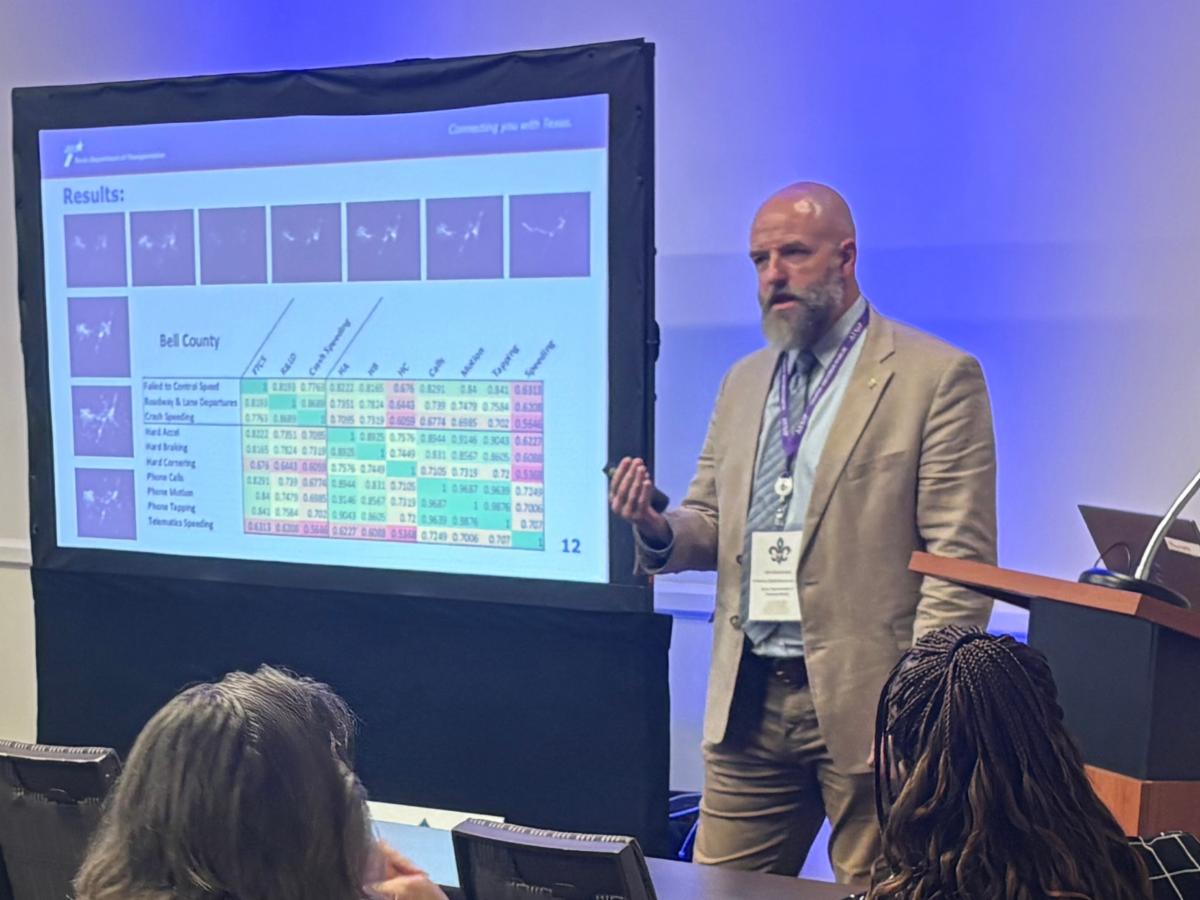
StreetVision for Roadway Safety Pilot

TRCC member Jim Markham, Crash Data & Analysis Section Director at TxDOT, provided an update to the ATSIP-administered pilot project exploring the use of Cambridge Mobile Telematics (CMT) StreetVision Data to better identify and understand traffic safety problems. The CMT StreetVision AI road safety platform makes aggregate driver behavior data, gathered via telematics, accessible through interactive maps and other visualizations.


Mr. Markham presented an update from this pilot project on how Texas is using this platform to associate crash data with enforcement data and behavioral data indicative of speeding and distracted driving. 


Enterprise-Scale PII Redaction of Crash Narratives

Mahin Ramezani, from TTI, presented an update on her recent work to develop a natural language processing (NLP) model to deidentify personally identifying information (PII) from crash narrative text. By systematically removing PII, crash narratives can be more readily shared.


The current phase of this project focuses on transitioning the original NLP model from a research prototype to an enterprise-scale production system. The labeled training dataset was expanded using redacted narrative documents and historical crash files and the retrained model was validated and prepared for deployment into TxDOT’s Enterprise Data Platform (EDP), enabling automated PII redaction within the daily CRIS ingestion workflow.


This work outlines a clear path for moving transformer-based de-identification into an enterprise environment, supporting secure and scalable access to crash narratives while maintaining both privacy protection and research value.


Impaired driving is a nationwide problem. The Texas Impaired Driving Task Force works to create awareness about the impaired driving problem and offer resources and support for countermeasures against impaired driving.


Help Guide the Next Texas Strategic Highway Safety Plan


The Texas Strategic Highway Safety Plan, the federally-required statewide safety plan and Texas' roadmap toward reducing fatalities and serious injuries, is being updated this year and stakeholder feedback is critical. Everyone is invited to participate in emphasis area teams focused on key safety challenges, including


  • Impaired Driving,
  • Distracted Driving,
  • Vulnerable Road Users,
  • Speed-Related Crashes,
  • Roadway Departure Crashes,
  • Intersection Safety,
  • Occupant Protection, and
  • Post-Crash Care.


Sign up here to share your expertise and help identify the strategies, programs, and investments that will have the greatest impact on traffic safety in Texas over the next five years.

Premier Safety Conferences Coming to Texas


Coming up in 2027, Texas will be hosting several premier safety conferences, including:


Lifesavers Conference on Roadway Safety

San Antonio | March 6-9, 2027 | Website


Lifesavers is the nation’s largest highway safety conference, bringing together thousands of transportation, public health, law enforcement, and safety professionals. The conference highlights proven countermeasures, emerging research, and innovative programs designed to reduce roadway fatalities and serious injuries.


ATSIP Traffic Records Forum

San Antonio | Summer 2027 | Website


The Traffic Records Forum is the leading national conference focused on traffic safety data systems and analytics. It convenes traffic records coordinators, analysts, engineers, law enforcement, and public health practitioners to advance data quality, integration, and accessibility in support of evidence-based safety decision-making.


TxDOT Traffic Safety Summit

Texas Location TBA | Date TBA


The Texas Traffic Safety Summit is the state’s premier forum for collaboration on roadway safety priorities. Transportation professionals, law enforcement officers, engineers, healthcare providers, and community partners come together to exchange best practices and coordinate strategies across education, enforcement, engineering, and emergency response to make Texas roads safer for all users.

Do you have ideas for the next issue? Share them with Emily Martin.