November 2026

Any comments/suggestions please email the editor at editor@redrockrx.com

Edited by Malcolm Fraser MD, CMD


Great News for the Thanksgiving Season

As we get ready for Thanksgiving with family and friends, I want to share some great news with you.


In the 20 years that I have been practicing in long-term care, this season’s flu vaccine appears to be the best tolerated I have seen. In my experience, side effects have been minimal.


According to a CDC analysis of eight RSV seasons, nearly one in 10 adults hospitalized with respiratory syncytial virus (RSV) infection died during hospitalization or within 30 days of discharge. Among those who died, 81.3% were ages 65 or older, 53.9% were female, 69.7% were White and non-Hispanic, and 89.0% had at least one underlying medical condition.


The CDC recommends a single dose of any of three FDA-licensed RSV vaccines for all adults ages 75 or older and adults ages 50–74 who are at increased risk of severe RSV illness. People who have already received an RSV vaccine should not receive another dose at this time. Here at Red Rock, we have found RSV vaccination to be well tolerated. According to the CDC, vaccination reduces the risk of RSV-related hospitalization by approximately 75%.


I also want to draw your attention to the article below about the potential role of GLP-1 medications in managing schizophrenia.


This could be huge!


Finally, from all of us in the Red Rock family, we wish you and your loved ones a wonderful Thanksgiving!

Shixian Wang

Director of Operations


Sources: RSV hospitalization analysis — MedPage Today | CDC RSV vaccine guidance

Nursing Home Survey Update
September 2026

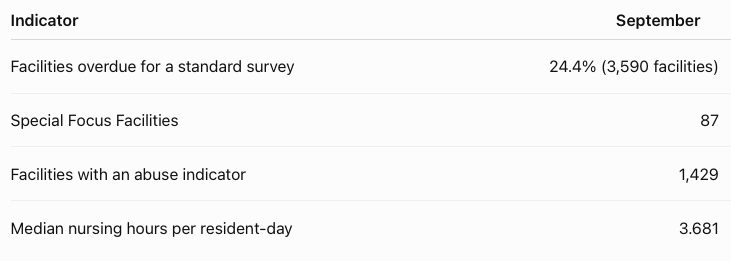
Key National Indicators

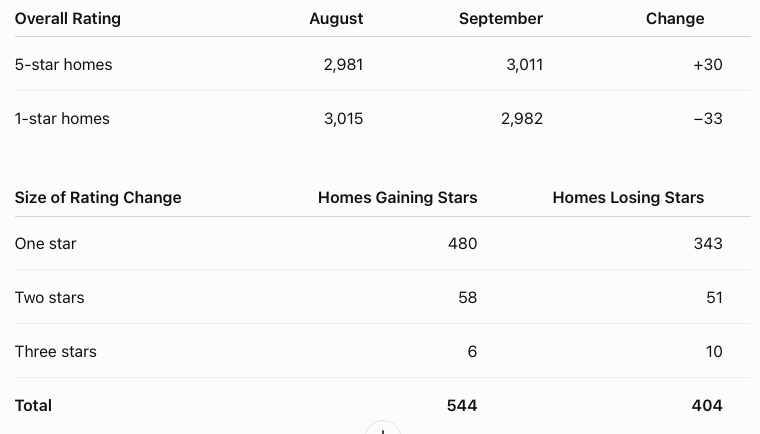
Overall Star Rating Changes

Overall ratings increased for 544 homes (3.7%) and decreased for 404 homes (2.8%)—a net gain of 140 homes. Most changes were driven by new inspections.

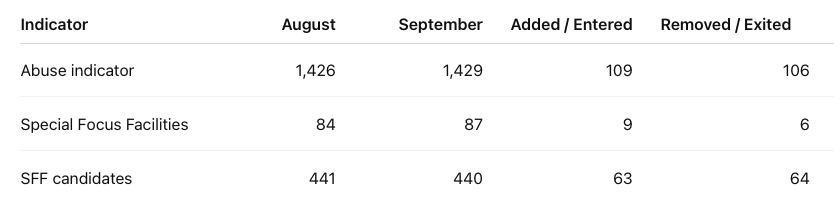
Warning Flags and Special Focus Status

What these indicators mean: The abuse indicator is CMS’s red-hand symbol identifying homes cited for abuse. A Special Focus Facility (SFF) is a nursing home identified by CMS for a pattern of serious problems and inspected about twice as often as other homes. SFF candidates are facilities being considered for the program.

Source: Nursing Home Database — September 2026 Monthly Pulse

364 Days of What's Wrong, One Day of What's Right


Let's face it. We spend a remarkable amount of time focusing on what's wrong.

The staffing shortages, budgets that don't stretch far enough, regulations that seem to multiply overnight. The technology that's supposed to make our lives easier but somehow requires three passwords, two phone calls, and a minor miracle just to function. And that's just Monday.


In long-term care, there's certainly no shortage of challenges competing for our attention. We spend our days solving problems, putting out fires, and preparing for the next unexpected complication. Somewhere along the way, it's easy to lose sight of everything that's actually going right. Then November rolls around, and suddenly we're reminded to be thankful.


One day out of 365. Seems like we might have that backward.


Think about everything that happens in a senior living community on any given day. A caregiver takes an extra moment to comfort a resident. A nurse catches a medication discrepancy before it becomes a problem. A dietary employee remembers exactly how someone likes their coffee. A coworker steps in without being asked. These moments rarely earn recognition, but collectively, they're what make exceptional care possible.


And they're happening every single day.


Being thankful doesn't mean pretending everything is wonderful. Healthcare is complicated, and no amount of positive thinking will magically solve staffing shortages or make reimbursement rates more reasonable. But gratitude offers something valuable: perspective. It's recognizing the people around us who do extraordinary things, often without acknowledgment. It's appreciating the coworker who makes a difficult day easier, the administrator who supports their team, or the family member who simply says “thank you.” Sometimes, it's celebrating the fact that we made it through another Monday without throwing the computer out the window.


At Red Rock Pharmacy, we're grateful for the communities that trust us and the dedicated professionals we have the privilege of working alongside.


We recognize that we're just one piece of a much larger puzzle. Our goal is to make medication management one less thing you have to worry about while being a dependable partner when challenges arise. Great partnerships aren't defined by never having problems; they're defined by how people respond when they do.


What if we spent a little less time dwelling on what's wrong and a little more time recognizing what's right? Better yet, what if we focused not only on being thankful for others but on becoming someone others are thankful to have around? Someone who offers encouragement, recognizes a job well done, or takes an extra moment to make another person's day a little easier.


In healthcare, we measure success through outcomes, efficiencies, and compliance. Those things matter. But sometimes, the most meaningful measure is much simpler: Did we make someone's day better because we were a part of it?


That's a question worth asking more than once a year.


From all of us at Red Rock Pharmacy, thank you for the trust you place in us and the difference you make every day.


Happy Thanksgiving!


Dave Rimlinger,

Director of Marketing

Psych Meds


Multiple CNS-Active Medications Linked to Nursing Home Admission in Early-Onset Dementia


A recently published study found that patients with early-onset dementia (EOD) who used three or more central nervous system (CNS)-active medications had approximately a one-third higher risk of nursing home admission during a one-year follow-up period compared with those without CNS-active medication polypharmacy.


This is no surprise to those of us working in nursing homes. What makes this study interesting is that it included patients as young as 30. However, the findings do not establish that medication use itself caused the increased risk; underlying disease severity and the conditions being treated may also explain the association. The study was recently published in the Journal of Alzheimer’s Disease Reports.


The study analyzed data from 18,029 patients ages 30–64 with EOD using the 2012–2021 MarketScan databases. CNS-active medication polypharmacy was defined as the concurrent use of three or more CNS-active medications for at least 30 consecutive days during the six months following the initial diagnosis of Alzheimer’s disease or related dementias (ADRD). The primary outcome tracked was nursing home admission.


Source: Journal of Alzheimer’s Disease Reports — Read the study

Can GLP-1s Help in the Management of Schizophrenia?

According to KFF Health News, a recent study of U.S. health records found that people with schizophrenia who were also taking GLP-1 medications for diabetes had fewer psychiatric relapses, suggesting another potential benefit of these medications.


Patients taking GLP-1s were 24% less likely to be admitted to a psychiatric hospital than those not taking these medications, researchers reported, and 29% less likely to visit the emergency department for a mental health crisis. They were also less likely to be admitted to a psychiatric hospital than those taking other types of diabetes medications. The study was recently published in The Lancet Psychiatry.


These findings show an association; they do not establish that GLP-1 medications prevent psychiatric relapses.


Editor’s Note: These findings could have significant implications for the U.S. nursing home population. As the medical director overseeing 1,100 beds in Colorado, I estimate that 20% of our residents have a schizophrenia diagnosis and that their care accounts for approximately 40% of my time as medical director.


Source: The Lancet Psychiatry — Read the study


Federal Funding Supports Falls Prevention


The three initiatives receiving funding are:

  1. A Demonstration to Scale Innovative Person-Centered Approaches to Falls Prevention through Clinical-Community Partnerships
  2. Scaling Evidence-Based Falls Prevention Programs
  3. National Falls Prevention Resource Center


Nonfatal falls account for an estimated $80 billion in healthcare spending each year.


Source: 

U.S. Department of Health and Human Services — Falls Prevention Funding


Improving Muscle Strength in Nursing Home Residents


The I-COUNT pilot randomized controlled trial, published online in August 2026, evaluated 90 long-term care residents assigned to either a six-month multidomain intervention or usual care.


After six months, the intervention group showed a 3.8 kg greater improvement in grip strength compared with the usual-care group. Sarcopenia—a condition involving reduced muscle strength and mass—decreased in prevalence from 37.1% to 15.4% in the intervention group, although the difference in changes between groups was not statistically significant.


The intervention combined exercise, cognitive training, nutrition, and vaccination promotion.


For nursing home teams, these findings highlight the potential value of a coordinated approach to maintaining residents’ strength and physical function. Larger studies are needed to confirm the results and determine whether these improvements translate into fewer falls.


Source: The Journal of Nutrition, Health & Aging — Read the I-COUNT study


If you have any questions, ask your Red Rock Consultant Pharmacist