|
CANINE SCIENCE SERIES · NO. 2 · OCTOBER 2026
When the Dog Says Nothing
An electronic nose, a clandestine grave, and what a new pilot study could mean for how cadaver dogs are trained
Michael Hadsell · President, Peace River K9 Search and Rescue Association
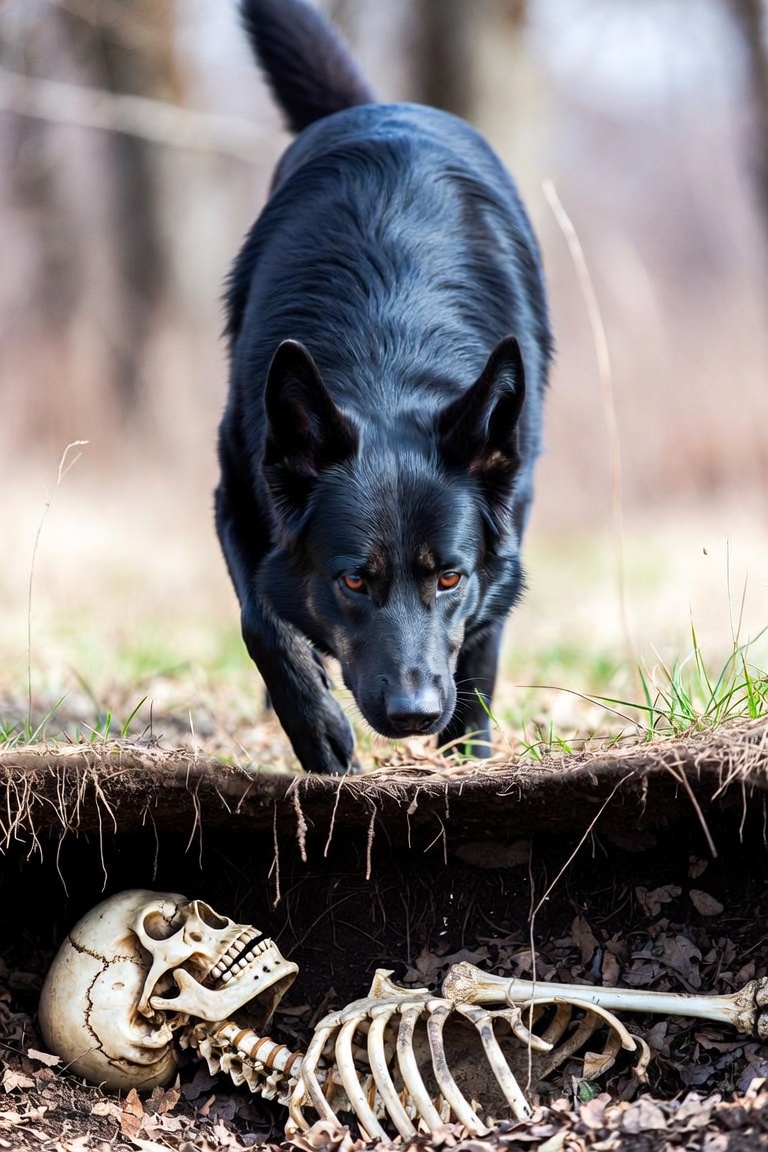
Every handler of a human remains detection (HRD) dog has stood at the edge of a search area and watched the dog work it clean. No change of behavior, no final response. And every handler has been left holding the same question that nobody else on the scene can answer: was there nothing here, or did the dog miss it?
A small study from Australia, published in PLOS One this month, targets that exact question. It does not try to build a machine that replaces the dog. It tries to build one that checks the dog’s homework.
AT A GLANCE
- Researchers at the University of Technology Sydney (UTS) tested a portable electronic nose, NOS.E, alongside police cadaver dogs at a grave holding human remains buried for more than three months.
- The most promising use they found was not searching. It was training: confirming whether decomposition odor is actually present where a dog did, or did not, respond.
- The researchers call the device a complement to the dog, not a replacement, and describe the work as a pilot: one grave, with a larger study still to come.
- Nothing here changes how a qualified team works today. It does point at a gap every trainer already knows about.
1. The study in brief
The work comes from UTS, where forensic scientists and engineers have been developing NOS.E for several years. Dr. Amber O. Brown, the lead author, completed her doctorate there. Her co-authors include Associate Professor Maiken Ueland, who directs the Australian Facility for Taphonomic Experimental Research (AFTER), the country’s human decomposition research facility.
The scenario was built to resemble a long-term missing-person case: a clandestine grave containing human remains buried for more than three months. The electronic nose sampled the air at the burial and at control areas around it. Police cadaver dogs searched the same site independently, without the instrument’s results to lean on.
The authors are candid about scale. This was a single grave, and they describe it as a pilot. Their stated next step is a larger, longer study with multiple donors, more dogs and repeated site visits. Ueland named the hard part plainly: keeping the controls rigorous enough that dogs and handlers do not learn the site or pick up unintended clues. Anyone who has run a training area more than twice knows exactly what she means.
One detail deserves attention. According to Ueland, it was the police partners, not the scientists, who saw the instrument’s value as a dog-training tool. The research team had not originally set out to study that. It is a good example of what happens when the people who do the work are in the room with the people who build the tools.
2. The problem it is aimed at
The uncomfortable truth underneath every cadaver dog program is that we do not know precisely what the dogs are smelling. Ueland put it directly: no one knows whether the dogs are keying on a single compound or on a combination. Laboratory work has cataloged hundreds of volatile organic compounds (VOCs) given off by human remains, and the profile is far less tidy than the phrase “cadaver odor” suggests. In one recent study of dry human bone, researchers recovered 296 different compounds, and the most frequently detected of them turned up in only about one sample in three.
Decomposition also moves. Brown notes that it passes through five distinct stages, each producing different odors at different concentrations. That makes HRD training fundamentally harder than training a dog on a substance that smells the same on Tuesday as it did on Monday.
Put those two facts together and the ambiguity runs in both directions:
-
When a dog does not respond, we cannot always tell whether there was no odor or whether the dog missed odor that was there.
-
When a dog does respond in training, we cannot always be certain it was the odor, rather than the handler, the disturbed ground, or the pattern of the session. The best-known demonstration is Lit and colleagues (2011): detection teams searched areas containing no target odor at all and still produced more than 200 alerts, and where the handlers believed the target was placed moved the alerts more than planted decoy scents did.
The field’s answer to this has always been procedural: blank searches, blind and double-blind hides, and training records that keep the misses as well as the finds. ANSI/ASB Standard 076, the American National Standard for HRD on land approved this year, builds those disciplines in. They work. But they all depend on one thing: the trainer knowing where the odor is. At a placed hide, the trainer knows. At an old training site soaked in residual odor, or at a real grave, the trainer does not. That is the gap this study is pointed at.
3. What an electronic nose actually is
NOS.E is not a miniature dog and not a laboratory mass spectrometer. It carries an array of commercially available metal-oxide gas sensors, each of which responds to different classes of compounds. Software reads the combined pattern of those responses as a kind of chemical fingerprint and compares it against what it has learned. It does not name every compound in the air. It recognizes a pattern.
The device has a published track record behind it:
-
2020. The UTS engineering team published the system design, including a controlled airflow intake and self-monitoring for faults.
-
2023. In the first outdoor test on human remains, NOS.E detected a surface-deposited donor through most stages of decomposition. Its readings were affected by wind.
-
2024. Bench testing put its average detection limit at about 7.9 parts per million across several chemical classes. In a simulated mass-disaster scenario with donated human remains, it separated donor samples from controls from day three after death.
-
2026. The current study: the first published side-by-side with cadaver dogs at a buried grave.
A word on that 7.9 parts-per-million figure. That is an instrument’s register, not a dog’s, and nobody involved is claiming the machine out-smells the animal. The UTS team says the opposite in plain terms: the dogs have the superior nose and can search an area quickly, while the instrument can say more about which chemicals are present. Ueland describes it as a bridge between the scent picture available to a dog and the chemical signals that people can measure and understand.
4. Why the training finding matters
The researchers describe three ways an instrument like this could help a trainer. Each one lines up with a problem working handlers already recognize.
Confirming odor where the dog did not respond
Ueland’s point is that the instrument can show whether decomposition odor is present in an area, including when a dog does not alert. That turns a silent pass into a data point. If the instrument reads decomposition odor and the dog walked past it, the trainer has learned something specific about the dog. If the instrument reads nothing, the dog may simply have been right.
Checking for cues, especially with young dogs
Brown suggests the technology could help trainers determine whether a younger dog is genuinely responding to decomposition odor or is being influenced by another cue. Given what the cueing research shows, an independent check that does not care what the handler believes is exactly the kind of control the discipline has been missing.
Finding gaps across the stages of decomposition
Because odor changes as remains decompose, Brown argues that tracking those chemical changes in real time could show whether a dog needs more work on early-stage or late-stage material. A dog that is excellent on fresh tissue and weak on old bone is a real and common profile, and it is one most teams discover only after a field deployment goes badly.
WHERE THIS COULD FIT IN OUR OWN RECORDS
This part is our reading, not the authors’. ANSI/ASB 076 recognizes a non-productive response: a trained final response that cannot be confirmed. Today, that single heading has to hold two very different events: a dog that was in real odor with no source recovered (residual odor, fluids, a moved body), and a dog that responded when there was no odor at all.
A trustworthy instrument reading at the point of response would, in time, let a trainer tell those two apart. The first is a dog doing its job in a hard situation. The second is a training problem. They deserve different entries in a log, and right now nobody can reliably separate them.
5. What it is not
-
It is not a replacement for the dog. The researchers say so repeatedly. A dog covers ground and works the scent picture on the move. An instrument samples the air at the points where someone chooses to put it.
-
It is not a field search tool for volunteer teams today. NOS.E is a university research instrument. The value demonstrated so far is in research and training, not in a callout.
-
It is not immune to the environment. The 2023 work found its readings were affected by wind, and electronic noses in general are known to suffer sensor drift over time and with use. A dog has bad days too, but the instrument’s weaknesses are different ones, and they need their own controls.
-
It has not been tested in conditions like ours. Southwest Florida means heat, humidity, sand and a high water table. Research on HRD dogs in sandy soil has found that porous sand brings a dog into odor sooner but spreads that odor wider, making the source harder to pinpoint. An instrument sampling at a single point in that ground would face the same dispersion problem. Nobody has published how it would cope.
-
The headline numbers are not in the press materials. The university’s release does not report detection rates or false-alarm figures for either the dogs or the instrument, and this article does not try to reconstruct them. Readers who need the numbers should go to the paper itself.
The researchers also point to one application well beyond training: mass disasters and other hazardous environments, where it may be too dangerous to send in people or dogs at all. That is a long way from a county search, but it is a reasonable place for this technology to earn its keep first.
6. What the evidence does and does not say
What it shows. A peer-reviewed pilot deployed an electronic nose alongside HRD dogs at a buried human grave more than three months old. Earlier published work shows the same instrument can detect human decomposition compounds outdoors and can separate donor samples from controls.
What it does not show. One grave cannot establish reliability across soils, climates, burial depths, ages of burial, or dogs. It does not validate a training protocol, and it does not support any general statement about the instrument being more or less accurate than a dog. The authors do not claim otherwise.
Our own bias. PRSAR has spent this year arguing that cadaver dog teams should be able to prove what they claim. A device that promises objective proof is precisely the result we would most like to be true. That is a reason to hold it to the same standard we ask of the dogs: repeated, blind, documented, and published. We will be watching the larger study for exactly that.
7. What it means now
For handlers, nothing changes on Monday. The disciplines that make a dog’s silence mean something are the ones already within reach: a blank in every set of hides, blind and double-blind work, training sites the dog has not learned, and records that keep the misses and the non-productive responses alongside the finds. An instrument may one day sharpen those records. It will not replace the habit of keeping them.
For agencies, the lesson is the one we keep repeating. A dog that does not alert has not cleared an area. Before you weigh a negative result, ask the team for its blank-search record and its miss rate. Someday an instrument may help answer that question at the scene. Today, the training records answer it.
For the field, this is worth following closely. If the larger study holds up, trainers may finally have a way to check their own assumptions about where the odor is, and that would make every honest team better.
The most useful thing a machine can do for a cadaver dog right now is not to find what the dog cannot. It is to tell the trainer, honestly, whether there was anything there to find.
Prepared for the worst, providing the Best . . . Until All Come Home
ABOUT PRSAR
Peace River K9 Search and Rescue Association, Inc. (PRSAR) is a Florida 501(c)(3) volunteer search and recovery organization serving the Great State of Florida. Its human remains detection teams follow guidelines based on ANSI/ASB Standard 076.
PRSAR does not certify canine teams. It conducts evaluations, including a Mission Ready Evaluation that every team must pass before deployment, and its teams obtain certification from outside certifying organizations.
Sources
Published titles keep their original spelling.
1. Brown AO, et al. A case study comparing the detection ability of cadaver detection dogs and electronic nose technology to a clandestine grave. PLOS One. 2026. doi:10.1371/journal.pone.0360233
2. University of Technology Sydney. Electronic nose puts police detection dogs to the test. News release, 22 October 2026 (via Scimex, Australian Science Media Centre).
3. Zhang W, Liu T, Ueland M, Forbes SL, Wang RX, Su SW. Design of an efficient electronic nose system for odour analysis and assessment. Measurement. 2020;165:108089.
4. Brown AO, et al. The use of novel electronic nose technology to locate missing persons for criminal investigations. iScience. 2023;26(4):106353.
5. Sunnucks EJ, Thurn B, Brown AO, Zhang W, Liu T, Forbes SL, et al. Performance of a novel electronic nose for the detection of volatile organic compounds relating to starvation or human decomposition post-mass disaster. Sensors. 2024;24(18):5918.
6. Karami H, Thurn B, Boer N, Ramos J, Covington JA, Lozano J, Liu T, Zhang W, Su S, Ueland M. Application of gas sensor technology to locate victims in mass disasters: a review. Natural Hazards. 2024. doi:10.1007/s11069-024-06809-5
7. Ouimet F, Patel D, Tsontakis M, Samson C, Forbes SL. Establishing the volatile organic compound profile and detection capabilities of human remain detection dogs to human bones. Forensic Science International: Synergy. 2025;10:100566. doi:10.1016/j.fsisyn.2024.100566
8. Lit L, Schweitzer JB, Oberbauer AM. Handler beliefs affect scent detection dog outcomes. Animal Cognition. 2011;14(3):387–394.
9. Alexander MB, Hodges TK, Wescott DJ, Aitkenhead-Peterson JA. The effects of soil texture on the ability of human remains detection dogs to detect buried human remains. Journal of Forensic Sciences. 2016;61(3):649–655.
10. ANSI/ASB Standard 076. Standard for Training and Certification of Canine Detection of Human Remains: Human Remains on Land. 1st ed. AAFS Standards Board; 2026.
|