A Computer Journal For Translation Professionals |
|
This edition of the Tool Box Journal provided to you by
A book for you (and your clients) to educate you, amuse you, and remind you of your passion for language and its beauty.
|
|
Issue 21-8-328
(the three hundred twenty-eighth edition)
|
|
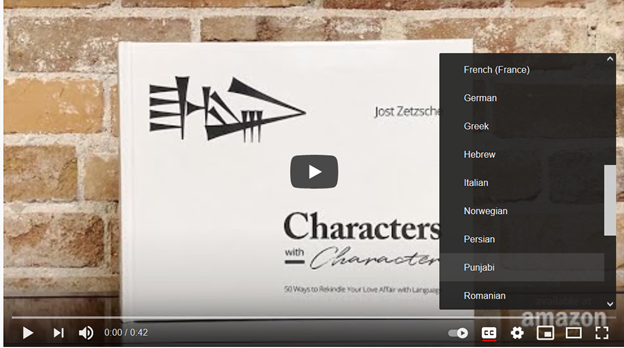
I feel blessed to be a translator and part of your community. Remember that I asked in the last Tool Box Journal for help with translating the subtitles to the promo video for my Characters with Character book? With your help it has now been translated into 24 different languages, and I'm so thankful. Really. |
(You can find the names of all your colleagues who helped in the description of the video.)
Also, an astonishing number of you responded to the survey I posted in the last edition. I can't yet disclose the results and outcome (you'll have to wait for the next Tool Box Journal to read all about it!), but it's going to be amazing. For realz!
|
|
Contents
THANK YOU!
Sind so kleine Hände!
Habit is habit (Column by Dorothee Racette)
How to create a professional branded background for video calls in under 5 minutes (Column by Josh Goldsmith)
New Password for the Tool Box Archive
The Last Word on the Tool Box Journal
|
|
Here's the problem when writing for a global audience: Anything I have to say about the season in my -- northern -- hemisphere inevitably sounds hollow to our rain-soaked and freezing colleagues on the other half of the globe. Still, let me say it: I love this summertime where I live, and I hope that many -- hopefully most -- of you who live on my half can celebrate this time of year with me. (Of course, I do realize that I live in a slice of the world where heat waves are virtually unknown, making me rather privileged these days.)
I love the sun, the sound of music from our new outdoor restaurant across the street from my office, the warm sand around my feet when I walk on our beach, and the sound of children playing outside. (I also love the fact that I'm just about to go on a two-week break to a rustic, remote little lake cabin that's been in my wife's family for generations.)
I wracked my brain for what technology I could cover in this summer edition of the Tool Box Journal. I had a couple of ideas: a new project management tool for translators, some old but cherished utilities that I've never covered, why subscription-based pricing might be a much under-used option for many translators, or a broader look at why I think we might have possibly plateaued with the technology we are using.
But then I thought back to last week, when each day I inhabited a ridiculous character in a little daily skit as part of a vacation program for kids in our community. And I decided to forego technology this week and talk instead about that. Or better yet: Why we need to pour into the children of our respective communities, and why just saying or feeling warm thoughts about them doesn't cut it. Why we have to do something about it instead.
I've mentioned before that my wife is a pastor at a local church in our town. Likely the most important part of that job is not the sermon prep or delivery or the organizing of events and programs, but the one-on-one meetings she has with people from the church and larger community. Meeting with a spiritual leader provides a space for many that allows for disclosures of hurts like very few other encounters do. Obviously, these encounters are confidential, so Kristen never shares names or details with me, but I know that the most-often-felt pain, the one that shadows so many people's lives into their old age, finds its origin in their childhood. Many of you know that all too well from personal experience or through people who are close to you.
It is heartbreaking, both personally and societally. And it brings me to the crux of this unusual plea: We need to notice and reach out with love to our children. Not just our biological or adopted ones but also the ones up and down the streets, the ones who our "own" children and grandchildren bring home with them or spend time with, the ones whose shouts and cries we hear from the playground the street over, the ones whose families might need a helping hand of food and shelter, the ones who look on as others play, the ones who have a hard time following the rules, the ones who are too timid to ever break any rule, the ones who are being bullied, and -- perhaps the most difficult to love -- the ones who are being the bullies. Obviously, the list could go on and on and on.
The afternoon you choose to spend with a child in these remaining days of summer might well be the most important hours you spend all summer -- or all year. You might be the ray of light that Kristen or her successors in 20 or 30 years from now will hear about during a counseling session. Or maybe, just maybe, that session will never have to take place because of you.
Just in case you think you're not good at playing or talking with children: You can be good at listening. (I can promise you some hilarious stories!)
If only one of you takes me up on this invitation, this could be the most successful newsletter for translators yet, even though we didn't talk about translation at all.
Well, except this: If you still have a few days or maybe even a week or two left without many pressing work assignments, read some translated literature. Why do I say that? Because I've realized what a snob I've been when it comes to translated literature in my working languages. With the ever-critical eye of a translator, it sometimes felt too difficult to just enjoy the book for the book's sake. Too often I felt I knew better (imagining what the original text might've been), often spoiling the reading experience.
If this were a Translators Anonymous meeting, I would report to you that I feel like I've turned a corner. I recently read a number of translated books that I not only enjoyed for the books' sake but also because I was a translator. While I still found plenty of passages that I conceitedly thought I could manage better, I also delighted in those that I felt were particularly well done from a translation point of view, and I celebrated those triumphs with my (imaginary) translator friend as I registered those passages in the new-things-learned part of my brain.
I'll let you know at the next Translators Anonymous meeting whether I was able to keep this up through our vacation.
|
|
Habit is habit (Column by Dorothee Racette)
|
|
"Habit is habit, and not to be flung out of the window by any man, but coaxed downstairs one step at a time." -- Mark Twain
Habit research is a fascinating field. It explores how much of our daily activity is automated, and how we can change deeply engrained routines that no longer serve us.
Self-help books about any topic often recommend to "make it a habit…," but that process can be much more challenging than it sounds. Take the example of New Year’s resolutions or other vows to make profound life changes: The common trajectory is a few days of feeling great about a new activity, followed by a more or less spectacular lapse into old patterns.
You can think of habits as automated routines that don’t require conscious decisions, not unlike 100% matches in a well-maintained TM. These routines make up about one third of our daily actions, and that’s good! Imagine how hard it would be if you had to learn how to drive a car every time you wanted to go somewhere. Our brain and muscle memory allows us to focus on the more relevant aspects of our day.
Your habits are an individual collection of behaviors that have become second nature. They range from your preference for a morning beverage to your aversion to marketing yourself. The more engrained they become, the more difficult they are to change. Not surprisingly, the way we treat and consider time is largely determined by habits as well. When you look at your daily T&I work, you are likely to discover several time-related habits that may or may not be beneficial. For starters, what prompted you to open this newsletter, and how many browser tabs are open as you are reading it?
Neuropsychology has helped us gain a much better understanding of the way our habits function. Habits are based on a simple loop of a cue, a routine, and a reward. To give you a simple example, a cue may be a sense of feeling unfocused, which prompts you to brew a mid-day cup of coffee (routine). The reward is the necessary concentration to finish a project.
What is the best way to start a new habit?
- Start small: Research has shown how important it is to start small when building a new habit. A new routine should be so short that your brain can’t possibly come up with an excuse. You are much more likely to stick with an activity that initially takes 30 seconds or less.
- Repeat often: Frequent repetition gets your neuropathways used to a new activity. Short repetitions are better than long sessions, especially if the new habit you want to build involves exercise. It takes many days for an activity to become fully engrained.
- Set up habit environments: You can encourage a new habit by setting out reminders and cues. For instance, walking shoes by the door will remind you to take a quick walk around the block at lunchtime. Any obstacle (can’t find shoes) will turn into a reason to stay with old behaviors.
- Tie to existing habits: It is easier to modify existing routines than to invent new ones. To stay with our previous example, you may decide that your caffeine consumption has become excessive. You can gradually modify the current loop
Cue = Feeling unfocused
Routine = Make coffee
Reward = Renewed concentration
by changing the routine portion, e.g. by drinking water instead of coffee.
- Don’t forget the reward: Nothing stops a new habit faster than an unpleasant experience. A new exercise routine should never hurt, and the water you drink instead of your coffee must be refreshing. A sense of obligation ("I should") does not provide sufficient motivation.
What can you do when you’ve fallen off the wagon?
Good habits take continuous work, even after you've established them. In chaotic times, even the best habits can be hard to follow.
Here are some ideas for coming back to a new habit:
- Stop beating yourself up. You fell back into old patterns, that's all.
- Don't attempt to 'catch up' -- just come up back to the activities that worked.
- Go back to the upside of the habit: what was inspiring and fun?
- Create fresh reminders and incentives for yourself.
- Invent a shorter habit routine that fits your life.
Dorothee Racette, CT has been a full-time freelance GER < > EN translator for over 25 years. She served as ATA President from 2011 to 2013. In 2014, she established her own coaching business, Take Back My Day, to help individuals and organizations solve problems related to workflow and time management. As a certified productivity coach (CPC), she now divides her time between translating and coaching. Her book Complete What You Started (2020) provides a blueprint for carrying big projects across the finish line. You can read her blog at takebackmyday.com/blog.
|
|
Productivity solutions on the go: Only need a few quick actions to address a challenge with your business or productivity?
Try laser coaching with Dorothee -- one topic, twenty minutes of conversation, fresh insights. |
|
The Tech-Savvy Interpreter 2.0 - How to create a professional branded background for video calls in under 5 minutes (Column by Josh Goldsmith)
|
|
If you’re anything like us, you’ve seen your fair share of virtual backgrounds. Most of them aren’t especially professional or convincing, with blurry edges around people’s faces and backgrounds that bleed through.
The secret behind a good look isn’t the background image, it’s using a green screen. (We covered our favorite portable option, the Webaround, in a prior column and video.)
Once you’ve picked up your green screen, you could just use one of the backgrounds that come with your meeting platform. But why would you want to use the same background as everyone else?
In this month’s column, we’ll show you how to create a professional, branded background image that’ll make you stand out at your next online meeting.
We’ve also created a tutorial video to walk you through every step of the process. Check it out to see how we created a professional branded background in under five minutes. (Three minutes and thirty-five seconds, but who’s counting? 😆)
Create your background image
Our favorite graphics software is Canva.com, a free online design tool to create your image in a flash. The best part: You don’t need an eye for design or expensive software. Even Josh, whose artistic skills leave a lot to be desired, can create surprisingly professional images. 😜
Ready to create a branded background in seven easy steps? Let’s dive in!
1. Set up an account on Canva.com. (If you use our affiliate link, we’ll receive a small commission to support our work at no extra cost to you. Win-win! ✨)
2. Click "Create a design," "Custom size," and create an image that’s 1920 x 1080 pixels.
( Geeky aside: Most platforms display video with a 16:9 aspect ratio. If your image is a different size, you may see black bars alongside the background. Here are the specific recommendations for Teams, Zoom, Webex, and Google Meet.)
3. Give your design a title -- like "My background image." (Click on the "Untitled design" at the top of the screen to name your design.)
4. Add a background by clicking the "Background" tab and picking from among a smorgasbord of options.
In general, we recommend keeping it simple -- with a single color that isn’t too flashy. Click the color palette followed by the plus button, then pick out the color you’d like. (In our example video, we’re popped in the code for our brand color.)
Alternatively, you can pick from among the patterns, gradients, textures and abstract images in the Canva library. Again, keep it simple and professional.
If your brand is a bit quirky, head on up to that search bar and look for a fun image that suits you. Remember that you’re going to appear in the video, so leave the center of the image clear.
5. Add a high-res version of your logo. A scalable format like .svg is best. (Others might get pixelated if enlarged.)
Head on over to uploads, click "Upload media," and then upload from your device or cloud storage.
6. Once your logo has uploaded, click on it to add it to the canvas. Then, drag it to the upper right or upper left corner. Remember, you don’t want to cover it up with your body during your video calls, so keep it small and out of the way. You can click on the logo and drag it to a new spot on the canvas or drag the dots to resize it.
7. Download the background image by clicking on the download button. Select .PNG or .JPG for file type, then click "Download."
Add the custom background to your meeting platform
Now, it’s time to add your background image to your meeting software. Every platform is slightly different, but the gist is always the same: just upload the background to your meeting software and tell it you’re using a green screen.
On Zoom, for example, open "Preferences" and go to "Background & Filters." Click "I have a green screen" and the plus button to upload a new background image.
Then, select the image you want and you’re ready to go.
And that’s it -- in under five minutes, you’ve created a background image with your logo -- for free!
Josh Goldsmith is a UN and EU accredited translator and interpreter working from Spanish, French, Italian, Portuguese and Catalan into English. A passionate educator, Josh splits his time between interpreting, researching and teaching through www.techforword.com, which empowers language professionals to make the most of technology.
|
|
Fed up with terrible audio and video? We feel you -- which is why we wrote the Interpreter’s Guide to Audio and Video.
Pick up your copy for just 25€ and take your video and audio game to the next level! 🚀
|
|
New Password for the Tool Box Archive |
|
As a subscriber to the Premium version of this journal you have access to an archive of Premium journals going back to 2007.
You can access the archive right here. This month the user name is toolbox and the password is andthelivingiseasy.
New user names and passwords will be announced in future journals.
|
|
The Last Word on the Tool Box Journal |
|
If you would like to promote this electronic journal by placing a link on your website, I will in turn mention your website in a future edition of the Tool Box Journal. Just paste the code you find here into the HTML code of your webpage, and the little icon that is displayed on that page with a link to my website will be displayed.
If you are subscribed to this journal with more than one email address, it would be great if you could unsubscribe redundant addresses through the links Constant Contact offers below.
If you are interested in reprinting one of the articles in this journal for promotional purposes, please contact me for information about pricing.
© 2021 International Writers' Group
|
|
|
|
|
|
|