A Computer Journal For Translation Professionals |
|
__________________________________
This edition of the Tool Box Journal provided to you by
|
|
_________________________________ |
|
Issue 22-12-343
(the three hundred forty-third edition)
|
|
Naturally, I don't know whether you truly are weary, but judging by the weariness of so many around me, it seems all but likely that you may be feeling the same end-of-year fatigue that I'm feeling.
There's good news, though!
It is indeed the end of the year, and for many of us that'll come with some rest. Be kind to yourself and those around you during these days!
Just one quick thing, and then I'll let you go have that well-deserved rest (though Josh, Dorothee, and Alan Melby will want you to look at what they have to say below as well!).
Throughout the last couple of weeks, there has been an interesting discussion on Twitter about what the latest developments in machine translation mean for professional translators. The discussion was sparked by an article by the Economist's Lane Greene about exactly that topic. Lane has always been interested in language and translation and, as an extension, in machine translation. His often thoughtful and well-balanced articles about our profession stand in sharp contrast to those of most other journalists who report on the same topic. If you're able to get behind the Economist's paywall (or, of course, if you're a bonified subscriber), it's a worthwhile read.
The discussion that developed on Twitter is unfortunately difficult to follow because of Twitter's aggravating inability to display discussions once they fork into different strands (something that certainly will be fixed once there's a new CEO!), but I combed through it to document the different arguments that were pontificated about (the discussion did have a tendency to do that).
I think it boiled down to essentially three arguments:
- Post-editing of machine translation has proven itself to be a failure because it does not produce high-quality translation and contributes to the de-skilling of translators (i.e., translators who lose their translation skills).
- The "Human-in-the-Loop" model, however, is the way forward. In the case of machine translation, this model decidedly doesn't refer to the reactive role of the translator who just fixes errors at the backend (i.e., post-editing as is typically practiced today), but to an interactive, proactive, and steering role.
- For specialized translation (with or without the use of machine translation), a mere translation degree is not sufficient. Either an additional specialized degree in the area of the respective specialization, additional working experience in that field, or translation as a second career after developing specialized knowledge are must-haves. Translation academia has largely failed by teaching technologies of yesteryear.
Hmm. I just finished writing an article about the current state of translators (I mentioned this in a previous edition of the Tool Box Journal, and I will share it once it's published). My main conclusions were "I don't really know" and "translators are going to be okay for the time being."
There are at a minimum three million largely unaffiliated translators worldwide with a range of experiences that neither I nor anyone else has any way of measuring. I can certainly see what's happening in my professional life, and I can maybe see what's happening in a few other (possibly well-curated) professional lives. But does that enable me to make sweeping statements about where we're headed? Maybe where my particular sub-tribe is headed, but that's about it.
Still, we can see some trends for some segments in the translation sector. We know, for instance, that most large LSPs (and increasingly many smaller ones) primarily use some kind of post-editing workflow -- and, while we don't have the latest numbers, they're making pretty good money doing it. So I think it's (unfortunately) wishful thinking that the post-editing model has failed. In fact, for a certain part of the market, I'm afraid it's here to stay for a long time to come. This doesn't mean that other, more innovative ways of translating alongside machine translation won't also (continue) to exist -- and, as we've said many times before in the Tool Box Journal, we need to continue to find ever better ways and technologies that allow us to do that.
I think it would be great if most translators who have access to state-of-the art machine translation (which obviously depends on language combination, open internet access, and many other things) would be willing to upskill in learning how to train, maintain, tweak, and integrate MT. But while I don't doubt that more of us will be doing that, I sense that this group still won't be in the majority in the foreseeable future. There are many reasons for this, including the fact that while most successful professional translators have some kind of specialization, it's either not narrow enough to warrant the investment into MT training, etc., and/or there would have to be too many trained engines for the individual translator to achieve the level of distinction from generic engines that we're aiming for.
I also find the comments on the failure of academic translation programs less than helpful, considering the wide range there as well, but I do think there's good food for thought in what training for specialized translators needs to look like. It's important to remember, though, that no one is a "generic person." We all have specializations, and while some of them might be easier to match with real-market expertise than others, those existing interests/areas of expertise might well provide good springboards, jumpstarting a marketable expertise rather than looking at a virtually undoable eight or more years of education for a profession that will continue to pay less than, say, doctors and lawyers in most parts of the world.
🎄 Happy Holidays! 🕎
|
|
Contents
The trouble with goalsetting (Column by Dorothee Racette)
How to use Sketch Engine to extract terminology from a document or parallel texts in just a few clicks (Column by Josh Goldsmith)
Grades of Translation as a Marketing Strategy in the Era of AI (Contribution by Alan Melby)
New password for the Tool Box archive
The last word on the Tool Box Journal
|
|
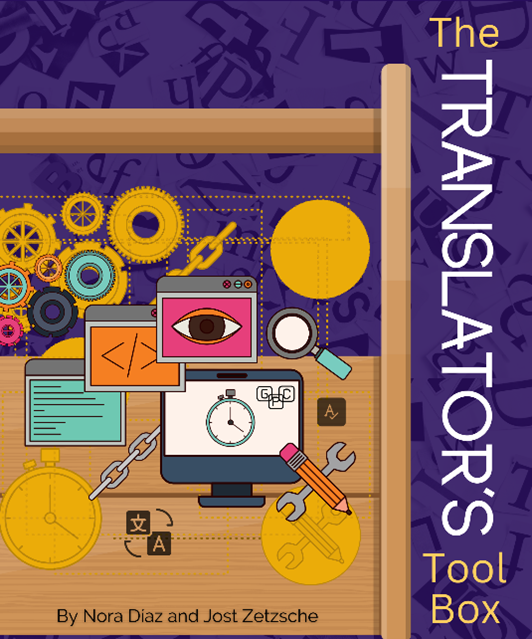
the ultimate resource for all things computer:
Enter HOLIDAYS2022 as your coupon code before you finalize the purchase and pay exactly as much as the current date in December (i.e., $21 on December 21, $22 on December 22, etc. -- instead of $50!).
Also: Visit and subscribe to the Translator's Tool Box YouTube channel with videos demonstrating tips and tricks from the book in action, including newly uploaded videos about copying and pasting like you've never done it before! (Really!) |
|
The trouble with goalsetting (Column by Dorothee Racette)
|
|
At this time of the year, business owners look back on the past twelve months to take stock. What worked well, and what needs improvement? What are the objectives for the coming year? While there is nothing wrong with setting your sights high and thinking big, the trouble with goals is often that we set ourselves up for disappointment when we forget to keep our own realities in mind. Is there an effective way to move beyond short-lived New Year's resolutions?
I was recently invited to a goalsetting business workshop to talk about making goals "stick" in the long term. Here are five different aspects of following through that I shared with attendees:
Self-knowledge
Knowing how you work and how much time is available to you is the foundation of realistic planning. This piece is often missing from conventional one-size-fits-all productivity advice. Instead of trying to follow someone else's blueprint, make it a point to understand as much as you can about your own work conditions. That also includes accommodating brain-based conditions such as depression or ADHD.
Your productive output depends on many pieces, including work conditions, your responsibilities outside of work, your ability to predict time accurately, and your tolerance for stress. It is also helpful to know about the length of your own attention span so you can plan tasks accordingly. When you apply this knowledge to the plans for pursuing your goals, you can plan much more specific actions that are within your own parameters.
Honesty
The second factor for achieving your goals is to be completely honest with yourself. For example, if you're from a large family and everyone is constantly phoning and texting you, it will be difficult to carve out more time for working on your business. Before you decide to go after additional clients, you would first have to examine how much time you can take away from family interactions. It is also helpful to look at the confidence you have in your skills. A new skill that is not yet fully developed will naturally cost you more time – think about researching terminology in a new field of specialty or learning new software. Being clear about your strengths and weaknesses gives you realistic insights in achievable actions.
Take a hard look at the aspects of your business that you tend to put on the back burner. Contrary to popular belief, procrastination typically is an expression of self-doubt, not a matter of time. For instance, if you abhor the idea of "marketing" as an intrusion in other people's lives, you are unlikely to follow through on an ambitious marketing campaign.
Attitude about learning
Building and growing a business involves making mistakes – for everyone. Success never comes in a straight line. Criticism and rejection are of course painful and embarrassing experiences, but the way we handle setbacks ultimately determines what we will get from them. Grit, the willingness to keep trying when things are hard and not a good match for our skillset, has been identified as the best predictor of success. A growth mindset will help you see the point of continuous learning without getting discouraged.
Adjustment
Successful goal achievement depends on your ability to adjust your goals to your working reality instead of abandoning them. Turning a larger goal into smaller, doable steps may generate more successful change in the long run. You won't train for a marathon, but you will get a daily walk. You won't start making six figures, but you'll have steady income from reliable clients who appreciate your work. Count it as a win if you continue to take actions, however small, to achieve your goal.
Accountability
The fifth and most important aspect is the mechanism that ties all the other factors together – accountability. Having an accountability partner who will listen and challenge you is the key to pursuing your goals. Whether it's in a peer group or through your network, try to find someone who will hold you to your commitments. If you are a member of a professional association, ask about their mentoring or peer group programs. You can also reach out to other freelancers who work in your language pair.
There is no question that 2022 has been a tough year amid war, soaring inflation, supply chain challenges, and the threat of a recession. Whatever you did to keep your business afloat was worth the effort. I wish you all peaceful holidays and all the best for the coming year.
Dorothee Racette, CT has been a full-time freelance GER < > EN translator for over 25 years. She served as ATA President from 2011 to 2013. In 2014, she established her own coaching business, Take Back My Day, to help individuals and organizations solve problems related to workflow and time management. As a certified productivity coach (CPC), she now divides her time between translating and coaching. Her book Complete What You Started (2020) provides a blueprint for carrying big projects across the finish line. You can read her blog at takebackmyday.com/blog.
|
|
What do you need to get your business ready for 2023?
|
|
The Tech-Savvy Interpreter 2.0 - How to use Sketch Engine to extract terminology from a document or parallel texts in just a few clicks (Column by Josh Goldsmith)
|
|
Ever received a hundred-page document and needed to find the key terms for your assignment – without reading the whole thing? 🤯
Or found a document and its translation, and wished you could use technology to automatically extract the key terminology from both versions?
You can!
In this article, I'll unpack how to use Sketch Engine's OneClick Terms to extract terms in no time flat.
Why extract terminology
Terminology underpins every translation or interpreting job. After all, when we use a client's terminology, we come across as competent.
But how can we develop that specialized knowledge and identify domain-specific terminology and phraseology?
Of course, you can – and should – read through materials you receive and search for additional resources, like industry publications or a speaker's previous statements.
But if you're looking for a fast, reliable way to identify key terms, look no further than terminology extraction.
Extracting terminology helps you spot the terms and abbreviations your client actually uses and add them to your glossaries. It provides a general understanding of a domain so you can pinpoint concepts for further research, create glossaries for your projects, teams, or clients and ensure you consistently use the client's terminology.
And if you're an interpreter, terminology extraction is the ideal way to quickly pull terms from a long document you receive right before an assignment.
What's a corpus? And what's a term? 😉
A corpus (plural: corpora) is a collection of one or more texts used to study language. We can use a corpus to identify links between words and unique features in language.
A term is a single or multi-word expression that appears in a corpus more than it would appear in general language. For example, the words "the" or "a" are not terms, while a more specialized concept, like the "United Nations Convention on Biological Diversity," is a term.
How terminology extraction works (in a nutshell 🥜)
Sketch Engine uses linguistic and statistical information to detect terms in a corpus.
First, it groups together word forms, like "word"/"words" or "study"/"studies"/"studied."
Then, it compares the corpus to general language to determine when terms appear more frequently than expected. High-frequency units are labeled as term candidates.
This approach works well with longer, written documents. If you receive short texts, presentations, spreadsheets, or lists of bullet points, opt for another strategy. 😉
Sketch Engine's OneClick Terms
Sketch Engine has been designed for linguists of all stripes, from translators and interpreters to terminologists and lexicographers.
For our purposes, we'll head to the web-based OneClick Terms interface to detect terminology in just a few clicks – in any domain.
Worried about confidentiality? SketchEngine is too. They hold the ISO 27001 Certificate of Digital Security, and never "feed" your data into the machine. If you choose not to store data on your account, it is automatically deleted after three days.
(If you don't create an account, you can still test out the features described below, but some results will be hidden.)
Monolingual terminology extraction
Let's start by extracting terminology from a document in a single language.
Go to OneClick Terms and pick "One language." Select and confirm the document language, upload a document in a supported format (.doc, .docx, .htm, .html, .pdf, or .txt), and click "Extract terminology."
After processing the text, Sketch Engine suggests single-word and multi-word term candidates.
Terms at the top of your list are most typical in your text, while those further down tend to be more general.
To see the frequency of terms in your document, click the "show statistics" button.
Like what you see? Click the download button to extract terms in .CSV or .XLSX format. 😁
When I extracted terms from a biodiversity-related text, top hits included "biodiversity loss," "invasive alien species," "habitats directive," "nature restoration," "protected area," and "biodiversity-friendly" – and that was just the tip of the iceberg.
Identify phraseology and collocations with the concordancer
Context matters.
By looking at the words immediately before and after a term candidate, we can fine-tune the term and see how it is used in real life. For example, the tool may have detected "terminology," while the full term is actually "terminology extraction."
Sketch Engine features a built-in concordancer that makes this process easy.
Simply click on the "boxes" icon next to any term, and Sketch Engine will display several examples of how the term is used in your document.
Pick an acronym, and the full version of the term is likely to pop up.
Click on an adjective, and you'll find the nouns that often accompany it. For example, "biodiversity-friendly" might yield "biodiversity-friendly practices," "biodiversity-friendly soil cover," "biodiversity-friendly trade," and other helpful expressions.
Select a noun, like "biodiversity loss," and you'll find verbs which typically precede it – like "address" or "reverse biodiversity loss" – or follow it – like "...is a threat," or "...reduces crop yields."
Click "See more examples in the reference corpus" to see how the term is used in other sources, like the media.
Bilingual terminology extraction from parallel documents
Do you ever receive a document and its translation, and want to extract terminology from both texts?
In 2022, the SketchEngine team rolled out an incredible feature to automatically align parallel texts, then extract terms in one language – and identify potential equivalents in the second! 🤩
Now, when you go to OneClick Terms, select "Two languages – Non-aligned documents." Pick the languages of your documents, upload both files, and click "Align documents and extract terminology."
After processing, SketchEngine will offer single and multi-words terms in each of the two languages, plus a new view called "Biterms," which identifies five potential target terms for each source term.
Select the correct target term, or click the "pencil" icon next to the source or target term to edit it. Not sure which term is right? Open the parallel concordancer to see the terms in use.
After you've selected equivalents, click "Download" to export a bilingual glossary in .TBX, .CSV, or .XLSX format. Clean up any extraneous columns, and you're ready to import your new bilingual glossary into your CAT tool or glossary management software and dive right into your assignment!
Pro tip: Click "Deselect all" before you start reviewing the terms, and only select the ones you actually want to include in your glossary. 😁
When you should use terminology extraction
Sketch Engine's OneClick Terms is my go-to preparation tool whenever I receive a long document in one language or a document and its translation – especially when I'm pressed for time.
By popping the documents into the tool, I quickly gain an overview of a field and its key terms, and can employ the terminology the client actually uses.
One word of warning: As with all technology, SketchEngine is a tool – and you're the human with the brain. While automatically identifying potential terms can be a huge time-saver, your linguistic knowledge and expertise are essential for delivering top-notch translation and interpretation. 😉
Josh Goldsmith is a UN and EU accredited translator and interpreter working from Spanish, French, Italian, Portuguese and Catalan into English. A passionate educator, Josh splits his time between interpreting, researching and teaching through www.techforword.com, which empowers language professionals to make the most of technology.
|
|
Ready to invest in your learning for 2023? 🎉
Join techforword insiders, the premier online community for innovative language professionals, and unlock 25+ hours of step-by-step training to work better and more efficiently – including an entire webinar on SketchEngine's terminology extraction.
Join by January 4 to pay just 20€/month and kickstart your learning for 2023! 🚀
|
|
Grades of Translation as a Marketing Strategy in the Era of AI (contribution by Alan Melby) |
|
In the 340th edition of the Tool Box Journal, Jost provided an excellent introduction to grades of translation. I would like to thank him for the opportunity to expand on this topic. And thank my colleague, Paul Fields, for introducing me, years ago, to the notion of product grades as a tool to facilitate the initial discussion between a requester and a provider. To complete this round of thanks, I need to include the many colleagues who have brainstormed with me over the past several years on how to apply grades to the pre-production phase of a translation project, along the path toward a full set of translation specifications.
Grades of product, as Jost and I are using this term, are categories, but not just any old categories. They are tied to various use cases and defined by requirements. Jost started with an extremely simple example to illustrate grades: plywood. Other simple examples of products with grades are eggs and bolts. The focus of this article is grades of translation. Not the process but the product. Within a use case, each grade of translation is defined by a required level of correspondence between source and target and by a required level of fluency of the target text. I know what you are thinking. A translation is infinitely more complex than a piece of plywood. The concept of product grades could not possibly apply. Yet, I believe it does, and I am an ATA-certified translator. So, my professional translator colleague, perhaps you can give it chance. Let's start with something we can all agree on. Machine translation based on Artificial Intelligence (AI) is causing a lot of confusion in the marketplace. Some people outside our profession think that machine translation has already reached "parity" with human translation and thus our profession will soon disappear. There are many ways to address this misconception. Grades of translation are one of them.
As a colleague recently put it, there are basically three types of translation: professional translation, amateur translation, and raw machine translation. The status of amateur translation depends on the region. I am told that in Argentina, anything that is published must be done by a licensed translator. In Quebec, some types of documents must be handled by a certified professional translator. Nevertheless, machine translation that is "raw", that is, not even looked at by a human before being delivered to the end-user, is rampant in Canada and Argentina and, so far as I know, all around the world. Anybody sense an impending train wreck here?
Let's look at a system of three grades of translation, with the understanding that the middle grade might not be needed in a region where there is no amateur translation because all translators must be licensed professionals. Regardless, the two extremes, high-grade and low-grade translation, can help us avoid being mangled in the collision between professional human translation and raw machine translation.
A request for a high-, medium-, or low-grade translation is always based on the use case at hand. A translation use case generally includes at least the following:
- Type of source content
- Source and target languages (and geographic region, if relevant)
- Purpose of the translation
- Intended audience of the translation
- Delivery deadline
There are approximately a gazillion use cases in the translation sector. Let's look at a handful of them and consider which grade might suffice for each.
1. Hospital instructions to a patient
In Wisconsin, the third most-commonly spoken language is Hmong. Suppose a hospital decides to provide a Hmong translation of its post-discharge instructions for patients who have limited English proficiency. A high-grade translation is required because of the risk posed to the patient by an inaccurate or hard-to-understand translation.
2. European Union legislation
The Directorate General for Translation (DGT) of the European Commission must provide a version of each piece of legislation in all 24 official languages. The documents can be used in court proceedings, so they must be clear and accurate. In this case, a source language is not designated, but behind the scenes, high-grade translation is required.
3. Microsoft tech-support articles
When a new support article is placed in the database, translations are produced almost immediately in many languages for end-users around the world. A less-than-optimal level of correspondence and fluency is tolerated because the end-user has options if the article does not enable them to solve their problem. Options include looking at the tech-support article in another language or speaking with a tech-support person. Therefore, a low-grade translation is an acceptable starting point, so long as it does not cause damage, such as loss of data. End-user complaints about an initial, low-grade translation of a particular article often result in a higher-grade translation being provided.
4. Pre-trial triage
An English-speaking attorney has hundreds of documents in Spanish, a few of which might be relevant to an impending court case. No one on the legal team reads Spanish, and there is neither time nor budget to request high-grade translations of all the documents. A set of "quick and dirty" translations will allow English-speaking members of the legal team to use their human intelligence and legal experience to sift through the documents, that is, conduct a triage, and reliably determine which, if any, are relevant to the case. A low-grade translation of two-hundred documents is requested. After triage, a high-grade translation is requested for those few that are deemed most relevant.
5. Maintenance manuals for heavy machinery
An expensive piece of machinery designed and built in Japan must be maintained by English-speaking staff members in Canada who cannot read the original service documentation. The translation does not need to be polished or highly fluent but must be understandable and contain no substantial correspondence errors. In this use case, a substantial correspondence error is one that could cause injury to the maintenance person or damage to the machinery. Therefore, a medium-grade English translation is sufficient.
Each of the other gazillion-minus-five use cases that occur in the translation sector should match up with a minimum required grade.
Why not just request a high-grade translation in every case? Because the underlying assumption in the proposed three-grade system is that a higher-grade translation typically takes more time and money to produce than a lower-grade translation. The practical result is that a high-grade translation is not the optimal solution for all use cases.
Grades of translation are not defined in terms of production method, but there is an obvious connection. OK. I will come out and say it. At this point in time, raw machine translation (MT) cannot produce a high-grade result. Even if the fifteenth sentence in a text is both highly readable and corresponds perfectly with the source sentence, the next sentence might contain a major blooper, since the MT system is only mechanically manipulating human translations, without really understanding what it is doing.
I was recently correcting a machine translation in which the word "arm" clearly referred to a human limb, but came out in French as a weapon, a firearm. The MT system was so empty-headed that it was not even embarrassed about making this mistake. Will MT systems, somewhere in time, be capable of consistently producing high-grade translations? That hot potato is for another discussion on another day. Today, they cannot. Period. I would be glad to debate that claim with a machine-translation enthusiast in a public setting.
For now, let's close this installment in the ongoing discussion of grades of translation by briefly exploring some benefits that could be derived from a broad acceptance of product grades in the translation sector, and listing some of the wild animals in the room. The following three scenarios demonstrate the benefits of grades.
A naive buyer requests a translation of a document. The provider, a representative of a language-service company, asks which grade is required. The buyer replies that they simply want the translation and asks what grades have to do with it. The provider says there are three grades of translation that are not interchangeable. The choice of grade has implications for time and money and, most importantly, stakeholder satisfaction. The buyer says they want the cheapest, quickest grade and hopes the conversation is over. The provider then points out that choosing the wrong grade can involve a risk of damage to people, equipment, or reputation. Now the naive buyer is willing to identify the use case, and the provider can recommend an appropriate grade. This provider works with many professional translators and bilingual editors who work under project managers to produce high-grade translations. The provider also maintains a custom system to produce raw machine translation when low-grade translation is agreed on. What about PEMT (post-edited machine translation) and Augmented Translation? Waltzing through this minefield of human plus machine translation is for another time but remember that grades are defined by requirements for a use case, not by method of production. So, if a translator takes a look at a segment of translation memory or machine translation along the way to producing a high-grade translation, that's their business.
A mature buyer comes prepared with a description of the use case and a tentative grade. The provider, this time a freelance professional translator, quickly confirms the grade as appropriate or suggests a different grade and explains why. The translator politely makes it clear that they only take on projects for which high-grade translation is needed.
A government RFP (request for proposals), aka "call for tender" in the UK, calls for a large translation project and includes the required grade, thereby avoiding the disaster called "price-only" selection. Price-only selection awards the project to the cheapest bidder, regardless of the intended audience and purpose. If there's a grade in the RFP, both price and grade must be considered. This is one of the motivations for including grades in the new version of the ASTM translation standard (F2575), which is being voted on as I write this.
There are, of course, a few elephants roaming around the room that we have not discussed, besides the question of whether MT will ever reliably produce high-grade translations. Another elephant is the connection between grade and quality. When prodded, this elephant will discuss various definitions of quality and their relationship to grades of translation. For now, let's say that each grade can be fit for a purpose, so long as the purpose of the translation is clearly identified as part of the use case. Remember, grades do not exist in a vacuum; their meaning instantly evaporates if they are not nourished by use cases.
Yet another elephant is the connection between grades of translation and the grades assigned at the end of a semester of school. That is definitely for another article. Sneak preview: The connection depends on whether norm-referenced or criterion-referenced grading is being used. I suspect that multidimensional quality metrics (MQM, theMQM.org) can be used for criterion-referenced determination of whether a translation made the grade requested during pre-production. Production? That elephant has a rhino friend who is anxious to talk about how grades fit into a multilingual-document production chain.
There is also a lion in the room: Functionalism. Her roar is heard everywhere in the translation sector. What would Christiane Nord, the undisputed leader of the movement, say about grades of translation? I intend to find out. Stay tuned.
The final elephant in the room is asking whether professional human translators should produce all three grades of translation. By now, you should know what I will say. It is insulting to ask a professional translator to produce anything but high-grade translation. You unapologetically charge a rate that reflects the value you provide to your clients, based on your training, experience, and expertise, and you are worth it. You differentiate yourself from other providers. This is a time-tested marketing strategy. High-grade and low-grade translations are not interchangeable. If language-service companies and freelance translators join forces in educating the public, we might counter the trend to put all translation in the same basket, which encourages buyers to expect to pay the same low price, regardless of use case. An educated buyer would not even think of asking a professional translator to produce a low-grade translation. Are we there yet? Of course not. So how do we get there? Do you think widespread acceptance of the notion of grades in the translation sector might help? Please let me know (for now, via alan.melby@fit-ift.org).
Bottom line for translators: Recognizing and utilizing grades could slow or even reverse the downward price pressure many of us are experiencing. There is plenty of high-grade, well-compensated work out there for all the professional translators in the world.
Further information about this topic can be found at tranquality.info/glic (currently under development). A moderated discussion forum about grades of translation might also appear on the tranquality.info website. |
|
New password for the Tool Box archive |
|
Subscriber to the Premium version of the Tool Box Journal have access to an archive of Premium journals going back to 2007.
You can support the Tool Box Journal and be subscribed to the Premium edition right here.
Thanks!
|
|
The last word on the Tool Box Journal |
|
If you would like to promote this electronic journal by placing a link on your website, I will in turn mention your website in a future edition of the Tool Box Journal. Just paste the code you find here into the HTML code of your webpage, and the little icon that is displayed on that page with a link to my website will be displayed.
If you are subscribed to this journal with more than one email address, it would be great if you could unsubscribe redundant addresses through the links Constant Contact offers below.
If you are interested in reprinting one of the articles in this journal for promotional purposes, please contact me for information about pricing.
© 2022 (barely) International Writers' Group
|
|
|
|
|
|
|